Wyplay has announced Frog by Wyplay, an initiative which makes available the full source code of Wyplay's set-top box middleware and backend add-ons free of charge for evaluation and development purposes. The platform is already deployed to 10 million subscribers at Canal+, Belgacom, SFR and Vodafone.
Frog by Wyplay encompasses all of the elements needed to build a foundation for pay-TV products (satellite, cable, IPTV, over the top, and terrestrial), including development kits for TV client devices, reference hardware, optional backend add-ons and companion apps for smartphones or tablets. Based on open-source technologies and open standards, the solution is described as agnostic with respect to chipset, delivery frontend and existing TV operator backend.
Company teamed with MulticoreWare to help develop and promote an H.265/HEVC codec, building on the success of the x264 codec, and already claims encouraging data rate reductions for encoding.
Telestream reached out to MultiCoreWare for assistance with multicore CPU and GPU acceleration. Telestream also involved Jason Garrett-Glaser, lead developer of the x264 project, who provided guidance on how to best apply parallelization to the x264 codec. The three-way collaboration worked so well that Telestream decided to apply it to the next generation x265 codec.
Cloud-based streaming and production services can be a boon to any large broadcaster, providing scale, power, and features inaccessible from on-premises facilities with minimal capital expenditure (CAPEX) and maintenance expenditures. Microsoft’s IIS Media Services, long a staple in on-premises servers of many broadcasters and large enterprises, has migrated to the cloud and is now available as Windows Azure Media Services. In this article, I’ll discuss the features of the service, how it was proven during the 2012 London Olympics, and the benefits achieved by two early adopters, NBCUniversal and the European Tour (a golf event).
MPEG Dynamic Adaptive Streaming over HTTP (DASH) is a new streaming standard that has been recently ratified as an international standard (IS). In comparison to other streaming systems, e.g., HTTP progressive download, DASH is able to handle varying bandwidth conditions providing smooth streaming. Furthermore, it enables NAT and Firewall traversal, flexible and scalable deployment as well as reduced infrastructure costs due to the reuse of existing Internet infrastructure components, e.g., proxies, caches, and Content Distribution Networks (CDN). Recently, the Hypertext Transfer Protocol Bis (httpbis) working group of the IETF has officially started the development of HTTP 2.0. Initially three major proposals have been submitted to the IETF i.e., Googles' SPDY, Microsofts' HTTP Speed+Mobility and Network-Friendly HTTP Upgrade, but SPDY has been chosen as working draft for HTTP 2.0. In this paper we implemented MPEG-DASH over HTTP 2.0 (i.e., SPDY), demonstrating its potential benefits and drawbacks. Moreover, several experimental evaluations have been performed that compare HTTP 2.0 with HTTP 1.1 and HTTP 1.0 in the context of DASH. In particular, the protocol overhead, the performance for different round trip times, and DASH with HTTP 2.0 in a lab test scenario has been evaluated in detail.
Android has limited support for HLS (Apple’s HTTP Live streaming protocol), and device support is not the same from one version or one device to the next. Android devices before 4.x (Gingerbread or Honeycomb), do not support HLS. Android tried to support HLS with Android 3.0, but excessive buffering often caused streams to crash. Devices running Android 4.x and above will support HLS, but there are still inconsistencies and problems.
With a new generation of television displays coming, capable of displaying Ultra-High-Definition Television, the question is how broadcasters and television service providers will respond. FAME, the Forum for Advanced Media in Europe, an initiative led by the EBU and the Digital Interoperability Forum, brought together in Geneva a group of executives and specialists from across the television industry to understand the barriers and keys to success for UHDTV in Europe. An early issue will be to agree on what to call it to avoid further consumer confusion.
One recalls the consumer confusion that arose from an industry keen to adopt high-definition television before displays were widely and cheaply available. As a result, the industry compromised on 720p and 1080i formats, rather than 1080p or Full HD as it was subsequently promoted to consumers.
The standards for the spatial resolution of UHDTV may have been specified, but there is still a question of frame rate and bit depth, as well as compression schemes and transmission formats.
This post is the result of a sort of challenge. The objective is to create an architecture to generate, manage and deliver HTTP streaming videos using free and/or open-source tools and/or applications. It need to answer to many questions : tools must be open source or free; reliability of the platform and the ability to scale up quickly. The architecture can be split in two parts : the content preparation and the delivery. I will expose an overview for each part of the architecture. Then I will list differents tools you can use. To finish, I will give you in details the architecture I will choose to deploy. But to realize this, few or some developments can be required, the language you will use, will be your choice. The operating system will be on Linux.
MPEG DASH is hot news. Widely anticipated to become the 'de facto' delivery standard, this session is part presentation -- to bring you up to speed on what MPEG DASH is -- and part opportunity to ask questions of one of the instigators of the standard.
Intertrust Technologies has introduced an integrated content protection solution-as-a-service that it says is simple and cost-effective to implement by any service provider yet strong enough to protect high-value entertainment and media content including video, audio, ebooks and games.
Called ExpressPlay, it works with existing Marlin-enabled Smart TVs and set-top boxes and with iOS and Android apps. Intertrust also provides an embedded SDK for device manufacturers and a content packager for service providers to ingest content. ExpressPlay supports Marlin and media streaming standards such as DASH and HLS.
QuickFire thinks so, which is why it's introducing the T-Video Transcoding Platform V1100, a single-RU box with multiple Ethernet connectors and 11 quad-core Core i7 mobile CPUs.
The next-generation of CDN needs to give service providers much greater control over bandwidth priorities in the home, Alcatel-Lucent believes. If there are multiple devices competing for bandwidth, you need to be able to say that a connected television needs priority for streaming and that a smartphone should be given a lower bitrate stream, for example.
“Service providers need a way to control the quality that is delivered to every screen and that is not possible today with adaptive bitrate streaming,” Mestric explains. “So in the CDN we will include a session manager that makes the CDN aware of all the different devices and session requests so that if you start to watch video on an iPhone and there is no congestion in the access network you will get the highest bitrate possible, but if someone else in the family turns on a connected TV device the service provider can then limit the bitrate profiles that can be accessed by the iPhone, for instance.”
Mestric points out that session prioritization could be useful if there is contention on mobile networks. Then a content provider could prioritize a premium subscriber over a basic subscriber so they get the higher bitrate if there is no chance to provide them both with the best possible experience.
Interesting approach fro priviledging premium subscribers/contents, and a new competitor for Seawell Networks Spectrum which is delivering this kind of features for a long time now...
Neotion has launched what it calls an HBB (Hybrid Broadcast Broadband) tablet solution to expand the enjoyment of HbbTV-compatible TV services. This solution means consumers using HbbTV compatible TVs and set-top boxes can use the tablet as a companion device for TV programming and HbbTV interactive services on the main screen, but it also enables people without HbbTV compatible televisions or STBs to enjoy the interactive HbbTV services on the tablet, including in synchronization with the TV live programme.
The Neotion Blue Bridge platform makes this possible. This provides secure wireless communication (e.g. Bluetooth or Wi-Fi) between television sets and companion devices, which enables synchronization of the screens if required for applications like real-time voting. Blue Bridge also supports an innovative digital couponing model where coupons (like for product promotions) can be delivered within the digital TV signal, then transferred to the companion and subsequently redeemed at shops, which has obvious potential for advertisers.
In the case of the Hbb Tablet, the Blue Bridge application extracts HbbTV data from the DVB stream and transfers this to the second screen. One of the target markets is legacy CI Plus televisions that are not compatible with HbbTV.
Interesting technology idea of extracting the Hbb data from the DVB streams to play it on the tablet - I'd like to see the solution work without CAM module, in pure cloud configuration, though, as the CAM requirement is quite a restrictive requirement.
With all the excitement around HEVC and all the reports we have put out at Frost & Sullivan on the topic, we get asked all the time if MSOs should skip AVC and directly switch from MPEG-2 to HEVC. Why is this such an enticing notion and does the idea actually bear merit? To answer that question, first, some history is in order.
Back in the nineties as North America transitioned to digital cable, MPEG-2 was the state of the art compression technology at the time. North America was ahead of the game even with HD and thus nearly all cable applications relied on MPEG-2 for SD and HD alike. But the industry paid a price for that early innovation – no sooner were they done with HD deployment than AVC broke onto the scene and fundamentally disrupted the video compression equation. Faced with a weak economical outlook (remember the dot com crash of 2002, anyone?), and having just made major investments in HD rollouts, the cable industry was unable to take advantage, in a meaningful way, the benefits offered by AVC. In contrast, as Europe began to transition somewhat later in the game, they did use MPEG-2 for SD digital cable but predominantly use AVC for HD.
Fast forward to 2013, when the growth of North American cable subscribers slows and IPTV is surging in popularity with its vast array of content and the lure of rich applications enabled by bi-directional connectivity. The writing on the wall is clear to MSOs –they can transition their primary business to broadband services, or they must dramatically reinvent themselves and the user experience they offer to remain relevant as mainstream Pay TV service providers. Wherein lies the rub – how do MSOs meaningfully and strategically invest in infrastructure that will ensure they are at state of the art over the next decade?
It takes a lot of confidence in the online entertainment market to devote two years and $20 million (£12.75 million) to the development of an end-to-end video platform for premium content. London-based Saffron Digital has done just that with Stage, which it describes as the industry’s first true end-to-end solution for premium OTT. It combines all the tools required to launch a multi-platform OTT entertainment service or UltraViolet storefront and is aimed at retailers, MSOs, TV broadcasters, mobile network operators and content owners that are seeking to launch new services or upgrade to the latest technology with the minimum of upfront investment.
Stage encompasses a suite of products that includes MainStage for the creation of OTT services, MainStage UV for the creation of an UltraViolet storefront and BackStage, a custom content-management system (CMS). StagePlay is a device player that uses Saffron Digital’s own technology to control every key component of content delivery, ensuring the optimum user experience. StageCraft provides automated ingest, transcoding and encryption of content. - See more at: http://mesalliance.org/blog/2013/08/22/saffron-digital-delivers-stage-ott-platform-to-ibc-in-amsterdam/#sthash.iRnmHj5C.dpuf
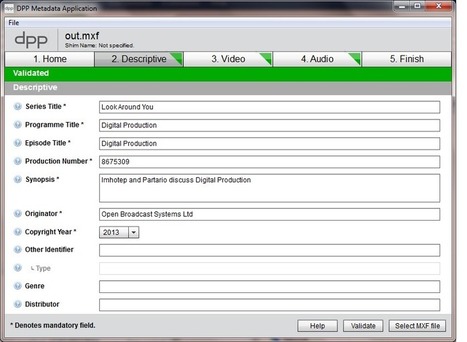
From time to time we work on other things beyond DVB broadcast encoding where Open Source can be used to transform closed broadcast workflows. The file delivery specification from the Digital Production Partnership (DPP) is one such area. However, the AVC-Intra codec used in DPP is effectively a proprietary codec with implementation in the real world being more complex than the SMPTE RP2027 that AS-11 recommends and in a number of areas implemented incorrectly. However, we have now successfully reverse engineered AVC-Intra from available samples which allows a fully open source DPP creation workflow. Along with existing Open Source projects for manipulation and creation of mxf files, a fully compliant DPP file can be delivered to UK broadcasters.
The new ExpressPlay content protection solution-as-a-service makes it dramatically easier to implement DRM for Connected TV and multiscreen services, Intertrust, the company behind the solution, claims. ExpressPlay is designed for use with Marlin DRM, the open-standard content protection system, and can be used with existing Marlin-enabled connected TVs and set-top boxes. The market for this service therefore includes HbbTV-based broadcast/broadband services as well as YouView in the UK. Intertrust says ITV and BT both use the ExpressPlay service for their DRM requirements on YouView. A good proportion of the transactions on the Tivù platform in Italy use the ExpressPlay hosted service. Eutelsat KabelKiosk is going to use this cloud-based content protection.
Google today announced it has enabled its VP9 video codec by default on the Chrome dev channel. The addition means users of the company’s browser can expect to see the next-generation compression technology available out-of-the-box before the end of the year.
For users, the main advantage of VP9 is that it’s 50 percent more efficient than H.264, meaning that you’ll use half the bandwidth on average when watching a video on the Internet. Yet that doesn’t take H.265 into account, the successor to H.264 that offers comparable video quality at half the number of bits per second and also requires its implementers to pay patent royalties.
The Harmonic, Inc. Workflow System (WFS; created by Rhozet, which is now a part of Harmonic) is an architecture for retrieving and encoding audio and video files into multiple single file and adaptive formats, checking their quality, and delivering the encoded results to local or remote destinations. The primary encoding engine has been ProMedia Carbon (formerly Carbon Coder), a Swiss army knife program with extensive input and output options, excellent output quality, and many other fine features. Unfortunately, encoding speed was not one of them.
To remedy this, Harmonic recently released ProMedia Xpress, a highly focused product designed to fit neatly into the encoding workflows used by many broadcasters. Specifically, in its first iteration, the product can only input MPEG-2 transport streams using either the MPEG-2 or H.264 codec, and it can only output H.264 encoded MPEG-2 transport streams, though with additional licenses, the system can convert these outputs into chunked video files and metadata for HTTP Live Streaming (HLS), HTTP Dynamic Streaming (HDS), and Smooth Streaming.
The DASH-IF continues move toward interoperability points and even H.265 integration. Publication will follow in mid-July.
Interoperability for DASH-AVC/264 surrounds the use of the H.264 video codec, also known as the Advanced Video Codec (AVC). DASH-AVC/264 combines AVC with the AAC audio codec and the fragmented MP4 file format (also known as the ISO Base Media File Format).
Publication is expected on July 13, including about 25 test cases and a few real-world test scenarios for bitrate variation. Conformance software is also anticipated to be available around mid-July, along with several reference clients that are released under the BSD-3 license.
DASH-IF has defined test cases for interoperability points (IOPs) to implement conformance testing. One IOP that this site has covered, in terms of a DASH-AVC/264 client, is interoperability on adaptive streaming heuristics. The DASH-AVC/264 eliminates the need to interoperate for multiplexed media downloading, and also eliminates the need to interoperate with open group of pictures (GoP) switching, relying instead on closed GoP switching.
DASH Industry Forum (DASH-IF), the organisation dedicated to promoting interoperable streaming of multimedia content over Internet, has released DASH-AVC/264, its recommended guidelines for deployment of the MPEG-DASH standard.
The DASH-AVC/264 Implementation Guidelines:
- Provide an open, interoperable standard solution in the multimedia streaming market
- Address major multimedia streaming use cases including on-demand, live and time-shift services
- Outline the use of two specific MPEG-DASH profiles
- Describe specific audio and video codecs and closed caption format
VeriSilicon announced today the availability of Hantro G2 multi-format video decoder IP to support ultra HD 4K video decoding for HEVC (High Efficiency Video Coding, aka H.265) video coding standard. The G2 IP also adds support for the upcoming VP9 web video format from the WebM Project. In addition, all legacy video formats such as H.264, VP8, MPEG-4, VC-1, AVS (soon also AVS+), MPEG-2, DivX, Sorenson Spark and VP6 are supported in Hantro G2 IP.
The latest MPEG-DASH insights from Akamai, castLabs, Digital Primates, Dolby, Fraunhofer, Microsoft, MPEG DASH Industry Forum, Unified Streaming & Wowza...
To get content containing either thought or leadership enter:
To get content containing both thought and leadership enter:
To get content containing the expression thought leadership enter:
You can enter several keywords and you can refine them whenever you want. Our suggestion engine uses more signals but entering a few keywords here will rapidly give you great content to curate.


 Your new post is loading...