Your new post is loading...

|
Scooped by
Nicolas Weil
October 20, 2013 3:19 PM
|
DLNA + UPnP allows you stream media from mobile phones, laptops to compatible HDTVs. But you will find plenty of steps involved. Mostly, these solutions are complex enough for any typical home user. But Chromecast uses UPnP and DIAL protocol to eradicate intrication. DIAL (Uncover And Launch Protocol) uses UPnP (Universal Plug N Play) protocol for network element discovery. Upnp multicasts and probes for available audience and senders on the given local Wi-fi compatability network. So basically moment clicking Chromecast icon on Chrome tab or android device, it probes and finds out First screen DIAL server (Chromecast device blocked to High definition tv within this situation). Once discovered, it synchronizes information about how for connecting into it.
|
|
Scooped by
Nicolas Weil
October 12, 2013 3:51 AM
|
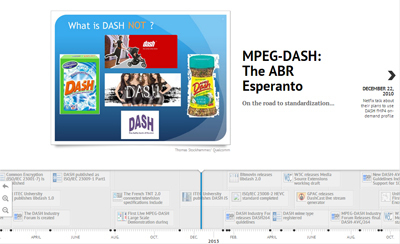
MPEG-DASH is the ABR Esperanto. Find out how this major video standard was built since 2011, with crucial contributions from Netflix, Microsoft, GPAC, Alpen Adria University ITEC Institute, DASH Industry Forum, HD Forum, Bitmovin or USP, under the joined standardization efforts of MPEG consortium and ISO, in collaboration with complementary standards from ITU, W3C...
|
|
Scooped by
Nicolas Weil
October 12, 2013 3:31 AM
|
ACCESS has been presenting a vision of how Pay TV operators can start to marry their broadcast/VOD infrastructure with multiscreen/OTT delivery infrastructure and treat them as a shared resource to optimize the delivery of content to multiple devices around the home, including televisions. It uses its Netfront Living Connect DLNA stack and client software to provide a central view of what each device is capable of and what is currently happening on that device to then manage whole-home resources. Content can be distributed using the new DLNA Commercial Video Profile-2 (CVP-2), which was developed with the cooperation of service providers to enable more secure playback of their content across multiscreen devices. It also gives them more control over the user interface on different devices. CVP-2 leverages HTML5 Remote User Interfaces (RUIs) and HTTP Adaptive Delivery and Authentication on top of the DTCP-IP-based link layer protection, which was already available. ACCESS is actually demonstrating NetFront Living Connect with CVP-2 at the DLNA Members meeting in Hawaii today (Thursday October 10). In this new architecture, DLNA acts as an abstraction layer. Not only does it provide a unified view of activity across diverse devices, it also means platform operators can avoid writing native apps for each DLNA-enabled device. You still need a software client to reach them but not the unique applications development work. “DLNA is a way to overcome device fragmentation,” says Larbey at Alcatel-Lucent.
|
|
Scooped by
Nicolas Weil
October 5, 2013 3:25 PM
|
As the multicast standard for Long Term Evolution (LTE), Enhanced Multimedia Broadcast Multicast Service (eMBMS) was introduced by Third Generation Partnership Project (3GPP) to facilitate delivery of popular content to multiple users over a cellular network. If a large number of users is interested in the same content, for e.g., live sports, news clips, etc., multicast transmission can significantly lower the cost and make better use of the spectrum as compared to unicast transmission.
In this paper, we study and analyze the quality of experience (QoE) at the end user during live video streaming over eMBMS. We consider a comprehensive end-to-end MBMS streaming frame-work based on H.264/AVC encoded video content delivered in a chunked format over multiple segments using the File Delivery over Unidirectional Transport (FLUTE) protocol, combined with application layer (AL) forward error correction (FEC) based on Raptor and RaptorQ codes. Specifically, our study involves QoE evaluation in terms of startup delay, rebuffering percentage and Peak Signal-to-Noise Ratio (PSNR) metrics and provides performance evaluations to characterize the impact of various MBMS streaming, transport and AL-FEC configurations on the end user QoE. We also propose a decoding strategy that takes into consideration the systematic structure of AL-FEC codes to enhance performance when a source block decoding fails.
|
|
Scooped by
Nicolas Weil
October 3, 2013 5:08 PM
|
Présentation donnée par Cyril Concolato lors de la réunion du 1/10/2013 au GDR-ISIS, présentant les concepts de streaming vidéo sur HTTP, la norme MPEG-DASH et les outils Open
|
|
Scooped by
Nicolas Weil
October 1, 2013 6:32 PM
|
A few weeks ago Google released Chromecast, a device which plugs into the HDMI port of a TV, and can stream content directly to the TV, with controls from either a mobile device or a computer. The Chromecast device is a powerful tool that utilizes the latest features HTML5 to provide an environment capable of rich media playback. The Chromecast is specifically designed for this task, as evidenced by the great YouTube and Netflix applications that are already available. The idea is that the Chromecast is a small dedicated computer that is capable of playing media all by itself; it simply needs somebody else to tell it what to play.
|
|
Scooped by
Nicolas Weil
September 25, 2013 4:40 PM
|
Adobe also announced a new cloud DRM service that’s designed to simplify the deployment of content protected videos across devices. Adobe Primetime DRM, the company noted, already s being used by companies including AT&T, DirectTV, Fox, Scripps Networks, Turner Broadcasting System, Inc., Walt Disney Pictures, Hulu, HBO Go and Comcast. The cloud-based version will help content owners and distributors bring more premium content to more devices efficiently. Available as a hosted web service in the cloud, the DRM manager handles compliance and robustness, management and scalability, and ensures that new features can be added easily without the need to update software on an on-premises server.
|
|
Scooped by
Nicolas Weil
September 25, 2013 1:20 AM
|
L’IBC était l’occasion de faire le point sur l’offre de plusieurs concepteurs de chipsets pour set-top-boxes. Chaque année, les gammes évoluent pour tenir compte de l’évolution des besoins et de l’environnement technologiques : la gestion du multi-écrans, le support de l’HEVC, l’arrivée de la 4K et la gestion des réseaux domestiques. Le support d’HEVC est clé pour tout fabricant de chipset car les appels d’offre des opérateurs de TV payante et d’IPTV commencent à intégrer le support d’HEVC. Ce support permet aux opérateurs d’étendre le parc de clients éligibles à l’IPTV. Pas question d’UHD dans ce cas, mais de simple SD ou HD. Comme l’HEVC réduit de 30% à 50% le débit nécessaire pour la transmission de vidéo, le bénéfice est évident pour les opérateurs. Les autres bénéfices de l’HEVC sont de réduire les coûts de CDN (Content Delivery Networks, les serveurs dans le cloud qui optimisent l’accès aux vidéos pour les consommateurs) et aussi d’améliorer les offres mobiles de consommation de vidéo en live comme à la demande. Les appels d’offre d’aujourd’hui correspondent à des déploiements qui démarreront entre fin 2014 et fin 2015 et génèreront une base installée de box qui devra tenir jusqu’à facilement 2019. Donc, il faut voir loin !
|
|
Scooped by
Nicolas Weil
September 21, 2013 1:13 PM
|
Imaging technology Beamr demonstrated a video optimisation solution at IBC 2013 that can potentially reduce bit-rates by up to 40% for streamed OTT video. Bit-rates from physical media such as BluRay discs could be reduced by up to 75%, the company also claimed. Beamr’s CTO, Dror Gill, emphasised that Beamr Video is not a new type of video compression codec: instead it controls existing video compression systems like H.264 or HEVC, manipulating the encoding process in such a way that, in effect, it lowers the threshold at which bit-rate reductions cause artefacts visible to the naked eye.
|
|
Scooped by
Nicolas Weil
September 19, 2013 5:02 PM
|
MPEG-DASH Conformance and Reference Software ISO/IEC 23009-2 by Christian Timmerer (Alpen-Adria-Universität Klagenfurt (AAU) / bitmovin GmbH)
|
|
Scooped by
Nicolas Weil
September 19, 2013 4:26 PM
|
We are on the verge of an important inflection point for the Web. In the next few years commercial web video delivery utilizing new, international standards (DASH Media Ecosystem) will become commonplace. These standards will enable cross-platform, interoperable media applications and will transform the media entertainment industry, delight consumers and expand the nature of the Web.
|
|
Scooped by
Nicolas Weil
September 12, 2013 3:36 PM
|
In the Broadcast and Connected Systems team here in R&D one of the things we have been looking at for a few years is adaptive bitrate technology. Recently the main focus in this area has been MPEG DASH, what profile of it to use, and how we can create content using it. The reason for today’s post is to introduce the first piece of test material we have created.
|
|
Scooped by
Nicolas Weil
September 10, 2013 5:06 PM
|
MPEG-DASH allows for efficient transmission of layered codecs, such as the Scalable Video Coding (SVC) and Multiview Video Coding (MVC). For efficient transmission of layer codecs, each of the layers is described by a different representation. Enhancement layers/views are considered dependent Representations that depend on representations that contain lower layers, referred to as complementary Representations. The dependency on other representations is indicated in the MPD by the dependency_id (dep_id in the following figures), which indicates additional Representations that need to be downloaded to be able to decode a dependent Representation.
|
|
|
Scooped by
Nicolas Weil
October 12, 2013 5:29 AM
|
Find back all my blog posts about DASH, OTT Trends and Technologies, SecondScreen, OpenSourceTV and much more !
|
|
Scooped by
Nicolas Weil
October 12, 2013 3:42 AM
|
There is a new initiative to make it easier, cheaper and faster to build hybrid DVB/IP receivers and initially it is aimed at the Tier 2 and Tier 3 Consumer Electronics market, although the company behind the new open source stack-kit believes that T1 connected TV device makers and even platform operators may eventually see value in their work. The new UTK stack-kit was officially unveiled at IBC in September and is driven by Pixsan Digital Software, which describes itself as the master gatekeeper for the stack.
Like RDK, UTK exploits gstreamer (which will be available in a number of next-generation chipsets, according to Williams) and Qt frameworks (which has 450 developers working on it) to create what Pixsan claims is a compelling hybrid TV architecture. As well as being the ‘master gatekeeper’ Pixsan Digital is a lead developer and will assist other UTK licensees with modules for building into devices.
|
|
Scooped by
Nicolas Weil
October 11, 2013 4:52 AM
|
Presentation discusses various aspects of IPTV delivery and relationship with H.265 (HEVC), HTML5 and other latest technologies.
Presented during IMTC 20th Anniversary Forum in Porto, Portugal
|
|
Scooped by
Nicolas Weil
October 4, 2013 11:49 AM
|
A major advantage of HTTP Live Streaming, and it is still unbeaten by any other standard, is that you can use any technology to compose multimedia content. You don’t need expensive media servers to handle media streams. You can easily delegate media composition to some simple PHP / Python / Ruby / Node.js modules. As a long-time Flash lover I was somewhat prejudiced against the Apple’s video delivery standard. But as a developer, every day I use it to solve tasks which have been almost unattainable with the previous stack (or required expensive software). Adobe HDS playlists have been really hard to deal with. Just think of binary data in f4m playlists. They require much more time to develop & debug the solution. MPEG DASH is also far from being intuitive. In this post, we are going to discuss how to make an alternative audio track for your video. Although HTTP Live Streaming can streamline this task, yet there are some limitations, so you need to make certain hacks on the client side. In our Togetherproject, we had to implement alternate sound tracks for user videos. Luckily, we use HTTP Live Streaming throughout the system.
|
|
Scooped by
Nicolas Weil
October 2, 2013 9:05 AM
|
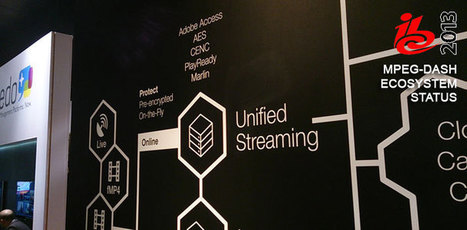
How dynamic is MPEG-DASH Ecosystem after IBC 2013 ? Here is an analysis of the latest trends and an extensive industry DASH-compliant solutions directory. While most of IBC’s buzz was generated by the shiny HEVC + 4K couple, it was a good occasion to stand back from the hype and measure how one of the most important video standards (at least for the OTT world) had spread over the industry since last year. MPEG-DASH is not sexy (let’s remember that it’s basically a collection of XML schemes), it’s a bit boring (as it’s usually demonstrated with the Big Buck Bunny that you saw not less than 2.000 times) and it’s complex – but once you go past those defaults, you might find that its potential to simplify your workflows and boost the profitability of your video service is high… And that’s precisely what the industry has finally understood: video distributors want to streamline their workflows and save their storage budgets by reducing the number of output formats, they search for ways to build long term strategies with evolutive solutions – and all of this implies rolling away from proprietary ABR solutions like Smooth Streaming, HLS, HDS and the now defunct Widevine WVM proprietary packaging format (rest in peace), DASH’s first victim.
|
|
Scooped by
Nicolas Weil
September 25, 2013 4:44 PM
|
For the 2012 Summer Games in London, the BBC demanded that its live streams be just as resilient as its broadcast channels. Learn how it delivered on that goal. Live video streams were key to the ambitious online user proposition for the London 2012 Olympics, and that coverage had to mirror the very high traditional broadcast standards of resilience and quality. Hear the challenges the BBC faced when designing a resilient HTTP streaming infrastructure that was designed to cope with huge volumes. Learn about the solution the BBC used during the games and hear what changes to their methodology was required to build resilience into a cloud-based infrastructure.
|
|
Scooped by
Nicolas Weil
September 25, 2013 1:25 AM
|
HEVC encoding and decoding technology is “ready for primetime,” but licensing negotiations are holding up real-world deployments.
While it was clear from walking the exhibit floor in Amsterdam that HEVC encoding and decoding technology is now “ready for primetime” as Sam Blackman, CEO of Elemental technologies put it, the licensing negotiations now underway between MPEG LA, the standardizing body, and those that would implement the patented technology into their products (consumer electronics companies and broadcast equipment suppliers), are holding back real-world deployments. According to Blackman, companies like Apple, Samsung and others now have the technology to utilize HEVC, but they don’t dare for fear of having to pay billions in licensing fees. Although there has been no official comment on the negotiations, word on the street is that MPEG LA is seeking a $20 million cap on single users, whereas they receive roughly a $7 million cap for the use of H.264 today. The big difference reflects the potential multiple uses that new IP-based video services will require in the future.
|
|
Scooped by
Nicolas Weil
September 23, 2013 4:40 PM
|
This white paper explores MistServer, a greenfield initiative by DDVTech BV, The Netherlands-based startup who recently created a lightweight, scalable media server. With a goal of solving significant media delivery problems, MistServer’s design offers benefits over current solutions. Brains and brawn, just not in the same place. DDVTech’s MistServer is based on a philosophy that a media server should do what it does best: serve audio and video streams. They split the brawn (MistServer) from the brain (MistSteward, MistCenter, or a web control interface).
|
|
Rescooped by
Nicolas Weil
from Video ecosystem
September 21, 2013 3:10 AM
|
The demonstration featured simultaneous PlayReady encryption, powered by Inside Secure’s Downloadable DRM Agent for iOS, and Verimatrix encryption from the same MPEG-DASH url delivered to both Android and iOS players from Inside Secure and NXP Software. The CENC scheme specifies standard encryption and key mapping methods that can be utilized by one or more digital rights management (DRM) and key management systems to enable decryption of the same file using different DRM systems. Such an approach supports a broader range of accessible clients from a single content stream.
Via Olivier NOEL
|
|
Scooped by
Nicolas Weil
September 19, 2013 4:47 PM
|
Although Ultra HD was the visible headline story from IBC2013, with demonstrations of the new format everywhere, the serious business, when you scratched beneath the surface, revolved around multiscreen TV yet again. The technologies to get multiscreen deployed and then make it a compelling user experience have dominated the last five shows, with only 3DTV offering any serious challenge for the crown before disappearing off our radar. This year the focus was on personalizing and monetizing multiscreen TV more effectively, while there is also a trend towards end-to-end multiscreen solutions (including multi-vendor pre-integrations) and managed services. A key driver for these last two trends is the need to help smaller operators into the multiscreen market.
|
|
Scooped by
Nicolas Weil
September 19, 2013 1:15 AM
|
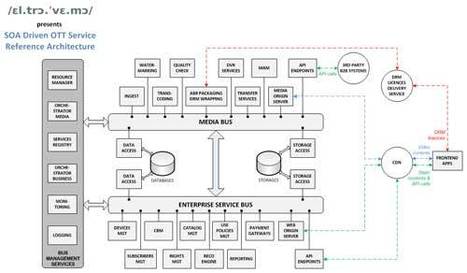
The reign of end-to-end OTT platforms is over, here comes the modular OTT Platform ! With SOA, FIMS, IMF and DASH, agility time has (almost) come... This is the report/sequel of Vimond's Industry Visionaries IBC2013 talk about “The Future of OTT Platforms: Is it Diversification or Standardization ?” with Eric Schumacher-Rasmussen, Editor of Streaming Media Magazine, and Nicolas Weil.
|
|
Scooped by
Nicolas Weil
September 11, 2013 5:46 PM
|
Version 2.0 of the DASH-AVC/264 guidelines, with support for 1080p video and multichannel audio, is now publicly available on the DASH Industry Forum (IF) website. The new guidelines includes several promised extensions, including one on HD video that moves the recommended baseline from 720p to 1080p. 720p had initially been chosen, according to the initial guidelines released in May, as a "tradeoff between content availability, support in existing devices and compression efficiency." At that time, the baseline video support used the Progressive High Profile Level 3.1 decoder and supported up to 1280x720p at 30 fps. "The choice for HD extensions up to 1920x1080p and 30 fps is H.264 (AVC) Progressive 12 High Profile Level 4.0 decoder," the new guidelines state, adding support for 4.0 decoders that was lacking in the previous set of guidelines. In addition, the guidelines also provide a way to handle standard definition (SD) content.
|