


|
Scooped by
Nicolas Weil
December 7, 2013 5:17 AM
|
 Scoop.it!

Nicolas Weil's insight:
Excellent overview of what's coming by Laurent Tescari (Etisalat)


 Your new post is loading...
Scoop.it!
Nicolas Weil's insight:
Excellent overview of what's coming by Laurent Tescari (Etisalat)
Scoop.it!

At Streaming Media West, BBC senior technical architect Stephen Godwin gave an in-depth look at the broadcaster's new Video Factory workflow. With the popularity of iPlayer, the BBC found itself facing a challenge of creating a new and better ingest and transcoding workflow system. The new system is called Video Factory.
“Video Factory is designed to be scalable from the ground up, and to use the cloud,” said Godwin.
“We wanted something that would scale,” said Godwin. “The system we were replacing was 4-5 years old, and a hardware solution, and we didn’t plan for it to support smartphones. On the old system, we started running into limits, including storage limits.”
”When we designed the new system, we wanted a system that would scale in capability and price,” said Godwin. “The old system has some single-points-of-failure. We wanted to move to a model where we had the resiliency of the broadcast chain.”
Scoop.it!
One of the best things about presenting at Streaming Media conferences is that the expertise level of attendees is so high that it’s rare you don’t learn a thing or so in the sessions that you present. So it was during my HEVC session atStreaming Media West.
The week before the session was the first time I was able to gauge the quality of HEVC with my own test clips. Though I had expected less than the oft-stated 50% bandwidth savings as compared to H.264, the Rovi-supplied clips encoded with the MainConcept HEVC codec lived up to the billing, confirming that HEVC should allow content producers to shave bandwidth costs significantly.
Scoop.it!

MPEG-DASH introduced open standards into HTTP streaming but did not include the client application as part of their standards. Online video player developers have been left to fend for themselves in determining how best to build the client side applications to consume DASH content. This article discusses the current state of online video, delves into the DASH standard, explores the challenges of building a DASH player, and, finally, walks through the basics of implementing the open source Dash.js player.
Scoop.it!

The first commercial implementations of Haivision's HEVC encoding allied with the company's Secure Reliable Transport (SRT) protocol, are due in the new year.
HEVC was perhaps the hottest topic at this year's IBC show in September, but while most demos sought to showcase 4K HEVC in a controlled environment,Haivision took a different tack. The company showed off its HEVC encoding delivered via Haivision's proprietary Secure Reliable Transport (SRT) protocol—sent over the public internet from a hotel close to the conference venue.
Scoop.it!

Yesterday, Sony continued its push to jump-start the 4K ecosystem with the announcement of a 4K TV media player. The $699 device will be available from retailers on July 15th and will come bundled with 10 movies and video shorts at 4K resolution. The encoder technology for the content comes from eyeIO, the power behind the Netflix streaming service. I stopped by eyeIO offices to get a demonstration of some of the 4K content. What I found convinced me more than ever that online delivery will lead the ultraHD charge. However, regardless of 4Ks fortunes advanced video codecs like eyeIO's are a game-changer.
Doubly amazing is the bitrate these movies were being streamed at: less than 10mbps! Mr. Vargas also claimed the next release of the codec will reduce that even further. At bitrates as low as this many consumers in the US could stream a 4K movie today on their existing broadband connections.
Scoop.it!

Kaltura has long enabled service providers, universities, enterprises, and media companies to deliver video to viewers, with an extensible platform for publishing, distributing, and monetizing content. But for the most part, while it provided a player and CMS, it was up to those companies themselves to do the work of building their sites and readying them for video.
Well, no longer. Kaltura is releasing a new product, called MediaGo, which is aimed primarily at the growing number of media partners who wish to quickly roll up an end-to-end video platform and customize it. This so-called “Netflix-in-a-box” portal enables those customers to quickly start serving up ad-based and subscription video services without having to build any infrastructure of their own.

Moses B. Tambason's curator insight,
November 9, 2013 3:09 PM
Charity tube is the leading social networking site today.More people are running to charity tube to post free videos and watch free videos than posting on you tube. Try posting at charity tube and you will never leave. http://www.africatube.net/ More visitors and more video views. Don't take our word for it, try it. Post one same video on youtube and put it on http://www.africatube.net/ and return ater five hours and compare the viewers rate and decide for yourself. Create your very own group or forum and control who watch it and invite everyone to watch the video. Above all, post video in English or in any language and viewers can watch video description in their own language. Try it and let us know your experience. Above all it is absolutely free like youtube
Scoop.it!

This blog gives an overview of what kind of client support Microsoft offers as part of Windows Azure media Services. On one side, you could create, manage, package and deliver media asset through Windows Azure media services. Many popular streaming formats are supported, such as Smooth Streaming, Http Llive Streaming and MPEG-dash. On the other hand, we provide various SDKs and frameworks for you to consume media asset by building rich media applications rapidly on many platforms, such as PC, XBox, mobile and etc.
Scoop.it!
Une présentation OVFSquad de Nicolas Weil le 17/10/13.
Scoop.it!
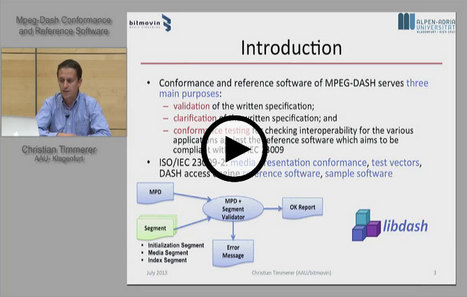
Christian Timmerer and Carsten Griwodz. 2012. Dynamic adaptive streaming over HTTP: from content creation to consumption. In Proceedings of the 20th ACM international conference on Multimedia (MM '12). ACM, New York MPEG-DASH Part 1, Media presentation description and segment formats by Thomas Stockhammer MPEG-DASH, Part 2, Conformance and Reference Software by Christian Timmerer
Scoop.it!

In this article, I am going to cover one of the most common questions in the multimedia field: what is a standard and what does it cover? Once you have read this article, you will notice how often people, even the most influential ones, use some approximate wordings. Confusion leads to a lot of misunderstanding, so it’s good to review the subject.
A recurrent misinterpretation is about open-source software and open standards. In this article, I will take the AVC/H264 codec as an example. Beside the coverage of a standard, I’d like to explain how standards link one to the other. I will use the examples of MPEG-DASH and the ISOBMF/MP4 container.
Then I will show what the MPEG-DASH standard is really about.
Scoop.it!

With free-to-air broadcasters increasingly looking to hybrid solutions, combining broadcast with IP-based advanced interactive services to stay relevant, Europe’s HbbTV standard is evolving to enable a wider range of applications. Stuart Thomson reports.
|
Scoop.it!
I'm pleased to announce MPEG-DASH support in nginx-rtmp-module. Browser-side support in implemented in dash.js library.
Dash module will create m4v, m4a, mpd files in its directory.
Scoop.it!
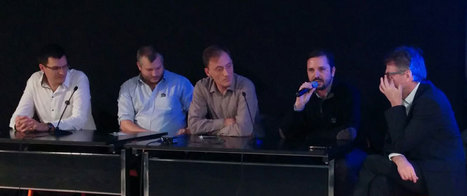
J’ai assisté hier à plusieurs présentations au SATIS, dont la « Carte blanche OVFSquad – DRMs – quel prix pour la sécurité de l’OTT ? ».
La question est importante, car tous les distributeurs de contenus en OTT sont confrontés à l’implémentation des DRM imposées par les ayants droit (pour appuyer sur un fait exprimé par les intervenants, ce n’est pas de gaité de cœur que les sites de VOD mettent en place des DRM ; s’ils ne le font pas, ils n’ont pas les films, point !).
Quelques rappels tout d’abord : - OTT (Over The Top) veut dire en pratique diffusion en dehors des plateformes IPTV des FAI, donc directement sur Internet; cela s’applique en particulier à la VOD (Vidéo à la Demande) sur PC, Mac, tablettes et TV connectées. - DRM (Digital Rights Management ou gestion de droits numériques) correspond à la protection du contenu par un système de licence (qui limite l’utilisation du contenu à certaines plages de temps, certains pays, certains terminaux) et un système de chiffrement des contenus (qui évite une utilisation immodérée du contenu). - ABR (Adaptive Bitrate) correspond à des technologies de streaming qui permettent d’adapter la qualité d’image d’un flux vidéo à la bande passante disponible. L’idée est de préférer une image de moins haute définition à une image qui bloque (freeze) de temps en temps.
Le problème est d’autant plus complexe le nombre de terminaux supportés est important. Supposons que vous développiez une plateforme VOD premium, qui commercialise des long-métrages pour lesquels l’implémentation d’un système de DRM est imposée, et qui désire mettre en place une diffusion ABR. Supporter PC et Mac est relativement facile, quoi que …
Nicolas Weil's insight:
Bonne synthèse de Laurent Le Meur !
Scoop.it!

bitmovin's CIO Dr. Christian Timmerer regularly attends the standardization meetings of the Moving Picture Experts Group (MPEG). This is his report from the 106th MPEG meeting in Geneva, Switzerland ...
Scoop.it!

While NAB 2012 was approaching, Will Law was pushing forward MPEG-DASH on this blog as "a single [video] format that can be supported across a common ecosystem of content and services, all the way from the encoder down the chain to the end consumer" with the potential to "translate into an industry with a deeper feature set and a steeper innovation curve". What is the situation after IBC 2013? Did MPEG-DASH successfully handle this industry spread to allow a world of streamlined media workflows?
Let's agree that the general perspective provided by MPEG-DASH is quite appealing for most online video professionals, with the target of drastically reducing the number of Adaptive Bitrate streaming formats to support. The recent move of Widevine dropping proprietary packaging in favor of DASH clearly goes in this direction, as well as the positive efforts of Microsoft to translate Smooth Streaming to DASH through a new generation of PlayReady DRM and new DASH-enabled player frameworks. After having recently focused on HLS support in its client implementations, Adobe now gets back to DASH with announcement of early 2014 support, which will be a major event if DASH finally comes to the huge installed basis of Flash Players and supersedes Adobe HDS format.
Scoop.it!

Keeping apace with camera technology is like running a race where the finish line keeps on moving. Just as the next generation of games consoles go on sale boasting the ability to display 4K images (although for the moment only those with the salary of a pro-footballer can afford screens able to make use of all those pixels) Japanese broadcaster NHK has started to film and broadcast events in 8K. NHK are so excited about the technology that they have commissioned filmmakers to make short films showcasing 8K, which were screened at the recent Tokyo International Film Festival.
Scoop.it!

Quiptel, a five-year-old start-up company, claims it has an online media platform that improves the user experience of streaming audio and video while making more efficient use of available network bandwidth. It is a bold claim, which acting chief executive Richard Baker tested at a low key launch in a London hotel.
The patented technology appears to be based on using multiple logical network routes and a network overlay that intelligently manages traffic to optimise use of available access network bandwidth.
The result, Quiptel claims, is that more of the available network capacity is used to deliver sound and pictures, while operators can serve more customers with equivalent infrastructure.
Scoop.it!

/PRNewswire/ --
Scoop.it!
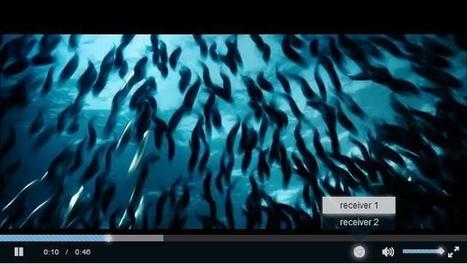
Display a chromecast Button on Control Bar video.js players. This plugin was tested on video.js 4.1.0 4.2.0 and 4.2.1.
Scoop.it!
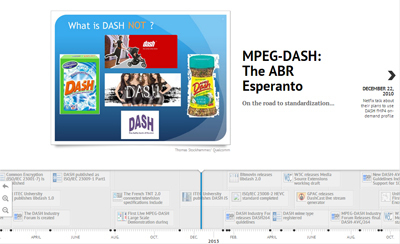
Nicolas Weil, Digital Media Solutions Architect (France, World), provides a nice blog post about the post-IBC'13 MPEG-DASH ecosystem status which highlights also the DASH timeline referred to as "The ABR Esperanto: On the road to standardization..." (ABR stands for adaptive bit rate) The former provides not only an excellent overview about the status quobut also an implementation directory of products and services supporting DASH (incl. our award-winning bitdash & bitcodin). The latter shows the history of MPEG-DASH from back in 2010 - when standardization started - until now ... but what's next?
Scoop.it!
Dynamic Adaptive Streaming (DASH) is a technology that has been implemented and deployed although the scientific literature was inexistent. Simply put, the server offers several representations of the same video ; clients can choose the representation that best fit their capacities. Since 2008, many researchers have deciphered the global behavior of client-based adaptive mechanisms. However, one key piece of the theoretical cake is still missing: what is the optimal set of video representations the server should offer?
|






Quite realistic overview of the HEVC. 2015 for the beginning of massive deployement.