Low Power Heads Up Display
8.6K views | +0 today
Low Power Heads Up Display
Your new post is loading...
Rescooped by Richard Platt from HMD hot spot
June 9, 2018 3:02 AM
Scoop.it!

Apple's In-Depth Work on a Next-Gen Mixed Reality Headset is Simply Mind Boggling in Scope

Apple's In-Depth Work on a Next-Gen Mixed Reality Headset is Simply Mind Boggling in Scope | Low Power Heads Up Display | Scoop.it
Buried in a plethora of patent applications published by the U.S. Patent Office today was a patent filing with a completely new vision for Apple's future headset. It's mind boggling in scope and even provides us with a vision 10 years out of a desktop replacement using a head mound display system that's wild

Via Sara Mautino
Richard Platt's insight:

Buried in a plethora of patent applications published by the U.S. Patent Office today was a patent filing with a completely new vision for Apple's future headset. It's mind boggling in scope and even provides us with a vision 10 years out of a desktop replacement using a head mound display system that's wild

No comment yet.
Rescooped by Richard Platt from HMD hot spot
June 9, 2018 2:57 AM
Scoop.it!

Why do people keep giving Magic Leap (an AR startup) money?

Why do people keep giving Magic Leap (an AR startup) money? | Low Power Heads Up Display | Scoop.it
Magic Leap, an augmented reality company that has never shipped or even shown a product, has just gotten a $502 million investment on top of its nearly $1.4 billion in existing funding. Th

Via Sara Mautino
Richard Platt's insight:

Magic Leap, an augmented reality company that has never shipped or even shown a product, has just gotten a $502 million investment on top of its nearly $1.4 billion in existing funding. The round is led by Singapore holding company Temasek, and includes major existing investors like Google, Alibaba, and J.P. Morgan Investment Management. It adds to the mystique around the secretive company, which has been on the verge of unveiling a pair of compact augmented reality glasses since at least 2015. Two years later, its main output is still flowery paeans to its own greatness.  Investors have proven more than willing to throw money at overblown tech startups, like Theranos and Juicero. But Magic Leap still seems like a potentially viable company — just one that I doubt will deliver exactly what it’s promised.

Magic Leap ignores all the legitimately tricky parts of building augmented reality glasses Magic Leap’s prototype hardware is supposed to produce incredibly realistic virtual objects. Its reputation is nearly mythical — someone, secondhand and possibly apocryphally, once told me it stands people in a demo room and challenges them to identify what’s real. The company is also building a powerhouse media division, staffed with creative talent like author Neal Stephenson and game developer Graeme Devine, and is partnered with major digital effects studios Weta Workshop and ILMxLAB.
No comment yet.
Rescooped by Richard Platt from HMD hot spot
June 9, 2018 2:52 AM
Scoop.it!

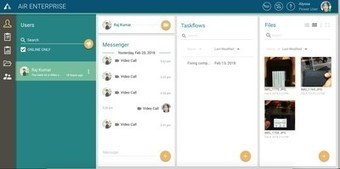
Toshiba partners with Atheer: AiR™ Enterprise solutions  to integrate dynaEdge smart-glasses

Toshiba partners with Atheer: AiR™ Enterprise solutions  to integrate dynaEdge  smart-glasses | Low Power Heads Up Display | Scoop.it

MOUNTAIN VIEW, Calif., March 15, 2018 /PRNewswire/ -- Atheer Inc., a leader in industrial enterprise AR solutions, today announces a strategic partnership with Toshiba America Information Systems, Inc. for the Atheer AiR™ Enterprise AR solution and the dynaEdge™ AR Smart Glasses.


Via Sara Mautino
Richard Platt's insight:

Using AiR Enterprise, the new Toshiba dynaEdge AR Smart Glasses offer an ideal solution for industrial applications such as field service, dealer service, manufacturing and repair operations, assembly line management, technician and expert training, warehouse picking, asset inspection and repair as well as remote visualization and support

Sara Mautino's curator insight, March 16, 2018 12:38 AM
"Using AiR Enterprise, the new Toshiba dynaEdge AR Smart Glasses offer an ideal solution for industrial applications such as field service, dealer service, manufacturing and repair operations, assembly line management, technician and expert training, warehouse picking, asset inspection and repair as well as remote visualization and support"
Scooped by Richard Platt
May 30, 2018 4:09 PM
Scoop.it!

Global Market Shares of Samsung Electronics’ Major Products Are Falling Rapidly 

Global Market Shares of Samsung Electronics’ Major Products Are Falling Rapidly  | Low Power Heads Up Display | Scoop.it
The global market shares of Samsung Electronics’ non-semiconductor business items such as TVs, smartphones and display panels have been on the decline for years with Chinese manufacturers supplying competitive products at low prices.According to industry sources, Samsung Electronics posted a share o
Richard Platt's insight:

According to industry sources, Samsung Electronics posted a share of 20.1%, down 1.3 percentage points from a year ago, in the global TV market in the first quarter of this year. The market share, which exceeded 20% for six years in a row until last year, is estimated to fall below 20% this year for the reason mentioned above. Meanwhile, the market share of Chinese TV manufacturers like TCL and Hisense exceeded 30% for three years in a row until last year. Early this year, TCL, the third-largest TV manufacturer in the world, unveiled an 8K QLED TV to which artificial intelligence is applied as in Samsung’s product.   In the global smartphone market, Samsung Electronics’ share fell from 21.4% to 18.9% during the same period. For reference, its market share had amounted to 28.6% in the first quarter of 2013. In the meantime, Chinese smartphone suppliers are nipping at the heels of Samsung with sophisticated design and advanced camera features. For instance, Vivo is going to unveil its NEX next month. In the display panel market, Samsung Electronics’ share dropped from more than 20% to 13.2% from 2015 to the first quarter of this year. Chinese display panel manufacturers are planning to build at least 19 additional plants in their home country by 2022 for manufacturing of 8th-generation and above panels.

No comment yet.
Scooped by Richard Platt
May 2, 2018 12:36 AM
Scoop.it!

Tiny, Powerful Retrofits (USB Power in Economy)

Tiny, Powerful Retrofits (USB Power in Economy) | Low Power Heads Up Display | Scoop.it
USB-C is coming, but when and how?
Richard Platt's insight:

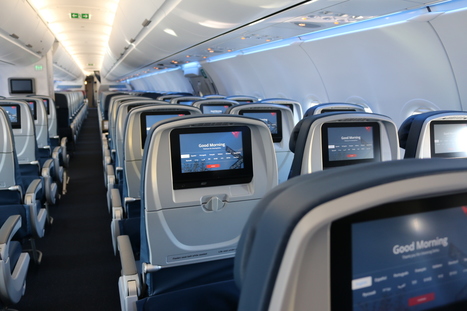
What do all those hordes of passengers dragging their multiple smartphones, tablets and laptops aboard aircraft want? Right, they want to use them onboard.  But they also want something else. Before passengers debark at destinations, many want to recharge all their devices so they arrive fresh and connected when, for example, they need directions to hotels or access to Uber.  But recharging options have been limited for many passengers. Premium cabins may have 110-volt, alternating current laptop chargers, but what do the cheap seats have? Maybe 10 watts of direct current, not enough to get a good charge on a laptop or tablet.  That is about to change. Apple and Samsung are adopting the new USB-C ports for both power and data. Other device makers will follow. These new ports can handle up to 100 watts of power and 10 gigabytes per second of data.  So suddenly, it is becoming possible to let economy passengers get a fast charge with a USB-C outlet in economy.

Panasonic already has an early version of USB-C with 27 watts flying with British Airways and Emirates. It will bump the wattage up with a new model in 2021. In early 2019, Astronics will offer a 60-watt version, as will IFPL. The IFPL equipment will split the power converter from the outlet itself, so if the latter gets damaged by a clumsy plugger, it’s an easy and cheap replacement.  Both firms expect USB-C outlets will be much more durable than the current USB-A standard, partly because they are reversible. That is, you can plug in upside down, and it doesn’t matter. DigEcor and Rockwell Collins also will offer their USB-C devices.  There will thus be plenty of choices. But carriers need to be careful. The transition from consumer devices with USB-A to those with USB-C will probably take about five years to complete, so both kinds will have to be supported for a while.

No comment yet.
Scooped by Richard Platt
February 16, 2018 8:26 PM
Scoop.it!

This whirlpool turbine uses water to provide limitless energy

This whirlpool turbine uses water to provide limitless energy | Low Power Heads Up Display | Scoop.it
Richard Platt's insight:

Turbulent can provide 24/7 energy for dozens of homes. It can be installed in most rivers and canals.  The generator could be the solution to providing low-cost power to rural areas around the world.  This whirlpool turbine can power dozens of homes, providing energy 24 hours a day.  Belgian company Turbulent have possibly come up with a solution to generate energy for small-scale rural areas, but you need to live near a river.   The turbine can be installed in most rivers and canals, using the flowing water to produce energy - which the creators claim is enough to power up to 60 homes.

No comment yet.
Scooped by Richard Platt
February 16, 2018 2:01 AM
Scoop.it!

Tesla Seeks Upgrade to Grid to Recognize World's Biggest Battery

Tesla Seeks Upgrade to Grid to Recognize World's Biggest Battery | Low Power Heads Up Display | Scoop.it
Richard Platt's insight:

The world’s biggest battery, built by Elon Musk’s Tesla Inc. in Australia, is doing its job too well.  The response time for Musk’s Powerpack batteries to feed power into the grid when outages hit is less than 200 milliseconds, Tesla said in a submission to the nation’s energy markets rulemaker. However, the rules, written with large coal and gas generators in mind, gives them a leisurely six seconds to respond. That’s prompted Tesla to call for a shake up of Australia’s old-fashioned grid.  Like most Musk pursuits, Tesla wants things done faster. It’s called for a new system that address technical restraints and better values the dispatch of emergency power to the grid from fast-response technologies -- such as its Hornsdale Power Reserve in South Australia that delivers electricity at lightning speed.

No comment yet.
Rescooped by Richard Platt from Technology and Gadgets
January 9, 2018 1:49 AM
Scoop.it!

A 65-inch TV you can roll up like a poster and take with you

A 65-inch TV you can roll up like a poster and take with you | Low Power Heads Up Display | Scoop.it
It's the world's first big-screen TV that can be rolled up to hide away when not in use.

Via Tiaan Jonker
Richard Platt's insight:

When you roll your future TV out of sight into a little box, thank LG Display.  (Well they had the competitive help of Samsung also going after this, and both of these companies use TRIZ to come up with these systems - too bad other companies aren't savvy in this way as they too could bring awesome new designs to the world).  The leader in big-screen OLED manufacturing, not satisfied to debut the first 88-inch 8K OLED TV, will show off another world's first at CES: a 65-inch 4K OLED display that's, get this, rollable. Although some concept big-screen TVs shown at past CES shows have been bendy, this is the first one that's flexible enough to spin up into tube form. LG's images depict it descending into a little box the size of a sound bar, but the company also talks about making the display portable. The secret, as usual, is its paper-thin organic light emitting diode display (OLED).

No comment yet.
Scooped by Richard Platt
January 8, 2018 6:07 PM
Scoop.it!

HTC unveils higher-resolution Vive Pro VR headset with built-in headphones

HTC unveils higher-resolution Vive Pro VR headset with built-in headphones | Low Power Heads Up Display | Scoop.it
HTC is refreshing its Vive headset with a new Pro model today. The original Vive debuted nearly two years ago, and the new Vive Pro is clearly designed to address some of the complaints of that headset.
Richard Platt's insight:

HTC is refreshing its Vive headset with a new Pro model today. The original Vive debuted nearly two years ago, and the new Vive Pro is clearly designed to address some of the complaints of that earlier headset. HTC is increasing the resolution of the dual-OLED displays to 2880 x 1600 (1400 x 1600 per eye, and 615 ppi), a 78 percent increase from the 2160 x 1200 (1080 x 1200 per eye) resolution in the current Vive. This resolution increase should help with clearer text rendering and overall graphics, and the bump puts the Vive Pro beyond the Oculus Rift or Windows Mixed Reality headsets.  Alongside the resolution increase, HTC has also redesigned the Vive Pro’s headstrap and added built-in headphones. One of the complaints of the original Vive was that it was difficult to adjust and heavy, and you had to plug in headphones, creating another cable dangling to potentially upset your VR experience. The Vive Pro’s headstrap includes a sizing dial so the headset is a lot more balanced, and it hopefully won’t feel too top heavy at the front. We’ll be testing it out later today to find out if this redesign has helped with the comfort, and whether the headset feels lighter as a result.

No comment yet.
Rescooped by Richard Platt from Learning & Technology News
December 10, 2017 1:22 AM
Scoop.it!

Getting into Virtual Reality Part 1: Creating Virtual Reality Worlds

Getting into Virtual Reality Part 1: Creating Virtual Reality Worlds | Low Power Heads Up Display | Scoop.it
Now another ten years on VR seems to be making another surge into the mainstream consumer market and the field of education. Whether it’s here to stay or not largely depends on how accessible edtech companies can make this to mainstream teachers and classrooms around the world and the ability of edtech companies to provide experiences that have genuine educational outcomes that match the kind of investment that will be necessary to enable students to access those experiences.

Via Nik Peachey
Richard Platt's insight:

Now another ten years on VR seems to be making another surge into the mainstream consumer market and the field of education. Whether it’s here to stay or not largely depends on how accessible edtech companies can make this to mainstream teachers and classrooms around the world and the ability of edtech companies to provide experiences that have genuine educational outcomes that match the kind of investment that will be necessary to enable students to access those experiences.

Nik Peachey's curator insight, December 7, 2017 7:41 AM

Some free tools and resources to create virtual reality worlds and experiences.

Scooped by Richard Platt
December 9, 2017 10:43 AM
Scoop.it!

VR Research Ushers in Aviation Advances

VR Research Ushers in Aviation Advances | Low Power Heads Up Display | Scoop.it
The use of virtual reality is helping create new aviation advancements like intelligent autopilot systems and advanced cockpit design.
Richard Platt's insight:

In the past 25 years, airlines and the amount of flights per day have risen considerably. In the EU, the number of flights has risen from 360 million in 1993 to almost a billion this year. In the U.S., there are 5,000 aircraft in the sky at any given time, and in 2016 the FAA handled 42,700 flights daily.  As the volume of air traffic continues to rise, experts across the aerospace industry, including companies like Honeywell and the German Aerospace Center, have teamed up to introduced advanced virtual reality (VR)-based autopilot systems. These autopilot systems will help offset the high workload and the burden of stress on pilots.  The A-PiMod is an EU-funded project that introduces sophisticated software into the cockpit. The software makes recommendations based on the conditions of the aircraft and that of the pilot. It can measure eye movement, gestures, and inputs from the pilot, which allows it to draw conclusions concerning their stress levels. Based on the current workload, it can make suggestions to the pilot adapted for the current situation. It cannot override the pilot’s decisions, but rather, make suggestions to the crew on which tasks they should perform themselves and when the autopilot should take over.

No comment yet.
Scooped by Richard Platt
December 5, 2017 11:35 PM
Scoop.it!

BMW and Porsche join forces to enable 15-min electric car charging at 450 kW charge rate

BMW and Porsche join forces to enable 15-min electric car charging at 450 kW charge rate | Low Power Heads Up Display | Scoop.it
BMW and Porsche are already working together and with other major automakers, like Mercedes and Ford, on the major Ionity ultra-fast (350 kW) electric car charging network in Europe. But now they w…
Richard Platt's insight:

BMW and Porsche are already working together and with other major automakers, like Mercedes and Ford, on the major Ionity ultra-fast (350 kW) electric car charging network in Europe.

But now they want to lay a path to improve that charge rate to 450 kW in order to enable quicker electric car charging.  BMW is leading the project through the ‘FastCharge’ consortium in partnership with other companies, like Porsche, Allego, Siemens and others. Interestingly, the German Federal Ministry of Transport and Digital Infrastructure supports the project with a  € 7.8 million grant, which is supervised by the National Hydrogen and Fuel Cell Technology Organization (NOW). They have now confirmed that the bulk of their research will focus on improving charging rates using the existing Combined Charging System (CCS), but at a voltage of 900 volts and an amplitude of 500 amperes for a charge rate of 450 kW.  The group sees this charge rate as ideal to charge an average long-range electric car in about 15 mins.

No comment yet.
Scooped by Richard Platt
December 4, 2017 3:24 PM
Scoop.it!

Sci-Fi Inspired Wearable Provides Hands-Free Solutions for MRO Workers

Sci-Fi Inspired Wearable Provides Hands-Free Solutions for MRO Workers | Low Power Heads Up Display | Scoop.it
Star Wars inspired head-mounted wearable aids MRO diagosis
Richard Platt's insight:

The RealWear HMT-1 can be worn with a helmet and safety glasses as it delivers computing power and remote collaboration functionality.  RealWear credits part of the design’s inspiration to Boba Fett’s helmet from the Star Wars movies, which—like the HMT-1—has a monocular display for visual data that can be flipped up when not in use. RealWear’s VP of industrial design and human factors, Stephen Pombo, previously worked with one of the original designers of Boba Fett’s prop helmet to create a monocular headset patent at technology company Kopin before going on to develop the HMT-1’s predecessor.  While wearing the HMT-1, workers can use voice commands to browse and search technical documentation or instructions, which are stored on the wearable’s microSD card and can be synced from the cloud using Wi-Fi. The wearable’s rugged design includes noise cancellation and multiple microphones, which is designed to ensure that field workers can be heard in loud environments while using the wearable’s remote collaboration functionality. This allows experts to watch a procedure taking place via live HD video stream from the wearable’s camera. The remote expert can communicate with the field worker through the audio channel and capture images from the camera, zoom in on details and annotate an image using a pen tablet.  “When a malfunction occurs in an airport distant from the maintainers that have the knowledge to repair it, they are able to dial in to a local maintenance engineer with software like Librestream’s Onsite remote collaboration to diagnose and fix the problem,” says RealWear CEO and Founder Andy Lowery. According to Lowery, the company is working with a major producer of commercial jets to equip each aircraft with an HMT-1 for collaboration functionality like this.   “The most popular applications we integrate and deploy are remote collaboration apps, such as Onsight, workflow applications, such as Frontline, and industrial IoT visualization applications, such as ThingWorx,” says Lowery. Software is installed on the HMT-1 via Wi-Fi or a USB cable connected to a desktop computer, much like it would be with a device like a tablet. RealWear says basic functionality, such as document reading or the recording and playback of training videos, can be done right out of the box.   According to RealWear, benefits of the HMT-1 include increases in productivity and safety, error reduction, and time and cost savings. Lowery says just one use of the HMT-1 will return savings to an airline worth ten times what they would pay for the device. The company has an adaptive pricing model and available leasing programs, but says the cost to buy an HMT-1 and try it out would be $1,500 plus freight. 


No comment yet.
Rescooped by Richard Platt from HMD hot spot
June 9, 2018 2:58 AM
Scoop.it!

Intel wants smart glasses to be a thing

Intel wants smart glasses to be a thing | Low Power Heads Up Display | Scoop.it

The glasses are called Vaunt, and they are nearly indistinguishable from regular glasses. Instead of some cumbersome headset with a special screen, Intel’s Vaunt glasses are simple plastic frames that weigh under 50 grams . They work with prescription and non-prescription lenses.


Via Sara Mautino
Richard Platt's insight:

The glasses are called Vaunt, and they are nearly indistinguishable from regular glasses. Instead of some cumbersome headset with a special screen, Intel’s Vaunt glasses are simple plastic frames that weigh under 50 grams . They work with prescription and non-prescription lenses

No comment yet.
Rescooped by Richard Platt from HMD hot spot
June 9, 2018 2:54 AM
Scoop.it!

The Race for AR Glasses Starts Now

The Race for AR Glasses Starts Now | Low Power Heads Up Display | Scoop.it
The big players in tech, from Google to Amazon, and some little players, too, are jockeying to own augmented reality.

Via Remi El-Ouazzane, Sara Mautino
Richard Platt's insight:

The big players in tech, from Google to Amazon, and some little players, too, are jockeying to own augmented reality.

No comment yet.
Scooped by Richard Platt
June 3, 2018 2:33 AM
Scoop.it!

As Uber and Tesla struggle with driverless cars, Waymo moves forward

As Uber and Tesla struggle with driverless cars, Waymo moves forward | Low Power Heads Up Display | Scoop.it
When it comes to self-driving cars, there's Waymo and then there's everyone else.
Richard Platt's insight:

Waymo announced on Thursday that it was ordering 62,000 Pacifica minivans from Fiat Chrysler. It's the latest sign that Alphabet's self-driving car company is operating on a different level from the rest of the industry.  The last few months have had a lot of bad news for fans of self-driving cars. Last December, after news that Volvo and Ford might not achieve ambitious early goals, Wired wrote that self-driving cars were entering a "trough of disillusionment." Events over the last six months have only deepened that trough.  In March, an Uber self-driving car struck and killed pedestrian Elaine Herzberg in Tempe, Arizona, forcing Uber to suspend its testing program indefinitely. In May, the National Transportation Safety Board released a preliminary report finding big problems with Uber's software.  The same month, a Tesla customer died in a crash in Mountain View, California, while Tesla's driver-assistance program, Autopilot, was engaged. Tesla is working to upgrade Autopilot to a fully self-driving system, but the leader of that effort, Jim Keller, left the team in April. He was the third Autopilot boss to leave Tesla in the last 18 months.  These and other negative headlines have contributed to a darkening public mood on self-driving cars. A poll released in May found that the proportion of Americans who would be afraid to ride in a self-driving car had risen from 63 percent in late 2017 to 73 percent.  But if the self-driving industry is in crisis, nobody told Waymo. Over the last 18 months, the company has been methodically laying groundwork to launch a commercial driverless car service.  Uber, Nvidia, and Toyota all suspended self-driving car testing in the wake of the March Uber crash—but not Waymo. Waymo continued logging miles in Arizona and elsewhere. And days after the crash, the company announced a deal with Jaguar Land Rover to build 20,000 fully self-driving I-PACE cars.  Then on Thursday, Waymo announced a massive deal for 62,000 Chrysler Pacifica minivans—by far the biggest deal for self-driving vehicles so far. Waymo wouldn't be making deals this big unless the company was very confident that its technology was on track for commercial use within the next year or two.  When people use stories about Tesla, Uber, or Ford to argue that self-driving cars are still many years away, they ignore the fact that Google—now Waymo—has been working on this problem way longer than anyone else. In October 2015, Google was already confident enough in its technology to let a blind man take an unaccompanied test drive on Austin streets. Almost three years later, it's not clear if anyone else has managed to build technology as sophisticated as Waymo had three years ago.   So it might be true that the rest of the industry is failing to live up to early self-driving car hype. But Waymo is in a class by itself.

No comment yet.
Scooped by Richard Platt
May 30, 2018 4:01 PM
Scoop.it!

Qualcomm XR1 virtual reality platform takes VR mainstream

Qualcomm XR1 virtual reality platform takes VR mainstream | Low Power Heads Up Display | Scoop.it
Qualcomm's new XR1 platform will enable companies like Facebook to make better portable virtual reality headsets.
Richard Platt's insight:
  • Qualcomm's new XR1 platform will help take portable virtual reality mainstream.
  • It's designed for standalone headsets that don't need expensive computers to operate, like the Oculus Go.
  • It will support features that are currently reserved for expensive VR headsets.
No comment yet.
Scooped by Richard Platt
May 2, 2018 12:33 AM
Scoop.it!

Oculus Go VR headset hits shelves ahead of F8 launch and developer giveaway

Oculus Go VR headset hits shelves ahead of F8 launch and developer giveaway | Low Power Heads Up Display | Scoop.it
Just ahead of Facebook’s F8 conference for developers today, photos and new details emerged suggesting that the company’s low-cost standalone VR headset Oculus Go is close to an official launch. A post on Reddit shows boxed headsets in a Best Buy glass display case, and Amazon has posted a pre-relea…
Richard Platt's insight:

Just ahead of Facebook’s F8 conference for developers today, photos and new details emerged suggesting that the company’s low-cost standalone VR headset Oculus Go is close to an official launch. A post on Reddit shows boxed headsets in a Best Buy glass display case, and Amazon has posted a pre-release page for the headset, as well.  Discovered by RoadtoVR, Reddit user theDarthonly shared a photo of 16 Oculus Go units on display at a Fayetteville, Arkansas Best Buy, some marked 32GB and others 64GB, matching previously known storage capacity options for the headset. With F8 starting shortly, the announcement of immediate in-store availability is likely to take place soon.

No comment yet.
Scooped by Richard Platt
February 16, 2018 1:18 PM
Scoop.it!

Dyson's Plan To Build 3 Electric Cars From Scratch

Dyson's Plan To Build 3 Electric Cars From Scratch | Low Power Heads Up Display | Scoop.it
Dyson is mostly known as a prominent manufacturer of vacuum cleaners and hand dryers, and that’s fine. But in September it announced it wanted to get into the electric car business, and it had $2.8 billion with which to do it. Now the Financial Times has got more details on how it plans to do it, and how it just might work.
Richard Platt's insight:

Dyson is mostly known as a prominent manufacturer of vacuum cleaners and hand dryers, and that’s fine. But in September it announced it wanted to get into the electric car business, and it had $2.8 billion with which to do it. Now the Financial Times has got more details on how it plans to do it, and how it just might work.  Much of the Dyson plan relies on solid state batteries, which are supposed to be the next step beyond the lithium ion batteries widely used in cell phones, laptops, and electric cars like those made by Tesla. But while those are supposed to be the main crux of Dyson’s electric car argument, they likely won’t go in the first car, the FT reports.  There are also rumors of carbon fiber being a large component of the cars, but to be honest we’re probably way too far out to see whether that will happen. Plus, Dyson doesn’t have a car factory yet. Or a dealership network. Or really, anything car-related that the public can see.  Of course, that $2.8 billion certainly helps. Most manufacturers spend around $500 million to $1 billion to develop new cars, so $2.8 billion should, theoretically, be easy, if that’s all Dyson was doing. It has to do much more than that.

No comment yet.
Scooped by Richard Platt
January 15, 2018 12:26 PM
Scoop.it!

Tesla’s massive battery in Australia was paid up to $1000/MWh to charge itself

Tesla’s massive battery in Australia was paid up to $1000/MWh to charge itself | Low Power Heads Up Display | Scoop.it
Yesterday, Saturday 13th, in South Australia the Tesla battery at Hornsdale Power Reserve was paid AU$1,000/MWh (USD$790/MWh) to absorb excess electricity from the power grid. The battery owners wi…
Richard Platt's insight:

Yesterday, Saturday 13th, in South Australia the Tesla battery at Hornsdale Power Reserve was paid AU$1,000/MWh (USD$790/MWh) to absorb excess electricity from the power grid. The battery owners will later be able to sell this energy also.

The battery has become famous for coming online in under 100 days after an Elon Musk Twitter bet and later reacting to a crashed coal plants in milliseconds.  Starting around 12 PM, and continuing until around 4 PM, the battery was paid during at least five separate windows.  Per my interpretation of the below tweeted image, electricity was priced above $0/MWh for only 25 minutes – meaning negative pricing for around 215 minutes. At a minimum, there were 183 minutes (85% of the time period) where the price of electricity was a fully negative $1000/MWh ($1/kWh). During the four hour window, the battery discharged electricity for short periods (nine minutes total) four separate times.

No comment yet.
Scooped by Richard Platt
January 8, 2018 6:09 PM
Scoop.it!

Samsung just unveiled a monstrous 146-inch TV called The Wall

Samsung just unveiled a monstrous 146-inch TV called The Wall | Low Power Heads Up Display | Scoop.it
Samsung has come to CES 2018 with an enormous TV it refers that it has branded The Wall — and it’s also touted as "the world’s first modular TV." The Wall measures 146 inches and uses MicroLED technology to produce its picture.
Richard Platt's insight:

An update to an older post on Samsung's Wall - The Wall falls into concept territory, but Samsung has very real plans to commercialize it. More information is promised to come at “a global launch” sometime this spring. Whatever final form The Wall takes, you can count on it being exorbitantly expensive and aimed at high-dollar home theater installations.

No comment yet.
Scooped by Richard Platt
December 25, 2017 12:01 PM
Scoop.it!

Morgan's EV3 electric car will enter production in 2018

Morgan's EV3 electric car will enter production in 2018 | Low Power Heads Up Display | Scoop.it
influenced by 1930's aero-engine race cars and classic motorcycles, morgan EV3 delivers a raw driving experience with traditional british craftsmanship.
Richard Platt's insight:

Morgan motor company announces a technical partnership with frazer-nash energy systems as the all-electric ‘EV3’ prepares for production in 2018. the electric automobile extends morgan’s truly unique offering. EV technology combines with a lightweight coach-built body to offer a mix of craftsmanship and technology. influenced by 1930’s aero-engine race cars, classic motorcycles and 1950s fantasy automatons, the ‘EV3’ embraces new technology while delivering a raw driving experience with traditional british craftsmanship.  as a result of the partnership, the morgan ‘EV3’ electric car will feature a more robust architecture, greater levels of torque, a stiffer chassis and underslung battery beneath the skin. encased within the tubular space frame chassis is a 21 kWh lithium battery and a liquid-cooled 34.8kW (41.8kW peak) motor driving the rear wheel. the car will have a range of 120 miles and will provide occupants with a hands-on, exhilarating driving experience. the production vehicle is anticipated to have comparable performance figures to its petrol sibling. production will begin in the third quarter of 2018 at morgan’s pickersleigh road factory in the UK, following the completion of the model’s test and development programme.

No comment yet.
Scooped by Richard Platt
December 9, 2017 11:11 AM
Scoop.it!

Wearables Are Pushing Forward the Construction Industry

Wearables Are Pushing Forward the Construction Industry | Low Power Heads Up Display | Scoop.it
BIM (Building Information Modeling) is a big trend in the construction industry. BIM captures the whole lifecycle of real estate, an industrial building or the
Richard Platt's insight:

BIM (Building Information Modeling) is a big trend in the construction industry. BIM captures the whole lifecycle of real estate, an industrial building or the infrastructure around it – from the scratch to the maintenance, and over the next decade. Before anyone starts to work in the real environment, the whole project is captured and designed in 3D. Every cable, every element, and even the energy consumption is figured out by a collaborative database. Of course, using VR and AR solutions to visualize the 3D models has a huge impact on the daily work of the AEC industry.

WT: In a nutshell – Why should we use Wearables in the construction industry?
WW: I see two areas where Wearables may provide significant benefits to the construction industry. Construction is inherently dangerous and physically demanding, very often under harsh environmental conditions. First, monitoring environmental conditions, health parameters, and overall activity may help detect unsafe conditions. Secondly, tracking location and movement of workers (as well as machinery and moving objects) allows us to sound the alarm if danger zones are penetrated. In combination, those applications of wearables could significantly increase worker wellbeing and reduce the number and severity of injuries and accidents.

WT: You are offering an AR solution for holographic visualization of 3D house designing. Along the supply chain of the building lifecycle, who can work with it and what are the benefits? In addition, from your point of view, what are we yet to see in the future?
WW: Today, Holographic Visualization and Augmented Reality are almost exclusively used in design and planning, as well as marketing and sales of real estate, predominantly for larger projects. We also see a strong demand for using our products for public outreach, presentation and communication of project plans to government officials and regulatory agencies. As technologies mature, we already see a strong demand for using our technology during construction and later for facility management purposes. With companies like Apple, Google and Microsoft investing heavily in lower-cost consumer hardware, one can expect a progression towards smaller construction projects in areas like interior design, landscaping, etc.

No comment yet.
Scooped by Richard Platt
December 7, 2017 10:18 AM
Scoop.it!

Power to the people: Tesla mega-battery goes online

Richard Platt's insight:

The world’s biggest lithium-ion battery has begun dispatching power into Australia’s energy grid, delivering on an audacious promise by Tesla’s Elon Musk to build the storage solution within 100 days or provide it for free.

No comment yet.
Scooped by Richard Platt
December 4, 2017 5:52 PM
Scoop.it!

VA Failed to Protect Patients from Inept Docs

VA Failed to Protect Patients from Inept Docs | Low Power Heads Up Display | Scoop.it
A new report criticizes medical leaders of the VA for failing to follow their own policies for reporting incompetent health care providers.
Richard Platt's insight:

In one of the most disturbing recent audits of VA health care, a new Government Accountability Office report criticizes medical leaders at all levels of the Department of Veterans Affairs for failing to follow their own policies for reporting incompetent and unprofessional health care providers to state licensing boards and a National Practitioner Data Bank, routine steps to protect patients from harm.  At a House hearing Wednesday, VA acknowledged years of lax oversight by VA medical center directors, regional supervisors and top leaders. But Dr. Gerard R. Cox, a retired Navy physician who last month was named VA’s acting deputy undersecretary for health for organizational excellence, told lawmakers VA accepts GAO’s findings and recommendations and vowed reforms are underway.

Randall Williamson, GAO’s director of health care, told the House veterans affairs subcommittee on oversight and investigations that auditing teams visited only five of 170 VA medical centers to determine compliance with policies that require directors to report providers subject to adverse actions because of unsafe clinical practices or unprofessional conduct. Medical centers are required to share the names of providers they discipline or fire to the National Practitioner Data Bank and to appropriate state medical licensing agencies.  What GAO found, said Williamson, was a “variety of disturbing problems with how these processes are being carried out.”

No comment yet.