 Your new post is loading...

|
Scooped by
Charles Tiayon
September 24, 9:18 PM
|
Many braille textbooks are transcribed in prisons. For the last 25 years, the Billman Braille Center in Gatesville has prepared women for careers on the outside.
The country’s biggest braille transcription center is inside this Texas prison
Many braille textbooks are transcribed in prisons. For the last 25 years, the Billman Braille Center in Gatesville has prepared women for careers on the outside.
"Trichele Allen, braille translator, translates a college course anatomy book at Patrick O’Daniel unit, a women’s prison, in Gatesville, Texas on Wednesday, Sept. 9, 2026. Allen has worked at the Billman Braille center for 11 years. The center teaches inmates to read and write braille to translate textbooks for Texas students.
Tucked in the back of a women’s prison in Gatesville, 40 miles west of Waco, the Billman Braille Center is a hub of activity.
Women in white jumpsuits transcribe textbooks on computers, while others practice their skills on Perkins Braillers — typewriter-like machines that punch dots into the page.
Trichele Allen has been at the braille center for 11 years. She is transcribing the graphics in a college-level anatomy book.
“We make the picture as big as we can for the page and then we do a key page,” she said. “Like this would be a texture. This texture here will tell them that those are the ribs.”
Patricia Lim / Texas Standard
Sheets of braille are loaded into a machine used by the women at the Billman Braille Center.
The center has been here for over 25 years and has ballooned into quite the operation, employing around 90 prisoners who fulfill transcription contracts in Texas and beyond.
Like most prison jobs in Texas, the transcribers aren’t paid. But program manager Delores Billman, for whom the center is named, said the goal is to offer mission-driven work behind bars.
“I wanted to give the female population a job and a career that would be meaningful to them also,” Billman said.
The center’s work creates access to braille that is essential for those who need it.
“For those of us who read braille, braille is literacy,” said Robert Englebretson, the chair of the Department of Linguistics at Rice University. “Braille allows us to read in our own voice and at our own pace. Braille allows us to see how sentences are structured and how punctuation works and how things are formatted on the page.”
The Billman Braille Center teaches inmates to read and write braille to translate textbooks for students.
Englebretson has been a braille reader since kindergarten. And despite the rise in other technologies that assist blind and low vision people, he said transcription services are still necessary.
“The automated braille transcription systems often get things very wrong,” he said. “If you want textbooks for kids, you want to make sure that the braille is accurate. And so human-based braille transcription is still essential.”
Billman started as a correctional officer. She started the program to provide workforce training to female inmates at a time when most programs focused on men’s prisons.
“I wanted the ones that were going to be released to have a job that they could do and make money and support themselves,” she said.
Marilyn Wilkes, braille translator in training, does braille drills at the Billman Braille Center. Wilkes has been working at the Billman Braille Center for two months.
This remains a primary goal of the center. The U.S. added over 160,000 jobs in August, but many seeking employment report that it feels difficult to find work. People with criminal records are among those hit hardest when the job market is tough — often experiencing an unemployment rate around 30%.
Billman and her original cohort taught themselves braille until they were proficient enough to earn the Library of Congress’ transcription certification. She said the hardest part in those early days was finding contracts.
“We could study as long as we wanted to, but it wasn’t going to get us anywhere until we actually started production,” she said. “And we had to find clients to work for.”
The Billman Braille Center is the biggest of the 45 prison braille programs across the U.S., and the only one in Texas.
Prisoners play a big role in producing braille textbooks. Jayma Hawkins is the leader of the National Prison Braille Network at the American Printing House for the Blind.
“In the fiscal year 2025, 70% of all textbooks orders for American Printing House for the Blind were transcribed by prison braille programs in the United States,” Hawkins said.
The National Federation of the Blind said incarcerated people make up the majority of those certified in literary braille transcription by the Library of Congress each year.
Christina Harris said knowing she’s helping blind people go to school has kept her working in the Billman Braille Center for the last eight years.
“It was a natural fit for me. I truly love my job. I have a background in education. A long time ago I was a teacher. I taught fourth and fifth grade,” Harris said. “This is how I’m able to use my degree and still make a difference.”"
By Sarah Asch
September 22, 2026
https://texasstandard.org/stories/braille-transcription-billman-center-texas-prison-gatesville/
#metaglossia
#metaglossia_mundus

"Charles Tiayon, cartographer of the translation world
Charles Tiayon is a translator, lecturer and consultant whose Scoop.it activity reflects the professional universe named in his bio: translation, terminology, lexicography and intercultural issues. Through METAGLOSSIA, his public selection tracks language as a field of work, a field of rights, and a field being altered by AI.
A systems view of language
Tiayon looks at translation as a living system. His selections connect interpreters, translators, dictionary makers, universities, publishers, language activists and software companies, rather than treating them as separate worlds.
Technology with memory
AI is a recurring concern, but it is not treated as the whole story. Real-time speech translation, OCR and voice AI appear alongside older and slower forms of linguistic work: dictionaries, terminology, literary translation and language education.
A multilingual compass
The geographic spread is notably international, with attention to French, Spanish, Chinese, Arabic, Maltese, Breton, Ukrainian, Filipino, Indigenous languages in Canada and Indian language politics. No single country dominates the map.
What defines this selection
Archive-scale attention
With 99,235 posts analysed in a single topic, this is a long-running, high-volume observatory of the translation world. The account dates back to 2011, giving the selection the feel of an archive as much as a live feed.
A broad professional lens
The material moves easily between AI translation tools, national dictionaries, literary translation, terminology work, market news and language policy. That range reflects a professional view of language work as both craft and infrastructure.
Mixed-source reliability
The sources span institutions, universities, technology companies, mainstream media and regional outlets. UNESCO, university sites, DeepL, Mistral, CBC, Ouest-France and other sources create a mixed diet of policy, research, product news and local reporting.
Specialist reach, public scale
The audience numbers are substantial, with more than 567,000 views and over 424,000 unique visitors across all topics. The reach suggests sustained interest beyond a narrow specialist circle.
Topics
◍
Metaglossia: The Translation World
This flagship topic covers translation, interpreting, intercultural communication, terminology and lexicography as they unfold in public life. It is especially strong on AI language tools, institutional language policy, minority languages, literary translation and dictionaries.
99.2K posts
en
Deep dives
Where language becomes infrastructure
Charles Tiayon’s main topic reads like a newsroom for the language professions, but with a wider lens than trade news alone. Translation, interpreting, terminology and lexicography appear beside minority-language rights, literary circulation, dictionaries, competitions, and the fast-moving world of AI speech and OCR tools.
Metaglossia: The Translation World
The strongest thread is the collision between language as culture and language as system. A new Maltese digital dictionary, a Doha historical dictionary with text-to-speech, UNESCO and Unicode cooperation, and First Nations language translation all sit in the same frame as DeepL, Mistral OCR, and real-time speech models.
Metaglossia: The Translation World
His editorial voice is not silent aggregation. The analysis points to regular INSIGHT notes, often substantial and quote-based, with an explanatory tone and occasional sharper framing when language politics or AI consequences are at stake. The result is a practical map of a field being reshaped by institutions, software, markets and communities at once."
Courtesy
Scoop.it
06.07.2026
#metaglossia_mundus
#metaglossia

"Live subtitles are coming to Luxembourg's Parliament, translation could follow
Loretta Marie Perera
Luxembourg's parliament is preparing live Luxembourgish subtitles for its debates, a first step toward AI translations that could help more residents follow the decisions that affect them.
Published: 26.09.26 08:00, Update: 26.09.26 08:04
"We want people to integrate in Luxembourg, to feel at home, and at some point of their life to take Luxembourgish nationality and to be interested in what's happening, being interested in politics", Chamber President Claude Wiseler explained in conversation with RTL Today.
© Flickr / Chambre des Députés
Prof Dr Peter Gilles from the Institute of Luxembourgish Linguistics at the University of Luxembourg has for years been working on making parliament more accessible to Luxembourg's diverse population.
While French remains the administrative language and is used for all official and legal texts in Luxembourg, much of the debate in the Chamber of Deputies is held in Luxembourgish.
"Considering that this represents only 50% of the population who can understand", Gilles explains in conversation with RTL Today, "there is clearly a need to offer these public decisions, organisation, and institutions to the entire population."
Shifting trends
Luxembourg's foreigners: Who are the 48%?
08.08.2026
How to train a Luxembourgish LLM
It was only around 10 years ago that the possibilities changed entirely with the arrival of deep learning algorithms. And with that in 2022, the professor, whose academic background is in computational linguistics, finally found an avenue to realise his goals.
"I found the possibility to collaborate with the Chamber of Deputies to develop [deep learning for Luxembourgish] further", he said. "Especially for a small language. All these small languages are not left behind, but it is more difficult to develop the systems for them."
It is only through flexibility that we as a Luxembourgish nation can define an optimal or workable way of living together and using multiple languages.
Prof Dr Peter Gilles
Speaking to RTL Today, doctoral researcher Nils Rehlinger elaborated: "Google Translate can translate from Luxembourgish, into Luxembourgish. In terms of quality, if you compare it to bigger languages like German, French, English, the quality is lagging behind. So, we're trying to improve this."
An ambitious and multi-step initiative by the University of Luxembourg, funded and developed in collaboration with the Chamber, was eventually launched in 2022.
"We first developed our system, LuxASR, for transcribing Luxembourg speech", said Gilles. This technology is already being used in the Chamber: for everyday work internally and to transcribe meetings and speeches.
The way a Large Language Model (LLM) is trained in Luxembourgish is the same as with any other language: on a vast amount of text for natural language processing tasks.
LuxASR is trained to a large part on speeches from Parliament, as well as data from RTL, local communes, and radio stations such as Radio 100.7. But all that data is still insufficient to train a good model.
"We don't create the models from scratch because that would require huge amounts of resources", said Rehlinger. "[Instead] we let bigger and better models translate the data, and then we give it to our model so that our smaller model can still improve a bit."
After years of training and almost 50 models developed and improved over the years, LuxASR is ready for production.
Historic accessibility
President of the Chamber of Deputies Claude Wiseler provided us with further insights on the adoption of the new technology so far.
"We use it for our internal purposes to facilitate the work we have to do and just to schematise – to make a transcription of what is said in Parliament", he noted, pointing to the constitutional obligation to document every word said in public sessions.
Publicly available parliamentary discussion and debate is not something new, it has been done manually since the 19th century.
During commission sessions, the AI transcription technology is also used for taking notes or summarising discussions. In this case, the AI-generated transcriptions can be checked for grammar and accuracy after they are produced.
With the technology already ready, the next step is near completion: to translate Luxembourgish dialogue into Luxembourgish text in real time.
"Putting subtitles online will help us with two things: first, of course, with people who have hearing difficulties, and because a lot of people watch TV without [audio], on the bus or train, or on their phone. And they [could] read subtitles without having to listen", said Wiseler.
Another benefit of Luxembourgish audio-to-text subtitles is that it can help those who know some Luxembourgish, but have not yet reached full fluency. "Reading is easier [than listening], so people with a low knowledge of Luxembourgish are better able to follow if they have the help of subtitles", the Chamber president added.
The ultimate goal is more ambitious still: LuxMT, a model being developed to automatically transcribe, document, and translate live-streamed Luxembourgish parliamentary debates by providing multilingual subtitles in real time – in French, German, Portuguese, and English.
The human element
As good as a model can be, when faced with something as consequential as parliamentary debate, there are, without question, risks. In the case of LuxMT, the question is where the line for risk tolerance is.
"Whatever you use AI for, in our case transcription or translation, you need to do a risk assessment. So, how risky is it to have mistakes? Will there be big consequences for mistakes, or is it okay if there are small mistakes?", Rehlinger said.
"If you're in a situation where there's a high risk, for example, medical or the law, where there will be very real repercussions, then, of course, there needs to be a human in the loop."
For LuxMT, it is the speed and quantity of material being worked on that makes it suitable for AI use – but the team acknowledges its limitations.
"No model, not even for English, or the best one, is 100% reliable", Gilles stressed. "Parliament, of course, is quite a sensitive issue and you could create severe misunderstandings if it is real time, because you cannot correct it – it is on the TV, it is in the world."
More challenges present themselves through specific words and phrases a machine cannot know.
"And that will continue to be the case, especially idiomatic expressions, names, brand names, specific institutions, names for institutions, which are very specific for a country, for example", Gilles added. "This, I think, can only be solved by humans.”
Rehlinger shared that the next steps are working with professional translators: "To really focus on language that's very specific to the Luxembourgish parliament, so all the terminologies, the special terms related to the law and so forth – to really specialise the model for this use case."
One solution could be a delayed response, where a human acts as a middle person to control the output of the translation and make corrections. Another is what most of modern society has already become accustomed to: understanding that real-time captions serve a purpose, rather than strive for perfection.
Advocating for multilinguality
Growing up in Luxembourg and appreciating diverse linguistic backgrounds among his peers from a young age, Rehlinger considers himself an advocate for multilinguality and sees this project as a real opportunity to improve accessibility in Luxembourg.
"The topic of multilingualism in Luxembourg to me always is quite often split between advocating for Luxembourgish and advocating for multilinguality", he said. "I find it a bit odd that it seems to be difficult to do both. Multilingualism is part of what makes Luxembourg so special."
Gilles added that the country’s trilinguality and a strong international presence reassert the need for greater accessibility.
"It is only through flexibility that we as a Luxembourgish nation can define an optimal or workable way of living together and using multiple languages", he said.
For Wiseler, the reality of real-time translations in Parliament is an exciting and encouraging one.
He explained: "If you live in a country, you should have access to what's happening. Even if [residents] can't vote or don't want to vote, they will be concerned. And if you are concerned, you have the right to understand."
What is also important, he stressed, is integration.
"We want people to integrate in Luxembourg, to feel at home, and at some point of their life to take Luxembourgish nationality and to be interested in what's happening, being interested in politics", Wiseler said. "I think it's important to at least make the offer to them to understand."
What's next?
While the possibilities continue to grow, the first step for using this technology is clear for Parliament.
"What we are trying to do in Parliament [is] having an AI instrument to make subtitles in Luxembourgish for the parliamentary debates", Wiseler said. "We are almost ready to do that. The next step will be to have the automatic translation in French and English at least, so that you can follow on YouTube: Parliament with subtitles."
Alongside the ongoing work of the University, more is being done still.
A bot that allows Q&A and conversation in Luxembourgish is being developed. Currently, a smartphone application that transcribes Luxembourgish voice messages into Luxembourgish text is available for Android and iOS. A web version is also available for use.
Later in 2026 or at the start of 2027, the team also plans to launch a survey for rating the AI translations, which will provide more information on what needs further improvement."
Loretta Marie Perera
Published: 26.09.26 08:00, Update: 26.09.26 08:04
https://today.rtl.lu/news/luxembourg/ai-in-parliament-making-luxembourgish-debate-accessible-1556033069
#metaglossia #metaglossia_mundus

"Say What? Translation as Creation: A Guest Lecture by Lisa Dillman
Join us on October 8 for "Say What? Translation as Creation," an interactive talk with Lisa Dillman, a literary translator and Professor of Practice at Emory University. Dillman has translated acclaimed authors such as Yuri Herrera, Pilar Quintana, and Sabrina Berman, and her work has received numerous honors, including the Best Translated Book Award, the Oxford-Weidenfeld Translation Prize, and the 2025 Queen Sofia Spanish Institute Translation Prize for her translation of Season of the Swamp, by Yuri Herrera.
This is a unique opportunity to learn about the art and practice of literary translation, the challenges of bringing Spanish-language works to English-speaking audiences, and careers in translation and publishing.
Event Details
When
Thursday, October 8, 2026, 2 - 3:15pm
Where
Anatol Center
CSULB
Long Beach, CA 90840
United States"
https://www.csulb.edu/college-of-liberal-arts/event/say-what-translation-as-creation-a-guest-lecture-lisa-dillman
#metaglossia
#metaglossia_mundus
"The lecture will present how basic emotions are conceptualised and expressed in Serbian and German phraseology, focusing on FEAR, ANGER, SADNESS and JOY. Since basic emotions are partly grounded in shared human physiology, the two languages often rely on strikingly similar phraseological images. Serbian krv se nekome ledi u žilama and German jemandem gefriert das Blut in den Adern, for example, express fear through the same bodily experience and con¬ceptual pattern. In other cases, however, a comparable emotional experience is structured thru related but different images. Serbian and German share the scenario of the heart moving downwards, but conventionalise it differently. Drawing on cognitive linguistics, contrastive phraseology and corpus data, the talk will give examples of different degrees of semantic and conceptual correspondence and will distinguish between phraseological units based on the same embodied experience and image, units sharing a broader conceptual model but differing in their linguistic imagery, and language-specific conventionalisations without a direct conceptual counterpart. It will be demonstrated how these findings can be represented in a concept-based bilingual phraseological resource. Using FEAR as a case study, phraseological units will be organised through intermediate conceptual scenarios such as COLD/FREEZING, TREMBLING AND LOSS OF BODILY CONTROL, DOWNWARD MOVEMENT OF THE HEART, and HAIR STANDING UP. This model illustrates the central idea of EMOBRIDGE: moving beyond lists of translation equivalents towards a representation of how emotion concepts are structured, related and differently lexicalised in Serbian and German phraseology.
Svetlana Slijepčević Bjelivuk is a Senior Research Associate at the Department of Standard Language at the Institute for the Serbian Language of the Serbian Academy of Sciences and Arts (SASA). Her research focuses on lexicology and lexicography, phraseology, cognitive linguistics, discourse analysis, corpus-assisted discourse analysis and digital language resources. She has worked on the Dictionary of the Serbian Academy of Sciences and Arts, and in the development of digital lexicographic resources. Her current research examines Serbian–German phraseological equivalence and the conceptualisation of emotions in phraseology, with a particular focus on concept-based bilingual digital phraseography. She is the author of several monographs on crisis and political discourse, as well as several dictionaries, and has published widely on lexical innovation, conceptual analysis, public discourse and digital lexicography."
https://www.oeaw.ac.at/ihb/detail/event/from-shared-emotion-to-different-images-emotion-concepts-in-serbian-and-german-phraseology
#metaglossia
#metaglossia_mundus

Manuel González Moreno, president of Liber, discusses the future of the publishing industry, changing reading habits, the internationalisation of books and the impact of artificial intelligence.
"The New Barcelona Post
AI-translated and reviewed by a professional translator
A Catalan author pens a novel, published by a Barcelona imprint, which ultimately lands in a display window of a Buenos Aires bookshop. Another title crosses the Atlantic bound for New York, while a third is translated into new tongues to reach readers across Frankfurt, New Delhi, or Beijing. At times, the story even leaps off the printed page to become a film, a television series, or a video game. Literary narratives often travel much farther than we tend to think, and fairs like Liber – which holds its 44th edition from 29 September to 1 October at Fira de Barcelona – serve as key bridges making that journey possible, connecting Spanish publishers with international professionals, agents, and buyers.
Welcoming nearly 250 exhibitors and 9,000 professionals for its upcoming edition, Liber does more than simply propel books from Spain's publishing industry onto the global stage: it also captures the transformation of a sector in perpetual motion. Shifting reading habits, emerging markets, and new formats now share space with pressing concerns like reading comprehension – back in the spotlight following the latest PISA report – and the rapid rise of artificial intelligence. We sat down to discuss these industry shifts and the future of the printed word with Manuel González Moreno, the newly appointed president of the Spanish Federation of Publishers' Guilds (FGEE) and of Liber, representing an industry that, amid widespread disruption, continues to seek fresh pathways to make stories travel.
— The death of the book has been predicted time and again: first with television, later with the internet, and now with social media and artificial intelligence. Why does it continue to endure?
— As a historian, I have a habit of looking all the way back to prehistory. Yet the simple truth is that even then, human beings felt an innate drive to pass down stories, knowledge, and ideas. First came oral storytelling; later arrived writing and various methods of recording and reproducing texts, from clay tablets and parchment through to paper.
The format, therefore, has constantly evolved, but that fundamental human impulse to tell stories has not. For all these reasons, the future of the book is not under threat: the publishing industry has consistently shown an ability to adapt to every major technological revolution. The printing press transformed the circulation of the written word, yet it did not wipe out other forms of transmission; nor did radio, television, the internet, or audiobooks. These different formats coexist, responding to distinct ways of reading and engaging with content.
Manuel González Moreno, new president of the Federation of Publishers' Guilds of Spain and of Liber. © Fira Barcelona
To understand the growth of the publishing sector, however, one must also look at where we started. In 1975, around 25% of the Spanish population struggled to comprehend texts of even moderate complexity. Spain recorded reading levels far below those seen today, leaving the industry with substantial room to expand. Following the 2008 financial crisis, which hit publishing hard, the sector embarked on a sustained recovery that has continued through to the present day.
"Being able to read, yet unable to fully comprehend what one reads, leaves us far more vulnerable to simplistic messaging and manipulation"
— Yet despite upbeat sales figures and turnover, the latest PISA report sounds the alarm on reading comprehension. What do these findings tell us about the way young people read today?
— Young people read more than any other demographic group, but that does not automatically mean they grasp what they are reading any better. The latest PISA study has raised a major red flag: reading comprehension among evaluated students remains poor. We are not expecting them to plough through monumental works like The Brothers Karamazov; the issue is whether they can analyse, reflect, and genuinely understand what is on the page, moving beyond the bite-sized messaging of the digital space.
— What lies behind this decline?
— It has a great deal to do with the way we consume information today, especially across social media networks, where short, fragmented, and heavily simplified content dominates. This makes it difficult for many young people to build the stamina required to engage with texts that demand greater focus and cognitive depth.
And all of this carries real risks. Deficient reading comprehension can easily slide into a form of functional illiteracy: being able to read, yet unable to fully comprehend what one reads, leaves us far more vulnerable to simplistic messaging and manipulation. That is why it is essential for readers to have access to a rich diversity of books, authors, and viewpoints, allowing them to compare ideas, think critically, and form their own opinions.
— Given the sheer volume of titles published every year, is there a genuine danger of overproduction?
— I do not believe we are facing overproduction. The Spanish market has distinctive traits that explain a substantial portion of the roughly 65,000 new releases published each year. Educational textbooks alone, published across Spain's four official languages, account for more than 20,000 titles. On top of that, essential new editions and technical revisions are continually required in fields such as law, medicine, and engineering.
Not all of these publications are new works chasing the same readership. They cater to very different realities and structural demands. Rather than overproduction, I would describe it as cultural breadth.
Manuel González, president of Liber, notes that the book has not disappeared, but continuously adapted. © Fira Barcelona
— That industry breadth also finds a shared platform at Liber. What role does the fair play for the Spanish publishing sector?
— Liber has evolved enormously over the past four decades. In its early days, the event served primarily to show the wider world that Spain possessed a sophisticated publishing ecosystem capable of producing high-quality books and competing internationally. Today, we have nothing left to prove on that front: Spain’s publishing industry is firmly consolidated, and Liber has established itself as an indispensable international benchmark for Spanish-language publishing and global partnerships. Every year it draws an increasing volume of companies, visitors, and trade buyers from distant markets, including foreign librarians looking to acquire Spanish-language collections.
Related content
Liber turns Barcelona into a global focal point for the Spanish publishing industry
by Ainara Valadez Medina
— How does Liber reflect the wide range of scales and profiles among publishers?
— It is evident in the broad spectrum of publishers and catalogues taking part. Spain counts roughly 3,000 publishing houses, but the approximately 900 imprints belonging to the Spanish Federation of Publishers' Guilds account for over 90% of total industry revenue. What is more, the six largest publishing groups generate around 48% of the €3.1 billion the market turned over last year, while some 800 houses are small independent presses, frequently posting revenues below €200,000 a year and operating with fewer than six staff.
Liber brings together publishers of vastly different sizes and profiles, particularly those for whom scoping out new markets, trading rights, or building professional networks is a commercial priority.
Liber will bring together nearly 250 exhibitors and 9,000 professionals. © Fira Barcelona
— Liber continues to adapt, and this edition brings a feature to Barcelona that debuted at last year's event in Madrid: the Rights Centre. What prompted this new space?
— When we speak of selling rights, we mean an international publisher acquiring the licence to publish a Spanish title in their domestic market, or securing translation rights for another language. Years ago, the Spanish publishing industry was far more accustomed to buying rights than selling them, but the dynamic has shifted: our authors and titles have earned significant international standing.
We have writers commanding wide global appeal, such as Javier Cercas, more than 48 Spanish publishers running subsidiaries across Latin America and North America, and an ever-expanding appetite for the Spanish language worldwide: New Delhi alone counts around 20,000 students learning Spanish through the Instituto Cervantes, while in China that figure is approaching one million. All of this makes rights sales an increasingly vital revenue stream, both economically and culturally.
Liber The 44th edition of Liber will run from 29 September to 1 October at Fira de Barcelona.
— Beyond international publishing rights, what other growth opportunities does Liber see on the horizon?
— The screen and audiovisual sector is one of the clearest. Streaming platforms, television networks, and cinema producers are ravenous for original narratives, and books remain a primary fountainhead for compelling characters, premises, and plots. As a result, more and more authors are licensing adaptation rights for film, television, or even video games. I firmly believe rights licensing for screen adaptations will prove to be one of the industry's greatest growth avenues in the coming years – a trend Liber is actively working to support.
"Artificial intelligence can assist us and streamline workflows, but it can never replace the creator"
— The sector also faces major headwinds: how is artificial intelligence affecting publishing, and what concerns publishers most?
— Artificial intelligence can serve as a highly effective tool for accelerating workflows and cross-referencing vast bodies of information. The problem arises when it ingests content created by human authors without attribution, remuneration, or respect for copyright.
That is why ensuring traceability is vital: we must know where training data originates, and clearly disclose when a work or a book cover has been generated by artificial intelligence. AI can support and streamline processes, but it cannot stand in for the creator. A machine may function as an instrument to generate material, but it cannot hold intellectual property rights. Copyright belongs exclusively to human creators; our responsibility is to guarantee that technology respects and does not displace the authorship of human beings.
— Intellectual property belongs, therefore, to an intellect.
— Exactly: to a human intellect, complete with ideas and emotions – qualities a machine cannot readily replicate.
Ainara Valadez Medina
Writer at The New Barcelona Post
Manuel González
Ainara Valadez Medina
(Writer at The New Barcelona Post)
september 23, 2026 - 01:30
https://www.thenewbarcelonapost.com/en/manuel-gonzalez-liber-interview-future-book-not-in-danger/
#metaglossia
#metaglossia_mundus

Fine on the company responsible for the translation in the trial of 4 national police officers
"The Justice Department of the Generalitat has initiated a sanctioning file with the aim of imposing a fine on the company responsible for the translation in the trial of 4 national police officers for the mutilation of an eye of Roger Español during the 1-O, a hearing that took place last week.
During the course of the oral hearing, the renunciation of the use of Catalan occurred due to the lack of competence of the assigned translators. In a statement released this Wednesday, the department details that it has received the information requested from the company in charge of the interpretation services "within the established deadline," as 'Nació Digital' has reported.
After examining this documentation, the Justice Department has requested complementary data and, simultaneously, has decided to "initiate a file to impose the economic penalties provided for in the contract specifications."
The same sources indicate that the company committed to implementing internal organizational measures in order to optimize the assignment of professional profiles to the services required.
Alternatives provided in the regulations
On the other hand, the Justice Department reminds the Governing Chamber of the High Court of Justice of Catalonia that, according to article 231.5 of the Organic Law of the Judiciary, in extraordinary situations, any person knowledgeable of the language used can be authorized as an interpreter, beyond the translators and interpreters on staff that the Department has in certain judicial venues.
The Department also emphasizes that it is the judge's authority to assign the translation to any person present in the courtroom.
https://www.democrata.es/en/courts/the-government-of-catalonia-will-sanction-the-translation-company-of-the-trial-for-the-damages-to-roger-espanol/
#metaglossia #metaglossia_mundus

"Lost in translation: can Europe’s publishing industry sustain its linguistic diversity?
English accounts for as much as 70 per cent of translated titles in some European markets, raising questions over whether funding, changing reader tastes and new technology can help the continent’s smaller languages reach wider audiences, writes Isabella Russell
Europe is home to an extraordinary range of languages, but the books crossing its borders tell a less diverse story.
Translations from English account for between 50 and 70 per cent of translated titles in many European markets, according to the 2026 Books in Translation: Trends and Transformations in the European Publishing Market report.
But translation between smaller European languages remains far less common. A novel may travel more readily from English into Danish, Italian or Polish than directly between two of those languages, even when their countries are neighbours.
The imbalance exposes a contradiction at the heart of European publishing. Linguistic diversity is widely treated as part of the continent’s cultural identity, yet the economics governing which books reach new readers tend to favour the largest languages and safest commercial prospects.
For publishers, acquiring a foreign title involves more than recognising its literary merit. They must secure the rights, commission a translator, edit and produce a new edition, and convince booksellers and readers to embrace an unfamiliar writer.
Each stage adds cost and uncertainty, and those pressures can be particularly acute for independent publishers operating with limited budgets, and for authors whose work has no established international sales record.
There is a more basic economic problem too: acquiring a foreign title is an expensive bet before a single reader sees it. A publisher taking on a translated novel is committing to costs an English-language acquisition doesn’t carry, including the rights fee, a commissioned translation, and often a longer runway to build awareness for an author with no existing UK sales record. For a Danish or Polish novel with no prior English edition, there’s no sales data to de-risk the decision, so the publisher is betting on taste rather than track record.
That asymmetry shapes which books get taken on, and it bears hardest on smaller, independent publishers, the ones most likely to champion a lesser-known language in the first place, and least able to absorb a failed bet.
Britain offers a useful test case. As Europe’s largest English-language publishing market, it sits on the dominant side of the translation imbalance, yet its recent sales patterns suggest that readers may be more receptive to literature from elsewhere than publishers have traditionally assumed.
Japanese literature has undergone a striking rise in Britain. Nielsen figures reported by the Guardian showed that Japanese fiction represented 25 per cent of UK translated-fiction sales in 2022, while Japanese authors produced 43 per cent of the 40 bestselling translated fiction titles during the first part of 2024. The success has spanned literary fiction, crime and the increasingly visible category of Japanese “comfort” fiction.
That boom offers both encouragement and a warning. It demonstrates that translated literature can move from a specialist market into the commercial mainstream, but it also shows how quickly publishers can concentrate around a recognisable country, genre or visual formula once it begins to sell.
The wider sales data bears this out. UK sales of translated fiction rose from 2.9 million copies, worth £23.2m, in 2016, to 3.8 million copies, worth £40.7m, in 2025, and the momentum is still building: physical sales saw double-digit growth in 2025 alone, and 2026’s bestsellers are already tracking ahead of last year’s midway point. Japanese, French and Russian are now the most popular source languages, a shift from Swedish, French and Italian a decade ago.
Perhaps more revealing is who is buying. In 2025, 72.8 per cent of translated fiction was bought by under-45s, up from 67.6 per cent in 2016, and the largest single age cohort has shifted from 45 to 59-year-olds to 25 to 34-year-olds over the same period. Translated fiction isn’t a niche propped up by an ageing readership. It is skewing younger than the market as a whole, which should give publishers more confidence to bet on unfamiliar languages, not less.
That gap between what the market assumes and what readers will actually embrace is best illustrated by a single small press. Fitzcarraldo Editions was founded in Deptford, southeast London, in 2014 by Jacques Testard, a French-born publisher who started the company from his kitchen table with a £70,000 loan, enough, by his own calculation at the time, to publish ten books and keep himself afloat for two years. The press built its identity around exactly the kind of writing the industry treats as commercially marginal: literary fiction and long-form essays, much of it in translation, by authors considered too difficult or too obscure for larger houses.
A decade on, four of Fitzcarraldo’s authors have won the Nobel Prize in Literature: Svetlana Alexievich in 2015, Olga Tokarczuk in 2018, Annie Ernaux in 2022 and Jon Fosse in 2023. Ernaux herself is a telling case. She was already a major literary figure in France, tipped for the Nobel for years, yet remained largely unknown to English-language readers outside academic circles until Fitzcarraldo began publishing her in translation. The press had made her its most published author years before the Nobel Committee took notice.
A selection of fiction titles from Fitzcarraldo Editions, the independent London publisher that has become one of Britain’s leading champions of translated literature. Picture: Quince&Medlar/Wikimedia Commons, CC0.
Testard has been direct about what he thinks that record disproves. Translated fiction, he has argued, carries none of the commercial curse the industry assumes it does; the real obstacle has been a kind of institutional incuriosity in English-language publishing, a sense that a dominant language doesn’t need to look outward. Fitzcarraldo’s authors, he points out, were already published by leading houses in France, Spain, Germany and Italy long before an English edition existed. The gap wasn’t literary merit. It was the Anglophone market’s willingness to bet on it.
The bet paid off commercially as well as critically: the press has now sold more than a million print units, against an industry average of around 250 copies for a new work of literary fiction. It remains a small operation, run by fewer than ten people, which makes the scale of its influence on what British readers now consider prestigious, translated fiction harder to dismiss as an outlier.
Britain’s experience is not representative of the wider continent though. Smaller European-language markets face the imbalance from the opposite direction: in markets with fewer than 10 million speakers, translations typically account for 20 to 40 per cent of annual book production, and direct translation between two smaller languages remains almost non-existent, typically routed through an English translation first. A single London success story, however striking, does nothing by itself to help a Danish novel reach a Polish reader, or a Greek one reach Finnish readers, without passing through a larger language on the way.
That is the gap the EU’s Creative Europe programme has set out to address. Through its “Circulation of European Literary Works” scheme, it now makes translator credit a condition of funding: publishers receiving support are required to work with professional literary translators and to name them visibly in the published book, ideally on the cover, alongside the source language. The scheme funds translation of around 500 titles a year from about 40 source languages into roughly 30 target languages, with grants running as high as €300,000 for consortium projects, and it specifically weights support toward less widely translated languages, the ones structurally least likely to travel on commercial merit alone.
Publishers and booksellers gather at the London Book Fair, one of the international publishing industry’s major marketplaces for rights, translation and cross-border deals. Picture: Arielinson/Wikimedia Commons, CC BY-SA 4.0
The scale suggests a real appetite for intervention. The most recently completed round drew 189 project submissions for 46 funded places, competition that points to more translatable work, and more willing publishers, than the market alone is currently able to support.
Technology cuts both ways here. Some publishers now use machine translation as a triage tool, a way of gauging a manuscript’s potential before committing to a costly commissioned translation, but industry surveys suggest confidence narrows quickly once literary quality is at stake. A 2024 Society of Authors survey of nearly 800 UK writers, illustrators and translators found that 37 per cent of translators had used generative AI in their work, with over a third already reporting lost work and more than four in ten reporting decreased income as a direct result. More than three-quarters believed the technology would negatively affect their future income.
Yet literary translation itself has proven hard to automate. That’s why schemes like Creative Europe’s insist on named, credited human translators as a condition of funding: it functions as both a labour protection and a statement about where the value in a translated book actually lies.
Britain’s growing appetite for translated fiction and Fitzcarraldo’s decade of prize-winning bets point the same way: the market isn’t the fixed obstacle publishers have long assumed it to be.
But that evidence comes from one of Europe’s largest and best-resourced publishing markets, translating overwhelmingly into English. Extending the same curiosity to Europe’s smaller languages, so that a Slovak or Estonian novel can find readers in Lisbon or Helsinki without an English edition acting as gatekeeper, will take the kind of funding and publishing infrastructure that only continent-wide schemes like Creative Europe can sustain.
Whether that curiosity reaches the rest of Europe’s languages is no longer a question of reader appetite. It depends on whether the funding and infrastructure exist to carry it there.
Isabella Russell is a London-based contributor with a background in film, culture and communications. She holds a degree in Film and Television from the University of the Arts London, where her research explored European cinema and political history, and has worked as a freelance copywriter across editorial and consumer content."
Isabella Russell
Guest Writer
Published
September 23, 2026
https://the-european.eu/story-66478/lost-in-translation-can-europes-publishing-industry-sustain-its-linguistic-diversity.html
#metaglossia
#metaglossia_mundus
Arabic, Persian, Hebrew, Kurdish, French, German, and Spanish editions of the Forum's analysis, updated daily from meforum.org.
"PHILADELPHIA – September 22, 2026 – The Middle East Forum today launched MEF Translations, a set of seven language editions of its published analysis: Arabic (ar.meforum.org), Persian (fa.meforum.org), Hebrew (he.meforum.org), Kurdish in Sorani (ku.meforum.org), French (fr.meforum.org), German (de.meforum.org), and Spanish (es.meforum.org). The editions open at translations.meforum.org with 307 articles across the seven languages and add each new MEF-original piece within a day of its publication in English.
The editions carry the Forum’s own work: the Middle East Forum Observer, Focus on Western Islamism, the Middle East Quarterly, Campus Watch, Islamist Watch, the Dhimmitude Project, MEF Reports, and press releases. Every translated article links to its English original, which remains the text of record, and every page carries an address for reporting a translation error. The sites are open access, with no registration and no paywall.
The Forum’s analysts work in the region’s languages, and much of the material they document, from Turkish state media to Iranian regime economics to Gulf railway plans, has until now reached only English readers. The new editions put the same analysis in front of readers in Riyadh, Tehran, Jerusalem, Erbil, Paris, Berlin, and Madrid on the day it appears.
“The Middle East Forum writes about Tehran, Ankara, Erbil, and Gaza for readers in Washington. From today it also writes for readers in Tehran, Ankara, Erbil, and Gaza, in their own languages, on the same day,” said Gregg Roman, executive director of the Middle East Forum. “A finding that stays inside an English research file is a wasted finding. Seven languages is where we start.”
Further languages are in preparation. Readers can report errors or request coverage at info@meforum.org.
About the Middle East Forum
The Middle East Forum, founded in 1994, promotes American interests in the Middle East and protects Western values from Islamist threats through research, activism, and support for allies.
For immediate release
For more information, contact:
Gregg Roman
Roman@MEForum.org
+1 (215) 546 5406"
https://www.meforum.org/press-releases/middle-east-forum-launches-mef-translations-in-seve
n-languages
#metaglossia #metaglossia_mundus

Prime Minister Benjamin Netanyahu and Finance Minister Bezalel Smotrich denounced Macron's comments earlier on Wednesday, with Netanyahu calling the statements “outrageous.”
The statement was translated as "Hamas has never been particularly active," but the meaning of the French phrase stated by Macron, "le Hamas n'a jamais sévi en Cisjordanie," is "Hamas has never governed the West Bank."
"French President Emmanuel Macron's earlier comments on Hamas's West Bank operations were a translation "misinterpretation," a French diplomatic source told The Jerusalem Post on Wednesday.
According to the source, the statement was translated as "Hamas has never been particularly active," but the meaning of the French phrase stated by Macron, "le Hamas n'a jamais sévi en Cisjordanie," is "Hamas has never governed the West Bank."
...
Read more 👇🏿👇🏿👇🏿
https://www.jpost.com/international/article-909407
#metaglossia
#metaglossia_mundus
"Dometrain Launches Global Expansion with 28-Language Localization & Translated Hands-on Courses
Distributed by EIN Presswire
Driven by demand, Dometrain introduces subtitles in 28 languages and fully translates terminal environments, opening software engineering to millions.
LONDON, UNITED KINGDOM, September 23, 2026 /EINPresswire.com/ — Developer education platform Dometrain has announced a major global localization initiative, adding comprehensive subtitle coverage across 28 languages and translating its interactive, browser-based hands-on courses. The expansion directly responds to strong international demand from customers and enterprises, featuring native support for key global languages, including Arabic, Russian, Spanish, Portuguese, Japanese, and Mandarin.
While English remains the dominant language in software documentation, millions of software engineers around the world face unnecessary cognitive friction when learning complex, production-grade engineering concepts in a second language. Dometrain’s 28-language rollout removes these barriers, making senior-level technical education accessible to developers, engineering teams, and enterprise organizations worldwide.
Breaking Down Barriers in Hands-on Interactive Learning
Unlike traditional video platforms that rely solely on automated, raw speech-to-text captions, Dometrain’s localization initiative covers both video instruction and interactive course mechanics:
28-Language Subtitle Coverage: High-accuracy localized subtitles across all core deep-tech courses, covering architecture, concurrency, cloud systems, Git, C#, Rust, and Python.
Translated Interactive Environments: In-browser terminal exercises, instant feedback engines, step-by-step instructions, and capstone challenges translated to provide a seamless native learning experience.
High-Demand Regional Focus: Prioritizing regions with rapidly growing software development ecosystems, specifically fulfilling major community requests for Arabic, Russian, and Latin American Spanish.
Nick Chapsas, Founder of Dometrain and Microsoft MVP, commented:
“Software engineering is a universal language, but learning it shouldn’t require native English fluency. We’ve had thousands of developers and enterprise teams asking us for Arabic, Russian, Spanish, and native translations so their engineers can learn without constantly translating complex terminology in their heads. By localizing our subtitles and interactive hands-on environments into 28 languages, we’re opening Dometrain up to millions of brilliant developers who deserve senior-level engineering depth in the language they think in.”
Global Enterprise Availability
The 28-language update will be available across the Dometrain platform for both individual learners and enterprise teams. Subtitle preferences and localized hands-on exercises can be toggled instantly within the player settings across all active Dometrain subscriptions and individual course purchases.
To explore the expanded multi-language catalog or test a localized hands-on preview, visit dometrain.com.
Nick Chapsas
Dometrain
contact@dometrain.com"
https://www.northjersey.com/press-release/story/242735/dometrain-launches-global-expansion-with-28-language-localization-translated-hands-on-courses/
#metaglossia
#metaglossia_mundus
"Wordly is an AI-powered translation and captioning platform designed to make multilingual communication more inclusive and accessible across meetings, events, classrooms, government settings, and other environments. Founder and CEO Lakshman Rathnam has a background in human-machine interfaces, acoustics, and audio technologies and holds more than 25 patents in these areas. Pulse 2.0 interviewed Wordly Founder and CEO Lakshman Rathnam to learn more about AI translation, accessibility, and the company’s growth.
Lakshman Rathnam’s Background
Wordly Founder and CEO Lakshman Rathnam
When asked about his background, Rathnam shared:
I’m the Founder and CEO of Wordly, where I focus on building AI-driven solutions that make communication more inclusive and accessible.
My background is in human-machine interfaces, acoustics, and audio technologies, and I hold more than 25 patents in these areas.
Prior to Wordly, I spent my career developing and scaling enterprise technology products, which ultimately led me to the opportunity to apply AI to resolve one of the most universal challenges: language barriers.
How Wordly Started
When asked how the idea for the company came together, Rathnam explained:
The idea for Wordly was sparked by a deeply personal experience. At a global conference in Japan, I was surrounded by experts sharing valuable insights, yet I couldn’t understand a single word.
I was physically present, but effectively excluded, not because of a lack of expertise, but because of language.
That moment stayed with me. It underscored how easily important ideas are lost when people can’t understand one another, and how limited traditional solutions like in-person interpreters are, given their cost, complexity, and lack of scalability.
It also made clear to me that technology could bridge this gap.
That experience became the foundation for Wordly. Today, the platform is used by over 6 million people across 60+ languages, helping organizations make meetings, events, sermons, and classrooms more inclusive through real-time AI translation and captioning.
Favorite Memory
When asked about his favorite memory working for the company so far, Rathnam said:
One of the moments that’s stuck with me most wasn’t a big launch or announcement; it was hearing a Spanish-speaking community member speak up confidently during a city meeting for the first time.
Before, they likely wouldn’t have even attended because if you can’t understand the discussion, it’s almost impossible to weigh in on decisions that directly impact you and your family.
With Wordly, they were able to follow the debate in real time and jump in without hesitation.
That same impact shows up in different ways: a student who once felt like an outsider because of language barriers finally understanding a lesson in a way that builds confidence and a true sense of belonging, someone at a church service hearing words of faith and encouragement in a moment they truly need it, or conference attendees gaining richer discussions and better ideas from diverse global perspectives.
Those moments make it real. They’re a reminder that what we’re building goes beyond just technology and gives people a voice where it truly matters.
Core Products And Features
When asked about Wordly’s core products and features, Rathnam detailed:
Wordly provides a comprehensive real-time AI platform for multilingual communication, including:
Real-time translation, audio and captions
Live captioning and subtitles
Transcripts and post-event summaries
Support for in-person, virtual, and hybrid events
Integration with platforms like Zoom, Microsoft Teams, and Webex
Custom glossaries to improve translation accuracy
All of this is delivered through a single, easy-to-use SaaS platform accessible via a tabletor mobile device. No special equipment is required.
What truly sets Wordly apart is how effortlessly it removes language as a barrier to participation.
Organizations can instantly scale communication across dozens of languages without the cost, complexity, or scheduling challenges of human interpreters, making every meeting, event, or interaction more inclusive and productive.
Whether it’s a global town hall, a government meeting, a classroom, or a community event, Wordly ensures every voice can be heard and understood in real time, helping organizations expand their reach, improve engagement, and meet growing accessibility expectations with confidence.
Building Trust In AI Translation
When asked about recent challenges in the sector and how Wordly has addressed them, Rathnam explained:
One of the biggest challenges has been overcoming skepticism around AI, particularly the perception that it’s either unreliable or somehow a step backward from in-person communication.
For years, organizations associated accuracy and trust exclusively with human interpreters, and more recently, concerns about AI quality have added another layer of hesitation.
We’ve addressed this head-on by showing how AI, when applied thoughtfully, can actually strengthen human connection rather than replace it.
Wordly is built specifically to make communication more inclusive, not less, and accuracy is central to that mission.
Features like our custom glossary allow organizations to train the platform on their unique terminology, names, and industry language, dramatically improving translation precision in real-world settings.
Combined with continuous improvements in our AI models, this gives customers confidence that what’s being said is not only translated instantly, but translated correctly.
As a result, we’re helping shift the narrative by proving that AI can be both powerful and trustworthy when it’s designed with purpose.
How The Technology Has Evolved
When asked how Wordly’s technology has evolved since launching, Rathnam said:
Since launching in 2019, Wordly has evolved from a solution focused on in-person events to a fully integrated platform supporting virtual, hybrid, and on-demand use cases. Over the past year, we’ve expanded the platform to support more of the event lifecycle, as an always-on communication layer that can support audiences before, during, and after an event.
We’ve significantly expanded both the depth and intelligence of the platform, including:
Natural-sounding AI voices that make translations more conversational and easier for global audiences to follow, improving comprehension and engagement in real time
Automatic language detection that instantly identifies the spoken language without manual setup, making the platform faster to deploy and more reliable in live, fast-moving environments
Customizable glossaries that allow organizations to train the system on their own terminology, including industry-specific language, acronyms, product names, and proper nouns. This results in significantly higher translation accuracy and greater consistency across communications.
Advanced video captioning capabilities that extend accessibility and multilingual support beyond live events into recorded and distributed content
Robust APIs that enable seamless integration of Wordly into existing platforms, workflows, and enterprise systems, making multilingual communication part of the broader tech ecosystem rather than a standalone tool
The platform now supports thousands of language pairs and multiple output formats, including audio, captions, transcripts, and summaries.
These improvements make Wordly adaptable to virtually any communication scenario while continuing to improve in accuracy, scalability, and ease of use.
Key Company Milestones
When asked about some of Wordly’s most significant milestones, Rathnam highlighted:
Launching the first AI translation solution for events in 2019
Reaching 1 million users within three years
Scaling to over 6 million users globally
1 billion minutes of live translation and captions
Being named the 521st fastest-growing privately held company in the United States on the Inc. 5000 list.
Supporting thousands of organizations across corporate, government, education, and nonprofit sectors
Processing hundreds of millions of minutes of translated content
These milestones reflect both strong product-market fit and growing demand for accessible communication.
Customer Success Stories
When asked to share specific customer success stories, Rathnam explained:
We’ve seen powerful success stories across a range of environments, from civic spaces and religious institutions to classrooms and global stages.
In local government, the City of Sunnyvale, CA is a great example of what inclusive communication can look like in practice. With Wordly, a Spanish-speaking Commissioner can now fully participate in meetings in real time.
They can ask questions, contribute ideas, and engage with peers without delay. The result is a more representative decision-making process that reflects the community it serves, often described as a “mini United Nations Council.”
At the same time, the city has reduced interpretation costs by up to 55%, while increasing civic participation among non-English-speaking residents who now feel they truly have a voice.
On the global stage, Japan’s largest technology event, CEATEC, adopted Wordly to meet growing demand for multilingual access.
The technology was put to the test during a keynote delivered by Japan’s Prime Minister, where accuracy and timing were critical. Wordly performed at the highest level, demonstrating that AI translation is ready for large-scale, high-profile international events.
In education, PS 69 in New York has used Wordly to support multilingual learners in the classroom.
Students can follow lessons in real time with translated captions, allowing them to work independently without relying on classmates.
This has reduced confusion, increased participation, and helped students feel more confident and included, while enabling teachers to maintain the flow of instruction without disruption.
And, in faith-based settings, Christ Community Church used Wordly to welcome more attendees than ever before, achieving its highest Easter attendance in its 40-year history.
By removing language barriers, the church created a more inclusive and accessible experience, allowing people from different linguistic backgrounds to fully engage in the service.
Across all of these examples, the outcome is consistent: greater engagement, broader participation, and more inclusive experiences for people regardless of the language they speak.
Funding And Growth
When asked about funding and revenue metrics, Rathnam said:
Wordly is a privately held company. We’ve raised early-stage funding and have focused on building a capital-efficient business with strong customer growth and recurring SaaS revenue.
We have over 5,000 customers in 120 countries.
Total Addressable Market
When asked about the total addressable market Wordly is pursuing, Rathnam explained:
We’re operating at the intersection of several large and growing markets, including event technology, enterprise collaboration, and language services.
Given the global nature of business, education, and government, virtually every organization that hosts meetings or events is a potential customer.
As multilingual participation becomes the norm, we see this as a multi-billion-dollar global opportunity.
Competitive Differentiation
When asked what differentiates Wordly from its competition, Rathnam said:
We pioneered this category early, which has allowed us to build deep expertise and continuously innovate ahead of the market.
A big part of that innovation comes from listening closely to customers and incorporating their feedback directly into the platform.
The product keeps getting better in the ways that matter most in live environments.
Other factors that set Wordly apart include:
AI-first approach that eliminates the need for the complexities of scheduling in-person interpreters
Ease of use that doesn’t require hardware, downloads, or complex setups
Cost efficiency in having multiple languages available on demand for the cost of a single interpreter
All-in-one platform that combines translation, captions, transcripts, and summaries
Scalability across thousands of participants and languages
High accuracy powered by customizable glossaries that ensure correct translation of industry-specific terminology, names, and context. This is critical for maintaining precision in real-world use cases.
Future Goals
When discussing Wordly’s future goals, Rathnam explained:
Our vision goes beyond improving translation quality or adding more languages; we’re working toward a future where language is no longer a barrier to human connection.
We’re building technology that makes communication feel completely natural and seamless, where people can speak in their own language and be instantly understood by anyone, anywhere.
In that world, language becomes invisible, no friction, no delay, no exclusion.
A big part of getting there is staying closely connected to our customers. Listening to how they communicate, where they face friction, and what they need to be successful.
That feedback directly shapes how we evolve the platform and prioritize new capabilities.
We’re continuing to advance translation accuracy, expand language coverage, and deepen integrations with the tools people use every day.
But ultimately, our goal is to enable truly universal understanding, so that ideas, collaboration, and participation are never limited by the language someone speaks.
The Future Of Inclusive Communication
When invited to discuss another topic, Rathnam concluded:
One important trend is the rising expectation of true inclusivity.
Language access is becoming a core requirement in all areas of our lives for engagement, compliance, and equity.
AI is now making it possible to deliver that level of access at scale, in real time, without compromise.
We believe this shift is fundamentally reshaping global communication and enabling people and organizations to compete and excel in a global economy.
We’re also seeing AI translation improve outcomes in everyday life, from classrooms and places of faith to civic participation and community decision-making.
As language barriers come down, more people can fully participate, contribute their perspectives, and help shape the communities they live in."
https://pulse2.com/wordly-profile-lakshman-rathnam-interview/
#metaglossia
#metaglossia_mundus
Excellent books in translation, including sci-fi, horror, and nonfiction
"September is National Translation Month! Books in translation are severely underrepresented in the English market, which means we’re missing out on some of the best writing in the world. The best way to counter this is to prove there’s a market for literature in translation. Here are seven excellent books in translation that also check off tasks on the 2026 Read Harder Challenge, including graphic nonfiction, a book set in space, genre books in translation, and more.
Task #2: Read a book featured on a “best book covers” list
Save to Collection
I Deliver Parcels in Beijing by Hu AnYan, translated by Jack Hargreaves; design by Rodrigo Corral; illustration by Klaus Kremmerz
Not only is that title amazing, the cover matches it nicely. There’s nothing secret here: it’s a person who delivers parcels out doing their thing. Corral and Kremmerz bring energy in their color choices and in the way they focus on the image instead of the font–we’re still in an era where font drives so many designs.
The other thing that really makes this cover magic is what might be most unexpected for US readers: this is a work of nonfiction. Rarely does adult nonfiction or memoir see an illustrated cover outside of comics. This bucks so many conventions and does it well. —Kelly Jensen, Best Book Covers of 2025
...
Task #13: Read a nonfiction comic
Hmong: A Graphic History by Vicky Lyfoung, translated by Kao-Ly Yang
Lyfoung tells the history of the Hmong people through the lens of her own family history. It’s a story of an ethnic group that has long been oppressed but has continued to preserve its vibrant culture and traditions. This is a work of graphic nonfiction, so you’ll get to experience the Hmong story visually. —Kelly Jensen"
Danika Ellis Sep 21, 2026
https://bookriot.com/celebrate-national-translation-month-with-these-books/
#metaglossia
#metaglossia_mundus

On-Call Interpreter
Burlington School District
Burlington, VT, US
Salary
Competitive
...
The Burlington School District is seeking bilingual individuals in one or more of the following languages: Kirundi, Swahili, Spanish Nepali, Somali, or Maay Maay to serve as an on-call interpreter and or translator. This position supports Multilingual students and their families as well as school personnel to assist students in achieving success in the U.S. education system by providing interpretation or translation, as needed.
ESSENTIAL FUNCTIONS:
Provide accurate, impartial, and confidential interpretation between students, families, and school staff in a variety of settings, including classrooms, meetings, and school events.
Facilitate effective communication to support student learning, family engagement, and equitable access to school programs and services.
Interpret in situations that may involve sensitive or confidential information, maintaining professionalism at all times.
Accurately convey meaning, tone, and intent without adding, omitting, or altering messages.
Assist in bridging cultural understanding between families and school personnel.
Respond to on-call assignments with flexibility and professionalism, often on short notice.
Maintain current knowledge of educational terminology and school district policies relevant to interpretation.
Comply with professional standards and the district's code of ethics regarding interpreting and confidentiality.
Work collaboratively with educators, administrators, and support staff to ensure effective communication in diverse settings.
Perform other interpretation-related duties as assigned to support student and family needs.
QUALIFICATIONS:
Must be fluent and literate in native language as well as English language in order to provide translation and interpreting services.
Must be familiar with the US education system as well as education in the native culture.
Must be able to communicate effectively and respectfully with students, parents, and the school community, using strong cross cultural and interpersonal skills. Professional, courteous behavior expected.
Basic knowledge of computers is preferred, but not required.
Experience as a professional interpreter would be an asset, but is not required.
Burlington School District is an Equal Opportunity Employer and is committed to maintaining a work and learning environment free from discrimination on the basis of race, color, religion, national origin, pregnancy, gender, sexual orientation, marital/civil union status, ancestry, place of birth, age, citizenship status, veteran status, political affiliation or disability, as defined and required by state and federal laws...
Applications from women, veterans, individuals with disabilities and people from diverse racial, ethnic, and cultural backgrounds are encouraged.
The Burlington School District will provide reasonable accommodations for qualified individuals with disabilities."
https://www.topschooljobs.org/job/2484433/on-call-interpreter/
#metaglossia
#metaglossia_mundus

Transient Worlds” because I believe translations by nature are ephemeral, because language is always changing, or vocabulary, or syntax, or diction is always changing. You can have a wonderful translation, but it will only be good for a certain amount of time, and that's not a bad thing. Each generation needs to remake, if the poem is good, their own translation.
"U.S. Poet Laureate who builds bridges across language barriers comes to Oʻahu
Poet Laureate Arthur Sze hikes among ancient indigenous rock carvings that inspired some of his work at La Cieneguilla Petroglyph Site near Santa Fe, New Mexico, March 12, 2026.
Arthur Sze is the 25th U.S. Poet Laureate and a former Merwin Conservancy resident, and he’s in town for two free poetry events this Friday and Saturday.
These events mark the start of his “Words Bridging Worlds” tour, a literary project that offers public events and workshops to share his passion for poetry and translation.
Sze is known for his translations of ancient Tang Chinese poetry into English, and as poet laureate he’s made the theme of sharing and diversifying meaning across languages the focus of his work.
He spoke with HPR to share more about the poetry he’s created and the works that inspire him.
Interview Highlights
On his book, “Transient Worlds”
ARTHUR SZE: In my first year, I assembled this book, "Transient Worlds," on translating poetry, and it features 22 poems from 13 different languages around the world, and it brings poetry from many different languages and cultures into conversation, and I wanted the book to be very inviting, so that instead of most books will say, "Here's the original poem, here's the translation, I did things like, "Here's the original poem in Chinese. Here are three different translations in English. Each one can provide a lens or some vision of what's happening in the original, but no one translation is definitive. There's no such thing as that. And the other thing I wanted to do was make the book very inviting. So in that first zone, I invite the reader to make their own translation of the Chinese poem.
On the arts of translation and poetry
SZE: When I read translations of ancient Chinese poetry translated into English years ago, I felt really uncomfortable because many of the translations had voices. The speakers sounded like they lived 100 years ago, or their use of the language, the diction, felt dated. And I call my book “Transient Worlds” because I believe translations by nature are ephemeral, because language is always changing, or vocabulary, or syntax, or diction is always changing. You can have a wonderful translation, but it will only be good for a certain amount of time, and that's not a bad thing. Each generation needs to remake, if the poem is good, their own translation. So one of the things I'm looking for in a good translation is a voice that is contemporary and alive, and to feel that the language has a kind of rigor and spontaneity behind it. And yes, there's no one way to do it."
Hawaiʻi Public Radio | By Jacob Aloi
Published September 18, 2026
https://www.hawaiipublicradio.org/the-conversation/2026-09-18/u-s-poet-laureate-known-for-building-bridges-across-language-barriers-comes-to-oahu
#metaglossia
#metaglossia_mundus: For content relevance!

Sign Language interpreter for children on Santa Special trains
"Santa trains to get BSL interpreter for first time
The festive trains operate thanks to a team of more than 800 volunteers
A heritage railway will have a British Sign Language interpreter for children on its Santa Special trains for the first time later this year.
The East Lancashire Railway (ELR) said the festive trains operate thanks to a team of more than 800 volunteers to make "a welcoming and magical experience for as many people as possible".
Three years ago it ran its first experience adapted for those with special educational needs, including toned down lighting, quiet carriages and less "hustle and bustle".
ELR chairman, Mike Kelly, said the railway wants "every visitor, whatever their additional needs or challenges" to experience "the wonder and excitement of Christmas".
ELR
Station master Daniel Threadgold, ELR commercial manager Lorna Kelly, BSL interpreter Marie Marshall and Family Care group director Phil Williamson
The interpreter will be sponsored by Chorley-based Family Care, a foster care and special needs provide.
The BSL interpreter will travel on specific Santa Specials run by ELR between Rawtenstall and Bury from 29 November until Christmas Eve.
Interpreter Marie Marshall said she was "really looking forward" to being part of the team.
The ELR was closed to passengers by British Rail in 1972. It was rebuilt later that same decade, continuing into the 1980s, and reopened between Bury and Ramsbottom in 1987. It was later extended to Rawtenstall and Heywood.
The 12.5 mile (20km) heritage route runs through the scenic Irwell Valley, passing through a landscape dotted with industrial relics, factories, fields and cottages."
Emma Stanley
North West
ELR
https://www.bbc.com/news/articles/cje3rwxr5qzpo
#metaglossia
#metaglossia_mundus

The Homeric scholar’s new book on translation is bitingly smart.
"Emily Wilson Chooses Her Words Carefully
A woman with glasses and tattooed arms rests her elbows on the back of a green plush auditorium seat. She leans forward slightly while seated in a large, empty theater filled with rows of matching green velvet chairs...
Is there a scholar better at promoting a book launch than Emily Wilson? Almost a decade ago she revolutionized the promotion of literary translation after the release of her first Odyssey translation. While literary media outlets were breathlessly heralding the arrival of the first-ever translation of the Odyssey into English by a woman, Wilson took to Twitter and showed everyone in granular detail how a translator works, with lengthy threads (still available here, even though Wilson has since deleted her Twitter account) detailing how the choices she’d made differed from earlier renditions.
The threads combined transparency, accessibility, and humor, and they were hugely popular. Whether you came to them as a trained classicist trying to figure out which translation you wanted to teach, or as a newcomer to Homer wondering why another translation was needed at all, Wilson had something to teach you..."
September 18, 2026, 2:00 PM
By Donna Zuckerberg, the author of Not All Dead White Men: Classics and Misogyny in the Digital Age and the forthcoming memoir Antiquated.
https://foreignpolicy.com/2026/09/18/odyssey-emily-wilson-translation-nolan/
#metaglossia
#metaglossia_mundus

Translating Shakespeare Into Material Form
Bespoke textile books translate the structural complexity of the sonnets into tactile, page-based narratives
"Coded Threads: Translating Shakespeare Into Material Form, a Talk by Artist Suzanne Coley
September 23 @ 4:30 pm - 5:30 pm
Free
Suzanne Coley is a book artist, printmaker, and writer whose work engages textile art, printmaking, and embroidered bindings as forms of literary interpretation. Through a signature process she defines as Material Excavation, she recomposes fabric through stitching, layering, and formal transformation, treating material process as a rigorous method of reading Shakespeare’s sonnets. Her bespoke textile books translate the structural complexity of the sonnets into tactile, page-based narratives. Please RSVP to attend the talk.
Coley’s work is held in the collections of Ohio University Libraries, the Smithsonian National Museum of African Art, The National Museum of Women in the Arts, and the Folger Shakespeare Library. Her current project, 52 Weeks of Shakespeare’s Sonnets, explores the sonnets through complex, tactile, page based narratives.
Light refreshments will be served.
Event sponsored by the English Department’s Shakespeare Fund and Ohio University Libraries with support from the Chaddock + Morrow College of Fine Arts and the College of Arts and Sciences."
https://woub.org/event/coded-threads-translating-shakespeare-into-material-form-a-talk-by-artist-suzanne-coley/
#metaglossia
#metaglossia_mundus

Traduire, quelle aventure !
"Atelier traduction de l'italien au français
Le 03/12/2026
Bibliothèque Germaine Tillion | Paris
Gratuit
Traduire, quelle aventure !
Glissez-vous dans la peau d’un traducteur le temps d’un atelier et venez découvrir les joies de la traduction littéraire ! Rendez-vous à la bibliothèque Germaine Tillion le jeudi 3 décembre à 19h.
Accompagnés par Marie Giudicelli, les participants se pencheront sur les pages d’une œuvre littéraire en langue italienne. Pendant deux heures, ils navigueront d’une langue à l’autre à l’aide d’un lexique détaillé, dans un cadre bienveillant et détendu. Cet atelier s’adresse à tous. Aucune connaissance de l’italien n’est requise.
Marie Giudicelli est traductrice littéraire de l’italien et de l’anglais. Elle s’est spécialisée depuis quelques années dans le roman graphique et la bande dessinée. Pour elle qui aime passionnément son métier, les ateliers de traduction sont avant tout des moments de partage, où elle a à cœur de transmettre son amour des langues.
Public adulte. À partir de 15 ans.
Accessible aux personnes à mobilité réduite.
Cet événement a été renseigné par un organisme institutionnel. Date de dernière mise à jour le 20/09/2026."
https://www.jds.fr/paris/activite-experience/ateliers/atelier-traduction-de-l-italien-au-francais-1758720_A
#metaglossia
#metaglossia_mundus

Enregistrement, transcription, compte rendu de réunions, et traduction instantanée : trois fonctionnalités mises en avant
"Nous avons pu découvrir les Shokz OpenFit 2 AI en avant-première à l’IFA 2026. Toujours fidèles au concept d’écouteurs ouverts de la marque, ces nouveaux modèles ajoutent une dimension supplémentaire qui pourrait bien changer leur usage au quotidien.
Présentés pour la première fois hors de Chine à l’IFA 2026, les Shokz OpenFit 2 AI marquent une nouvelle étape pour le spécialiste des écouteurs ouverts. Ils ont non seulement pour particularité de diffuser de la musique tout en laissant l’utilisateur entendre son environnement, mais aussi de se transformer en outil de productivité. Le produit est déjà commercialisé en Chine, mais aucun lancement n’est pour l’heure prévu en Europe.
Ad
Les OpenFit 2 AI embarquent le modèle Qwen et se présentent comme une sorte de boîte à outils IA contrôlable depuis les écouteurs. Les trois fonctionnalités mises en avant par Shokz sont l’enregistrement et la transcription, le compte rendu de réunions et la traduction instantanée.
Jusqu'à 8 h d'enregistrement via les écouteurs ou le boîtier
L’enregistrement peut être déclenché depuis l’un des écouteurs, le boîtier ou l’application Shokz. La marque annonce une portée d’enregistrement allant jusqu’à 5 m dans des environnements contrôlés et jusqu’à 8 h d’enregistrement en stéréo. Un double appui permet également de marquer un passage important pour le retrouver plus facilement par la suite.
Si la captation s’effectue principalement à l’aide des quatre microphones intégrés dans les écouteurs, elle peut aussi être réalisée directement via le boîtier, qui intègre lui aussi un microphone. L’utilisateur peut donc enregistrer lorsque les écouteurs ne sont pas portés, voire lorsqu’ils sont rangés dans leur boîtier. L’enregistrement est ensuite transmis des écouteurs au smartphone, puis directement stocké dans le cloud, avant de pouvoir être consulté au sein de l’app Shokz.
Pour la transcription, Shokz revendique 49 langues et dialectes, répartis en 30 catégories de langues et 19 dialectes chinois. Le français figure bien parmi les langues prises en charge. Le système peut également distinguer plusieurs intervenants afin de faciliter la lecture des transcriptions affichées sur le smartphone.
Après une réunion, l’IA peut générer un résumé avec les principaux sujets abordés, les tâches à effectuer, etc. Shokz annonce que 19 modèles de comptes rendus sont proposés, dont certains adaptés à des domaines comme le droit, la finance, l’informatique, la médecine ou encore le journalisme.
Traduction en face-à-face, directement dans les écouteurs
Les OpenFit 2 AI proposent également plusieurs fonctions de traduction : traduction des appels, traduction en face-à-face et traduction de contenus audio ou audiovisuels. Pour la traduction vocale, Shokz annonce actuellement 11 langues, parmi lesquelles le français, l’anglais, l’allemand, le japonais, le coréen, le russe, le portugais, le thaï, l’indonésien et le vietnamien, en plus du chinois. Les propos de notre interlocuteur, qu’il soit au bout du fil ou directement en face de nous, sont énoncés à voix haute via les écouteurs dans une langue définie au préalable.
Le fait que le français soit déjà pris en charge en Chine ne signifie donc pas que le produit soit immédiatement prêt pour l’Europe. Shokz semble plutôt vouloir valider la qualité et la fiabilité de son expérience multilingue avant de procéder au lancement européen. Pour des fonctions comme la transcription ou la traduction en temps réel, la gestion des accents, des conversations à plusieurs, des contextes professionnels et des différentes variantes linguistiques sont effectivement un enjeu important.
Des OpenFit 2+ boostés à l'IA, sans trop passer à la caisse ?
Outre les fonctions IA, les OpenFit 2 AI reprennent à l’identique la fiche technique des OpenFit 2+. Ils embarquent le principe acoustique DualBoost, qui utilise deux transducteurs par oreillette, tandis que les traitements OpenBass 2.0 et DirectPitch 2.0 renforcent les basses et limitent les fuites sonores. Chaque écouteur pèse environ 9,4 g et se positionne autour de l’oreille à l’aide d’un crochet en titane flexible recouvert de silicone. Surtout, ils demeurent placés à environ un demi-centimètre du conduit auditif, sans y pénétrer, afin d’offrir un confort optimal au quotidien.
Côté autonomie, Shokz annonce jusqu’à 11 h sur une charge et 48 h avec le boîtier. Ce dernier peut être rechargé en USB-C ou via un chargeur sans fil Qi."
Arthur Letang
19/09/26
https://www.lesnumeriques.com/ecouteurs-sans-fil/on-a-vu-les-shokz-openfit-2-ai-ces-ecouteurs-veulent-devenir-votre-traducteur-et-prendre-vos-notes-n262027.html
#metaglossia
#metaglossia_mundus

Appel à la grève des traducteur•trices le 30 septembre 2026
19 septembre 2026UD 93
Partagez cet article
Nous relayons l’appel du collectif En chair et en os, du Stef (syndicat des traducteur·ices de l’édition en France) et du collectif IA-lerte Générale à une grève des traducteurs et traductrices le 30 septembre 2026. Cet appel a été rejoint par Solidaires informatique.
Traducteur·ices : le 30 septembre prochain, on s’arrête et on se mobilise !
Appel du collectif En chair et en os, du Stef, syndicat des traducteur·ices de l’édition en France,
et du collectif IA-lerte Générale
Pour la première fois en 2025, En chair et en os, IA-lerte Générale et l’ATLF organisaient partout en France une grève » des traducteur·ices pour la journée mondiale de la traduction, le 30 septembre. Une grève symbolique – car ce droit n’est toujours pas garanti à notre profession, la plupart d’entre nous travaillant en indépendant·es – mais qui témoignait de notre détermination à défendre nos conditions de travail, à refuser l’IA et son monde et à imposer la reconnaissance de nos métiers.
En 2026, on remet ça : faisons du 30 septembre une journée de lutte collective nationale et internationale, contre l’isolement et le fatalisme. Prenons le temps de nous rencontrer, de nous rassembler, d’échanger, et de nous organiser.
Lire la suite de l’appel :
Appel-a-la-greve-des-traducteur·ices-30-septembre-2026-Télécharger
Le 30 septembre, rendez-vous aux Poussières 1 rue Sadi-Carnot à Aubervilliers : ateliers, table-rondes, cantine, AG, etc. Consulter le programme
Syndicat STEF
Collectif En chair et en os
Appel à la grève de Solidaires informatique
Solidaires Informatique appelle à la grève des travailleur’euses du numérique, des bureaux d’études et du jeu vidéo le 30 septembre 2026, lors de la journée internationale de la traduction, et apporte son soutien à l’appel à la grève et à la mobilisation du collectif En chair et en os, du Stef, syndicat des traducteur·ices de l’édition en France, et du collectif IA-lerte Générale.
Déjà victimes d’une grande précarité, les travailleur’euses du monde de la traduction qui travaillent pour des entreprises de la tech et du conseil subissent doublement l’impact néfaste du recours grandissant aux technologies qualifiées d’intelligence artificielle : augmentation de la cadence de travail, réduction des tarifs et des opportunités d’emploi ou de contrats, transformation forcée de leurs méthodes de travail, utilisation de leur travail pour entraîner des LLM. De plus en plus, les entreprises cessent d’avoir recours à la traduction dite « humaine », pour la remplacer partiellement ou entièrement par de la traduction « par IA ». Ce faisant, les entreprises ne réduisent pas la part humaine : en réalité ils la délocalisent à moindre coût – économique, mais au fort coût écologique, social et humain. Les outils d’intelligence artificielle reposent entièrement sur la surexploitation des travailleureuses du clic des pays du Sud, pour entraîner, valider et corriger leurs modèles. Derrière l’apparente automatisation de ces technologies se cachent des chaînes de sous-traitance complexes, qui permettent aux entreprises de réduire leurs coûts, maximiser leurs profits, tout en maintenant l’opacité de leur chaîne de valeur.
Dans la lignée de notre revendication « Notre syndicalisme face à l’Intelligence Artificielle », Solidaires Informatique soutient l’organisation des travailleur’euses affecté’es face à l’aggravation de leurs conditions de travail dans un contexte de généralisation du recours à l’intelligence artificielle."
https://solidaires93.org/appel-a-la-greve-des-traducteurtrices-le-30-septembre-2026/
#metaglossia
#metaglossia_mundus
Traduction en Français facile à lire et à comprendre (FALC) pour favoriser la compréhension des documents officiels par tous les parents
"Toujours plus de document traduits en Français simple. L’Etat de Fribourg veut rendre accessible des décisions écrites
Une traduction en Français facile à lire et à comprendre (FALC) a été mise en place pour favoriser la compréhension des documents officiels par tous les parents.
Certains documents en provenance de l’État de Fribourg seront désormais traduits en français facile à lire et à comprendre (FALC) au sein des services de l’enseignement obligatoire et spécialisé. L’objectif est de rendre accessible des décisions écrites à tous les parents y compris ceux qui éprouvent des difficultés de compréhensions selon un communiqué de l’État de Fribourg.
Pour se faire, deux collaboratrices spécialisées du Service de l’enseignement obligatoire de langue française (SEnOF) et du service de l’enseignement spécialisé et des mesures d’aide (SESAM) ont suivi une formation par le Bureau du langage simplifié de Pro Infirmis. La démarche s’étend à un nombre toujours plus grand de document avec également une traduction en allemand simple."
https://www.laliberte.ch/articles/regions/canton/l-etat-de-fribourg-veut-rendre-accessible-des-decisions-ecrites-1430211
#metaglossia
#metaglossia_mundus

"L’Institut de traduction de Tunis (ITT) célébrera son 20e anniversaire et la Journée mondiale de la traduction à travers un colloque international consacré au dialogue interculturel, les 30 septembre et 1er octobre 2026 à la Cité de la Culture.
Intitulé « Esthétique et éthique de la traduction dans le contexte du dialogue interculturel », l’événement réunira des chercheurs, universitaires et experts de plusieurs pays, notamment de Tunisie, d’Algérie, d’Italie, de Russie et du Portugal.
Le programme prévoit quatre sessions scientifiques et un forum thématique portant notamment sur l’éthique textuelle, la traduction poétique, l’éco-traductologie ainsi que les enjeux liés à l’intelligence artificielle et à la traduction automatique.
Fondé en 2006, l’ITT entend également dresser, à travers cette rencontre, le bilan de deux décennies d’activités consacrées aux échanges linguistiques et culturels."
2026/09/18 23:25
https://www.mosaiquefm.net/amp/fr/national-tunisie/1530712/l-institut-de-traduction-de-tunis-celebre-ses-20-ans
#metaglossia
#metaglossia_mundus

"Visio-interprétation ou langue des signes
Ce décret entrera en vigueur « le premier jour du sixième mois suivant sa date de publication », donc le 1er mars 2027. Il précise que pour appliquer ces dispositions, les personnes sourdes et malentendantes doivent pouvoir disposer « d’un dispositif d’accueil adapté permettant la traduction simultanée écrite et visuelle », dispositif qui peut prendre plusieurs formes : « la transcription écrite instantanée » , le recours à un interprète en langue des signes (en présentiel ou en visio), l’échange avec un agent maîtrisant la langue des signes ou… « tout autre moyen permettant à l’usager d’accéder à des fonctionnalités équivalentes ».
Le décret précise que si un tel dispositif n’est pas « immédiatement disponible », la personne chargée du service public « organise, dans un délai raisonnable, les modalités permettant un échange dans des conditions adaptées ».
3 000 euros par an, a minima
Comme toutes les mesures améliorant l’accès au service public des personnes en situation de handicap, il s’agit évidemment d’une mesure positive. Mais comment la mettre en œuvre ? Et à quel prix ?
Ce sont les questions qu’ont posées les représentants de l’AMF, lors de l’examen de ce projet de décret par le Conseil national d’évaluation des normes, en juillet dernier. À cette occasion, le ministère concerné a indiqué avoir procédé au début de l’année à une consultation auprès des services publics de l’État qui ont déjà mis en place un tel service, qui a permis de mettre en lumière que la majeure partie d’entre eux ont recours à des services dits de « visio-interprétation ». Il s’agit de mettre en contact par visioconférence la personne sourde ou malentendante et un interprète s’exprimant en langue des signes. Un bon nombre d’entreprises proposent de tels services.
Mais ils ont un coût élevé, que la consultation organisée par le ministère a permis d’estimer « entre 20 000 et 80 000 euros HT par an », selon les forfaits. Le gouvernement estime néanmoins – sans que l’AMF ait bien compris sur quoi repose cette estimation – que pour les communes, un montant moyen de 3 000 euros est à envisager.
L’AMF, qui n’a pas rejeté par principe ce décret, dans la mesure où il va dans le sens d’une plus grande accessibilité des services publics, s’est en revanche interrogée sur ce coût estimé de 3 000 euros, qui serait démultiplié en fonction du nombre de points d’accueil dans les communes – celles-ci, rappelant l’association, étant « responsables d’une grande majorité des services publics qui accueillent des usagers ».
Et si les communes font le choix de l’accueil par des agents maîtrisant la langue des signes, cela engendrera là encore des coûts de formation non négligeables.
La question reste donc entière de savoir comment les communes et EPCI vont pouvoir financer ce nouveau service, alors qu’aucun fonds de soutien en la matière n’est prévu par le gouvernement, et au moment où les injonctions à réduire les dépenses des collectivités se font plus pressantes que jamais.
On ignore également, à ce jour, quel accompagnement sera mis en place par l’État, d’un point de vue opérationnel, pour aider les communes – notamment les plus petites – à mettre en place ce service dans un délai si restreint. Ces dispositions législatives ayant été adoptées il y a trois ans, il est bien dommageable que l’anticipation, une fois de plus, n’ait pas été au rendez-vous, avec la parution tardive d’un décret qui ne laisse que six mois aux communes pour s’organiser.
Suivez Maire info sur Twitter : @Maireinfo
https://www.maire-info.com/accessibilita%C2%A9/dans-six-mois-toutes-les-communes-devront-a%C2%AAtre-a%C2%A9quipa%C2%A9es-pour-accueillir-les-usagers-sourds-ou-malentendants-article-31089
#metaglossia
#metaglossia_mundus

DeepL Voice améliore la communication multilingue en temps réel
"DeepL, leader en intelligence artificielle linguistique, a annoncé des mises à jour majeures de sa technologie d'IA vocale. Ces nouvelles fonctionnalités visent à préserver les qualités uniques de la voix de chaque locuteur lors des traductions en temps réel. Cette innovation permet des conversations plus naturelles entre les langues, en améliorant la restitution du ton, des émotions et des expressions.
L'entreprise a également lancé une nouvelle application de bureau permettant des réunions multilingues fluides grâce à la traduction vocale en temps réel, désormais disponible dans plus de 30 langues. Cette avancée est particulièrement avantageuse pour les utilisateurs de Zoom, Microsoft Teams et Google Meet, car elle favorise des interactions interlinguistiques naturelles.
Des entreprises de divers secteurs intègrent DeepL Voice pour améliorer la collaboration internationale et conquérir de nouveaux marchés. DeepL assure notamment les traductions en temps réel lors de Salesforce Dreamforce 2026, un événement d'envergure proposant de nombreuses sessions.
R. H."
https://www.webdisclosure.com/article/deepl-etr-deepl-voice-ameliore-la-communication-multilingue-en-temps-reel-X33IYU1kBb4
#metaglossia
#metaglossia_mundus

La première traduction intégrale du Code Noir en créole haïtien. 341 ans après Versailles.
"James Fleurissaint : 341 ans de silence brisé, le Code Noir parle enfin créole
Le 28 octobre paraîtra un événement que j'attends depuis des années : la première traduction intégrale du Code Noir en créole haïtien. 341 ans après Versailles.
Ce n'est pas une traduction. C'est une victoire.
1. Mémoire
Le Code Noir n'a pas seulement volé le travail de nos ancêtres. Il a volé leur mémoire.
Mars 1685. 60 articles. L'article 44 dit : l'esclave est un bien meuble. On le vend comme une chaise. L'article 2 dit : il doit être baptisé et instruit dans la religion catholique. Traduction : on efface son nom, sa langue, ses dieux.
Pendant 341 ans, ce texte est resté en français ancien, illisible pour les descendants de ceux qu'il a transformés en objets. On nous a enseigné 1492, on ne nous a jamais enseigné 1685. Résultat : nous avons un cimetière à l'intérieur de nous. Une mémoire bledigo, bleue, enflée de coups qu'on ne sait pas nommer.
Traduire le Code Noir en créole, c'est rendre son nom à la blessure.
2. Langue
Le créole est né dans l'habitation que le Code Noir organisait. C'est la langue inventée par les esclaves pour se comprendre entre eux quand le maître interdisait leurs langues africaines.
Et pourtant, cette langue n'a jamais eu force de loi.
La Constitution haïtienne de 1987 dit article 5 : créole et français sont langues officielles. Article 40 : toutes les lois doivent être publiées dans les deux langues. Dans les faits, les lois sont en français, le tribunal parle français, l'école punit encore l'enfant qui parle créole.
Le français a toujours eu le monopole de la loi. Le créole a eu le monopole de la vie.
J'ai traduit les 60 articles mot à mot depuis l'édition originale de Versailles, en créole haïtien standard, sans y laisser un seul mot de français. Pour prouver qu'on peut dire le droit le plus violent dans notre langue maternelle.
3. Victoire
Le 28 octobre, pour la première fois, la loi qui nous a niés va parler notre langue.
Ce jour-là, le créole ne sera plus seulement la langue de la cuisine, de la blague, de la chanson. Il deviendra la langue qui juge l'histoire. La langue qui dit : voilà ce qu'on nous a fait, avec les mots exacts de ceux à qui on l'a fait.
Le français avait servi à donner force de loi à la violence. Le créole va maintenant lui donner force de mémoire.
C'est ça la victoire. Ce n'est pas moi qui gagne. C'est la langue qui revient chercher ses morts.
La traduction intégrale paraîtra le 28 octobre en format papier, dans une grande maison d'édition présente en France, au Canada et en Haïti.
Godson Moulite"
https://blogs.mediapart.fr/jamesfleurissaint1804/blog/170926/james-fleurissaint-341-ans-de-silence-brise-le-code-noir-parle-enfin-creole
#metaglossia
#metaglossia_mundus
|


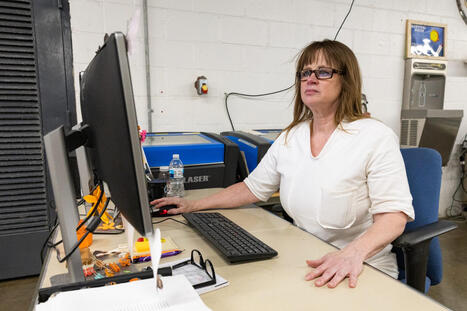







The country’s biggest braille transcription center is inside this Texas prison
Many braille textbooks are transcribed in prisons. For the last 25 years, the Billman Braille Center in Gatesville has prepared women for careers on the outside.
"Trichele Allen, braille translator, translates a college course anatomy book at Patrick O’Daniel unit, a women’s prison, in Gatesville, Texas on Wednesday, Sept. 9, 2026. Allen has worked at the Billman Braille center for 11 years. The center teaches inmates to read and write braille to translate textbooks for Texas students.
Tucked in the back of a women’s prison in Gatesville, 40 miles west of Waco, the Billman Braille Center is a hub of activity.
Women in white jumpsuits transcribe textbooks on computers, while others practice their skills on Perkins Braillers — typewriter-like machines that punch dots into the page.
Trichele Allen has been at the braille center for 11 years. She is transcribing the graphics in a college-level anatomy book.
“We make the picture as big as we can for the page and then we do a key page,” she said. “Like this would be a texture. This texture here will tell them that those are the ribs.”
Patricia Lim / Texas Standard
Sheets of braille are loaded into a machine used by the women at the Billman Braille Center.
The center has been here for over 25 years and has ballooned into quite the operation, employing around 90 prisoners who fulfill transcription contracts in Texas and beyond.
Like most prison jobs in Texas, the transcribers aren’t paid. But program manager Delores Billman, for whom the center is named, said the goal is to offer mission-driven work behind bars.
“I wanted to give the female population a job and a career that would be meaningful to them also,” Billman said.
The center’s work creates access to braille that is essential for those who need it.
“For those of us who read braille, braille is literacy,” said Robert Englebretson, the chair of the Department of Linguistics at Rice University. “Braille allows us to read in our own voice and at our own pace. Braille allows us to see how sentences are structured and how punctuation works and how things are formatted on the page.”
The Billman Braille Center teaches inmates to read and write braille to translate textbooks for students.
Englebretson has been a braille reader since kindergarten. And despite the rise in other technologies that assist blind and low vision people, he said transcription services are still necessary.
“The automated braille transcription systems often get things very wrong,” he said. “If you want textbooks for kids, you want to make sure that the braille is accurate. And so human-based braille transcription is still essential.”
Billman started as a correctional officer. She started the program to provide workforce training to female inmates at a time when most programs focused on men’s prisons.
“I wanted the ones that were going to be released to have a job that they could do and make money and support themselves,” she said.
Marilyn Wilkes, braille translator in training, does braille drills at the Billman Braille Center. Wilkes has been working at the Billman Braille Center for two months.
This remains a primary goal of the center. The U.S. added over 160,000 jobs in August, but many seeking employment report that it feels difficult to find work. People with criminal records are among those hit hardest when the job market is tough — often experiencing an unemployment rate around 30%.
Billman and her original cohort taught themselves braille until they were proficient enough to earn the Library of Congress’ transcription certification. She said the hardest part in those early days was finding contracts.
“We could study as long as we wanted to, but it wasn’t going to get us anywhere until we actually started production,” she said. “And we had to find clients to work for.”
The Billman Braille Center is the biggest of the 45 prison braille programs across the U.S., and the only one in Texas.
Prisoners play a big role in producing braille textbooks. Jayma Hawkins is the leader of the National Prison Braille Network at the American Printing House for the Blind.
“In the fiscal year 2025, 70% of all textbooks orders for American Printing House for the Blind were transcribed by prison braille programs in the United States,” Hawkins said.
The National Federation of the Blind said incarcerated people make up the majority of those certified in literary braille transcription by the Library of Congress each year.
Christina Harris said knowing she’s helping blind people go to school has kept her working in the Billman Braille Center for the last eight years.
“It was a natural fit for me. I truly love my job. I have a background in education. A long time ago I was a teacher. I taught fourth and fifth grade,” Harris said. “This is how I’m able to use my degree and still make a difference.”"
By Sarah Asch
September 22, 2026
https://texasstandard.org/stories/braille-transcription-billman-center-texas-prison-gatesville/
#metaglossia
#metaglossia_mundus