 Your new post is loading...

|
Scooped by
Charles Tiayon
June 11, 12:23 PM
|
The International Congress and Convention Association (ICCA) has taken years to return to Africa. Unfazed by the irony, the association is blowing its trumpet, giving itself brownie points, for taking its 66th congress to Africa, in Kigali in October 2027. "...Europe will host COP 31, likely to attract 50,000 people, in November. This will be the 15th time that Europe hosts the rotational COP, the UN’s Framework Convention on Climate Change, to Africa’s five times. Rotating events, or the World Cup, has a transformational effect. The recognition of any host city is symbolic but there are also tangible and immediate benefits such as forex. Beyond those points, the sector is well-placed to foster regional collaborations, buoy inter- and intra-trade, and, in the case of COP gatherings, say, raise awareness about issues like drought, rising sea levels and a list of other vulnerabilities. Still – despite their numeric significance, half a billion people in 20 countries – West and Central Africa regions have never had the opportunity to host the world’s largest climate change conference. Like its southern cousin, East Africa has hosted it once. That brings us back us to the question pondered by delegates at Poate: is Africa missing in action or being overlooked? Ask the UN. Rotation is a throwaway line. If it weren’t, Africa would host no fewer than two COP editions per decade. Added to showcasing host territories even to the millions of people following the event on TV, the business-card effect widened, these events bring a thick slice of GDP. Look at Davos, hosts of the World Economic Forum annual meeting. Davos generates €65-million each January when the WEF meeting swings by in winter. The sum exceeds €100-million when the rest of Switzerland is factored in. As an aside, Swiss media reported, the United States delegation once paid a hotel bill of €390,000, in St Gallen, and signed a €1-million car rental contract. The sums are huge and there is good human-developing legacy. Global entities, including the UN, known for its inconsistency and uneven distribution of opportunities, must be called out for their tokenisation of Africa. Kampala and Nairobi stand up. Will African leaders from Bassirou Diomaye Faye, Yoweri Kaguta Museveni and Netumbo Nandi-Ndaitwa to King Mohammed VI and their peers in Asia, Europe and beyond take global entities to task? Let the students in economics, media, politics, science and other fields at Cairo, Makerere, Roma, UCAD, Wits and every other institution also rise and, through tourism-centred diplomacy and economy, build an Africa they want – the land that Thomas Sankara dreamed of. To tap the realm of possibilities, when will Côte d’Ivoire, Gabon, and Senegal bid to host COP? Citizens should be asking governments, academia and the private sector. Has Nairobi and Durban, as previous COP hosts, put their names in the hat of late? Ethiopia, Rwanda, Uganda or – near the Sahel – Algeria, Nigeria and Cameroon could also do it. If governments are slow or lazy, as they often are, where is the private sector to take charge? Back to ICCA’s GlobeWatch: had Africa been treated equally, why wouldn’t its cities have claimed a bigger slice of the pie? That, after all, is the metric the surveyors are using. Regardless of the prevailing bias, African nations must double incoming tourist traffic. Bidding for more MICE opportunities is an avenue. East Africa punches below its weight in MICE and leisure categories. At the last count, Uganda tallied 1.3 million tourists, in the league of Ghana and Senegal, according to data collated by the UN World Tourism Organisation. Excepting the likes of Chad and Malawi (a nation prone to very high ministerial turnover) – with each scraping south of a million arrivals – Africa-bound tourist traffic is rising. But that’s off a very low base. Scratch the surface for context. The Great Wall of China reportedly drew about 15 million people each year to Paris’s 25 million. The latter exceeds the whole of West Africa’s inbound traffic. Africa attracts 80 million per annum – Southern Africa and its northernmost cousin claim big chunks of that. For the bigger picture, look at France’s lively 100 million. Time for a paradigm shift. Some of these points made it to this year’s Poate, which drew about 2,000 people. If the delegates enjoyed their time they’d be back. Anyway, what’s there not to like about Uganda? But the expo – like Afcon (set to come to East Africa next June) – is a bridge. It’s not a destination. Government and the private sector must join forces to grow Uganda’s sector: double arrivals for two years in a row, consolidate for another two. Repeat. That’ll bring six million visitors per annum before Kagwa’s fifth anniversary. Diversifying the offering and adding signature meetings will help. Uganda, like some of her peers, underwhelms partly due to lazy and perennial overreliance on wildlife and waterfalls. We haven’t even touched on cuisine, filmmaking or heritage. To the southernmost tip, in Durban, Africa’s Travel Indaba does the same, at a significantly larger scale, through gathering industry players from across the continent and the globe each year. According to the tourism ministry, almost 10,000 people turned up for Indaba in May. The expo added $51 million in tourism expenditure and sustained 1,100 jobs for the coastal city. The streets of Kigali. Abroad, WTM London, which calls itself the world’s premier trade show though it’s short on voices from the Global South, congregates nearly 50,000 participants per year. The show adds £200 million ($270 million) to London’s economy and maintains thousands of jobs. Broadly, WTM generates an estimated £2.8 billion in contracts. It is worth reflecting how much each nation realised for their investment. Taxpayers, from Egypt, Kenya, Uganda and Mali to Ghana, Canada and Japan, must pose such questions lest those events become a cool jaunt for those sent as representatives. Finally, how much the MICE sector adds to the GDP is the easiest part. What’s more critical, but often left unsaid, is that business events accelerate training, foster regional collaborations, and stimulate various areas of the economy, sometimes across borders. The sector is a PR and branding exercise, a forex earner and a practical catalyst for change, for shared growth. It just has to be used right, make the circle bigger. Time for a shift. Finally, how much the MICE sector adds to the GDP is the easiest part. What’s more critical, but often left unsaid, is that business events accelerate training, foster regional collaborations, and stimulate various areas of the economy, sometimes across borders. The sector is a PR and branding exercise, a forex earner and a practical catalyst for change, for shared growth. It just has to be used right, make the circle bigger. Time for a shift. Shoks Mnisi Mzolo https://www.ghanabusinessnews.com/2026/06/10/time-for-a-shift-african-countries-must-claim-their-share-of-the-global-conferences-economy/ #metaglossia #metaglossia_mundus

"Charles Tiayon, cartographer of the translation world
Charles Tiayon is a translator, lecturer and consultant whose Scoop.it activity reflects the professional universe named in his bio: translation, terminology, lexicography and intercultural issues. Through METAGLOSSIA, his public selection tracks language as a field of work, a field of rights, and a field being altered by AI.
A systems view of language
Tiayon looks at translation as a living system. His selections connect interpreters, translators, dictionary makers, universities, publishers, language activists and software companies, rather than treating them as separate worlds.
Technology with memory
AI is a recurring concern, but it is not treated as the whole story. Real-time speech translation, OCR and voice AI appear alongside older and slower forms of linguistic work: dictionaries, terminology, literary translation and language education.
A multilingual compass
The geographic spread is notably international, with attention to French, Spanish, Chinese, Arabic, Maltese, Breton, Ukrainian, Filipino, Indigenous languages in Canada and Indian language politics. No single country dominates the map.
What defines this selection
Archive-scale attention
With 99,235 posts analysed in a single topic, this is a long-running, high-volume observatory of the translation world. The account dates back to 2011, giving the selection the feel of an archive as much as a live feed.
A broad professional lens
The material moves easily between AI translation tools, national dictionaries, literary translation, terminology work, market news and language policy. That range reflects a professional view of language work as both craft and infrastructure.
Mixed-source reliability
The sources span institutions, universities, technology companies, mainstream media and regional outlets. UNESCO, university sites, DeepL, Mistral, CBC, Ouest-France and other sources create a mixed diet of policy, research, product news and local reporting.
Specialist reach, public scale
The audience numbers are substantial, with more than 567,000 views and over 424,000 unique visitors across all topics. The reach suggests sustained interest beyond a narrow specialist circle.
Topics
◍
Metaglossia: The Translation World
This flagship topic covers translation, interpreting, intercultural communication, terminology and lexicography as they unfold in public life. It is especially strong on AI language tools, institutional language policy, minority languages, literary translation and dictionaries.
99.2K posts
en
Deep dives
Where language becomes infrastructure
Charles Tiayon’s main topic reads like a newsroom for the language professions, but with a wider lens than trade news alone. Translation, interpreting, terminology and lexicography appear beside minority-language rights, literary circulation, dictionaries, competitions, and the fast-moving world of AI speech and OCR tools.
Metaglossia: The Translation World
The strongest thread is the collision between language as culture and language as system. A new Maltese digital dictionary, a Doha historical dictionary with text-to-speech, UNESCO and Unicode cooperation, and First Nations language translation all sit in the same frame as DeepL, Mistral OCR, and real-time speech models.
Metaglossia: The Translation World
His editorial voice is not silent aggregation. The analysis points to regular INSIGHT notes, often substantial and quote-based, with an explanatory tone and occasional sharper framing when language politics or AI consequences are at stake. The result is a practical map of a field being reshaped by institutions, software, markets and communities at once."
Courtesy
Scoop.it
06.07.2026
#metaglossia_mundus
#metaglossia

The Church’s liturgical language evolved from Greek to Latin before returning to the vernacular...
"Why Catholic Mass changed from Latin to local languages
The Church’s liturgical language evolved from Greek to Latin before returning to the vernacular, reflecting the enduring conviction that the Gospel should be proclaimed in languages people can understand
By Debra Maria Flint
Published: July 14, 2026 11:09 AM GMT
Updated: July 14, 2026 11:10 AM GMT
Jesus spent his life in the Roman province of Judaea, where four languages were in use: Latin, Koine Greek, Aramaic, and Hebrew.
Latin was the official language of Rome used by politicians, administrators and the military; Koine Greek was used in Judaea as the main language for administration and commerce among different cultures; Aramaic was the native language of Judaea, and Hebrew was the sacred language used for religious texts."
https://www.ucanews.com/news/why-catholic-mass-changed-from-latin-to-local-languages/114271
#metaglossia
#metaglossia_mundus

Automated sign language recognition and translation Submission deadline 14 April 2027 This Collection supports and amplifies research related to: SDG 3 - Good Heath & Wellbeingand SDG 4 - Quality Education. This Scientific Reports Collection welcomes original research on Automated sign language recognition and translation. Narrative review articles are also welcomed to our sister journal, Scientific Reviews. For further information, please view the ‘Participating Journals’ below. The automated recognition and translation of sign language is increasingly important for improving communication access for Deaf and hard‑of‑hearing communities. Advances in deep learning and computer vision have significantly enhanced the ability to capture hand shapes, movements, facial expressions, and body posture. Modern models now support real‑time recognition, continuous signing interpretation, and natural‑language translation across diverse sign languages. Despite this progress, challenges remain due to linguistic complexity, signer variability, limited annotated datasets, and the need for culturally accurate translations. — To submit, see the participating journals Editors Jiaxin Cai, PhD , Abhishek Kumar, PhD , Phakkharawat Sittiprapaporn, PhD & Andrew Jeyabose Sundar, PhD https://www.nature.com/collections/dfbcghfhbc #metaglossia #metaglossia_mundus

"Teaching with Ubuntu: Relational pedagogies for greater inclusion and equity
By CEID Blogger, on 15 July 2026
By Kwame Akyeampong and Sean Higgins
This blog shares reflections from our new book ‘Reconceptualising the learning crisis in Africa: Multi-dimensional pedagogies of Accelerated Learning Programmes’. For more than a decade, the conversation on education in Africa has been framed by the language of ‘crisis’, particularly the so-called ‘learning crisis’. Whilst there is a real challenge in literacy and numeracy outcomes, a crisis-dominant lens easily drifts into deficit thinking: portraying African children, teachers, and communities as lacking the capabilities to learn or teach.
An Ubuntu lens – grounded in African philosophies of care, compassion and collective responsibility – invites a different starting point. It reframes learners and teachers as knowledge-holders whose identities, languages and community ties are assets, not obstacles. As research across Ethiopia, Liberia and Ghana shows, when education systems honour these assets, learning becomes relational, joyful and transformative. Ubuntu turns attention away from imported toolkits and toward the relationships that make learning possible – between children and teachers, schools and communities and policy and practice.
Relational pedagogies in practice
Accelerated Learning Programs (ALPs) in Ethiopia, Ghana and Liberia illustrate Ubuntu in action. Each began as a response to exclusion – helping children who had dropped out or never attended school to re-enter formal education – and each achieved remarkable reach under tight constraints:
Ghana’s Complementary Basic Education (CBE) has supported over 250,000 learners, most in rural northern districts.
Ethiopia’s Speed Schools have reached more than 200,000 out-of-school children by 2017.
Liberia’s Second Chance program had about 5,000 participants by 2022.
What mattered was not imported materials but relational practice which included:
Recognising and building on the knowledge and strengths of African children and families.
Valuing local teachers’ deep knowledge of socio-cultural and economic contexts of their communities and children’s realities to organise participation, use home language strategically and build peer support.
Community language mapping to ensure teaching began in the language children actually understood.
Extended use of local languages in instruction (often two to three years longer than national policy required) which deepened comprehension and confidence.
Employing pedagogical approaches that supported holistic forms of learning, which dignify the agency and identity of the African child and their cultural and material environments.
Teacher-led, practice-centred support which replaced rigid scripted materials with shared problem-solving and mentoring.
Across settings, these moves connect curriculum goals to the material and cultural worlds of African children and enable deeper, transferable learning across subjects, not just literacy and numeracy. It also restored children’s dignity as capable learners and teachers’ agency as skilled professionals.
Language, identity and belonging
Decades of evidence show that learning in one’s home language for at least six years strengthens literacy, numeracy, motivation and self-esteem. Yet millions of African children still start school in a language that is not their own. Language of instruction is not a technical footnote – it is an equity hinge. When children cannot understand the language used in lesson delivery, they are effectively excluded from learning and from the sense of being legitimate learners.
Language of instruction can act as a gateway to communal engagement in learning, allowing children to bring what they know and experience into the classroom learning environment. As one Ghanaian linguist we interviewed points out: “…a child needs to learn from known to unknown… and from the mother tongue to be able to understand the principles, concepts and value… To use that as a basis to know.”
Instead, African children’s home languages are often trivialised as preparation for immersion in an ex-colonial language, rather than valued for their potential in facilitating meaningful and engaging learning opportunities. By excluding children’s languages, monolingual education policies and the pedagogical and curriculum approaches that result in devaluing their lives and lived experiences. In doing so, they thwart opportunities to draw on their familiar communicative practices to facilitate learning.
The myths concerning mother-tongue education – that there are too many languages, that African languages cannot express complex ideas, that English immersion guarantees fluency – have been disproven repeatedly. The deeper issue could be argued as the fear of the unknown: fear that valuing African languages may threaten national unity or global competitiveness. In truth, linguistic inclusion expands both. When learners hear and use their own languages in school, comprehension rises, participation increases and self-worth grows. Language becomes a bridge to belonging – and belonging is the soil in which learning takes root.
Four practical levers towards relational shifts in practice
Drawing on the book’s twelve guiding principles for a renewed postcolonial agenda to make meaningful progress towards Education For All, we have identified four practical levers can help ministries, teacher educators and development partners act now:
Map community languages before design: Conduct linguistic mapping so curriculum and materials match children’s real language environments.
Use local languages more consistently and for longer: Strengthen the implementation of mother-tongue instruction and ensure a more gradual, bilingual transition to the second language.
Centre classroom practice: Invest in teacher professional communities where educators adapt and co-create lesson resources rather than implement scripted plans.
Value teachers’ local knowledge: Redesign teacher education to build on teachers’ lived experience and multilingual capability.
These are not costly reforms – they are relational shifts. Each affirms Ubuntu’s ethic of mutual recognition and collective care, repositioning teachers, learners and communities as partners in the educational project.
Recommendations and ways forward
Moving from small pilots to national policy requires breaking with the ‘projectisation’ of reform. Donor-driven toolkits and narrow test-score targets cannot build the institutional capability needed for relational pedagogy to thrive. Ministries can take three steps:
Institutionalise language-inclusive policy – ensuring every child begins school in a language they understand.
Embed Ubuntu principles in teacher standards and curriculum frameworks, recognising teaching as a social, ethical practice of care.
Foster local professional learning networks that connect schools, communities and teacher colleges around shared inquiry.
Development partners can align funding and metrics to these goals – valuing participation, inclusion and teacher agency alongside test outcomes.
A way forward
Ubuntu reminds us that education is relationship before it is measurement. Inclusion and equity are not achieved by more testing but by restoring the human connections that make teaching and learning meaningful. The comparative lessons from Ghana, Ethiopia and Liberia show what is possible when policy begins with language, identity and belonging.
Filed under CEID, education and inequalities, Schools"
https://blogs.ucl.ac.uk/ceid/2026/07/15/teaching-with-ubuntu-relational-pedagogies-for-greater-inclusion-and-equity/
#metaglossia
#metaglossia_mundus
ECA/OIF Fellowship Programme for Young African Translators Call for Applications – 2026 Cohort Application deadline: 31 July 2026 Organizational Setting and Reporting Relationships The United Nations Economic Commission for Africa (ECA), in partnership with the Organisation internationale de la Francophonie (OIF) and as part of the development by the OIF of the international programme in translation and conference interpretation at the Collège international de Villers-Cotterêts (Cité internationale de la langue française), is launching a pilot fellowship programme aimed at strengthening the pool of qualified African language professionals and preparing young translators for the standards and competitive examinations of the language services of the United Nations system, including the DGACM. This initiative contributes to the promotion of multilingualism within international organizations and supports the professional development and employability of young African language professionals. The 3-month fellowship programme will be implemented between October and December 2026, within the Publications and Conference Management Section (PCMS) of ECA in Addis Ababa, Ethiopia, and will combine practical immersion in UN language-service workflows, mentoring by experienced professionals, and targeted professional development activities. The programme is initially planned as a pilot cohort for 2026. Fellowship Areas The fellowship programme is open to young African professionals specialized in: • Translation • Revision/editing • Conference documentation • Multilingual communication • Terminology and language technologies The programme will primarily focus on French language professionals, with strong working knowledge of English required. Knowledge of another UN official language is an advantage. Responsibilities Under the supervision of experienced language professionals within PCMS, Fellows will contribute to selected activities related to multilingual conference and documentation services.Assignments may include: • Translation and revision of documents; • Research and terminology work; • Exposure to UN editorial and documentation standards; • Participation in mentoring and professional development activities; • Familiarization with multilingual conference servicing workflows; • Participation in practical exercises and simulations related to UN language examinations; • Support to selected multilingual communication and conference-related activities. The Fellows will also participate in structured learning and mentoring activities and online seminars/modules developed jointly by ECA and OIF. Competencies Professionalism: Ability to produce high-quality written work under supervision; ability to work under pressure and meet deadlines; interest in multilingualism and international public service. Communication: Excellent drafting and language skills; ability to communicate clearly and effectively in multicultural environments. Teamwork: Ability to work collaboratively with colleagues from different cultural and professional backgrounds. Qualifications, target audience and eligibility criteria (i) Be nationals of an African member State; (ii) Be under 35 years of age at the time of application; (iii) Hold a master’s degree, or equivalent, in translation, languages, linguistics or a closely related field; (iv) Have obtained the required degree within the last three years; (v) Have French as their main language (“A” language); (vi) Have English as a working language; (vii) Demonstrate a strong interest in translation, revision and language services in an international organization; (viii) Be available to participate in the full duration of the programme in person in Addis Ababa. Special Notice This call is open only to nationals of member States of the Economic Commission for Africa. 2Candidates must submit the following documents in PDF format: (i) UN Administrative Profile (AP) generated through Inspira in French; (ii) Motivation letter in French; (iii) Curriculum vitae in French; (iv) Certified true copies of advanced university degrees or attestation of results, and transcripts; (v) (vi) Copy of valid passport information page; One professional or academic reference letter; Shortlisted candidates will be invited to participate in a written assessment and a short online interview. The selection process will be conducted jointly by ECA and OIF. Logistics 1. 2. The fellowship programme will take place in Addis Ababa, Ethiopia; The duration of the fellowship is expected to be three months; 3. Selected Fellows will receive: - A monthly stipend of USD 3,000; - A one-time settling-in grant of USD 3,000; - Return air travel between the fellow’s country of residence and Addis Ababa; - Medical insurance coverage arrangements as applicable. ALL SUBMISSIONS TO BE EMAILED TO: Email Address: RecruitmentPPost@un.org Subject Line: ECA Fellowship for Young African Professionals, 2026 Application deadline - Applications must be received no later than 11:59 p.m. Addis Ababa time on 31 July 2026. - Only shortlisted candidates will be contacted. https://www.uneca.org/sites/default/files/vacancies/Language%20Talents%20EP.pdf #metaglossia #metaglossia_mundus
AI Translator Provides Fast Multilingual Translations Communicating across languages is becoming increasingly important in a connected world, from international business conversations to everyday travel and learning. AI Translator offers a simple way to convert text between multiple languages using artificial intelligence-powered translation technology.
The online tool provides instant translations without requiring users to create an account, making it accessible whenever a quick language solution is needed. Whether translating messages, documents, or general text, users can receive fast results through a straightforward interface. The platform helps remove language barriers by making multilingual communication easier and more convenient for a wide range of users. With no registration process, AI Translator offers a friction-free experience for anyone looking to understand or share information in another language. It provides a practical digital resource for global communication, helping users translate content quickly while keeping the process simple and accessible. Trend Themes -
Frictionless Translation — No-account access lowers barriers for spontaneous multilingual communication, creating space for lightweight tools embedded across travel, commerce, education, and workplace workflows. -
Instant Multilingual Communication — Real-time AI translation supports faster cross-border conversations, enabling digital services to become more inclusive for users who interact across languages. -
Accessible AI Utilities — Simple browser-based AI tools are expanding everyday adoption by delivering practical value without complex onboarding, subscriptions, or specialized knowledge. Industry Implications -
Business Communication — Global teams and client-facing organizations benefit from rapid translation layers that reduce delays in emails, chats, proposals, and international collaboration. -
Travel Technology — On-demand language conversion strengthens traveler confidence by making directions, messages, menus, and local information easier to understand in unfamiliar markets. -
Education Technology — Multilingual translation tools broaden access to learning materials and peer communication, supporting more flexible participation across international classrooms and self-directed study.

"By Maung Maung Myint Thein (RIT)
In an increasingly interconnected world, translation is more than the conversion of words from one language into another. It is a bridge between cultures, civilizations, and generations. Through translation, readers gain access to the ideas, philosophies, histories, and artistic achievements of peoples beyond their own linguistic boundaries. For young people in particular, translated literature provides a gateway to global knowledge while strengthening intellectual curiosity, critical thinking, and cultural understanding.
Translation is the art of conveying the meaning, tone, and purpose of a text from its original language into another without losing its essence. It requires not only linguistic competence but also cultural sensitivity, literary judgment, and creative expression. Because no two languages are perfectly equivalent, translators must carefully balance accuracy with readability, ensuring that the translated work feels both faithful to the original and natural to its new audience.
The tradition of translation dates back thousands of years. The ancient Greek concept of metaphrasis emphasized faithful translation, while paraphrasis encouraged freer interpretation. Across Asia, particularly in India and China, translation played a vital role in the spread of religious texts, philosophical thought, and administrative knowledge. Buddhist scriptures, for example, travelled across linguistic and cultural borders through generations of dedicated translators, shaping civilizations far beyond their places of origin.
Myanmar has its own distinguished tradition of translation. Evidence of multilingual scholarship can be traced to the Bagan era, while earlier Pyu civilizations are believed to have translated texts from Sanskrit and Pali. The celebrated Myazedi Inscription, commissioned by Prince Rajkumar, stands as one of the world’s earliest examples of multilingual translation, presenting the same text in Burmese, Mon, Pyu, and Pali.
During the Konbaung Dynasty, increasing contact with Britain and France expanded the scope of translation from European languages into Burmese. Under the British education system, numerous academic works were translated for local students. Between the 1920s and the 1940s, books on anti-colonial struggles and international political movements introduced Myanmar readers to ideas that influenced the country’s own independence movement.
Following the Second World War, the translation of world classics accelerated significantly. A landmark moment came in 1947, when General Aung San called for the advancement of knowledge through translation. His vision inspired the establishment of the Burma Translation Society on 26 August 1947. The Society sought to translate important works into Burmese while introducing Myanmar literature to international readers through foreign-language translations. Its mission reflected the belief that translation is essential to national education, cultural development, and intellectual progress.
For any nation, translation is not merely a literary pursuit but an investment in human development. It enables societies to exchange knowledge, share cultural values, and participate in global intellectual life. As translation flourishes, so too does a nation’s capacity for innovation, education, and cultural dialogue.
Young readers stand to benefit enormously from translated literature. World classics introduce them to different civilizations while encouraging empathy, reflection, and intellectual maturity.
Jane Austen’s Pride and Prejudice, beautifully translated into Burmese by the distinguished writer Tint Te, offers timeless insights into social class, personal integrity, and human relationships. Through such works, Burmese readers gain an understanding of nineteenth-century British society while recognizing universal human values that transcend time and geography.
Charles Dickens’ Great Expectations, translated into Burmese under the title Myaw Ta Lin Lin by Shwe U Daung and later by Maung Htun Thu, follows the moral and emotional journey of the young protagonist Pip. Beyond its compelling narrative, the novel enriches readers’ vocabulary, deepens their appreciation of literary style, and explores themes of ambition, humility, and personal growth.
Emily Brontë’s Wuthering Heights, translated into Burmese as Lay Htan Kone by Min Kyaw, presents one of English literature’s most powerful explorations of love, obsession, revenge, and human psychology. The novel demonstrates the enduring complexity of human emotions while exposing readers to sophisticated literary expression.
William Shakespeare’s Macbeth remains one of the greatest studies of ambition, guilt, and political power. Long included in higher education curricula, its Burmese translation has enabled generations of students to appreciate Shakespeare’s profound understanding of human nature without language becoming a barrier.
Young readers interested in history and politics should also explore Leo Tolstoy’s monumental War and Peace, masterfully translated into Burmese by the renowned scholar Mya Than Tint, who received the National Literary Award for his translation in 1972. Set against the backdrop of the Napoleonic Wars, the novel examines leadership, war, morality, and the resilience of ordinary people amid extraordinary historical events.
For readers seeking philosophical depth, Fyodor Dostoevsky’s The Brothers Karamazov, translated by Nat Nwe, offers profound reflections on morality, faith, justice, and human responsibility. Its intellectual richness challenges readers to think critically about ethical dilemmas and the complexities of the human condition.
Translated literature is not limited to fiction. Non-fiction works also play a transformative role in shaping young minds. U Nu’s translation of Mittabala Tika remains an important contribution to Burmese intellectual life. Likewise, Dale Carnegie’s internationally acclaimed How to Win Friends and Influence People has introduced millions of readers worldwide to practical principles of communication, leadership, and interpersonal relationships. The book encourages readers to avoid unnecessary criticism, express sincere appreciation, inspire others through genuine interest, and cultivate habits that strengthen both personal and professional success.
Among translated novels, one particularly remarkable work is A J Cronin’s The Citadel, translated into Burmese by Maung Htun Thu, which won the Myanmar National Literary Award for Translation in 1983. Drawing on Cronin’s own experience as a physician, the novel explores medical ethics, professional integrity, social reform, and the conflict between idealism and materialism. More than a medical novel, it is a compelling examination of human character and moral responsibility.
The enduring value of translated literature lies in its ability to broaden perspectives while nurturing emotional intelligence and ethical awareness. Through unforgettable characters and richly imagined worlds, young readers develop empathy, resilience, and the capacity to understand lives different from their own.
Classics such as Pride and Prejudice, Great Expectations, and Jane Eyre teach lessons about personal character, responsibility, ambition, love, and integrity. They reveal how social structures, moral choices, and individual determination shape human destiny. American classics, including The Old Man and the Sea, The Grapes of Wrath, and Invisible Man, likewise encourage perseverance, courage, justice, and self-discovery while offering insights into the social and historical experiences of another nation.
For today’s generation, translated literature is far more than entertainment. It expands intellectual horizons, strengthens critical thinking, encourages cultural appreciation, and inspires lifelong learning. In an era defined by globalization, young people who engage with translated works are better equipped to understand both their own heritage and the wider world.
A nation that invests in translation invests in its future. By encouraging young people to read translated literature, Myanmar can cultivate informed citizens, thoughtful leaders, and globally minded individuals who are prepared to contribute meaningfully to both national development and international understanding.
https://www.gnlm.com.mm/beyond-borders-why-young-people-should-read-translated-literature/
#metaglossia #metaglossia_mundus

"The origins of “habitus”
by Paul Bernard-Nouraud, 14 July
Étienne Anheim and Paul Pasquali examine a key moment in interdisciplinary dialogue: Pierre Bourdieu’s translation and editing of the art historian Erwin Panofsky.
In May 1967, Pierre Bourdieu published, in the “Sens Commun” collection he had recently founded with the Éditions de Minuit, the first French translation of a book by the art historian Erwin Panofsky, Gothic Architecture and Scholasticism. At the time, Panofsky was seventy-six years old and recognized internationally as an essential reference point in his field. The translation was accompanied by considerable editorial work. To the slender volume first published in 1951, Bourdieu added another text by Panofsky on the Abbot Suger published in 1948, which he translated from English. He added a postface that laid the groundwork for a key feature of his own sociological theory, the theory of habitus. This “publishing event” (p. 11), as Étienne Anheim and Paul Pasquali describe it, had considerable epistemological significance and acquired, for Bourdieu, the status of a genuine foundational moment.
It is these three aspects—translation, editing, and epistemology—that Anheim and Pasquali’s “essay in intellectual archeology” seeks to explore. Éditions de Minuit has published it in the same collection as the original volume. Since Anheim is a medievalist and Pasquali a sociologist, not only does their collaboration apply the principle of multidisciplinarity to the study of Bourdieu’s methodology; it also reproduces the respective positions occupied by Panofsky in art history and Bourdieu’s in sociology. Anheim and Pasquali observe that Bourdieu’s “intellectual project,” which is “indissociable from a conquering conception of sociology, had multidisciplinary aims that encompassed history and anthropology as well as, to a degree, philosophy” (p. 32).
Anheim and Pasquali have thus undertaken the archaeology of an editorial and scholarly field by writing a book that is itself situated on the cusp between sociological holism and an account of the young Bourdieu’s intellectual development. Over six chapters, they reconstruct the context in which this editorial project emerged (chapter 1); what Bourdieu learned through this experience of the editor’s role (chapter 2); and the socialization process he underwent in his relationship with Panofsky (chapter 3), based on his previously unpublished correspondence with the art historian, which has been included in an annex. They describe how Bourdieu planned the translation, a task he undertook for the first and last time (chapter 4); the resulting development of the concept of habitus (chapter 5); and, finally, the book’s critical reception, in sociology and art history as well as over the long term (chapter 6).
Chapter 5 contains what are undoubtedly the most important theoretical and epistemological issues that Bourdieu identified in Panofsky’s two texts. To gauge their significance, a detour is necessary through the final pages of Anheim and Pasquali’s conclusion, in which they consider the object that Panofsky uses—Gothic cathedrals—to establish a homology between architecture and scholastic thought.
“During the interwar period,” the authors write, “the idea circulated that one could interpret European society through the lens of the unique object that is the Gothic cathedral.” The stakes of the latter, they suggest, thus went far beyond “a scholarly problem in art history” (p. 235). This was Panofksy’s more or less avowed goal, and one that naturally interested Bourdieu. “The medieval cathedral,” Anheim and Pasquali continue, “was a matrix, in the etymological sense, for European societies as well as for the subjectification processes of their individual members” (p. 239), from a scholastic as well as a religious point of view.
On the one hand, the cathedral had come to represent a “world that supposedly held together in an organic and harmonious way.” This homogeneity implied the “task of ordering and establishing a hierarchy” that, at the same time, required “the exclusion of heretics, Jews, and Muslims.” On the other hand, the idea of the cathedral legitimated “the domination of lords and clerics” (p. 239). During this process, it as if the clerics had succeeded the priests in the pulpit (cathedra in Latin), enjoyed a transferal of symbolic capital topped up with a little erudition. In other words, discovering homologies between scholastic thought and Gothic architecture, as Panofsky had done, allowed Bourdieu to shed light on the historical determinants of mechanisms of domination on which the fields of art as well as the medieval university were structured.
Yet it is precisely this critical forgetting—“as if the social sciences had metabolized what came before them” (p. 240), as Anheim and Pasquali put it—to which Bourdieu refers through his concept of habitus and that, inspired by Panofsky, he simultaneously invents, in the archaeological sense of the word. Panofsky uses the term “mental habits” (in English) in the text, translating a quote from Thomas Aquinas, while Bourdieu “translates” “mental habits” by the term “habitus,” which Panofsky had not used and which he endorsed reluctantly.
The conditions for the extraction of the concept of habitus—via Thomism, and through it, Aristotle’s hexis, to an expanded conception of art history before arriving in a liberated sociology with emancipatory ambitions—thus contributed to an operational term at the intersection of various human and social sciences. Habitus is thus one of those concepts that itself has metabolized, specifically through scholars who have sought to restore its exploratory and explanatory functions. As Anheim and Pasquali note, Bourdieu himself, once he was “beyond this Panofskian moment,” used the concept of habitus in later work, formalizing it based on his reading of Panofsky but with “less and visible—which does not mean incidental—references” (p. 214).
Conversely, for the many French art historians who had read Panofsky in German or English before Bourdieu, but who ultimately mentioned him infrequently and who were less enthusiastic than their young colleague about translating him, the question became: “to return to Panofsky, how do we forget Bourdieu?” (p. 208). When one considers the cumulative sales numbers mentioned by Anheim and Pasquali, there is no doubt that Bourdieu contributed to making Panofsky known to a far vaster readership than the specialized title of his book would lead one to expect. Yet it must be admitted that a Boudieusian reading of Panofsky did not dominate, or even occur in, the field of French art history. It is also regrettable that an oeuvre of this importance did not give rise to more interpretations that were, if not in the same league, at least as theoretically rich as the now famous 1967 postface.
The main reason for this fruitfulness that has no real equivalent deserves to be emphasized, if only for its methodological lessons. If Bourdieu was extract such fruit from Panofsky’s book, it was not because it contained many layers of knowledge from many different periods and disciplines, but because its interpreter had a multidisciplinary education and that he eagerly read authors—in this case, art historians—who would seem quite distant from his research area. In a sense, disciplinary distance favored conceptualization. In this respect, one of the merits of Anheim and Pasquali’s essay is to insist regularly on Bourdieu’s participation in “writing chains” (p. 92), including one consisting of “an entire editing world’” (p. 107) that resulted in “a hermeneutic chain” (p. 114). Relating to the latter, the authors emphasize how much Bourdieu’s interest in the habitus owed to another Panofsky reader, the medieval paleographer Robert Marichal, to whom he explicitly acknowledges his debt in the postface.
To go even further back, as Anheim and Pasquali do, it becomes clear that Bourdieu was most likely “disposed” to such an approach by the teaching of Maurice Merleau-Ponty, who had a deep knowledge of Panofsky’s work, which he had recommended to Hubert Damisch in the late 1940s. Anheim and Pasquali write that by “putting philosophy in an authoritative position in the reflexive constitution of the human sciences, Merleau-Ponty brought about a considerable shift that simultaneously entailed an epistemology, a theory of action, and an ontology of temporality” (p. 163). Mirroring this trend, the concept of habitus, they maintain, allowed sociology as Bourdieu conceived of it at the conclusion of his philosophical education “to bring together a theory of practice, a reflexive epistemology, and an empirical approach” (p. 165).
It is not so much that Bourdieu borrowed a word from Panofsky’s art history as that he borrowed a term so that he could return it, enhanced with critical and epistemological powers that Panofsky himself had, as it were, kept in reserve. In this way, “the postface, according to Bourdieu, was intended to ’manifest’ the truth found implicitly in the book” (p. 137). It is the responsibility of Panofsky’s followers to keep reclaiming the term and reintegrate it into their vocabulary, just as it is up to Bourdieu’s disciples to continue to read art history books that would appear to be foreign to their discipline so that they, too, may acquire some perspective.
Étienne Anheim, Paul Pasquali, Bourdieu et Panofsky. Essai d’archéologie intellectuelle, (Bourdieu and Panofsky: An essay in intellectual archeology), Paris, Les Éditions de Minuit, 2025, 286 p., €23, ISBN 9782707356369
by Paul Bernard-Nouraud, 14
https://laviedesidees.fr/The-origins-of-habitus
#metaglossia
#metaglossia_mundus

"The values Claude expresses vary across languages. When Claude speaks in English, it emphasizes different values than when it speaks in Portuguese, Indonesian, or Chinese.4 The largest variation is in the Warmth vs. Rigor axis, with Claude leaning toward expressing warmth-related values most in Arabic and Hindi and rigor-related values most in English and Russian.
With this approach we can begin to ask why values shift across models and languages and better test how factors such as behavioral training or cultural context influence the values that Claude expresses.
How do we interpret the giant space of values?
Ultimately, our goal is to have a way to empirically understand the values that Claude expresses and how these vary across contexts. In this work, we focus specifically on how the values change between models and languages. But our previous work, Values in the Wild, identified more than 3,000 values expressed by Claude. Comparing these thousands of values one by one would be unwieldy and would obscure broader trends.
To make comparing values easier, we constructed value axes that reduce those thousands of values down to a few underlying dimensions based on which values tend to show up together in real-world conversations. For example, Claude responses that are characterized as “warm” are often also characterized as “encouraging” and “positive.” Those same “warm” responses are less often characterized as “rigorous” and “accurate.” Constructing an axis from warmth to rigor allows us to organize these groups of related values—warmth-related values on one side, rigor-related values on the other—and captures an important aspect of how Claude interacts with someone in conversation. If Claude expresses more warmth-related values than rigor-related values in a conversation, that conversation sits more on the warmth side of this axis, and vice versa. This doesn't mean the value groups on either end are mutually exclusive—Claude can express warmth and rigor in the same conversation. But in practice, the more Claude expresses values on one side of an axis, the less it tends to express values on the other. These axes allow us to compare the most salient groups of values that Claude expresses, without having to track changes across thousands of individual values.
To build the value axes, we began with the 3,307 values identified in Values in the Wild and manually clustered those with similar meanings, producing a shorter list of 339 high-level values. Next, with our privacy-preserving analysis tool, we sampled 309,815 Claude.ai conversations in which the user gave Claude a subjective task.5 Our sample drew equally from three models (Sonnet 4.6, Opus 4.6, Opus 4.7) and the 20 most common languages used on Claude.ai, giving us roughly 5,000 conversations per model-language pair. For every conversation, the tool used Claude to label each of the 339 high-level values as present or absent.6 We followed the same process to identify the values expressed by the user, and the conversation's task and topic. We then applied dimensionality reduction, a technique that compresses the labeled values into axes based on which ones Claude tends to express together. See the appendix for method details, prompts, additional analyses, and limitations.
This left us with four axes that capture the main ways Claude's expressed values shift from one conversation to another:
The Deference vs. Caution axis contrasts values like accommodation and respect for preferences with values like responsible guidance and harm reduction.
The Warmth vs. Rigor axis contrasts values like positive framing and encouragement with values like accuracy and transparency.
The Depth vs. Brevity axis contrasts values like nuance and critical thinking with values like brevity and compliance.
The Candor vs. Execution axis contrasts values like honesty and transparency with values like results orientation and optimization.
To make sure we measured the values Claude expressed—rather than differences in what users were asking about or how they asked—we controlled for each conversation's task, topic, and user-expressed values.
Figure 2: The four value axes that represent the most variation in the values that Claude expresses. Each axis is a number line between two groups of values. Every value is positioned on each axis by how many times more it contributes to the axis than the average value contribution, with the strongest contributors labeled. Most values contribute less than the average, which means each axis is driven by a small set of key values (labeled in the figure).
Do different Claude models express different value profiles?
In this section, we compare the values expressed by different models. For each model, we average the positions of all its conversations along each of the four axes, giving one overall position per axis. The result is a high-level picture of which value groups each model tends to express more than the others. These differences are small relative to the variation across conversations but structured and detectable.
Figure 3: Each model’s average position on the four value axes, in standard deviations from the mean across all conversations, and its distinctive behaviors. Sonnet 4.6 leans warm, deferential, and brief, while Opus 4.7 is more likely to express rigor, caution, and depth. Opus 4.6 leans toward rigor, deference, and brevity.
To see what those differences look like in practice, we zoom in on the specific values where the models diverge the most. Each time our Claude-based privacy-preserving tool labels a value in a conversation, it also writes a short description of how Claude expressed that value. We group descriptions that reflect similar behaviors within a value group and summarize them in Figure 3, giving a more concrete view of how the models differ.
Deference vs. Caution. Sonnet 4.6 leans the most toward expressing deference relative to caution, often affirming the user’s ideas and their work. Opus 4.7 leans the most toward expressing caution, often warning the user of risks unprompted.
Warmth vs. Rigor. Sonnet 4.6 leans the most toward expressing warmth, frequently through humor, playfulness, and comforting the user without judgment. Opus 4.7 leans the most toward expressing rigor relative to warmth and is more likely to challenge the user's assumptions and candidly critique their work.
Depth vs. Brevity. Opus 4.7 leans toward depth by showing the reasoning behind its conclusions, while Opus 4.6 and Sonnet 4.6 lean toward brevity. Opus 4.6 in particular tends to get straight to the point.
Candor vs. Execution. Opus 4.7 leans toward candor by being upfront about its limitations, while Opus 4.6 leans toward execution, being more likely to stay within the scope of the user’s request.
These findings line up with how people perceive these models, both within Anthropic and online. Claude.ai users have commented that Opus 4.7 hedges its answers more often than other models. Anthropic staff have characterized Opus 4.7 as expressing relatively more transparency, honesty, and humility, and Opus 4.6 as expressing more brevity. We also described Sonnet 4.6 as warm, honest, and prosocial in its launch blog post. The fact that our axes recover these impressions suggests our method for labeling and comparing the values Claude expresses is tracking something real about how the models actually behave.
Across many conversations, users may encounter a different mix of values when interacting with different Claude models. For example, Opus 4.7 tends to offer candid critique of users’ work or unprompted warnings about risks, while Sonnet 4.6 tends to be encouraging and humorous. Such differences in values across models are likely shaped by character training decisions (among other factors), and our value axis approach highlights key differences in the values Claude expresses that we may ultimately be able to trace back to these training choices.
Are Claude’s expressed values different between languages?
We expect the values Claude expresses to vary based on the language of the conversation for several reasons. First, Claude's training data differs across languages, which may shape the values it expresses. Second, our model evaluations shared in system cards already find differences across languages in what Claude knows and how it handles sensitive requests.7 Measuring how much the values expressed by Claude vary by language is a first step to determining whether differences across languages reflect reasonable variation or should be addressed in training.
We compute how Claude’s value profile differs across the 20 most common languages on Claude.ai using the same method as the previous section. Below, we plot Claude's value profile across the top languages on the Claude platform, beginning with the languages where Claude's expressed values diverge the most.
Figure 4: Claude's average position on the four value axes when conversing in each language, in standard deviations from the average across all conversations, and Claude's distinctive behaviors in each language. Claude leans furthest toward warmth in Hindi while leaning furthest toward rigor in Russian. Claude leans furthest toward execution in Indonesian while leaning furthest toward candor in Dutch. Claude leans furthest toward deference and brevity in Arabic while leaning furthest toward caution and depth in English.
Claude's value expression varies most across languages on the Warmth vs. Rigor and Candor vs. Execution axes, while staying most stable on the Deference vs. Caution and Depth vs. Brevity axes.
Deference vs. Caution. Claude expresses the most deference in Arabic and the most caution in English.
Warmth vs. Rigor. Claude expresses the most warmth in Hindi and Arabic, characterized by polite language, humor and playfulness, and affirmations of a person’s ideas and work. Claude leans toward expressing rigor most in English and Russian, characterized by challenging assumptions, correcting details, and asking for evidence.
Depth vs. Brevity. Claude leans toward depth in English, refining and correcting details, while leaning toward brevity in Arabic.
Candor vs. Execution. Claude leans toward candor in Dutch, owning up to its own errors, while it leans toward execution in Indonesian.
Taken together, these results show that the values Claude expresses vary meaningfully with the language of a conversation. Given the same kind of request, Claude leans more toward warmth and deference in some languages and more toward rigor and caution in others. This has important implications we’ve only begun to explore. To take one example: two people asking for feedback on the same business plan, one in Hindi and one in Russian, may come away with different impressions of its quality because Claude expressed different values in how it framed its assessment.
We don't yet know which properties of our training data drive these differences. One possibility is that our training data is not evenly distributed across languages. Some languages have far more data than others, and training for Claude to express consistent values may be more effective in languages where data is abundant. The composition of that data also varies. Some languages might be overrepresented in professional writing, for example, and this kind of text may reflect different values. Together, these imbalances in quantity and composition could lead Claude to express different values in different languages.
We also aren’t yet sure how much of this variation is desirable. Different languages carry different conversational norms, and Claude may be responding with different values based on those norms. Claude may also be more closely matching our intended behavior for some languages than others, resulting in a gap in how well Claude serves certain language communities.
This method lets us start disentangling which properties of our training data drive these differences—and whether the variation is desirable.
Looking forward
We showed that the values that Claude expresses can be compressed into a small number of axes, and that where Claude sits on those axes shifts across models and languages. That gives us a way to track these shifts during model evaluation and post-deployment monitoring. But we don’t yet understand why these shifts happen or what they mean for the people interacting with Claude. Below we sketch the future directions we think are most promising.
Where do these value differences come from?
Knowing that Claude's values shift across models and languages doesn't tell us why. Some variation could be inherited from differences in pretraining and fine-tuning data across languages. Our four axes highlight which value differences to inspect more closely in our training data. Tracing these differences back to specific data, training stages, or contextual factors would show us where to intervene if we wanted to shape Claude's behavior in more nuanced ways.
What do these differences mean for users?
We've measured what values Claude expresses differently and their associated behaviors, but not what impact these have on our users. Using tools like Anthropic Interviewer, we could ask users about their wellbeing, trust in Claude, or Claude’s decision quality and then correlate these impacts with the values Claude expresses. This would allow us to directly link value differences to user outcomes and let us prioritize fixing the value differences that meaningfully affect users.
How should Claude's values vary across languages?
Claude's constitution describes the core values it should express, like warmth, caution, and honesty, but doesn't specify how these should vary across languages. Our results show users across languages are already experiencing Claude differently, but we don’t know what kinds of variation users interacting with Claude in those languages want. Determining how Claude’s values should vary across languages would mean understanding and weighing the perspectives of the people who speak them.
What other factors drive differences in the values Claude expresses?
Language and model are unlikely to be the only drivers of what values Claude expresses. The values may also be shaped by demographic signals such as age, profession, or geographic region, whether through explicit cues in what the user writes or through subtler differences in topic, tone, and style that are correlated with who is asking. Understanding which of these signals matter, and whether the resulting variation serves users well, is a next step enabled by our method.
Can we reliably steer the values Claude expresses?
Having a way to measure a model's value profile raises a natural question: how reliably can we steer the values Claude expresses? One way we might test this is by attempting to steer values through character training adjustments or system prompt changes, then using our value axis method to verify whether the model’s expressed values shift as expected.
Can value profiling become part of how we evaluate and monitor models?
The value axis method gives us a simple way to summarize a model's behavioral tendencies in open-ended conversations, and we could build this into our evaluation processes. Running value profiling before a model ships and after its release could flag unexpected shifts in the values Claude expresses. We could also identify correlations between value profiles and problematic behaviors, such as not adhering to Claude’s constitution, and use what we learn to improve Claude’s behavior.
Claude expresses values in millions of conversations every day, across dozens of languages, and until now those values were something we could shape in training but not reliably observe in deployment. Now that we have a method to measure them, we can see that the values expressed by Claude vary in ways we didn't deliberately choose, and we can study why they vary and whether that variation serves users. Making sense of this variation, and deciding what to do about it, is work we will continue to do.
Authors
Matt Kearney, Miranda Zhang, Shan Carter, Judy Hanwen Shen, Kunal Handa, Jerry Hong, Saffron Huang, Miles McCain, Thomas Millar, Michael Stern, Mo Julapalli, Suzanne Wang, Devin Kuokka, Andrea Vallone, Shaoyi Zhang, Jim Baker, Kevin Troy, Matt Botvinick, Hanah Ho, Monika Tuchowska, Sarah Pollack, Jake Eaton, Deep Ganguli, Esin Durmus"
https://www.anthropic.com/research/claude-values-models-languages
#metaglossia
#metaglossia_mundus

"The CLA Translation Institute (CTI) is committed to keeping high-quality translation, interpretation, and editing services within reach. Below is our current fee schedule for internal Temple University requests. Rates vary by service type and are calculated using the guidelines listed here.
Units whose budgets do not accommodate these rates are encouraged to contact CTI regardless. We are sometimes able to provide services at no cost for grant-funded Temple projects, and we welcome the opportunity to discuss what arrangement may be feasible.
Translation
8¢ – 12¢ per English word
Rate depends on language pair, subject matter, and turnaround time. Applies to flyers, web pages, blog posts, promotional materials, signage, intake forms, slide decks, and other written materials.
Interpretation
$35 – $45 per hour
Rate depends on language pair, format (in-person or remote), and session length. Available on a limited basis; please submit your request as early as possible.
AI-Assisted Editing
$20 per page (a page = 250 words)
For organizations that already have translated or AI-generated text and need it reviewed and refined by our team for accuracy, clarity, and cultural appropriateness.
Questions about fees or your project?
Email the CLA Translation Institute at clati@temple.edu, or submit a request through our Translation Services Form or Interpretation Services Form."
https://liberalarts.temple.edu/about/cla-translation-institute/translation-institute-fees
#metaglossia
#metaglossia_mundus

" The Mulai by Munir Hachemi, translated by Julia Sanches
By: Dawn Macdonald
Issue: 13 July 2026
The Mulai is a hyper-intellectual, literary work of anthropological-linguistic science fiction, one that’s deeply concerned with problems of translation, and if you’re reading it in English then it is itself a work in translation, so there are layers upon layers. The translator, Julia Sanches, gives numerous footnotes about nuances of Spanish-language wordplay and homophony. These appear interspersed between other footnotes that are integral to the original text. The back cover copy suggests that the book “pairs well” with Italo Calvino’s Invisible Cities (1972), and I’ll just alert the prospective reader right now that it’s helpful to have already read Italo Calvino’s Invisible Cities before embarking on The Mulai.
The story fits within a classic science-fiction framework of the lost colony that is rediscovered by the home world. At the point of recontact, the culture of the people known as the Mulai has evolved substantially from its origins in what seems to have been a planned utopian project, which brought with it a text known as the Libertarian Codex. Many of their mores derive from deliberate repudiation of norms that would be familiar to readers from the present-day Anglosphere, such as the nuclear family, various body taboos, and the English language itself. The standard relationship format among the Mulai is the “trinomial,” a sort of throuple. Urination, defecation, and sexual activity all take place in full public view. The culture is broadly collectivist, although the reader is warned that such words and concepts may not map well onto Mulai ways of thinking.
Mulai cosmology has developed in the presence of existing, self-sustaining, but imperfectly functioning technological systems. The population occupies a “habitable zone” within which terraforming has been partially successful. Outside the habitable zone, temperatures average sixty-some degrees below zero. Within the zone is a desert-like environment with four “seasons” that alternate unpredictably, lasting hours to days at a time. For the most part, the Mulai remain within the Dome where climatic conditions are controlled, but journeys to another structure known as the Temple are made on specific occasions, including to access fertilisation technology for reproductive purposes. Smaller “domelets” are scattered about, but not all have operational interior climate systems. Machinery in the Dome and domelets is maintained by service robots known as “wolves,” and the Mulai do not clearly distinguish these as being of a fundamentally different nature from the snakes and scorpions that abound in the desert. These latter creatures are edible, in a pinch, though the Mulai have a strong cultural preference for food from cans.
The colonists were accustomed to receiving regular supply drops, but at some point the deliveries ceased. A Mulai woman named Flukeh is said to have made the voyage from Dome to Temple in the year zero a.C. (“after containers”) wherein she experienced a series of revelations—about a god or gods (Mulai language does not inflect for the plural) known as Dog—that have become integral to Mulai understanding. “At times we are grateful for something that no one has done; the object of that gratitude is Dog,” Flukeh intones. Her pronouncements are collected as The Teachings of Flukeh, alternatively known as the First Amendment to the Libertarian Codex. The Mulai also believe in a vital force they refer to as “ionizing radiation” which can be amassed and transferred in ways both physical and, for want of a better term, spiritual.
Our story picks up several generations after the end of the cargo shipments, when a stray transmission from the planet is received Earthside. The message has many confusing and intriguing linguistic features. No one has any knowledge of the colonial mission and its history, so it’s decided to send a small contingent to investigate. When his colleagues depart for home, one of the group of interplanetary visitors, Dr. Nahum Cordovero, stays behind to learn more of the ways of the Mulai.
Dr. Cordovero is referred to as “The Archaeologist,” but his position observing a living society would seem to smack more of anthropology than of the study of dusty artifacts. As an anthropologist, Dr. Cordovero has a lot of Napoleon Chagnon energy (see Yanomamo: The Fierce People [1968] and the surrounding controversy): He’s a bit too eager to participate in the sexual and pharmacological rituals of the people he’s observing, and his interpretations of their language and culture should probably be treated with a degree of skepticism. The book we are reading, though, is mediated through Dr. Cordovero’s lens. Chapters consisting of his personal journal entries alternate with excerpts from his official report on the mission. Other chapters are headed with the names of certain of the Mulai, but would also seem to have been authored by Dr. Cordovero.
One of these central personages among the Mulai is a woman named Faida, a figure contemporaneous with Dr. Cordovero’s visit, and herself a kind of mirror Cordovero. She discovers a historical text, and a set of artifacts at the Temple, which become her obsession as she attempts to translate Spanish into Mulai. This is particularly challenging because, as we come to understand, the Mulai language is not that easy to pin down. In the words of Dr. Cordovero:
… I wrote the first Mulai dictionary. Their language is frenetic, unlike any of ours. It doesn’t change from generation to generation but from one hour to the next. It doesn’t bother the Mulai when they don’t understand what is written. To them, what’s written can always be understood. By the time a Mulai rereads a text they’ve authored, what they read is no longer what they originally wrote. In a way, the same is happening to us; it’s the fate of any language. The only difference is that, while the Mulai find joy in this process, we find nothing but despair.
Not only is the language exceedingly flexible, but the Mulai concept of authorship is rather different from our own. A Mulai looking at written material will happily rearrange the pages, which are not fixed or bound together in any way, into new orders either random or pleasing. This momentary arrangement is a kind of authorship, and the reader-writer may choose to sign the pages with a personal glyph which itself becomes part of the text.
The relationship of the descendent Mulai to their founding texts is therefore a slippery one. Some oral recitations, such as the ones they learned from the “loudhailer” or radio, are mere sounds to them, to be performed as “chants” on ceremonial occasions. (These are, of course, transmissions that, in their original context, consisted of call signs and instructions for operating the equipment.) Other texts, like the Libertarian Codex, have proved perhaps too flimsy a basis on which to build a culture, and so the culture had rapidly creolized into a form that finds equilibrium in a state of perpetual change. One has to wonder how many of our own beliefs and customs are based in unreliable material taken out of context and freighted with new meaning through generations of use.
It’s a truism that all ethnography is really auto-ethnography, and in studying the Mulai we study ourselves. When, in Italo Calvino’s Invisible Cities, Marco Polo speaks to Kublai Khan of his travels he speaks always implicitly of Venice. To speak directly of Venice would be to lose Venice; in speaking of other cities he has, perhaps, lost a little of Venice each time. To speak is to transform into words; to transform a thing is to lose the original. How much more so, then, in the act of translation? To translate is impossible; the translator is therefore an impossible person. The reader, who partakes of these impossibilities, comes to know only herself, and only the self that is made by language. Read, then, and be transformed.
Like this:
© Copyright 2026 By: Dawn Macdonald
About Dawn Macdonald
Dawn Macdonald lives in Canada’s Yukon Territory
https://strangehorizons.com/wordpress/non-fiction/the-mulai-by-munir-hachemi-translated-by-julia-sanches/
#metaglossia
#metaglossia_mundus
"The fourth "Translated Works Understanding China" Forum on Film Translation and Cross-Cultural Communication is held at the Communication University of China.[Photo provided to chinadaily.com.cn]
Experts, scholars and industry professionals gathered on Friday at the Communication University of China for the fourth "Translated Works Understanding China" Forum on Film Translation and Cross-Cultural Communication, which explored how emerging technologies are reshaping audiovisual translation and helping Chinese films and television programs reach global audiences.
Chai Jianping, vice-president of the Communication University of China, said that generative artificial intelligence is reshaping the global communication landscape, making effective storytelling about China an important mission of our time.
Chai said the university would draw on its strengths in international communication, multilingual education and regional studies to contribute to expanding the global reach of Chinese culture.
The fourth "Translated Works Understanding China" Forum on Film Translation and Cross-Cultural Communication is held at the Communication University of China.[Photo provided to chinadaily.com.cn]
Huang Yulong, president of the Academy of Translation and Interpretation under China International Communications Group, said audiovisual works provide overseas audiences with an important window into Chinese society and cultural values.
While artificial intelligence is reshaping the industry, Huang said human expertise remains essential, particularly in cultural interpretation and value assessment.
At the forum, translation experts and university professors shared their insights into the future of audiovisual translation from both academic and practical perspectives, discussing issues such as technological innovation, talent development, and cross-cultural communication."
By Bai Shuhao | chinadaily.com.cn
2026-07-14 14:50
https://www.chinadaily.com.cn/a/202607/14/WS6a55dc2fa310986e2b465301.html
#metaglossia
#metaglossia_mundus
"Wilson, a professor of classical studies at the University of Pennsylvania, has polarised the classics world for almost a decade. Her translation – the first complete English version of the Odyssey by a woman – is cast in strict iambic pentameter. Its foundation is academically rigorous, yet its language is boldly modernised. Some greeted it as a radical poetic feat. Others accused her of heresy, criticising her colloquial register and political inflection.
Among Wilson’s most distinguished peers, Edith Hall spoke for many in predicting, in these pages, that Wilson would “win a place in [the] roll-call of the most significant translations of the poem in history”. Daniel Mendelsohn, an Odyssey translator himself, on the other hand, has contended that Wilson “strips away many of the subtleties of the original”, pointing to a claim that a third of Homer’s text has been lost in her version.
Among armchair classicists on X, however, reactions have been almost uniformly hostile. Wilson has been accused of “wokery”, and of the “DEI-fication” of Homer. A post from May 2026 is representative: “The Emily Wilson translation… is basically the Odyssey for people who thought Homer needed to be run through a modern accessibility filter.”
What does Wilson herself think? Speaking on Zoom from her sunny Philadelphia home, she says she’s paying little attention to the online kerfuffle. “I avoid Twitter [now X] these days… I find it depressing.
“It would be nice to think that this was a serious dialogue about literature, poetry, translation and the study of Ancient Greek. I would love that. But I think this is about people latching on to particular ways to reinforce the very limited and toxic positions that they already have. I don’t think it’s about learning anything – and that just seems sad to me.”
Wilson’s frustration points to a broader truth: the Odyssey controversy is less about philological complexities than about the culture wars. As she writes in her new book, Crossing the Wine-Dark Sea: Journeys Through Ancient Literature, Homer’s poem is now “ultra-canonical, and often viewed as a wellspring of ‘Western civilisation’.” That’s clearer than ever in contemporary US politics. In a eulogy delivered last year after the murder of the activist Charlie Kirk, Stephen Miller, Donald Trump’s deputy chief of staff, invoked a civilisational lineage from antiquity to modern-day America: “Our lineage and our legacy hails back to Athens, to Rome, to Philadelphia, to Monticello. Our ancestors built the cities. They produced the art and architecture. They built the industry.”
“I think it’s extremely dangerous,” Wilson says of this narrative. “Of course, it’s true that figures like Thomas Jefferson did study both the constitution of Athens and Rome, and ancient Carthage, and other ancient societies. It’s not that there’s absolutely zero germ of history there.
“And yet this misleading, simplistic, historically [inaccurate] and extremely toxic stew of ideas is presented as if there were a completely hardwired through-line from antiquity to ‘we are the heirs of the ancient Athenians’. Of course that’s bogus.”
If you’ve been conditioned to have a glorified view of ancient Greek and Roman civilisations, it can be discombobulating to hear, in Wilson’s Odyssey, phrases such as “canapé”, “pep talk” and “you must be joking” uttered by heroes and gods. But Wilson is adamant that archaic language is nothing more than a stylistic conceit, one that falsely equates grandiosity with erudition and authority. “My Homer,” she writes in the preface to her translation, “does not speak in your grandparents’ English, since that language is no closer to the wine-dark sea than your own.”
Wilson fell in love with the ancient world as a child. Born in Britain in 1971, the daughter of the late academic Katherine Duncan-Jones and the critic AN Wilson, she played Athena in a primary school production of the Odyssey. She went on to study Latin and Greek, then read Classics at Oxford. She moved to America in 1996 to pursue a PhD at Yale.
Wilson was the first woman to publish a complete English version of the Odyssey Credit: Dan Callister for The Telegraph
Her penchant for the dramatic has only grown with age. She has become known for her electrifying readings of Homer, in which she brings the epic’s characters to life through vividly imagined voices, expressive gestures – at times you worry she will literally tear her hair out – and frequent quotations from the ancient Greek. “People very often clap when I do a bit of ancient Greek,” she says, “and I think it’s so lovely that people are excited to hear it.”
Wilson’s dedication to the Homeric world is even manifest on her body in the form of a series of tattoos. “I have a spear and a bow on my legs for the Iliad and Odyssey, representing Athena and Odysseus. I have an octopus representing Odysseus, changeability and multiplicity, then the horses of Achilles on my other arm – the immortal horses that tell Achilles he will die… A tattoo is a permanent thing. What is permanent for me is Homer.”
Still, she stresses the need to “rethink everything” about translating classical texts. For some, the mention of Classics conjures images of dusty Loebs and crusty professors. Not for Wilson. Among the “20 Rules of Translation” in her Crossing the Wine-Dark Sea is: “If nobody objects to any choice you make, your choices are too timid.”
That might have been the advice given to Christopher Nolan, judging by the furore his Odyssey film is already causing. His decision to cast the Kenyan-Mexican actress Lupita Nyong’o as Helen of Troy, for instance, has drawn fierce criticism from figures including Elon Musk, who declared that “Chris Nolan is p---ing on Homer’s grave.” (My fellow Greeks, meanwhile, are complaining that they are barely represented among the cast, who largely speak in American accents.)
Nolan’s script is said to draw heavily on Wilson’s translation. Though, she says, Nolan hasn’t directly asked her for help, she’s optimistic about the film. “I think it’s going to be fun… I hope it will bring more people to the original IP.” For one thing, she points out, Homer’s poem sits well with Nolan’s work to date. “It’s the same tropes that we’ve seen in almost every film that he has already produced – the themes of the lone man on a quest with a female character waiting for him.”
Matt Damon, who’s playing Odysseus, wouldn’t have been her first pick. “But his part in The Talented Mr Ripley was the best warm-up… he showed he can be a schemer.” Her ideal lead, in truth, would have been Samuel L Jackson. “He’s able to convey being very smart and wily and funny and command a room.”
Wilson’s next step is ambitious but not surprising, given her dedication to Homer. “I’m actually redoing the Odyssey all over again. In the last stages of doing my 2017 translation, I started to feel that the line-for-line constraint was just a little bit too tight. And that if I had just had a few more syllables, I could do a little bit more. And so I’m redoing it all.
“I think it’s going to be good.”
Crossing the Wine-Dark Sea is published by Profile at £12.99. The Odyssey is in cinemas July 17"
https://www.telegraph.co.uk/books/authors/emily-wilson-translation-interview-odyssey-wine-dark-sea/
#metaglossia
#metaglossia_mundus

"The New India Foundation (NIF) has announced the recipients of its third round of Translation Fellowships following a rigorous selection process. The 2026 Translation Fellows are Jayasree Kalathil and Mini Chandran in Malayalam; Murali Ranganathan in Hindi; and Shefali Jha in Urdu.Jayasree Kalathil, an award-winning bilingual writer and translator, has received the Fellowship to translate Adimamakka (Children of the Enslaved), the autobiography of Adivasi land rights activist C.K. Janu. It is the history of the indigenous movement for land rights in Keralam..."
https://indianprinterpublisher.com/blog/2026/07/new-india-foundations/
#metaglossia
#metaglossia_mundus
When a human interpreter is not available within five minutes, most healthcare leaders say they would consider AI instead. That is the central finding of AI Interpreting in Healthcare 2026, a new report from Boostlingo produced in partnership with Fierce Healthcare, based on a survey of 123 healthcare leaders.
Only 1 in 5 respondents said they would use AI immediately, even with the right safeguards in place. Once a wait passes five minutes, that number rises to roughly 3 in 4. More than 8 in 10 leaders said longer waits would make them more likely to evaluate AI at all.
The shift reflects where the pressure is coming from. Delays in care were the top consequence named when an interpreter is not available, cited by 60% of respondents, ahead of patient dissatisfaction and communication errors. Managing cost ranked as a top challenge for 54%.
"Organizations want high-quality interpreting services, but often select the lowest-cost provider," said Merrie Wallace, MN BSN, Chief Revenue Officer at Boostlingo. "There is a trade-off point between cost and quality that needs to be explored."
Trust, not cost, is the bigger barrier to using AI. Doubt that it will hold up in real conversations was the top concern, named by 59% of respondents, ahead of accuracy, compliance, and liability concerns.
Comfort with AI depends heavily on the interaction. Scheduling and billing conversations, with a human interpreter available as backup, were acceptable to 85% of respondents. Comfort drops sharply for emergency and sensitive care, where most leaders still prefer a human interpreter by default.
"Instead of asking questions like, 'Should we use AI or human interpreters?' the better question becomes 'What is the right modality with the right safeguards for this specific interaction?'" said Dr. Julie Mills, CNE at Boostlingo.
Taken together, the findings point to a hybrid approach. AI interpreting has a role in healthcare, according to 95% of respondents, and 61% say they are open to piloting it within the next 12 months.
The full report, AI Interpreting in Healthcare 2026, includes use-case risk and pilot design checklists for teams evaluating AI interpreting. It is available for download at: https://boostlingo.com/resources/ai-interpreting-healthcare-2026/.
Methodology
The findings come from a survey of 123 healthcare respondents, fielded with Fierce Healthcare from April 6 to May 6, 2026. Results are directional and are not intended as a statistically representative benchmark of the healthcare market.
About Boostlingo
Boostlingo is an interpreting technology company based in Austin, Texas. Its platform provides organizations with video, phone, and AI interpreting, plus scheduling, management, and reporting tools to run them, all in one place. The goal: communicate without barriers.
Media Contact
Morgan Lierley
Boostlingo
media@boostlingo.com"
https://tech.einnews.com/pr_news/926586514/three-in-four
#metaglossia
#metaglossia_mundus
"Even though the capital of Belgium is also that of Flanders, many Flemish people can frequently be heard exclaiming that "Brussels is another country".
And while there are many layers to that statement, the fact that Dutch speakers generally have a hard time using their native language in the city plays a big role. To find out how they felt about Brussels' complicated language situation, The Brussels Times took to the streets of the capital.
"When I came to Brussels 50 to 60 years ago, I would mainly hear French. And with my poor French at the time, I felt like an outsider," said Hélène Verelst, 73, a former secretary from Zemst in Flemish Brabant.
"But when I come to Brussels now, I hear lots of different languages. People are coming here from all over the world, and they usually speak poor French too," she said. "So weirdly, I actually feel more at ease now."
Like many Flemish people of her generation, Hélène rented a kot in Brussels when she was studying, and even though she later found work in the city, she opted to commute from her hometown every day rather than become a 'real' Brusseler.
Her sister, however, met her husband in Brussels and moved to the city permanently. "I like visiting her, like I am doing today. But I prefer Zemst, where I can know for sure what language to say 'hello' in," she said.
'A lot has changed'
Still, Brussels is popular among Flemish people: every year, some 13,000 to 14,000 people move from Flanders to Brussels – for work, studies, love or another reason entirely.
The latest official figures by the Brio language barometer (2024) show that just 7.5% of the capital's residents exclusively speak Dutch at home, while 4.3% live in a Dutch/French mixed-language household – bringing the total ratio of native Dutch-speakers in the capital to just over one in 10 (11.8%). Meanwhile, over 60% of residents speak French at home.
According to Michiel*, a 58-year-old Dutchman who spent his teenage years in the French-speaking part of Belgium and now lives in Woluwe-Saint-Pierre, a lot has changed over the years.
"When I came to Brussels as a young man, it was of course very francophone, but as soon as you went to the east, north or northwest of the city, you would hear Flemish people around you," he said.
Some areas in the northeast or Brussels, like Schaerbeek, traditionally have many Dutch speakers. Credit: Visit Brussels
Michiel used to regard Brussels as a bilingual city – with a lot of English thrown in because of the international organisations located there. Now, however, he feels that the international organisations speak English, and everybody else speaks French.
"If I go to places that traditionally were strongholds of the Dutch language in Brussels, I might as well speak French immediately," he said. "I still try in Dutch, but it usually does not get me very far. It does not bother me, but it is an interesting change that I have had to get used to."
For many other Dutch speakers in the capital, however, not being able to speak their own language is a common frustration – whether it is in the hospital, while grocery shopping or when arranging official matters with the municipality.
'Smoother in French'
"Sometimes the lack of Dutch bothers me when I need to deal with official bodies, such as the police or a government department," said Freija Poot, 29.
Her parents are Flemish but moved to Jodoigne in Wallonia, right on the linguistic border. Freija first went to a French-speaking school, then later to a Dutch-speaking one. She went to university in Brussels and permanently moved to the city after finishing her studies.
"I was brought up bilingually, but in those official situations, it is still easier for me to speak Dutch," she said. "However, I noticed that the process goes a lot smoother when I do it in French."
Officially, the Brussels-Capital Region is a bilingual territory. According to Belgium's language laws, which date back to 1966, public authorities and administrations in Brussels are obliged to communicate in Dutch and French – with citizens, internally and with other administrations.
Importantly, this does not mean that every person working for one of the municipalities, the police, Public Welfare Centres (CPAS/OCMW), hospitals, or other official institutions in Brussels must speak both Dutch and French.
Rather, it means that those official bodies must be able to provide their services in both languages: a dedicated number of staff members must be able to master the minority language (in Brussels' case, Dutch) to help citizens who only speak that language.
'A lottery'
While the system sounds fine on paper, in practice the policy often leaves much to be desired – to the frustration of many Dutch speakers. Eddy Vanderschueren, who moved from Flanders to Brussels in 1988, agrees that it can be difficult at times.
"I am currently receiving treatment for a condition, and I went specifically to the UZ Jette because I am sure everyone there speaks Dutch," he said. "At other hospitals, whether someone will be able to help me in Dutch is often a bit of a lottery."
When Vanderschueren brings up issues he has experienced in Brussels in conversation with French speakers, he says he is often dismissed as an extremist or Flemish nationalist. But he insists it has nothing to do with that.
"If people cannot or do not want to speak Dutch to me in a shop, that is fine. It is not ideal, but it's a private matter, they can do as they please and I will never say a word about it," he said. "But when it comes to official bodies, they should respect the law."
The language parity in Brussels – which guarantees representation for the Dutch-speaking minority – is directly linked to parity at the federal level, where French speakers are in the minority.
"If they do not want to follow the law, they will have to secure a two-thirds majority to abolish it. And then we will abolish it at the Belgian level too. But of course, they do not want that either," he said. "I absolutely get that Dutch is not always easy, but neither is French."
The fact that Brussels' new Minister-President Boris Dilliès (MR) does not speak Dutch – something that became clear during an embarrassing television interview on his first day – exemplifies the issue, according to Vanderschueren.
"It is a real disgrace for a bilingual region. [The previous Minister-President Rudi] Vervoort did not speak Dutch very well either, but he at least spoke it a little," he said. "Dilliès was a mayor, and is now Minister-President. He says he’s going to learn Dutch. On verra."
Correcting the imbalance
Difficult to learn or not, Belgian-American writer and consultant, Patricia Finn, 61, quickly mastered Dutch after moving to Belgium, speaks it fluently, and now always uses it when she is in Brussels.
"Many of my Flemish friends in Brussels – and Flemish people in general – seem to have the idea that there’s a sort of language hierarchy where one language is more important than another," she said. "But this is not true."
As many Flemish people are able to get by in French, however, she noticed that they are quick to switch. "I think this is partly to do with the Flemish mentality: they want to make others feel at ease. They tend to speak so many languages that they will just switch to ensure that their conversation partner does not have to make an effort," Finn said.
But as a result, they speak their own language less and less often in the capital. "And so, they are not helping their own case."
Finn believes that Flemish people should be proud of their culture, their identity and their language. "This quickly gets mixed up with what the Flemish nationalists are saying, but that is not what I am talking about. I mean, there is no need for Flemish people to put themselves second to make others more comfortable."
She therefore speaks Dutch as often as she can, and urges her Flemish friends to do the same when they are in Brussels. "I am not a Flemish nationalist," she said. "I am just trying to correct the imbalance between the languages a little, especially in Brussels."
*Name has been changed to protect the speaker's privacy.
Lost in translation? Why Dutch-speakers still feel out of place in Brussels
Monday, 13 July 2026
By Maïthé Chini
https://www.brusselstimes.com/2226116/lost-in-translation-why-many-dutch-speakers-in-brussels-still-feel-out-of-place
#metaglossia
#metaglossia_mundus

"The word Engrish is a slang term used to describe inaccurate, awkward, or nonsensical English produced by native speakers of other languages.
It originally referred to the way some Japanese speakers pronounce certain English sounds. Since Japanese does not distinguish between the English L and R in the same way, words like English may sound closer to Engrish, while London can sound more like Rondon..."
https://www.boredpanda.com/funny-translations-engrish/
#metaglossia
#metaglossia_mundus

"An interpreter has described how she stopped getting work at a university after she reported anti-Semitic comments that she was supposed to translate.
The woman, appearing at a royal commission under the pseudonym ACK, is not Jewish but has close connections to the community.
She relayed hearing a student say words to the effect of: "Hitler didn't have anything against Jewish people. He just didn't want them to suffer."..."
Lucinda Garbutt-Young
Jul 14, 2026, 8:31 AM
Translator 'lost work
https://aapnews.aap.com.au/news/anti-semitism-a-complex-issue-on-university-campuses
#metaglossia
#metaglossia_mundus
"Two Novellas by Vasil Bykaŭ Translated and Published in Vietnam
11.07.2026 / 15:48
БелŁacРус
Nashaniva.com
A book by the Belarusian writer Vasil Bykaŭ has been published in Vietnam, featuring two of his well-known novellas — "The Alpine Ballad" and "To Live Till Dawn". They were translated into Vietnamese by the renowned Russologist and educator Vu The Khoi, as reported by the Embassy of Belarus in Vietnam.
"The Alpine Ballad" is one of Bykaŭ's early novellas. It was first published in 1964 in the magazine "Maladost" (Youth) and later released as a separate book. The plot centers on the love story of Soviet prisoner-of-war Ivan and Italian Giulia, who escape from a fascist camp and together overcome difficult trials in the Alps.
Translator Vu The Khoi noted that it was a great honor for him to translate "The Alpine Ballad" into his native language. He emphasized that Bykaŭ's works have been repeatedly published in Vietnam and continue to attract the interest of local readers thanks to their humanist ideas, profound portrayal of characters' experiences, and condemnation of war.
The second part of the new Vietnamese edition is the novella "To Live Till Dawn"."
https://nashaniva.com/amp/en/399691
#metaglossia
#metaglossia_mundus

"Student's £30 device 'translates in real time'
Britta Zeltmann
Devon
University of Plymouth
Milya Mohd Asyraf designed her advice to be affordable and accessible
A student who has designed an affordable device which can translate and transcribe language in front of people's eyes hopes to make tech more accessible for all.
Milya Mohd Asyraf, 22, spent six months coming up with the design as part of her electrical and electronic engineering degree at the University of Plymouth.
The gizmo, which costs about £30 to make, translates speech into text before projecting it onto a small screen in front of a person's glasses via a clip-on electronic box, she said.
Using affordable and recycled materials, it was cheaper than many existing versions of the concept and ultimately aimed to help people overcome a range of communication barriers, she added.
More news stories for Devon
Listen to the latest news for Devon
Milya said: "My whole inspiration behind this project is that I grew up in a multilingual environment and was always one of those people who didn't understand what everyone else was saying.
"Language barriers – or even differences in accents – can make communication tricky, and many translation tools currently rely on phones, playback or expensive smart glasses that either interrupt conversations or reduce accessibility."
She said her device addresses that by fitting on someone's glasses "without additional features like other smart glasses that cause the high prices".
University of Plymouth
The device where the text would appear, sat beside a pair of glasses
The design captures speech through a small microphone, where an AI model translated and converted it into written text in real time.
The translated text was then sent over wi-fi Fi via a "microcontroller" which Milya said "sends signals from one thing to another".
She explained the controller was, in essence, "a small computer, and that's how the language is detected and also translated".
The text is reflected through a mirror, lens and reflector, appearing like subtitles in the user's field of view, she said.
Milya said the device was more accurate if programmed for a specific language - but was also not just helpful for understanding foreign languages.
She said: "Besides translation, it's really good at transcription.
"So, people hard of hearing can have a subtitle display."
Milya Mohd Asyraf
The electronics are hidden in casing to which a mirror, lens and reflector are attached
She added: "I'm really interested in accessibility technology and I'd like to make technology that people actually need, something that doesn't take advantage of people by taking their data, for example.
"I'd like to make something that people actually would like to use without any of that risk."
Asked what advice she would give to others hoping to create their own designs, she said: "I would say to just get started immediately, even if you don't know anything.
"Just have a piece of paper and write something down, whether it's a plan to get out of your head. Everything will fall in place.""
https://www.bbc.com/news/articles/ced47540de2o
#metaglossia
#metaglossia_mundus

L’IA au service des langues locales
Le Togo veut donner une place à ses dizaines de langues vernaculaires dans le monde de l'intelligence artificielle.
12 Juil 2026
Le gouvernement lance une initiative pour développer des modèles d'IA capables de comprendre et de parler ces langues, avec un double objectif : améliorer l'accès aux services publics numériques et combler la sous-représentation chronique des langues africaines dans les systèmes d'IA.
Annoncé cette semaine à Genève lors du sommet ‘AI for Good’, le projet réunit Togo AI Lab, la plateforme africaine Zindi et l'entreprise technologique togolaise Umbaji. Il s'inscrit dans la stratégie nationale d'IA du Togo, qui vise à renforcer l'inclusion numérique à travers des services capables de fonctionner en langues locales.
Le plan : bâtir une plateforme open-source pour collecter des données vocales et textuelles auprès des communautés du pays, avec un objectif d'au moins 50 heures de voix validées et 6 000 paires de phrases traduites pour chacune des 50 langues nationales.
Ces données alimenteront quatre compétitions d'IA ouvertes sur la plateforme Zindi, destinées à développer des modèles open-source de reconnaissance vocale, de synthèse vocale et de traduction automatique, avec 40 000 dollars de prix à la clé.
Le moment n'est pas choisi au hasard. Selon l'UNESCO, plus de 2 000 langues africaines restent gravement sous-représentées dans les jeux de données utilisés pour entraîner les modèles d'IA, privant des millions de personnes d'un accès véritable aux services propulsés par l'IA, largement construits autour de l'anglais ou du mandarin.
Ce n'est pas une première collaboration entre le Togo et Zindi. En 2024, le ministère en charge du Numérique avait déjà organisé, avec la plateforme, une compétition utilisant des données démographiques et géospatiales pour prédire la demande en infrastructures de fibre optique. Plusieurs des meilleurs participants avaient ensuite été recrutés par Togo AI Lab.
« Nous considérons les modèles linguistiques comme une infrastructure publique essentielle pour l'ère numérique », a déclaré la ministre de l'Efficacité du service public et de la Transformation numérique, Cina Lawson...
Pour la directrice générale de Zindi, Celina Lee, le constat reste le même : « Trop de langues africaines restent sous-représentées. En réunissant les communautés locales, des données ouvertes et un réseau mondial de praticiens de l'IA, cette initiative garantit que la diversité linguistique du Togo se reflète dans la prochaine génération de technologies d'IA africaines. »
Fondée en 2018, Zindi revendique une communauté de plus de 100 000 experts en IA répartis dans plus de 180 pays. Umbaji a, de son côté, déjà mené des projets de collecte de données multilingues couvrant 11 langues africaines dans six pays.
______
* Éwé, Mina (Gen), Kabyè, Tem (Kotokoli), Moba, Gourmantchéma (Gourma), Bassar (Ntcham), Losso (Naoudem), Akposso, Ana-Ifè …"
https://www.republicoftogo.com/toutes-les-rubriques/culture/l-ia-au-service-des-langues-locales
#metaglossia
#metaglossia_mundus

Seamus Heaney’s translations: An exploration of a gifted work
Like Joyce, Heaney was keen to ‘dislodge’ his work from the single-perspective canon of English literature
Seamus Heaney and the Art of Translation
Author:
Edited by Eugene O’Brien and Ian Hickey
Eugene O’Brien’s introduction to 11 chapters exploring Seamus Heaney’s gifted translations opens with the “helmeted pump” in Heaney’s essay Mossbawn where he links the pump with “the Greek word, omphalos, meaning ... navel ... hence the stone that marked the centre of the world” and repeating it “until its blunt and falling music becomes the music of somebody pumping water at the pump outside our back door”.
O’Brien sees this “seminal point” as a carrying over or translation of sound rather than meaning “a thing becomes a sound which becomes a word which allows for connection, empathy ... multiple perspectives.”
Translation is a tricky, layered art and O’Brien references Susan Bassnett’s view of “a dangerous act, potentially subversive and always significant”. Like Joyce, Heaney was keen to “dislodge” his work from the single-perspective canon of English literature. One can feel the sheer rebellious delight in his description of Beowulf as “somebody from the southwest of Sweden coming down into Denmark and helping the Danes, then returning to the southwest of Sweden and clearing a dragon out of that place. It is written in England, perhaps in Northumbria, but then Northumbria itself was a hybrid enough place…”
This book celebrates the endless ripples, each essay diving down and coming up with a fresh look. Ian Hickey sees Heaney’s translations as a shadow play between the original text and “the contemporary moment”, tracing the etymology of “confound” as it’s used in the sense of a blending of “the Lethe in Moyola” in Heaney’s poem The Riverbank. In From a Dark Wood to the Light of Heaven Mariella Gatto traces Heaney’s struggle to maintain poetic integrity while acknowledging that poetry and politics were “indissolubly linked” in what he called his “po-ethics”...
Heaney’s translations form a net of connections, rather than pointing out difference, O’Brien seeing them as a “heterogeneous, diverse and open interrogation of the present through the lens of the past.”
And Dennis O’Driscoll’s conversations with Heaney in Stepping Stones are an invaluable resource too, referenced many times here. Whether it’s Josie O’Donoghue’s On the Whim of a Marvellous Thing or O’Brien’s vision of Heaney “caught up in, and created by” a riverrun of languages – there is an exhilarating sense of an ever-renewing river of translations where no one will ever step twice."
Martina Evans
Sat Jul 11 2026
https://www.irishtimes.com/culture/books/review/2026/07/11/seamus-heaneys-translations-an-exploration-of-a-gifted-work/
#metaglossia
#metaglossia_mundus

Having an AI for Literature
NAAV AI is utilising an AI-assisted, human-refined process to translate India’s rich body of writing
Vikram Sampath and Sandeep Singh Chauhan
Mohd Shehwaaz Khan
Updated on:
12 Jul 2026, 1:33 am
It was not so much a coincidence as a statement that the first major book NAAV AI translated was Vikram Sampath’s My Name is Gauhar Jaan into Kannada. Published in English in 2010, the award-winning biography had never reached Kannada-speaking readers, even though Sampath grew up in Bengaluru and Gauhar Jaan spent her final years in Karnataka.
For Sampath, the choice was symbolic. More than a century after Gauhar Jaan became the first Indian artiste to commercially record her voice on the gramophone, her story became one of the first full-length books to be translated into Kannada using AI-assisted technology.
“As a historian, I look at patterns,” says Sampath. “When Gauhar Jaan embraced recording technology, many musicians said it would destroy music or anger the gods. Today, writers and publishers have similar doubts about AI. History is repeating itself.”
The brainchild of Sampath and technologist Sandeep Singh Chauhan, Bengaluru-based NAAV AI—short for Navigating AI Across Vocabularies, and a play on the Hindi word naav (boat)—uses artificial intelligence and human expertise to translate long-form content such as books. It currently supports 11 Indian languages, including Hindi, Kannada, Tamil and Malayalam, as well as five foreign languages: French, German, Russian, Italian and Spanish.
The idea grew out of a frustration Sampath knew well as an author. “Only about five or six per cent of India consumes content in English. The actual soul of Bharat is in the Bharatiya bhashas,” he says. “But translation in India has largely remained a manual, mechanical, expensive and time-consuming process.”
Covers of books translated to Kannada, Tamil, Odia, and Hindi
Its flagship product, Translit, generates a first draft of an odd 300-page book in about an hour. It is then reviewed by language experts and professional translators, some from the Central Institute of Indian Languages Mysuru, who refine the text before publication. “The heavy lifting is done by AI, but the final product is human-refined,” adds Chauhan. “Every language has cultural and linguistic nuances that technology alone cannot fully capture.”
The result is a dramatic reduction in time. A 300-350 page book that would ordinarily take six to seven months can now be completed in around four weeks. “This isn’t about replacing translators,” says Chauhan. “Instead of translating one book in six months, the same translator can now work on six or seven books. Their role becomes more valuable.”
Winning over publishers, however, has required patience. Sampath says much of his time is spent explaining that NAAV is AI-assisted rather than AI-driven. “It is natural for people in the creative industry to have doubts,” he says. “The fear is that AI will write the book or replace the translator. But the human expert remains central to the pipeline.”
The other product ZuNAAV creates audiobooks using AI-assisted technology in no time. “We make books come alive through immersive background sound, special effects and music. Our audio engineers and language experts refine the final version before it reaches the publishers,” adds Chauhan. The company has also successfully tested a Live Translation App with the spiritual organisation of Sadguru Madhusudan Sai, expected to go live shortly.
The startup has received funding support from Ola founder Bhavish Aggarwal and investors such as Asha Jadeja Motwani, Prashanth Prakash and Subrata Mitra.
For Sampath, the larger ambition goes beyond technology. “If technology helps literature travel across languages,” he says, “India’s languages will grow together rather than compete with one another, as they most often do in current times.”"
https://www.newindianexpress.com/magazine/2026/Jul/12/having-an-ai-for-literature
#metaglossia
#metaglossia_mundus

Créer en langues africaines: Nigeria, littérature en yoruba et roman fondateur de D.O. Fagunwa
50 millions de personnes parlent yoruba à travers les pays d’Afrique de l’Ouest et leurs diasporas. C’est une langue essentiellement orale mais qui possède tout de même des œuvres littéraires. Daniel Olorunfemi Fagunwa publie le premier roman en langue autochtone en 1938, à une époque où seule la Bible était disponible en langue locale. Aujourd’hui, des acteurs de la culture œuvrent pour entretenir et encourager une production littéraire.
«La forêt aux mille démons » de Daniel Olorunfẹmi Fagunwa, premier roman publié en langue yoruba.
De notre correspondante à Lagos, Harmony Pondy Nyaga
Dans La Forêt aux mille démons, Daniel Olorunfẹmi Fagunwa conte en Yoruba l'épopée d'un héros confronté à des épreuves surnaturelles, entre le monde des vivants et celui des esprits. Un premier roman publié en 1938, dans le but de contribuer à l’alphabétisation de son peuple dans un Nigeria encore sous domination britannique, mais aussi de préserver et partager un patrimoine culturel.
Ce n’est que trente ans plus tard que ce roman pionnier sera traduit en anglais par Wole Soyinka, dramaturge et prix Nobel de littérature, considéré comme l’un des héritiers de Fagunwa. Dans sa note de traduction de l’ouvrage, il admet que : « Le plaisir que procure son talent verbal est sans aucun doute largement perdu dans la traduction, mais cela ne justifie pas pour autant de réserver la lecture de Fagunwa aux seuls locuteurs du yoruba ».
Cette réflexion résume le paradoxe des auteurs yorubas, tiraillés entre le désir de préserver la pureté de leur langue et la nécessité de traduire pour exister auprès d’autres publics.
Mettre en avant la littérature yoruba
Rasaq Malik Gbolahan, poète et écrivain, a choisi et il a lancé Atelewo, un magazine en ligne en langue autochtone qui décerne chaque année un prix aux œuvres en yoruba : « L'un des principaux projets que nous avons réalisés lorsque nous avons lancé Atelewo, nous avons lancé un appel à soumission d’œuvres littéraires : poèmes, nouvelles, essais écrits en langue yoruba. Nous voulions nous concentrer uniquement sur la langue yoruba. »
Au centre J. Randle pour la culture Yoruba, à Lagos, entre tenues et objets traditionnels sont également exposés les auteurs populaires de la littérature yoruba comme Amos Tutuola, Wole Soyinka ou plus récemment Lola Shoneyin.
Le directeur du centre, Qudus Onikeku, prépare l'ouverture d'une bibliothèque entièrement dédiée à ce patrimoine : « Ce serait une énorme collection de livres sur la culture yoruba et nigériane principalement, mais aussi sur l’Histoire. » « Je veux redonner vie à la tradition orale, poursuit-il, parce que je pense que la littérature pour nous était surtout puissante lorsqu'elle était lue à haute voix. »
Afin d'assurer de nouvelles générations de lecteurs, le centre culturel propose tout au long de l’année des cours de yoruba."
13/07/2026 - 00:05
https://www.rfi.fr/fr/podcasts/reportage-afrique/20260712-cr%C3%A9er-en-langues-africaines-nigeria-litt%C3%A9rature-en-yoruba-et-roman-fondateur-de-d-o-fagunwa-1-5
#metaglossia
#metaglossia_mundus

German Bundestag Opens Applications for 2027 International Parliamentary Scholarship (IPS)
"The German Bundestag has announced the opening of applications for the 2027 International Parliamentary Scholarship (IPS), an internationally recognised programme that offers young graduates the opportunity to gain first-hand experience of Germany’s parliamentary system and political processes.
The five-month scholarship provides participants from eligible countries with practical insight into parliamentary work while strengthening their understanding of democratic governance, political institutions, and intercultural cooperation. The programme is designed for academically qualified young professionals with a strong interest in politics, public affairs, and civic engagement.
Eligible candidates are encouraged to submit their applications through the German Embassy in their home country before the applicable national deadline.
Scholarship Provides Five Months of Parliamentary Experience
The International Parliamentary Scholarship (IPS) is one of the German Bundestag’s flagship international exchange programmes aimed at promoting democratic values and international understanding.
Over a five-month period, participants gain practical exposure to the work of the German Parliament while expanding their knowledge of legislative processes, policymaking, and political institutions.
The programme enables scholars to:
Gain practical experience within Germany’s parliamentary system.
Develop a deeper understanding of democratic governance.
Strengthen intercultural communication and international cooperation.
Build professional networks with fellow scholars and parliamentary stakeholders.
Enhance their knowledge of political and social issues affecting Germany and the wider international community.
The IPS programme provides participants with valuable academic, professional, and cultural experiences that support future careers in public service, politics, international relations, research, and civil society.Health Foundations & Medical Research
Eligibility Requirements
Applicants must meet several academic, language, and personal requirements to be considered for the scholarship.
Eligible candidates must:
Hold citizenship of a participating country.
Be younger than 30 years of age at the start of the scholarship.
Have completed university studies with at least a Bachelor’s degree. In justified cases, proof of graduation may be submitted until 31 December 2026.
Demonstrate a strong interest in political and social issues.
Show evidence of social and/or political engagement.
Possess very good German language skills at Level B2 or higher according to the Common European Framework of Reference for Languages (CEFR).
The programme seeks motivated young graduates who are committed to democratic participation and international cooperation.
Required Application Documents
Applicants must submit their complete application as a single PDF file by email to the German Embassy responsible for their country.
The application file should not exceed 10 MB. Applicants with larger files should divide their documents into multiple emails. ZIP files are not accepted.
A complete application must include:
Completed application form in German.
Proof of German language proficiency.
Motivation letter written in German (maximum two pages).
University degree certificate or officially certified copy in English or German.
Two recent letters of recommendation in German or English assessing professional qualifications.
Copy of a valid passport or national identity card confirming citizenship.
A recent passport-style photograph in JPEG or another standard image format.
Applicants are also encouraged to use the official application checklist to ensure all required documentation has been included before submission.
Selection Process
The International Parliamentary Scholarship follows a two-stage competitive selection process.
The recruitment process includes:
Initial assessment by the relevant German diplomatic mission abroad.
Invitation of shortlisted candidates to a personal interview.
Final selection by a committee of the German Bundestag.
Interviews are expected to take place between July and December, with final decisions based on applicants’:
German language proficiency.
Academic qualifications.
Professional potential.
Social engagement.
Intercultural competence.
The programme seeks candidates capable of contributing positively to international dialogue and democratic cooperation.
How to Apply
Interested applicants should submit their application electronically to the German Embassy serving their country of citizenship.
Applicants are advised to:
Complete the official application form in German.
Prepare all supporting documents in the required format.
Combine documents into a single PDF where possible.
Ensure file sizes comply with submission requirements.
Submit applications before the national deadline established by the relevant German Embassy.
Country-specific application deadlines for the 2027 programme are available through the German Bundestag and participating German diplomatic missions.
An Opportunity to Experience Germany’s Parliamentary Democracy
The International Parliamentary Scholarship offers young graduates a unique opportunity to gain practical parliamentary experience while expanding their understanding of democratic institutions and international cooperation.
By combining professional exposure with academic and intercultural learning, the programme equips participants with valuable leadership skills that can be applied in government, diplomacy, research, non-governmental organisations, and public policy.Health Foundations & Medical Research
Young leaders with strong academic backgrounds, demonstrated civic engagement, and advanced German language skills are encouraged to prepare their applications and contact the German Embassy in their respective countries for country-specific deadlines and submission instructions.
https://www.globalsouthopportunities.com/2026/07/12/international-45/
#metaglossia
#metaglossia_mundus
"Des phrases limpides, sans fautes de grammaire. Sans hésitation, Lukaku déroule alors qu'il n'a jamais joué pour un club espagnol dans sa carrière, ni même vécu dans ce pays.
En l'occurrence l'attaquant de 33 ans a joué dans trois pays, mais son bagage linguistique va bien au delà de ça. Il y a d'abord les langues de son enfance, le français, héritage de son père, le lingala transmis par sa mère et le néerlandais appris à l'école, car il a grandi à Anvers, ville flamande belge. Si l'on ajoute l'espagnol évoqué précédemment, voilà déjà quatre langues maîtrisées.
Romelu Lukaku n'est pas polyglotte, mais hyper-polyglotte. Ce statut, on l'obtient lorsque l'on parle couramment six langues ou plus. Lukaku maîtrise aussi l'anglais, après avoir obtenu sa majorité à Londres durant son long passage au club de Chelsea. À l'époque, le jeune joueur qu'il était avait aussi appris le portugais comme une éponge auprès de son partenaire aîné, José Bosingwa. À cela s'ajoute son italien, parfait pour comprendre les consignes de son actuel entraîneur à Naples et aussi l'allemand, même si aucune explication n'est connue sur les motifs d'apprentissage de la langue de Goethe.
Au total, Romelu Lukaku sait s'exprimer dans huit langues. Le profil linguistique de l'avant-centre des Diables rouges fait de lui ce que les journalistes appellent « un bon client »."
Coupe du monde 2026: Romelu Lukaku, l’attaquant belge hyper-polyglotte qui étonne le monde - RFI https://share.google/PVcAbJDC6Nl3OgTwN
#metaglossia
#metaglossia_mundus
|


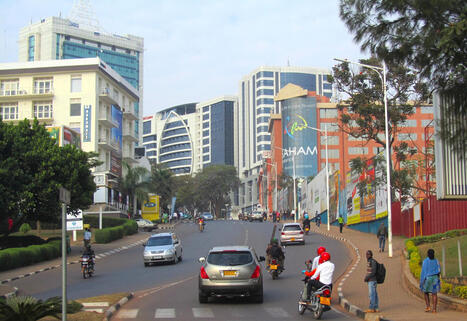







"...Europe will host COP 31, likely to attract 50,000 people, in November. This will be the 15th time that Europe hosts the rotational COP, the UN’s Framework Convention on Climate Change, to Africa’s five times. Rotating events, or the World Cup, has a transformational effect. The recognition of any host city is symbolic but there are also tangible and immediate benefits such as forex. Beyond those points, the sector is well-placed to foster regional collaborations, buoy inter- and intra-trade, and, in the case of COP gatherings, say, raise awareness about issues like drought, rising sea levels and a list of other vulnerabilities.
Still – despite their numeric significance, half a billion people in 20 countries – West and Central Africa regions have never had the opportunity to host the world’s largest climate change conference. Like its southern cousin, East Africa has hosted it once. That brings us back us to the question pondered by delegates at Poate: is Africa missing in action or being overlooked? Ask the UN. Rotation is a throwaway line. If it weren’t, Africa would host no fewer than two COP editions per decade. Added to showcasing host territories even to the millions of people following the event on TV, the business-card effect widened, these events bring a thick slice of GDP. Look at Davos, hosts of the World Economic Forum annual meeting. Davos generates €65-million each January when the WEF meeting swings by in winter. The sum exceeds €100-million when the rest of Switzerland is factored in. As an aside, Swiss media reported, the United States delegation once paid a hotel bill of €390,000, in St Gallen, and signed a €1-million car rental contract. The sums are huge and there is good human-developing legacy.
Global entities, including the UN, known for its inconsistency and uneven distribution of opportunities, must be called out for their tokenisation of Africa. Kampala and Nairobi stand up. Will African leaders from Bassirou Diomaye Faye, Yoweri Kaguta Museveni and Netumbo Nandi-Ndaitwa to King Mohammed VI and their peers in Asia, Europe and beyond take global entities to task?
Let the students in economics, media, politics, science and other fields at Cairo, Makerere, Roma, UCAD, Wits and every other institution also rise and, through tourism-centred diplomacy and economy, build an Africa they want – the land that Thomas Sankara dreamed of.
To tap the realm of possibilities, when will Côte d’Ivoire, Gabon, and Senegal bid to host COP? Citizens should be asking governments, academia and the private sector. Has Nairobi and Durban, as previous COP hosts, put their names in the hat of late? Ethiopia, Rwanda, Uganda or – near the Sahel – Algeria, Nigeria and Cameroon could also do it. If governments are slow or lazy, as they often are, where is the private sector to take charge?
Back to ICCA’s GlobeWatch: had Africa been treated equally, why wouldn’t its cities have claimed a bigger slice of the pie? That, after all, is the metric the surveyors are using. Regardless of the prevailing bias, African nations must double incoming tourist traffic. Bidding for more MICE opportunities is an avenue. East Africa punches below its weight in MICE and leisure categories. At the last count, Uganda tallied 1.3 million tourists, in the league of Ghana and Senegal, according to data collated by the UN World Tourism Organisation. Excepting the likes of Chad and Malawi (a nation prone to very high ministerial turnover) – with each scraping south of a million arrivals – Africa-bound tourist traffic is rising. But that’s off a very low base. Scratch the surface for context.
The Great Wall of China reportedly drew about 15 million people each year to Paris’s 25 million. The latter exceeds the whole of West Africa’s inbound traffic. Africa attracts 80 million per annum – Southern Africa and its northernmost cousin claim big chunks of that. For the bigger picture, look at France’s lively 100 million. Time for a paradigm shift.
Some of these points made it to this year’s Poate, which drew about 2,000 people. If the delegates enjoyed their time they’d be back. Anyway, what’s there not to like about Uganda? But the expo – like Afcon (set to come to East Africa next June) – is a bridge. It’s not a destination.
Government and the private sector must join forces to grow Uganda’s sector: double arrivals for two years in a row, consolidate for another two. Repeat. That’ll bring six million visitors per annum before Kagwa’s fifth anniversary. Diversifying the offering and adding signature meetings will help. Uganda, like some of her peers, underwhelms partly due to lazy and perennial overreliance on wildlife and waterfalls. We haven’t even touched on cuisine, filmmaking or heritage.
To the southernmost tip, in Durban, Africa’s Travel Indaba does the same, at a significantly larger scale, through gathering industry players from across the continent and the globe each year. According to the tourism ministry, almost 10,000 people turned up for Indaba in May. The expo added $51 million in tourism expenditure and sustained 1,100 jobs for the coastal city.
The streets of Kigali.
Abroad, WTM London, which calls itself the world’s premier trade show though it’s short on voices from the Global South, congregates nearly 50,000 participants per year. The show adds £200 million ($270 million) to London’s economy and maintains thousands of jobs. Broadly, WTM generates an estimated £2.8 billion in contracts. It is worth reflecting how much each nation realised for their investment.
Taxpayers, from Egypt, Kenya, Uganda and Mali to Ghana, Canada and Japan, must pose such questions lest those events become a cool jaunt for those sent as representatives.
Finally, how much the MICE sector adds to the GDP is the easiest part. What’s more critical, but often left unsaid, is that business events accelerate training, foster regional collaborations, and stimulate various areas of the economy, sometimes across borders. The sector is a PR and branding exercise, a forex earner and a practical catalyst for change, for shared growth. It just has to be used right, make the circle bigger. Time for a shift.
Finally, how much the MICE sector adds to the GDP is the easiest part. What’s more critical, but often left unsaid, is that business events accelerate training, foster regional collaborations, and stimulate various areas of the economy, sometimes across borders. The sector is a PR and branding exercise, a forex earner and a practical catalyst for change, for shared growth. It just has to be used right, make the circle bigger. Time for a shift.
Shoks Mnisi Mzolo
https://www.ghanabusinessnews.com/2026/06/10/time-for-a-shift-african-countries-must-claim-their-share-of-the-global-conferences-economy/
#metaglossia
#metaglossia_mundus