 Your new post is loading...

|
Scooped by
Charles Tiayon
June 6, 2014 4:17 AM
|
Ce jeudi 5 juin paraîssent en librairie les nouvelles éditions des deux dictionnaires français les plus populaires : le Larousse et le Petit Robert. Deux ouvrages de référence pour la langue...
Beyond words and languages: Building bridges across worlds.Twenty stories on translation, interpreting and language technology, with one question at the centre: in an age of machine translation, whose judgement and whose languages count?
📚 Anne Carson wins the Nobel, and the Academy calls her translations works in their own right. Kafka speaks Réunion Creole.
🤖 A BBC look at how long humans will be needed, and a survey in which 37% of literary translators have considered changing careers.
🌐 Africa’s languages and AI, Indigenous keyboards, and a 1,278-page Amazigh Quran translation.
🎯 Prizes, calls for papers and research that shape the profession.
👉 Read the issue: 👇
METAGLOSSIA WEEKEND DIGEST · Issue No. 002 (1)Download
💬 Who should decide when a machine translation is good enough? Tell us."
🌍 METAGLOSSIA WEEKEND DIGEST, Issue No. 002 https://metaglossia.com/%f0%9f%8c%8d-metaglossia-weekend-digest-issue-no-002-is-out/
#metaglossia
#metaglossia_mundus

29 chapters and more than 60 exercises and activities covering vocabulary, grammar, and everyday conversations
The textbook aims to address a shortage of updated educational resources for Haitian Creole, the third-most-spoken language in Florida
"A University Of Florida Professor Creates Haitian Creole Textbook To Preserve Language And Culture
The textbook aims to address a shortage of updated educational resources for Haitian Creole, the third-most-spoken language in Florida
A University of Florida professor is working to modernize Haitian Creole education with a new textbook designed to address outdated learning materials while strengthening language accessibility and cultural representation, The Independent Florida Alligator reports.
Benjamin Hebblethwaite, a professor in the university’s Department of Languages, Literatures and Cultures, collaborated with University of Alabama assistant professor David Tezil to develop Kreyòl pale, a Haitian Creole textbook published in August 2025 following nine years of work.
"We wanted to bring some more balance where we showed the culture in a more well-rounded, more representative way,” Hebblethwaite told the outlet.
The textbook features 29 chapters and more than 60 exercises and activities covering vocabulary, grammar, and everyday conversations. Lessons address practical situations, including ordering food, dating, and searching for employment, to help students develop conversational skills.
The resource also offers Haitian American students an opportunity to strengthen their connection to their heritage.
Georffrey Pierre, a first-generation University of Florida student, told The Alligator that speaking Haitian Creole helps him maintain relationships with family members who are not fluent in English. He also emphasized the importance of making language-learning resources more widely available.
Duchnah Richard, another first-generation student, said she speaks Haitian Creole but struggles to write it. She believes the textbook could help students navigate language barriers and improve their literacy skills.
The initiative addresses a broader challenge facing Haitian communities, where some native speakers have limited access to formal instruction in reading and writing their language.
Kreyòl pale is available as a free PDF through the University of Florida Digital Collections, expanding access to Haitian Creole education beyond the university classroom."
by Sidnee Michelle
October 18, 2026
https://www.blackenterprise.com/haitian-creole-textbook-language-culture/
#metaglossia
#metaglossia_mundus
"The challenge in making the national language a vessel for unity
Drawing from the spirit of tolerance in East Malaysia, Bahasa Melayu can begin to be viewed not as a tool of division, but as a bridge that unites.
From Moaz Nair
In the noble effort to elevate Bahasa Melayu as the core of national identity, a topic frequently discussed among language enthusiasts is the level of mastery and fluency of the national language among multi-ethnic communities.
Most narratives typically focus on daily communication, the corporate sector, or administrative affairs.
However, from a sociolinguistic perspective, there is a dimension that is rarely explored deeply but carries significant influence over language assimilation: the use of the national language within the religious and cultural expressions of non-Muslim communities.
On one hand, there are high expectations for all citizens to anchor their lives around Bahasa Melayu. On the other, when touching upon the spiritual realm, a more complex dynamic emerges.
Understanding these contrasting approaches is not meant to assign blame, but rather to examine how language can function more inclusively as a bridge for unity without disrupting established socio-religious sensitivities.
Historical framework and the unique situation in the peninsula
The difficulty of expanding the use of Bahasa Melayu in non-Muslim religious affairs in Peninsular Malaysia is rooted in a combination of legal history, demographics, and the evolution of the language’s corpus itself.
Under Article 160 of the Federal Constitution, Malay identity is clearly defined by three main elements: professing the religion of Islam, habitually speaking the Malay language, and conforming to Malay custom. This close alignment has caused Bahasa Melayu to evolve with a heavy Islamic imprint over hundreds of years through the absorption of Arabic theological terms into everyday vocabulary.
To preserve harmony and prevent theological confusion, most states in the peninsula enforce the Enactment on the Control and Restriction of the Propagation of Non-Islamic Religions, guided by the principles of Article 11(4) of the Federal Constitution. These laws restrict the use of certain religious terms to ensure the doctrinal integrity of the majority community remains protected.
Aware of these legal and social sensitivities, non-Muslim communities in the Peninsula—comprising largely Chinese and Indian ethnic groups—opt for a cautious approach.
To maintain racial harmony and safeguard their respective theological purity, they feel more comfortable retaining their mother tongues (such as Mandarin or Tamil) or English in their religious affairs. This situation inadvertently creates a linguistic divide in spiritual matters, even though they are fluent in Bahasa Melayu in other daily affairs.
Diverse models in East Malaysia and Indonesia
The reality in the peninsula presents a stark contrast when looking at the socio-political models in Sabah, Sarawak, and Indonesia. In East Malaysia, a unique demographic structure has long positioned Bahasa Melayu as the primary unifying vessel.
For hundreds of indigenous sub-ethnicities such as the Iban, Kadazandusun and Bidayuh, Bahasa Melayu has served as the daily lingua franca, including in church services and their Alkitab (Bible) texts.
The general practice and sharing of religious terms rooted in the same language are accepted with high tolerance as a historical norm, in line with the socio-political guarantees under the Malaysia Agreement 1963 (MA63).
Looking at our neighbour, Indonesia underwent a comprehensive language assimilation process because Bahasa Indonesia was established as a neutral and inclusive national asset. There, all recognised religions fully utilise Bahasa Indonesia in rituals and scripture translations.
Major Islamic figures and organisations like Nahdlatul Ulama (NU) and Muhammadiyah play a mature role in guiding society.
They have successfully educated the public by decoupling the language’s function as a national communication tool from the essence of an individual’s personal faith.
This approach allows for the harmonious sharing of certain religious vocabularies, anchored by the concept of inter-citizen brotherhood or “ukhuwah wathaniyah”.
Building harmony through mutual understanding
These differing linguistic approaches have a tangible impact on daily social relations. In the peninsula, the separation of language in religious affairs shapes a model of “cautious coexistence”.
Multi-ethnic communities deeply respect each other’s boundaries, yet opportunities for deeper cross-cultural dialogue can sometimes be limited by fears of stepping on legal sensitivities. Social interactions remain largely concentrated in secular spaces like economics, education and sports.
Conversely, the dynamics in Sabah, Sarawak and Indonesia demonstrate that when a national language is shared in the most deeply personal aspect of life—spirituality—it can erode suspicion and strengthen a sense of togetherness. The national language is no longer seen as the exclusive property of one group, but as a grand canopy sheltering all citizens.
Conclusion
The desire to see Bahasa Melayu fully embraced by all Malaysians is a noble dream that deserves support. However, discourses on elevating the language must look beyond casual conversation.
We must acknowledge the sociolinguistic challenge that arises when the national language is restricted in non-Muslim spiritual realms to safeguard faith, while simultaneously expecting these communities to assimilate the language into every facet of their lives.
To move forward, the best path is to construct a harmonious, localised understanding. Drawing from the spirit of tolerance in East Malaysia, we can begin to view Bahasa Melayu not as a tool of division, but as a bridge that unites.
Without compromising the legal protections that safeguard the faith of Muslims in the peninsula, the cultivation of the national language in cultural and literary spaces across all communities must continue to be nurtured maturely—for the future of a truly integrated Bangsa Malaysia.
Moaz Nair is an FMT reader."
https://www.freemalaysiatoday.com/category/opinion/2026/10/18/the-challenge-in-making-the-national-language-a-vessel-for-unity
#metaglossia
#metaglossia_mundus

"La valorisation des langues africaines au cœur des enjeux de développement
octobre 17, 2026
Kinshasa, 17 octobre 2026 (ACP).- La valorisation des langues, des cultures et de l’histoire millénaire africaines au service du développement du continent est au cœur d’une tribune intitulée ‘‘Langues, sociétés africaines et développement’’, rédigée par un professeur congolais et consultée samedi par l’ACP en République démocratique du Congo (RDC).
«Il n’existe pas, au sens scientifique, de langues intrinsèquement pauvres ou riches. Toutes les langues humaines possèdent une grammaire et permettent à leurs locuteurs d’exprimer des idéescomplexes, même si elles le font avec des structures différentes», a déclaré le professeur Raoul Ekwampok Ka’ndum, linguiste et enseignant à l’Université pédagogique nationale (UPN) de Kinshasa.
Dans cette tribune, l’universitaire remet en question la distinction entre langues riches et langues pauvres, estimant que leur statut dépend davantage de leur histoire, de leurs usages et de leur reconnaissance sociale que d’une quelconque supériorité linguistique.
«Une langue peut sembler riche parce qu’elle possède un vocabulaire très développé dans certains domaines, de nombreuses façons d’exprimer les nuances, les temps, les modes, les relations ou les émotions, ou encore une forte diffusion sociale, politique ou économique», a-t-il expliqué.
À l’inverse, une langue peut paraître moins développée lorsqu’elle est marginalisée, insuffisamment documentée ou peu présente dans les systèmes éducatifs.
Le manque de dictionnaires, de manuels scolaires et d’outils pédagogiques peut alors limiter son utilisation dans l’enseignement et la transmission des connaissances.
Le professeur Ekwampok Ka’ndum estime que le mépris dont font l’objet certaines langues africaines, y compris de la part de leurs propres locuteurs, s’inscrit dans un contexte historique marqué par la domination occidentale.
Il évoque notamment la traite négrière, l’esclavage, la colonisation et la néo colonisation, dont les conséquences culturelles et sociales continueraient d’influencer la perception des langues africaines.
Cette situation appelle, selon lui, à restaurer la confiance des populations dans leurs langues maternelles et à renforcer leur place dans l’éducation, la recherche et la production des connaissances.
Les langues africaines comme vecteurs de connaissances
Pour cet universitaire, les langues africaines disposent des capacités nécessaires pour exprimer des savoirs scientifiques et accompagner l’évolution des sociétés, à condition de bénéficier d’une promotion et d’un travail de documentation adaptés.
«Toute langue valorisée et dont on assure la promotion est un instrument réformable, adaptable à de nouveaux besoins de communication», a-t-il affirmé.
Il estime que les langues peuvent enrichir leur vocabulaire afin d’intégrer de nouveaux concepts, notamment dans les domaines scientifiques et techniques.
Leur développement nécessite ainsi des efforts de documentation, la production d’outils pédagogiques et leur adaptation aux exigences contemporaines.
L’universitaire rappelle également que l’oralité précède historiquement l’écriture et qu’aucune langue n’estdestinée, par nature, à rester exclusivement orale.
Toutes peuvent évoluer et servir à la production, à la conservation et à la transmission des connaissances.
Journalistes et chercheurs appelés à agir
Le professeur Ekwampok Ka’ndum interpelle les professionnels des médias ainsi que les scientifiques et les chercheurs sur leur responsabilité dans la valorisation des langues africaines et l’évolution des mentalités.
«Vous, journalistes, et nous, scientifiques et chercheurs, avons le devoir de dire la vérité et de faire changer les choses. Positivement !», A-t-il souligné, insistant particulièrement sur le rôle des journalistes.
Il considère que les médias peuvent contribuer à cette démarche en accordant une place accrue aux langues africaines dans l’information, la transmission des savoirs et la mise en valeur du patrimoine culturel du continent.
Cet engagement doit, selon lui, s’accompagner d’un travail scientifique visant à documenter les langues, à développer les ressources pédagogiques et à favoriser leur utilisation dans différents domaines de la connaissance.
Le thème «Langues, sociétés africaines et développement» a été développé lors des mélanges offerts au professeur émérite Mayaka Ma Kanda, les 19 et 20 août 2025.
Il constitue également le titre d’un ouvrage collectif publié le 20 août 2026, selon les précisions apportées par le professeur Ekwampok Ka’ndum.
Pour cet universitaire, la promotion des langues africaines doit aller de pair avec celle des cultures et de l’histoire millénaire du continent afin de préserver le patrimoine, de renforcer les identités et de favoriser un développement davantage ancré dans les réalités culturelles africaines.
«Valoriser ou promouvoir les langues, les cultures et l’histoire millénaire africaines pour mieux penser le vrai développement du continent africain», a-t-il résumé.
Le professeur Raoul Ekwampok Ka’ndum enseigne à l’Université pédagogique nationale (UPN) de Kinshasa.
Il défend notamment la valorisation des langues africaines et leur contribution à la transmission des connaissances et au développement culturel en République démocratique du Congo. ACP/Bob Ambongo"
https://acp.cd/culture/la-valorisation-des-langues-africaines-au-coeur-des-enjeux-de-developpement/
#metaglossia
#metaglossia_mundus

Confusion autour du code « CH »
À l’origine de cette erreur se trouve l’abréviation « CH », utilisée pour désigner la Suisse. Ces deux lettres correspondent à « Confoederatio Helvetica », le nom latin de la Confédération suisse.
Dans la traduction chinoise du panneau, ce code aurait toutefois été compris comme faisant référence à la Chine. Or, le code international de la Chine est « CN », et non « CH».
Le traducteur semblait ne pas avoir la moindre idée que “CH” signifie Suisse (Confoederatio Helvetica). »
'"Une erreur de traduction a provoqué une situation pour le moins surprenante à l’aéroport Paris-Charles-de-Gaulle.
Sur un panneau consacré au contrôle automatisé des passeports, la Suisse a été remplacée par la Chine dans la version chinoise du message.
L’information, rapportée par 20 Minutes, qui cite le média spécialisé Aerotelegraph, concerne les indications relatives aux portiques automatiques PARAFE. Le panneau indiquait notamment que les ressortissants suisses pouvaient utiliser ce dispositif de contrôle.
Erreur de traduction à l’aéroport de Paris : Une confusion autour du code « CH »
À l’origine de cette erreur se trouve l’abréviation « CH », utilisée pour désigner la Suisse. Ces deux lettres correspondent à « Confoederatio Helvetica », le nom latin de la Confédération suisse.
Dans la traduction chinoise du panneau, ce code aurait toutefois été compris comme faisant référence à la Chine. Or, le code international de la Chine est « CN », et non « CH».
Cette confusion a donc conduit à une indication erronée sur les conditions d’accès au contrôle automatisé des passeports dans l’aéroport de Paris-CDG.
Les portiques automatisés PARAFE sont notamment accessibles aux ressortissants majeurs de l’Union européenne, de l’Espace économique européen et de la Suisse, à condition de disposer d’un passeport biométrique.
Certaines nationalités extérieures à cet ensemble peuvent également utiliser ces dispositifs sous certaines conditions. Les ressortissants chinois ne font toutefois pas partie des nationalités concernées par cette possibilité, précise 20 Minutes.
L’erreur sur le panneau pouvait donc créer une confusion pour les voyageurs chinois en leur laissant penser qu’ils étaient concernés par le dispositif.
L’erreur a été repérée par Pascal Lottaz, qui a partagé une photographie du panneau sur le réseau social X. Dans son message, il a souligné avec ironie la confusion entre la Suisse et la Chine : « Quelqu’un doit dire à l’aéroport de Paris que la Chine ne fait pas partie de Schengen. Le traducteur semblait ne pas avoir la moindre idée que “CH” signifie Suisse (Confoederatio Helvetica). »
Paris Aéroport a rapidement réagi à cette publication, avec une réponse elle aussi teintée d’humour. « Oups… On dirait que nos panneaux ont décidé de faire un tour du monde un peu plus vite que prévu », a répondu l’aéroport, avant de remercier l’internaute d’avoir signalé le problème.
Paris Aéroport a également précisé que l’erreur avait été transmise aux équipes concernées afin qu’elle soit corrigée."
https://voyagerdz.com/aeroport-paris-cdg-erreur-traduction-surprend-voyageurs/

"À Lomé, le gouvernement veut faire entrer les langues locales du Togo dans l’ère de l’intelligence artificielle. La ministre de l’Efficacité du Service public et de la Transformation numérique, Cina Lawson, a lancé le 5 octobre dernier le Challenge national des langues locales, première étape du programme « Voix du Togo ». Apprendrelangue
L’initiative ouvre une plateforme de contribution où les citoyens peuvent fournir des textes, des enregistrements et des traductions. Ces données serviront à entraîner des modèles capables de comprendre puis de traiter les langues parlées dans le pays. L’objectif est clair : permettre à un citoyen d’échanger un jour avec un service public numérique dans sa propre langue.
Une collecte citoyenne et encadrée
Le dispositif démarre par une phase pilote d’un mois consacrée à trois langues : l’éwé, le kabiyè et le moba. Les organisateurs veulent d’abord tester la méthode de collecte avant de l’étendre progressivement aux autres langues du pays.
Les participants créent un compte à partir de leur numéro de téléphone et indiquent les langues qu’ils parlent, lisent ou écrivent. La plateforme leur propose ensuite des tâches adaptées à leurs compétences : lire des phrases à voix haute, transcrire des enregistrements, traduire des textes ou vérifier les contributions d’autres utilisateurs. Apprendrelangue
Cette organisation cherche à transformer la connaissance linguistique des citoyens en une ressource numérique collective. Chaque enregistrement, traduction ou correction alimente un corpus destiné à améliorer la compréhension automatique des langues togolaises.
Des garde-fous linguistiques
La qualité des données constitue un enjeu central. Les contributions ne seront pas exploitées sans contrôle : des linguistes et des membres des communautés linguistiques devront les valider avant leur utilisation. Le Togo AI Lab, avec des étudiants, des chercheurs et des développeurs, prendra ensuite le relais. L’équipe exploitera les corpus validés pour entraîner et affiner les modèles d’intelligence artificielle. Des compétitions organisées sur la plateforme Zindi devraient également mobiliser la communauté technologique autour de ces données. Cartesdu monde
Cette approche associe ainsi citoyens, universitaires et développeurs. Elle vise à éviter que les langues locales restent absentes des outils numériques, alors même qu’elles structurent la vie quotidienne, les échanges administratifs et la transmission culturelle.
L’inclusion numérique en jeu
Le programme poursuit un objectif plus large que la seule innovation technologique. En rendant les services publics accessibles dans les langues locales, les autorités espèrent réduire les barrières linguistiques qui éloignent une partie de la population des administrations numériques. Les applications concernent plusieurs secteurs essentiels : l’accès aux services publics, la santé et la justice. Un citoyen maîtrisant mieux l’éwé, le kabiyè ou le moba que le français pourrait ainsi obtenir une information, comprendre une procédure ou interagir avec une plateforme sans dépendre d’un intermédiaire. Explorerla tech
Le gouvernement prévoit également d’envoyer des agents de terrain dans les localités où l’accès au téléphone ou à Internet demeure limité. Ces équipes recueilleront directement les contributions afin d’éviter que la fracture numérique ne prive certaines communautés de l’initiative. Le défi consiste désormais à transformer cette mobilisation initiale en une base de données suffisamment riche, fiable et représentative. Si le pari réussit, le Togo fera de ses langues locales un instrument d’inclusion numérique, et non un patrimoine laissé en marge de la révolution technologique."
Helene Sourou
14 octobre 2026
https://www.journaldutogo.com/togo-challenge-national-langues-locales-intelligence-artificielle/
#metaglossia
#metaglossia_mundus

TranslationeTranslation reaches 1 billion requests in less than a year
Published 7 hours ago on October 16, 2026By EU Reporter Correspondent
This week, the European Union’s free and secure eTranslation tool passed a major milestone: more than 1 billion translation requests have been made this year so far. That’s more than the annual total for each of the previous years since the tool was launched in 2017.
eTranslation helps a wide range of users communicate across languages more fluently and efficiently. It is one of the EU’s flagship language technology services and supports multilingual communication across Europe and beyond.
Helping Europe communicate across languages
Co-financed by Digital Europe and EU institutions and bodies and developed by the European Commission, eTranslation can be used to translate documents and text in all 24 EU official languages, plus a number of other high-interest languages.
eTranslation can be used by EU institutions, bodies and agencies, public administrations, small businesses (including self-employed people), academia, non-governmental organisations, Digital Europe projects, and candidates for EU posts. In addition, you must be based in the EU or in a country affiliated with Digital Europe.
Reaching 1 billion requests so far in 2026 highlights the growing need for reliable language technology in the EU that draws on top-quality multilingual data. eTranslation relies on data curated over decades by EU translators.
An AI tool built for Europe
eTranslation is well suited to meet public-sector needs, with a strong focus on data security, confidentiality and high-volume multilingual workflows. It can be accessed through a web interface and integrated into other digital services via APIs. Users can upload their own glossaries or activate AI enhancements to support technical translator workflows.
The tool continues to evolve on the basis of user feedback, especially from language professionals. Over the years, eTranslation has supported many areas of EU cooperation, including public administration, justice, procurement, health, migration and online public services. By helping users understand and reuse information in multiple languages, it contributes to a more connected and inclusive Digital Single Market.
The milestone of 1 billion requests in less than a year shows how important language services have become in daily administrative and professional work. It also underlines the role of DG Translation in supporting digital multilingualism across the EU, combining linguistic expertise and technology for user-friendly AI-based services.
Find out more about eTranslation"
https://www.eureporter.co/economy/translation/2026/10/16/etranslation-reaches-1-billion-requests-in-less-than-a-year/
#metaglossia
#metaglossia_mundus

"The pleasures of translating Plato
Themes: Books, Classics, Culture, Philosophy
The reissue of Hamilton and Cairns’ celebrated edition of Plato’s dialogues shows how every translation bears the marks of its era and of its translator’s taste.
Anselm Feuerbach, Plato's Symposium, painting in oil on canvas, 1869. Credit: incamerastock
The Collected Dialogues of Plato, edited by Edith Hamilton and Huntington Cairns, with a new foreword by Rebecca Newberger Goldstein, Princeton University Press, £35
For a university student in the 1980s, The Collected Dialogues of Plato edited by Edith Hamilton and Huntington Cairns and published by Princeton University Press (first in 1961) was a treasured possession. The volume brought together readable English translations of essentially all of Plato’s writings: the genuine dialogues, a few doubtful ones, and the Letters – in all, the work of 14 translators from Benjamin Jowett in the 1870s to Hugh Tredennick (1954). It had to be handled with care because its India paper was thin enough for a careless turn of the page to tear it. The volume now reappears in a new design, with sturdier paper (hence a thicker book), semi-hard covers, and a brief foreword by Rebecca Newberger Goldstein; inside, the pages are those of 1961, reproduced from the original typesetting.
Plato was a marvellous and elegant stylist, and his translators must try to do justice to his artistry. How does one set about translating a Platonic dialogue? The Republic begins with four words: katebēn chthes eis Peiraia. Idiomatic English might say ‘Yesterday I went down to the Piraeus.’ Ancient sources report that a tablet was found among Plato’s effects on which these words had been written out in several different orders. Plato’s final choice puts katebēn (‘I went down’) first.
The verb evokes katabasis, the descent to the Underworld from which an initiate into the Mysteries returns with secret knowledge. The Republic sets out to do just that: the philosopher who has left the Cave is told that he must ‘go down’ again, and the tale of Er brings back a report from the land of the dead. George Grube’s version (revised by CDC Reeve) in John Cooper’s rival one-volume Complete Works (1997) runs: ‘I went down to the Piraeus yesterday.’ Paul Shorey, whose translation is used here, is scrupulous as regards word order: ‘I went down yesterday to the Piraeus’ (only ‘the Piraeus’ sounds perhaps old-fashioned – Plato has no article, and another translator might well drop it).
There is much to consider, then, in translating just four simple words. In this case nothing is lost by staying close to the Greek. More often the translator must reshape, expand, or even paraphrase to produce fluent English. How far may a translator stray? Every translation bears the stamp of its period and of its translator’s taste. Many of the versions Hamilton and Cairns chose were already decades old in 1961, and their idiom often looks back to the Victorians, not least because the most celebrated of Victorian Platonists, Benjamin Jowett, contributes seven of them (four more than any other translator).
A few lines after the opening of the Republic, Socrates remarks on the festival procession (in Shorey’s translation): ‘I thought the procession of the citizens very fine, but it was no better than the show made by the marching of the Thracian contingent.’ Shorey makes the Athenian procession the subject of both clauses. Grube renders epichōrioi more accurately as ‘local residents’, loosens the syntax, and keeps the Thracian procession as the subject of his second clause: ‘I thought the procession of the local residents was a fine one and that the one conducted by the Thracians was no less outstanding.’ Both translators call the procession ‘fine’ (kalē, the same adjective as to kalon in the Symposium), but today we might be happier with ‘splendid’, ‘impressive’, or even ‘a great show’.
The challenge is steep in the Symposium, which I have recently been translating for publication. Its speeches are a gallery of voices, and Michael Joyce’s exuberant version in this volume (dating from 1935) catches them well. Joyce tends to be expansive, as when the narrator Apollodorus near the start tells Glaucon what his life was like before he fell under Socrates’ spell: ‘Before that I used to go dashing about all over the place, firmly convinced that I was leading a full and interesting life, when I was really as wretched as could be – much the same as you, for instance, for I know philosophy’s the last thing you’d spend your time on.’ In this passage, Plato’s original oiomenos ti poiein, ‘thinking I was achieving something’, has grown into ‘firmly convinced that I was leading a full and interesting life’. While the Greek has the narrator thinking that he himself should be ‘doing anything rather than philosophy’, Glaucon’s response, ‘Don’t have a go at me!’, shows that he takes it as a jibe. Joyce’s emphatic you makes this explicit, not unreasonably, and it is not necessarily a worse rendering than my own more concise version: ‘Up until then I was running around aimlessly, imagining that I was living a productive life. But in fact I was as pathetic as you can get – a bit like you are now, Glaucon – because I imagined that philosophy was the last thing I needed.’
Conversational passages in Plato leave a translator room for manoeuvre. The technical passages and arguments allow much less. These can turn on particular words or series of propositions, and the translator must stay close to them if their logic is to survive. When Diotima in the Symposium says that love is tokos en kalōi, ‘giving birth in beauty’, the strange phrase binds physical procreation to the intellectual offspring of poets, lawgivers and philosophers. The word kalon should be rendered as recognisably the same term, as the ascent moves from beautiful bodies to beautiful souls, laws and knowledge, and finally to Beauty itself. A version that alternates ‘beautiful’, ‘fine’ and ‘noble’ for elegance may read more easily, but at the expense of breaking the thread of argument.
Hamilton and Cairns’ selection drew on some of the best Platonists of the 20th century; the prefatory notes are still a useful guide, and the remarkably full index lets the reader follow a name, theme, or term from one dialogue to another. The volume is in some respects a period piece, representing a Plato to be enjoyed by the English-speaking general reader in the decades before 1961. In many of the versions, hearing these voices can be a pleasure in itself. This reissue is a reminder that earlier attempts to render Plato have not lost their value; the treasury of Platonic thought can now be enjoyed, in one handy volume, by a new generation of English-language readers.
Author
Armand D'Angour
Armand D'Angour is a Professor of Classics at the University of Oxford and fellow of Jesus College, Oxford."
October 16, 2026
Armand D'Angour
https://engelsbergideas.com/reviews/the-pleasures-of-translating-plato/
#metaglossia
#metaglossia_mundus

HarperCollins Switches to AI Translators for Their French Publication
Association des traducteurs littéraires de France, also known as l’ATLF, and the collective En chair et en os, stated that dozens of Harlequin France translators were informed that their contracts would be ending as soon as possible. HarperCollins, Harlequin’s parent company, confirmed they would be using an AI-assisted translation workflow with Fluent Planet rather than relying primarily on human translators to translate their books. The company pointed to their declining sales as the reason for partnering with Fluent Planet. “Sales of our Harlequin collections have been declining in the French market in recent years,” the statement read. “We want to continue offering readers as many publications as possible at the current low retail price.”
A Fluent Planet spokesperson told The Bookseller that the company uses a hybrid of “in-house language assistance tools with systematic human translation carried out by professional literary translators.” Their website states that the human translators have “studied at the best translation universities or have decades of experience under their belt … When compared to standard machine translation systems that use neural networks, BrIAn [the Fluent Planet AI software] can provide 2 to 3 times higher quality translations, that are more accurate, offer idiomatic phrasing, provide a deeper understanding of the meaning and a faithful representation of the style and emotions of the source text. BrIAn takes into account the author’s tone and intention, making it highly effective for complex literary or marketing content.” Fluent Planet appears to believe their software is on par with human translators while also saying they’re offering a tool not intended to replace human expertise or editorial judgment.
Much can be said about the ethical issue of firing people so they can be replaced by AI. However, I want to focus on the nature of translation and why as of now, even Fluent Planet admits, AI can’t do it well, otherwise they wouldn’t need human translators with decades of experience to check their work. Translation is complicated, delicate work that requires deep knowledge and understanding of both languages. It’s about nuances and subtleties—two key factors that AI is notoriously bad at. When there’s a lack of nuance and subtlety, a great deal can be distorted or lost. Translation isn’t simply about substituting words. It requires the human touch to most truthfully convey idioms, jargon, regional dialects, and even with humans the results are never perfect because that’s the challenges of language. There is never a true one-to-one.
As someone who grew up bilingual, speaking both Spanish and English, I’ve always dealt with the frustration of needing to translate one thought from one language to another. Even when there’s a word or phrase that appears to have a direct translation, it doesn’t often hold the same meaning or intensity I’m trying to express. This is a difficulty I feel in minor translation moments; I can’t imagine needing to translate a whole novel. To translate a novel, the translator must first understand it in its entirety—the themes, the character arcs, the central truth. When there can’t be a 100 percent word-for-word accurate translation of a book, then it becomes about being as faithful to the original work as possible. AI cannot yet do this in the same way humans can because it lacks lived experience and interpretive judgment.
When I read the news about HarperCollins decision, I couldn’t help but think of R.F. Kuang’s “Babel, or The Necessity of Violence: An Arcane History of the Oxford Translators’ Revolution,” a book that utilizes language and translation to explore narrative themes of colonialism and exploitation. In Babel, our main characters contend with the brutality of translation. It shows how language can be weaponized, how the act of translating can be a betrayal of the original, violent and sharp, harming those at the hands of the people in power. Babel examines the harm of one group of people controlling the narrative, deciding which languages are prioritized over others. There is a reason that access to reading and writing has been used as a tool for oppression. Having access to knowledge gives you agency, when that knowledge is taken away, restricted, or watered down it prevents people from understanding themselves and each other.
Language is a constant shifting force, which is why dictionaries are constantly adding new words. It changes with the times, with environment, with society—always adapting. Something that is consistently changing and created by humans, can only be fully understood through the human experience. Even then language is a deeply internal thing. Emotions and thoughts can’t always be perfectly conveyed from one person to another even when they are both fluent in the same language—how can a software ever get to the heart of that? The act of translating one book from one language to another is trying to bridge the gap from one human experience to another and it’s not something that can be reduced to an algorithm. By its very nature it must be different and specific to each book."
Kelly Quintana
https://scadconnector.com/2026/10/15/harpercollins-switches-to-ai-translators-for-their-french-publication/
#metaglossia
#metaglossia_mundus

Vacancy alert: Consultancy Services of INTERPRETER IN SHIFT ASIA LEARNING SESSION
Organization
Oxfam
Posted
15 Oct 2026
Closing date
25 Oct 2026
TERMS OF REFERENCE FOR CONSULTANCY SERVICES
Interpreter in shift asia learning session
Oxfam is committed to preventing any type of unwanted behaviour at work including sexual harassment, exploitation and abuse, lack of integrity and financial misconduct; and committed to promoting the welfare of children, young people and adults. Oxfam expects all staff and volunteers to share this commitment through our code of conduct. We place a high priority on ensuring that only those who share and demonstrate our values are recruited to work for us.
Shaping a stronger Oxfam for people living in poverty.
BACKGROUND
The Supporting Humanitarian Initiatives for Transformation in Asia (SHIFT Asia) Project is a critical regional initiative building upon the success of the first phase of Women’s Local Humanitarian Leadership (WLHL) implemented in 2022–2023. SHIFT Asia now operates across Indonesia, Bangladesh, the Philippines, and Myanmar, and is focused on advancing women’s leadership by positioning their organizations at the center of humanitarian decision-making.
The project operates based on the reality that women and girls are disproportionately affected by crises yet remain severely underrepresented in leadership. By applying a feminist and participatory approach that fosters regional networks and solidarity, SHIFT Asia aims to transform humanitarian systems to be more inclusive, representative, and effective in achieving gender-transformative disaster preparedness and response.
Central to this second phase is the SHIFT Asia Learning Agenda (2025–2027). This agenda promotes feminist learning spaces, peer-to-peer exchanges, and collective capacity enhancement in key areas such as program design (Theory of Change - TOC) and robust Monitoring, Evaluation, Accountability, and Learning (MEAL) systems. Grounded in Oxfam’s Common Approach to MEAL, the Learning Agenda is designed to generate evidence, capture lessons, and drive accountability and social change across local, national, and regional levels.
To ensure effective participation and shared learning among all stakeholders, specifically bridging the language gap between English-speaking facilitators and participants from Indonesia (Bahasa) and Bangladesh (Bengali), we require professional interpretation services for four critical upcoming learning sessions.
PURPOSE
The primary purpose of this assignment is to secure the services of a professional interpreter (or team of interpreters) capable of providing high-quality simultaneous interpretation between English and the primary local languages of Indonesia (Bahasa) and Bangladesh (Bengali/Bangla) for four structured learning sessions. The goal is to facilitate seamless technical understanding and meaningful peer-to-peer exchange across the regional teams.
RESPONSIBILITIES
The selected Interpreter(s) shall be responsible for:
Interpretation: Providing accurate and simultaneous (preferred) or high-quality consecutive interpretation between English - Indonesian (Bahasa) and English - Bengali (Bangla) for all four virtual learning sessions. These two languages are recommended to delivered by different providers in the each country based.
Preparation: Reviewing all session materials (agendas, presentations, technical guides) provided at least 48 hours in advance to familiarize themselves with the subject and technical jargon.
Testing: Participating in a brief technical check prior to each session to ensure optimal audio and virtual platform settings (e.g., Zoom/MS Teams interpretation feature).
Impartiality: Maintaining strict confidentiality, professionalism, and impartiality throughout the assignment.
EXPECTED RESULTS
It must be noted that the copyright for all the plans and reports and other intellectual property created as a part of this project shall vest exclusively to Oxfam which would be free to use all such material, without restrictions.
The success of the interpretation service will be measured by its contribution to the technical quality and participatory nature of the learning sessions, specifically:
High Comprehension of Technical Content: Approximately 95% of all core technical content delivered by the facilitator are accurately conveyed and understood by Indonesian and Bangladeshi participants, minimizing the need for extensive clarification loops.
Facilitation Efficiency: The interpretation services do not introduce significant delays; the session concludes within the scheduled 2-hour timeframe, maintaining the flow and pacing set by the facilitator.
DELIVERABLES AND TIMELINE
The Interpreter(s) are expected to deliver interpretation services for the following four virtual sessions:
Deliverable - Description - Estimated Session Date - Estimated Duration (Each)
D1 - Rapid Gender Analysis (RGA) – internal review of RGA methodologies applied and tracked against MTR commitments -19 November 2026 - 2 Hours
D2 - Partnerships, Policy & Advocacy – sharing Year 1 partnership models and policy wins with donors and allies - 21 January 2027- 2 Hours
D3 - Rapid Care Analysis (RCA) – evaluating implementation of the new RCA method addressing unpaid care work - 18 March 2027 - 2 Hours
D4 - Women Local Humanitarian Leadership – evaluating how women’s organizations and leaders improve humanitarian outcomes - 20 May 2027 - 2 Hours
Note: Specific session dates will be confirmed upon contracting.
DURATION OF THE ASSIGNMENT
The intended start date is 19 November 2026 and the period of implementation will be for approximately 6 monthsfrom this date.
CONTRACT SUPERVISION
The consultant will work closely with and under day-to day supervision of the of the SHIFT Asia MEAL Coordiantor to fulfil the objectives of this consultancy.
REQUIREMENTS AND QUALIFICATIONS
We need two providers from each country based that have a team of appropriately qualified personnel with a broad range of skill mixes that allow it to deliver the tasks identified above. The consultant’s proposal shall demonstrate the following capabilities:
Language Proficiency: Near-native or native fluency in English and professional working proficiency in either Indonesian (Bahasa) or Bengali (Bangla).
Technical Experience: A minimum of 3 years of professional experience providing interpretation (simultaneous or consecutive) for international development or humanitarian organizations.
Technical Setup: Proven ability to use virtual conferencing platforms (e.g., Zoom, MS Teams) and access reliable high-speed internet and high-quality audio equipment essential for simultaneous interpretation.
Professionalism: Demonstrated ability to maintain strict accuracy, professionalism, and neutrality during high-stakes internal discussions.
KEY ATTRIBUTES
Ability to demonstrate sensitivity to cultural differences and gender issues, as well as the commitment to equal opportunities.
Ability to demonstrate an openness and willingness to learn about the application of gender/gender mainstreaming, women’s rights, and diversity for all aspects of development work.
Commitment to Oxfam’s safeguarding policies to ensure all people who come into contact with Oxfam are as safe as possible.
ORGANISATIONAL VALUES
Accountability – Our purpose-driven, results-focused approach means we take responsibility for our actions and hold ourselves accountable. We believe that others should also be held accountable for their actions.
Empowerment – Our approach means that everyone involved with Oxfam, from our staff and supporters to people living in poverty, should feel they can make change happen.
Inclusiveness – We are open to everyone and embrace diversity. We believe everyone has a contribution to make, regardless of visible and invisible differences.
How to apply
To apply please share the technical and financial proposal to consultancy_oxfam@oxfam.org.uk by 25 October 2026.
Submission should include:
Technical component:
CV/company profile with contact details for at least 2 references and relevant portofolio clearly indicating the language you are applying for: Indonesian (Bahasa) or Bengali (Bangla)
Financial proposal:
The financial proposal shall specify a total Net Fee Sum amount in US Dollar including consultancy fees and all associated costs
Contact Information
For questions or clarifications, please contact:
Dheni Fidiyahfika: Dheni.Fidiyahfika@oxfam.org>
Job details
Source
Oxfam
Type
Consultancy
Career category
Advocacy/Communications
Years of experience
3-4 years
Theme
Gender"
https://reliefweb.int/job/4234187/consultancy-services-interpreter-shift-asia-learning-session
#metaglossia
#metaglossia_mundus

Offers speech recognition for 1,600 languages, including 500 that can’t currently be transcribed by other AIs. Paired with Meta's new Omnilingual Machine Translation system, those transcripts can then be translated across more than 1,600 languages...
"Meta Omnilingual Automatic Speech Recognition (ASR)
Globally, people speak roughly 7,000 languages. But until recently, most automatic speech recognition (ASR) services with high-quality transcription only worked for a small number of them. Meta’s groundbreaking Omnilingual ASR is a major step in creating a universal transcription service. Using a suite of open-source models, it offers speech recognition for 1,600 languages, including 500 that can’t currently be transcribed by other AIs. Paired with Meta's new Omnilingual Machine Translation system, those transcripts can then be translated across more than 1,600 languages, too. “We’re very passionate about making sure technology supports as many languages as possible,” says Jean Maillard, a lead researcher on the project. Already, Nigerian health practitioners are using Omnilingual ASR to improve patient care in community clinics."
Richard Eisenberg
https://time.com/collection/best-inventions/2026/meta-omnilingual-asr/
#metaglossia
#metaglossia_mundus
De l'adoption à l'adaptation : Comment l'Afrique façonne sa propre IA
"Selon la Mise à jour économique pour l’Afrique de la Banque mondiale d'octobre 2026, l'Afrique subsaharienne concentre principalement son portefeuille d'intelligence artificielle dans les phases d’adoption et d’adaptation, tandis que la phase d’avancement (création de modèles frontières) reste marginale.
En raison des coûts élevés et du manque d'infrastructures de calcul, il ressort que la région tire son avantage comparatif de l’IA restreinte/pratique : des outils ciblés, à faible bande passante, conçus pour contourner la connectivité intermittente et la faible alphabétisation numérique.
Pour maximiser l'impact de ces technologies, l'adaptation locale est cruciale. Selon la Banque mondiale, les jeux de données mondiaux négligent largement le continent : environ « 56 % des données d'entraînement en accès libre sont exclusivement en anglais », laissant de côté les 2 000 langues africaines.
Ainsi, « les retombées les plus profondes pour les pays d'Afrique subsaharienne résident dans l'adaptation de l'IA aux données, aux langues et aux problèmes locaux ».
Sur le plan économique, le déploiement de l'IA s'appuie fortement sur la dynamique des startups et le secteur des technologies de l'information, qui a capté « plus de 1,25 milliard de dollars US » en investissements de capital-risque. La technologie se déploie principalement là où les transactions numériques sont déjà ancrées : la fintech, santé, l'agriculture et les services d'identification numérique.
Le rapport souligne que la réussite de ces solutions repose sur des canaux de diffusion accessibles (SMS, USSD, WhatsApp) et sur la présence de « compléments analogiques » indispensables comme l'électricité et les compétences de base.
D’après la Banque mondiale, la réplication à grande échelle exige d'intégrer l'IA aux systèmes existants et de maintenir un modèle de financement pérenne, rappelant que « la pérennité de l'échelle exige de maintenir les performances à mesure que les applications s'étendent à de nouvelles populations »."
Fodé Bakary Camara
15 Octobre 2026
https://www.pressafrik.com/De-l-adoption-a-l-adaptation-Comment-l-Afrique-faconne-sa-propre-IA_a313107.amp.html
#metaglossia
#metaglossia_mundus

Every person on the planet speaks with a vocal tract that is slightly different from everyone else’s
Differences in human vocal anatomy may help explain why languages around the world sound so different.
Human language diversity may have surprising biological roots
Scientists discover how differences in human vocal tract anatomy may help explain why the world's languages sound so different.
Every person on the planet speaks with a vocal tract that is slightly different from everyone else’s.
The tube of flesh, bone, and cartilage that turns breath into speech comes in endless shapes and sizes. No two people use it in quite the same way.
This individual variation was long dismissed as irrelevant noise by linguists.
A new study suggests it may actually be one of the hidden influences behind the astonishing diversity of the world’s spoken languages.
The research was led by Steven Moran and Tiena Danner from the University of Neuchâtel. It offers a biologically grounded explanation for a puzzle that has fascinated scholars for centuries.
Why do the roughly 7,000 languages currently spoken on Earth sound so different from one another?
Scanning throats in real time
To get at this question, the researchers took an unusual approach.
They analyzed data from 32 American English speakers – 16 men and 16 women – using real-time MRI scans taken while each person was actively speaking.
The scans, drawn from the USC 75-Speaker Speech MRI Database, captured the shape of each speaker’s vocal tract at the precise moment they were producing specific vowel sounds. What the imaging revealed was striking.
Even when producing the same vowel, speakers moved their throats, tongues, and lips in remarkably different ways.
Some had short, rounded palates; others had longer, flatter ones. Each person’s tongue adapted to their specific anatomy.
For instance, a rounded palate produced a more rounded tongue shape. These differences left measurable acoustic fingerprints in the sounds they produced.
Speakers compensate for their anatomical differences, the team found. They adjust their articulatory movements to converge on the same target sound.
But the compensation is imperfect. Vocal tract anatomy still influences the acoustic signal, leaving each speaker sounding slightly distinct even when pronouncing identical sounds.
The personal signature in your voice
This is not entirely surprising to anyone who has ever recognized a friend’s voice on the phone. What the study does is quantify the mechanism behind it, and then take the logic one step further.
The researchers compared the variation found among English speakers to phonetic variation recorded across nine other languages.
These languages were Basque, Bulgarian, Hindi, Italian, Portuguese, Romanian, Tamil, Turkish, Russian, and Vietnamese.
They found that the pattern of variation within any single language mirrors the pattern of variation between languages.
Thus, the acoustic spread found among English speakers looks strikingly similar to that found comparing English to Hindi to Turkish.
The implication is significant. The seeds of phonetic differences between languages are already present in the variation between individual speakers within a single community.
A biological baseline for language change
The researchers draw on a principle from evolutionary biology: variation within a population provides the raw material for differences to emerge between populations.
The same appears to be true of language.
Phonetic variation among individual speakers, influenced by their vocal tract anatomy, may contribute to the differences that emerge between languages.
Under this model, the physical characteristics of speakers may help shape how languages develop over time.
This matters because linguists have long treated individual phonetic variation as noise obscuring the underlying structure of a language.
Speech recognition systems discard it and phylogenetic analyses of language families ignore it. The new study argues that doing so leaves out important information.
The authors suggest their model can serve as a null hypothesis for studying phonetic evolution. If languages drift apart naturally because speakers vary anatomically, that gives researchers a baseline.
Any deviation from that baseline, such as languages converging or diverging faster than expected, could signal that other forces are at work, including history, culture, or social pressure.
Biology gives you the baseline; anything on top of it is human history.
From individual to language
The path from an individual’s particular palate shape to two communities eventually being unable to understand each other is long and winding.
The researchers do not claim more than their data supports. But the direction the evidence points is intriguing.
Shared ancestry, diet, or developmental environment can all nudge a community’s vocal anatomy in a common direction.
And if enough speakers share the same anatomical tendencies, those tendencies may quietly shape how the whole community sounds.
Over generations, as communities diverge and cultural forces push sounds in different directions, small anatomical predispositions could compound into substantial linguistic differences.
The study is published in the journal PLOS Biology."
ByAndrei Ionescu
Staff Writer
October 14, 2026
https://www.earth.com/science/human-language-diversity-may-have-surprising-biological-roots/
#metaglossia
#metaglossia_mundus

"
ASU lab addresses need for culturally sensitive multilingual AI learning tools
AI and Multilingualism Lab allows for development of ethical, transparent and socially responsible language learning tools
Faculty and students collaborate at the AI and Multilingualism Lab, housed within ASU's School of International Letters and Cultures. Photo courtesy of Marta Tecedor Cabrero
By Thit Thit T Win |
October 14, 2026
When a Spanish-Quechua speaker in Ecuador switches between the two languages while searching for health information online, rather than recognizing their natural bilingual communication, AI flags it as broken language.
That's because the AI behind most language tools was not built with them in mind. It was trained on standard, monolingual data.
"If an AI system does not understand linguistic variation, it can mistake difference for deficiency," said Olga Kellert, associate professor at Arizona State University's School of International Letters and Cultures, a unit within The College of Liberal Arts and Sciences.
Kellert leads a project that applies AI and computational methods to health communication for Spanish-Quechua speakers in Ecuador and Peru. Originally supported by the German Research Foundation, the research examines how bilingual populations access and interpret health information, including communication about COVID-19.
"Most digital language tools are developed for a relatively small number of globally dominant languages," Kellert said. "Many Indigenous languages, including Quechua, have far fewer computational resources."
Research at ASU's AI and Multilingualism Lab, where Kellert's project is housed, works to close that gap.
Starting with how people actually speak
Rather than training AI on textbook language, Kellert's team works with real interactions collected from classrooms and communities.
"Language learning happens in real interactions, and those interactions are messy, variable and deeply human," she said. "Students do not always produce the kind of language that appears in textbooks. They hesitate, repair what they say, switch languages, use regional varieties and develop in different ways."
This is deeply interdisciplinary work. Kellert collaborates with ASU's School of Computing and Augmented Intelligence, supervising a master's student and a PhD student. The team also works with the University of A Coruña in Spain.
"As linguists, we ask: What exactly is the speaker doing here? Is this an error, a dialectal form, code-switching or a normal feature of bilingual communication?" Kellert said. "Computer scientists ask how we can represent that information computationally and build systems that can detect it reliably."
Students in the lab work with real linguistic data at every stage, from collection and annotation to analysis with Python and NLP tools.
"We want students to see that they don't have to choose between the humanities and technology," she said.
What a language lab has to do with AI
The AI and Multilingualism Lab is directed by Marta Tecedor Cabrero, associate professor of Spanish, and it brings together faculty across the School of International Letters and Cultures who have worked for years in computer-assisted language learning, computational linguistics and digital humanities.
A graduate student pilot tests an AI language tool with the assistance of an undergraduate student. Photo courtesy of Marta Tecedor Cabrero
"The lab is a space for thinking critically about the use of AI as it relates to multilingual practices," Tecedor Cabrero said. "Language permeates every area of human knowledge, and we in the humanities play an important role in contributing to our collective understanding of this new technology — because we are language and culture experts, not the machines."
The lab's projects range from computational analysis of ancient poetry to research on how literature has shaped human responses to artificial beings, to an international collaboration training AI to analyze a century of Latin American immigration laws.
Its most student-facing tool, Language Buddy, is an AI conversation partner integrated into Canvas. Developed through the ASU AI Innovation Challenge and now being expanded with EdPlus, it has been tested in 12 Spanish 101 sections, with 334 of 679 enrolled students interacting with it across 801 conversations.
Tecedor's own research has produced a counterintuitive finding: Students who only practiced with human partners ended up more willing to try speaking with an AI bot than students who had actually been using one all along.
"We think it may reflect what we call the 'AI hype versus reality effect,'" Tecedor said. "Students in the AI condition had actual firsthand experiences on which to base their responses. Their smaller increase suggests a more realistic understanding of what using an AI avatar bot to practice a second language really entails."
Teachers are not going anywhere
Tecedor said the biggest misconception is that AI will replace human instructors. She sees a parallel that reaches back centuries.
"In medieval times, knowledge was stored in books that were written out and copied manually, so access to knowledge was severely limited," she said. "The invention of the printing press changed learning drastically. We have testimonials from those times of scholars who saw the printing press as a threat to learning for reasons very similar to those we hear today about AI. But just as teachers did not disappear then, I don't think they will disappear today. Because learning is an inherently social activity."
The lab is seeking undergraduate researchers through Barrett College Fellows and the OURS program.
"Facilitating student-faculty collaborations is one of the main goals of the lab," Tecedor said. "Some students are collaborating with us directly on our research, which includes presenting at national and international conferences and co-authoring papers."
Learn more about the AI and Multilingualism Lab at silc.asu.edu/ai-multilingualism-lab."
https://news.asu.edu/20261014-arts-humanities-and-education-asus-ai-and-multilingualism-lab-finds-ai-falls-short
#metaglossia
#metaglossia_mundus
"Why Language Models Hallucinate
Events section menu
Events
Colloquiums & Seminars
Public Lectures
User Meetings
October 15, 2026
2:30 PM – 3:30 PM
Building 240
Conference Room 4301
Also Online
Speaker: Santosh Vempala, Georgia Institute of Technology
LANS Seminar
Abstract: Large language models often guess when uncertain, producing plausible yet incorrect statements instead of admitting uncertainty. Such “hallucinations” persist even in state-of-the-art systems. We analyze this phenomenon from a mathematical perspective and find that the statistical pressures of the next-word prediction training pipeline induce hallucinations and current evaluation procedures reward guessing over acknowledging uncertainty. We also propose “open rubric” evaluations with explicit error penalties, providing a practical path to reliable LLMS by aligning their incentives. The talk will be fact-based, and the speaker will readily admit ignorance.
Joint work with Adam T. Kalai, Ofer Nachum and Eddie Zhang (Nature, 2026).
Bio: Santosh Vempala is Frederick Storey II Chair of Computing and Distinguished Professor in the School of Computer Science, with courtesy appointments in the schools of Mathematics and Industrial and Systems Engineering (ISyE). He served as the founding director of the Algorithms and Randomness Center and ThinkTank (2006-2011), and is currently the director of GT’s oldest interdisciplinary PhD program --- Algorithms, Combinatorics and Optimization. His research interests include algorithms, randomness, high-dimensional geometry, brain and computing-for-good (C4G). He graduated from CMU in 1997 advised by Avrim Blum and was on the MIT faculty until 2007 except for a year as a Miller Fellow at UC Berkeley. Vempala is also a Sloan, Guggenheim, ACM, AMS and generally excitable Fellow, especially when a phenomenon that appears complex from one perspective turns out to be simple from another. In recent years, he has been trying to understand the limits of sampling and optimization algorithms and building a computational theory of brain.
Series: See all upcoming talks at the LANS Seminars page.
Tags: High Performance Computing, Artificial Intelligence, Machine Learning
Join via Zoom"
https://www.anl.gov/event/why-language-models-hallucinate
#metaglossia
#metaglossia_mundus

Google's translation service handles one trillion words per month
That doesn't count the others: DeepL, Microsoft, Claude, ChatGPT and Gemini, not to mention made-to-measure corporate translation systems.
"How long will humans be needed for translation?...
In April, Google said people are now translating one trillion words a month with Google Translate.
That doesn't count the others: DeepL, Microsoft, Claude, ChatGPT and Gemini, not to mention made-to-measure corporate translation systems.
Direct sales of machine translation (i.e. outside general AI subscriptions) were worth an estimated $1.4bn (£1bn) last year.
AI translation is the "right call" in many cases says John Zimmerman
"For plenty of use cases, raw AI translation is now the right call: multiplying your costs by 100 to catch the last few percent of errors isn't rational if you're translating internal documents or product listings," says John Zimmerman, founder of OKA (Open Knowledge Association), a Swiss non-profit that translates Wikipedia articles into other languages.
"For an encyclopedia it's different. Wikipedia runs on trust. A wrong fact can sit there for years and get cited by journalists and AI systems," he says.
With more than 10,000 published pieces, mostly into Spanish, Portuguese and English, OKA is, Zimmerman says, the single largest contributor of translated articles to the collaborative online encyclopedia.
Which is something it absolutely could not have become without AI.
"Translating 10,000 articles the traditional way would cost millions. In our process, the AI produces the draft, then a human translator checks every sentence," he explains.
But that human input is required less and less.
"The machine output is now good enough that skipping the human entirely has become a serious option, and a real temptation across the industry. Two or three years ago, with tools like DeepL, our translators still rewrote a good chunk of every draft.
"Today the prose often doesn't need fixing at all. So, the question is no longer whether AI translation is good, it clearly is, but whether it's good enough to remove the human," says Zimmerman.
Not yet, translators argue...
Last year OKA ran a study, funded by Wikimedia. It studied 119 articles, 10 language pairs and more than 1,000 hours of translator work.
"27% of the AI-generated text still got corrected before publication. Three quarters of those corrections were errors the AI introduced, and 5 to 6% of errors changed the meaning of the original text," says Zimmerman.
Eradicating those errors is likely to be challenging...
This is because probability is a crucial part of the way AI translates each word rather than another and what is probably correct is not the same as what is correct. Especially in the realm of something as subtle and surprising as language...
But perhaps the big moment will be when AI can show doubt..."
John Laurenson
Business reporter, Paris
https://www.bbc.com/news/articles/c1wxdjx27ypo
#metaglossia
#metaglossia_mundus

Face à l'IA, 37 % des traducteurs littéraires interrogés envisageraient de changer de métier
Une enquête européenne menée auprès de 1785 traducteurs littéraires révèle que 37 % ont songé à changer de profession, tandis que près de 30 % déclarent subir les conséquences économiques de l'intelligence artificielle. Moins de commandes, rémunérations dégradées, multiplication des propositions de correction de textes produits par des machines : à la Foire de Francfort, ces résultats ont relancé les discussions sur les garanties que les éditeurs et les organismes de soutien peuvent apporter aux professionnels.
"Le Conseil européen des associations de traducteurs littéraires (CEATL) a rendu publics, le 5 octobre 2026, les principaux résultats de son enquête sur l'intelligence artificielle générative. Le constat est préoccupant : plus d'un tiers des répondants ont envisagé d'abandonner leur métier, principalement en raison de l'essor de cette technologie et de la dégradation de leurs perspectives professionnelles.
Une précision importe : il ne s'agit pas de départs effectivement constatés. Selon le compte rendu de l'association tchèque Obec překladatelů, qui avait présenté des résultats préliminaires lors de l'assemblée du CEATL à Oslo, en mai dernier, les 37 % concernent des professionnels ayant envisagé cette reconversion au cours des trois dernières années.
L'étude, conduite auprès de traducteurs littéraires entre le 12 et le 31 janvier 2026, a été élaborée par le groupe de travail du CEATL consacré à l'IA, avec la collaboration de chercheurs de l'Université ouverte de Catalogne et de l'Université de Zagreb. Elle prolonge deux précédentes investigations réalisées en 2023 et 2024, à une époque où les conséquences professionnelles des outils génératifs commençaient seulement à être documentées.
La postédition, un travail moins payé et moins reconnu
À la question des départs envisagés s'ajoutent des difficultés économiques déjà ressenties. Environ 30 % des participants font état d'une réduction du nombre de commandes ou de clients, de perspectives perdues et d'un déplacement vers des prestations moins rémunératrices, qu'ils attribuent à l'intelligence artificielle.
Ces déclarations ne permettent pas, à elles seules, de mesurer la contraction du marché européen. Elles éclairent néanmoins les transformations que les intéressés disent observer dans leurs relations avec les donneurs d'ordre.
L'une d'elles concerne la postédition, autrement dit la révision d'une traduction produite automatiquement. 32,5 % des répondants ont reçu des propositions de ce type. Parmi eux, 67,3 % déclarent les avoir refusées.
Le CEATL avance plusieurs raisons : les délais accordés seraient généralement plus courts, les tarifs moins avantageux et la contribution des professionnels insuffisamment reconnue, alors même que les exigences de qualité resteraient élevées. À la rémunération s'ajoute donc la question de la nature du travail demandé : non plus élaborer un texte dans une autre langue, mais intervenir sur une production dont les choix initiaux échappent au traducteur.
Le malaise dépasse ces seules propositions commerciales. Plus de 77 % des personnes interrogées expriment une opinion négative sur le développement de l'IA générative dans la traduction et l'édition.
Pour autant, ces résultats ne signifient pas que l'ensemble des professionnels rejettent indistinctement tous les usages informatiques. Le communiqué du CEATL insiste sur les conséquences des dispositifs génératifs pour l'exercice de la profession, sans fournir encore l'intégralité des données permettant d'examiner les pratiques selon les différents outils employés.
La prudence méthodologique reste nécessaire : les 1 785 réponses proviennent d'une participation volontaire, et non d'un échantillon représentatif de tous les traducteurs européens. Près de la moitié des participants indiquent d'ailleurs que la traduction littéraire ne constitue pas leur principale source de revenus. Le CEATL fédère, pour sa part, 38 associations réparties dans 30 pays et représentant environ 12 000 professionnels.
Le droit d'auteur, autre ligne de fracture
L'utilisation des traductions existantes pour entraîner les systèmes génératifs nourrit également de fortes oppositions. 55 % des répondants refusent que leurs textes soient employés à cette fin, quelles que soient les conditions proposées.
Environ un tiers accepterait cependant d'envisager une telle exploitation, à condition qu'elle repose sur un consentement explicite, une rémunération équitable et des modalités précisément définies. Le CEATL mentionne notamment la possibilité de limiter certains usages à des activités non commerciales.
À LIRE - Intelligence artificielle et traduction, l'impossible dialogue ?
La distinction est essentielle : la question ne porte plus seulement sur l'introduction d'un logiciel dans le processus éditorial, mais sur la réutilisation d'œuvres protégées et les droits de ceux qui les ont créées.
En France, l'Association des traducteurs littéraires de France (ATLF) a déjà adapté son contrat-type. Dans sa version actualisée en décembre 2024, elle recommande trois dispositions : exclure le recours à l'IA générative pour établir la traduction, interdire son utilisation dans l'exploitation des droits cédés et formaliser l'opposition à l'emploi des textes pour entraîner des modèles.
Cette dernière clause impose à l'éditeur une obligation de moyens pour faire valoir le refus du traducteur. Le dispositif porte également sur les exploitations dérivées : l'association donne ainsi l'exemple d'une adaptation en livre audio qui ne devrait pas recourir à une voix générée artificiellement.
Les pratiques contractuelles demeurent toutefois inégales. Dans son analyse d'une enquête menée auprès de ses adhérents en mars 2025, l'ATLF observait que 73 % des contrats comportant une clause relative à l'IA interdisaient l'utilisation de logiciels de traduction automatique fondés sur cette technologie. Seuls 26 % prévoyaient une opposition à la fouille de textes et de données.
L'étude française relevait parallèlement une baisse du niveau de vie, la multiplication de tâches annexes peu rémunérées et des difficultés persistantes dans la négociation avec les éditeurs. Les prestations complémentaires, telles que les fiches de lecture, les rencontres publiques ou les ateliers, ne représentaient que 4 % des revenus des répondants. Des fragilités qui dépassent donc la seule question technologique.
En Allemagne, les lecteurs se montrent bien plus favorables
Ces inquiétudes professionnelles contrastent avec la perception du public allemand. Selon un sondage publié le 6 octobre par l'association numérique Bitkom, 79 % des personnes interrogées approuvent l'utilisation de l'IA pour traduire des livres.
L'adhésion diminue sensiblement dès qu'il est question de création littéraire. Seuls 34 % jugent acceptable qu'un écrivain recoure à l'intelligence artificielle pour l'aider à rédiger son ouvrage, et 29 % accepteraient de lire un livre entièrement écrit par une machine.
Les réserves apparaissent aussi sur la transparence : 72 % souhaitent que l'utilisation de l'IA dans les livres soit signalée. Par ailleurs, 65 % redoutent que cette technologie puisse remplacer les auteurs humains.
Réalisée par téléphone auprès de 1 006 personnes âgées de 16 ans et plus, l'enquête allemande est présentée comme représentative de cette population. Elle ne peut donc être directement comparée au questionnaire du CEATL, réservé aux professionnels volontaires.
Elle révèle néanmoins une différence de perception : le recours à des systèmes automatisés pour produire une traduction rencontre, dans le public allemand interrogé, une acceptation nettement supérieure à celle exprimée pour la création intégrale d'un texte littéraire.
Les aides européennes face aux pratiques des éditeurs
La présentation des travaux du CEATL à Francfort, le 7 octobre, intervenait dans un contexte où plusieurs organismes de soutien à la traduction cherchent précisément à renforcer les garanties accordées aux professionnels. Lors d'une rencontre consacrée au réseau européen ENLIT, les participants ont détaillé le fonctionnement des aides publiques destinées à favoriser la circulation internationale des œuvres.
Le réseau réunit 30 membres issus de 25 pays. Il ne distribue pas directement de subventions, mais permet aux institutions qui en accordent de confronter leurs pratiques. En 2025, leurs dispositifs ont soutenu plus de 4 000 livres traduits dans 60 langues, pour une aide moyenne d'environ 2 900 euros par titre.
D'après les chiffres présentés à Francfort, le Centre national du livre (CNL) français affichait le montant total le plus élevé, avec environ 1,75 million d'euros, devant la Tchéquie, à quelque 1,58 million d'euros.
L'effort tchèque s'inscrit notamment dans la préparation de sa présence comme invitée d'honneur de la Foire du livre de Francfort 2026. Martin Krafl, responsable du Centre littéraire tchèque, a indiqué que son pays avait soutenu, cette année, la traduction de 194 ouvrages vers l'allemand, mais également des publications dans d'autres langues.
L'attribution d'une subvention ne suffit cependant pas toujours à garantir que le professionnel soit rémunéré. Martin Krafl a évoqué des éditeurs qui, une fois l'aide obtenue, ne règlent pas leurs traducteurs, en invoquant des problèmes de trésorerie. Les organismes financeurs sont alors contraints de renforcer leurs contrôles.
En Flandre et en Catalogne, les institutions concernées demandent désormais aux éditeurs de fournir une preuve du paiement du traducteur avant le versement des aides.
La France dispose également de mécanismes de vérification. Pour ses subventions à la traduction d'ouvrages français vers les langues étrangères, le CNL exige notamment, après publication, un justificatif du règlement effectué. En l'absence des pièces demandées dans les délais prévus, la subvention n'est pas versée. Le montant de l'aide peut aussi être réajusté lorsque les frais de traduction réellement engagés sont inférieurs d'au moins 10 % à ceux annoncés.
Des clauses pour garantir une traduction humaine
Reste la question de l'intelligence artificielle elle-même. Elise Vanoosthuyse, représentante de Flanders Literature, a expliqué que son organisme réfléchissait à l'introduction d'une clause spécifique dans les conventions de subvention.
Tout en reconnaissant que l'IA pouvait servir d'outil, à la manière d'un dictionnaire, elle a insisté sur ses limites en matière de création : « Pour l'instant, l'IA ne sait pas faire certaines choses, comme restituer l'humour, l'émotion ou trouver la voix juste. »
Du côté de l'Institut Ramon Llull, qui accompagne notamment la traduction d'œuvres catalanes, Izaskun Arretxe a indiqué qu'aucune disposition de ce type n'avait encore été introduite, mais que le futur dispositif devrait préciser que les traductions soutenues sont réalisées par des êtres humains.
L'institution catalane prépare parallèlement, pour la fin novembre, un premier forum consacré aux traducteurs littéraires du catalan. Quelque 150 professionnels travaillant vers d'autres langues doivent se retrouver à Barcelone pendant trois jours, afin de développer leurs échanges et de rencontrer des éditeurs catalans."
Clément Solym
Contact : cs@actualitte.com
Le 12/10/2026
https://actualitte.com/article/134547/auteurs/face-a-l-ia-37-des-traducteurs-litteraires-interroges-envisageraient-de-changer-de-metier
#metaglossia
#metaglossia_mundus
Best Indigenous Languages Graduate Paper Award / Prix du meilleur article de fin d’études sur les langues autochtones
"Call for submissions 2027
Canadian Modern Language Review: Best Indigenous Languages Graduate Paper
Deadline: April 30, 2027
The Best Indigenous Languages Graduate Paper Award is an annual competition open to all Indigenous graduate students within two years of graduation with a master’s or doctoral degree.
Submissions are to incorporate an explicit focus on Indigenous languages in contexts of teaching, learning, and other forms of community engagement. While we encourage papers with a pedagogical focus, including curriculum, teaching methods, and learning processes, we also welcome papers that consider the broader context of colonial and decolonial trajectories in language use and reclamation and the role of community, cultural, and policy initiatives in Indigenous language resurgence. Papers with Indigenous authorship or co-authorship are encouraged and can be published as "open access."
Submitted papers must adhere to all the requirements of regular submissions and describe original research, either qualitative or quantitative. Articles should be between 7,000 and 10,000 words, inclusive of references, figures, tables, notes and appendices and can be written in English, French, First Nations, Metis and Inuit languages, or a combination of these.
Submissions are due on April 30 of each year and will be evaluated by the editors and members of the journal’s Indigenous Languages Advisory Committee. The winning submission is normally published in the following year.
For more information please consult the CMLR Guidelines for Authors.
Meike Wernicke
Michael Zuniga
Editors-in-chief, The Canadian Modern Language Review"
https://utppublishing.com/journals/cmlr/best-indigenous-languages-graduate-paper-award
#metaglossia
#metaglossia_mundus

Putting the reader first
Estonia's first plain language standard took effect in early October, offering guidance on writing clear, reader-focused public communications...
Under the international definition, a text is written in plain language when its intended readers can find the information they need, understand it and act on it.
"Putting the reader first is the most important thing," Põldma said. "We need to think about who we're writing for or who we're making a program for. That determines the words we use, the sentences we write and what the text should look like
"Estonia's new plain language standard aims to make public writing clearer
Estonia's first plain language standard took effect in early October, offering guidance on writing clear, reader-focused public communications.
Adopted ahead of International Plain Language Day on Tuesday, the standard aims to make public-sector writing clearer and communication more effective.
Kristel Ress, who chairs the technical committee that developed the standard, said writers should first consider who will read a text and in what circumstances.
Instructions for a fisherman reading on a phone in a cold boat, for example, need to account for very different conditions than something read at home or standing at a bus stop.
Ress nonetheless emphasized that the standard is just one tool, offering broad principles rather than detailed rules on word choice or grammar.
"The advantage of the standard is that, for the first time, all this advice has been brought together in one concise guide," she explained.
This guide, she continued, can help anyone who writes for work, including editors, teachers and researchers — but also office workers and even students.
"This isn't just for language professionals anymore," Ress said.
Putting the reader first
ERR language editor and adviser Ester Põldma said the guidance will be particularly useful for people writing online, where brevity and clarity are essential.
"Readers should be able to understand on the first read what a sentence is trying to convey," Põldma said.
Under the international definition, a text is written in plain language when its intended readers can find the information they need, understand it and act on it.
"Putting the reader first is the most important thing," Põldma said. "We need to think about who we're writing for or who we're making a program for. That determines the words we use, the sentences we write and what the text should look like.":l
Indrek Ojamets
13.10.2026
https://news.err.ee/1610164957/estonia-s-new-plain-language-standard-aims-to-make-public-writing-clearer
#metaglossia
#metaglossia_mundus
"Use Crossword Generator to create challenging custom puzzles in 27 languages
Try to solve an exclusive 'Popular Science' crossword, then make your own.
Crossword Generator lets users create 13x13 grid puzzles for free.
Crossword puzzles range from those easy elementary school-level varieties up to nightmarish labyrinths of text. But crafting even the most simple versions remains its own artform. Seamlessly combining dozens of answers into a coherent, functional grid often requires years of practice, but digital strategist and creator Tex Jernigan has designed an impressive tool to level the playing field, so to speak: Crossword Generator.
“Making my own puzzles is something I wanted to do for my neighborhood coffee shop, and [I] started working on it many years ago,” Jernigan, who also recently debuted a vintage Blockbuster VHS sleeve maker, tells Popular Science. “I thought I would be able to have a huge list of theme words, but it can be quite difficult to get more than a small handful of theme words to work.”
Crossword Generator’s creator designed a custom edition for ‘Popular Science’ available for free online. Credit: Tex Jurnigan
To use Crossword Generator, creators first pick a grid size, then choose either a pattern with pregenerated or manually entered black squares. Next, creators have the option to fill the grid with a few specific words, or simply let the program create an entire puzzle itself. Either way, Crossword Generator employs a constraint solver to scour a database of hundreds of thousands of words, then starts plugging in potential options on a trial-and-error basis. Preference is given to more common, everyday words instead of particularly obtuse selections. Any words entered by a user remain locked in during the generation process, and the prom works around those as it fills in the blanks. Crossword Generator starts in English, but supports 27 other languages including Spanish, Russian, and Japanese.
While Jernigan’s constraint solver doesn’t rely on artificial intelligence, another generative program does use Google Gemini to crossmatch every word with a dictionary-based clue. That said, anyone can simply erase those and create their own hints to ensure their customized crosswords are as human-centric as possible.
“In my experience, AI isn’t very good at building a crossword from scratch, because it can’t reliably make every word cross,” Jernigan explained on his website. “It works much better as a partner to the solver.”
Crossword Generator is free for creating and printing up to 13×13 puzzles, but a subscription service opens up New York Times-style grids ranging from the 15×15 through 23×23 Sunday editions. But if solving crosswords is more your thing than creating them, you can start working on Jernigan’s exclusive Popular Science-themed puzzle."
Andrew Paul
Oct 13, 2026 3:09 PM EDT
https://www.popsci.com/technology/crossword-puzzle-generator/
#metaglossia
#metaglossia_mundus

An award for translators from Ukrainian into other languages
"Open Call for the 2026 Drahomán Prize
october 12, 2026
On October 12, the founding organizations of the Drahomán Prize, an award for translators from Ukrainian into other languages, announced an open call for 2026.
Based on the conditions of the Prize, all translators who have at least one translated and published literary or documentary work from Ukrainian language, can be nominated for the Prize. Literary and documentary works include prose, poetry, drama, and non-fiction (essays, reportage, interviews, biographies, memoirs). At the same time, anthologies of translated texts by three or more translators are not eligible for submission.
Translators can be nominated for the Prize by foreign cultural and academic institutions, diplomatic missions, publishing houses, creative associations, and members of the Chapter. The nominated book of the translator must be published by a foreign publisher within two years prior to the award year and should be compatible with values and principles of the founding organizations. Nomination of a tandem of translators who worked together on translating the same text is possible. Laureates of the Prize cannot be nominated for the second time.
The submission includes a filled-out application form as well as electronic and hard copies of the nominated book in Ukrainian and in the language of translation. Applications for 2026 will be accepted from October 12 to December 4.
Please send electronic copies to drahoman.prize@gmail.com. Details for sending paper copies of publications:
Recipient: Angelina Kucherenko
Telephone number: 0 (63) 704 75 00
Email: info@pen.org.ua
Postcode: 04052
Address: 14a Lukyanivska Street, Office 1, Kyiv, Ukraine
The long list of nominees for the 2026 Drahomán Prize will be announced no later than December 10. The winner of the Prize will be announced at a gala ceremony in spring 2027. The winner will receive a statuette created by a Ukrainian artist, a cash prize of 3,000 euros (after tax), as well as further opportunities to work on and promote their art.
The German translator Claudia Dathe became the first laureate of the Prize in 2020. Also, Imadeddine Raef, a translator from Ukrainian into Arabic, was awarded the Chapter’s Special Honor "for the excellence in translation and promotion of Ukrainian classical literature."
The Polish translator, writer, and literary critic Bohdan Zadura became the laureate of the 2021 Drahomán Prize. The Special Honor of the Chapter "for the filigree translation of the classics of Ukrainian literary modernism and contribution to the promotion of Ukrainian literature in Europe" was awarded to Tobias Wals, a Ukrainian-to-Dutch translator.
The French translator Iryna Dmytrychyn became the laureate of the 2022 Drahomán Prize. The Special Honor of the Chapter "for the particular contribution in translating and promoting Ukrainian literature, and in developing the Ukrainian studies in Italy" was awarded to Giovanna Brogi, a translator from Ukrainian into Italian.
The Polish translator Katarzyna Kotyńska was named the 2023 laureate of the Drahomán Prize. The Special Honor of the Chapter "for building cultural bridges between Ukraine and Georgia" was awarded to Raul Chilachava, a translator from Ukrainian into Georgian.
The Finnish translator Eero Balk has been awarded the 2024 Drahomán Prize. The Special Jury Commendation for the high professionalism and humanism in developing the Ukrainian-Lithuanian literary dialogue was given to a translator from Ukrainian into Lithuanian, Vytautas Dekšnys.
The Ukrainian-American translator and poet Nina Murray has been awarded the 2025 Drahomán Prize. The Special Jury Commendation "for her profound contribution to building a shared context between two distant cultures" was given to Mridula Ghosh, a translator from Ukrainian into Bengali.
***
Ukrainian Institute is a state institution dedicated to spotlighting Ukrainian culture globally and nurturing profound cultural ties with other countries and peoples. Since 2018, the Institute has worked worldwide with the head office in Kyiv. In 2023, its first branches opened in Europe: Berlin, Germany, and Paris, France. The Ukrainian Institute is affiliated with Ukraine’s Ministry of Foreign Affairs.
PEN Ukraine is a cultural and human rights NGO uniting Ukrainian intellectuals – writers, journalists, scholars, publishers, translators, human rights defenders, culture managers. With over 170 members, it is one of 146 national centers of PEN International. It is a co-founder of the Vasyl Stus Prize, the Yuri Shevelyov Prize, and the George Gongadze Prize.
Ukrainian Book Institute is a government entity affiliated to the Ministry of Culture and Information Policy of Ukraine. Its mission is to develop state policy in the book sector, promote book reading in Ukraine, support book publishing, encourage translation activity, and popularize Ukrainian literature abroad."
https://pen.org.ua/en/rozpochavsya-konkurs-na-zdobuttya-premiyi-drahom-n-prize-za-2026-rik
#metaglossia
#metaglossia_mundus

"Lost In Translation: How Language Changes Which Brand AI Recommends
Your English-only AI visibility checks can miss how brand recommendations change when AI answers the same buying questions in five different languages.
Reza Moaiandin
Chances are you’ve already got some idea of your brand’s visibility in AI responses. But I’m willing to bet those visibility checks were carried out in just one language: English.
If a customer in Singapore asks an AI chatbot a buying question in Simplified Chinese, and a customer in Kazakhstan asks the same question of the same AI in Russian, would they get the same recommendation? What about a customer in Riyadh asking in Arabic or a customer in Los Angeles asking in Persian?
These aren’t hypothetical customers. According to Statcounter’s August 2026 figures, ChatGPT was responsible for roughly three-quarters of website visits that came from AI chatbots in Saudi Arabia, Kazakhstan, and Singapore. Add in Claude and Gemini, and these three U.S.-based models accounted for more than 90% of AI referrals in each market.
Of course, you don’t need to leave the U.S. to find customers whose first language isn’t English. More than half of Los Angeles County residents speak another language at home, including around 74,000 Persian speakers, according to the latest Census estimates. I’d be surprised if they all switched to English every time they opened ChatGPT.
But when somebody asks an AI chatbot a question in another language, the response won’t simply be a translation of the answer it would give in English. The AI reasons and composes its response in that language. And that brings a whole slew of cultural values and other factors to bear on how the model responds.
Why The Choice Of Language Matters In AI
I’m not the first person to write for Search Engine Journal on how brand visibility and messaging in AI can come across differently in languages beyond English. In April, Duane Forrester explained why AI visibility strategies built in English don’t transfer easily to other markets. For a start, ChatGPT and Gemini aren’t accessible in China at all, while Claude isn’t officially offered in mainland China, Russia, or Iran. Instead, your brand’s AI visibility in some countries may depend on regional, homegrown models, such as Baidu’s ERNIE in China, Naver in South Korea, Mistral in France, and so on. As Forrester explains, each of these models evolved from a different starting point entirely: a national corpus, a specific cultural identity, and in some cases a government mandate. If you haven’t read his article, I’d bookmark it now to read after this one.
However, as we’ve seen, Western AI models like Claude, ChatGPT, and Gemini are still widely used in plenty of locations where other languages are spoken, not to mention all the diaspora communities around the world.
In July, Anthropic published a report on Claude’s values across languages and models. By values, we’re talking about the factors that shape responses where there is no definitive right answer. For example, are responses more likely to display deference or caution, warmth or rigor, depth or brevity, candor or execution?
The researchers sampled just under 310,000 real conversations across the 20 most common languages, equally split between three models (Sonnet 4.6, Opus 4.6, Opus 4.7). They found that the values Claude demonstrated shifted according to the language it was addressed in, such as leaning toward greater warmth in Hindi and Arabic and toward greater rigor in English and Russian."
https://www.searchenginejournal.com/lost-in-translation-how-language-changes-which-brand-ai-recommends/591585/
#metaglossia
#metaglossia_mundus

"More Indigenous Languages Come to iPhone and iPad Keyboards in New Apple Update
Some schools are using these keyboards to help students learn these endangered languages.
Students can use the iPad and other Apple devices to study Cherokee and other Native American languages.
Apple
When Apple released iOS 27 and iPadOS 27 in September, much of the buzz centered on the update’s revamped Siri AI. However, the update also brought a handful of new indigenous languages to the device’s keyboard, allowing users to type and send messages in Blackfoot and other languages. In the US, Monday is Indigenous Peoples’ Day, a federally recognized holiday honoring Native American heritage, culture and sovereignty.
Some of the supported languages have only a couple of thousand speakers. Consider Cherokee, which has only about 1,500 fluent speakers in the entire world. Cherokee was the first Native American language Apple added to iOS back in 2010, and its inclusion has been seen by some as a welcome development.
“The technology that we utilize with Apple has allowed us to take everything that we really are trying to achieve here, which is the perpetuation and the revitalization of Cherokee language and culture, and use that same technology to make it relevant to the young people that are learning here,” Chuck Hoskin Jr., principal chief of the Cherokee Nation, said, according to Apple.
Teachers in Oklahoma are also using these tools in their classrooms to help more students engage with Native American languages. These tools can help students practice their pronunciation by allowing them to record themselves to revisit later.
“In Cherokee language, every sound is so important,” Erlinda “Daksi” Soap, a fifth-grade teacher at Oklahoma’s Cherokee Immersion School, told Apple. “One sound off, and you’re saying a completely different word.”
The Cherokee keyboard can be accessed and used across iOS devices.
There are 85 characters, originally 86, in the written Cherokee language used to represent the sounds — or syllables — in the spoken language. Cherokee artist Roy Boney Jr. worked with Apple engineers to bring the Cherokee syllabary to Apple devices.
“A big part of being Cherokee is you ensuring things like language and culture survive and continue,” he told Apple.
High-schooler Olivia Daugherty graduated from the immersion school in 2024. She said she remembers her father teaching her to count and name animals in Cherokee as a child, and that she was nervous about losing her language and culture. Now, younger generations are helping to secure the language’s future.
“I was worried about my language and culture, and the way I might lose my community, and I might lose my language,” Daugherty told Apple. “My niece, she’s a first-language speaker in our language … She’s one of the first in a very long time.”
Zachary McAuliffe
Senior writer
Edited by Gael Cooper
October 12, 2026, 3:31 pm ET
https://www.cnet.com/tech/services-and-software/indigenous-languages-iphone-ipad-keyboards-apple-update/
#metaglossia
#metaglossia_mundus

"Dubverse – Plateforme de doublage vidéo par IA, sous-titrage et synthèse vocale
Dubverse double des vidéos dans d'autres langues grâce à des voix d'intelligence artificielle, tout en générant des sous-titres et de la synthèse vocale (TTS). Vous importez un clip, choisissez une langue et une voix, et la plateforme produit une piste doublée conçue pour préserver l'émotion de l'original. Les modèles utilisés sont Neo.One et Candy.Two. Le clonage vocal permet de conserver un locuteur attitré pour une marque d'une langue à l'autre, y compris pour des tournures bilingues comme le hinglish ou le spanglish au cours d'une même session. La synchronisation labiale (lip sync) et la traduction de texte incrusté dans la vidéo font partie des fonctionnalités des forfaits supérieurs. Une API permet d'intégrer ces voix dans des applications, avec une latence annoncée de moins de 500 ms. L'abonnement Pro est affiché à environ 18 $ par mois pour 50 crédits (soit environ une minute de doublage pour quatre crédits). Le plan Supreme coûte environ 30 $. L'entreprise à l'origine du projet est Lensmatic Solutions, basée en Inde, ce qui fait des langues indiennes un point fort indéniable. Le site revendique plus de 200 voix et des millions de voix off générées chaque jour.
Forces
• Doublage, sous-titrage et synthèse vocale regroupés sous un même compte
• Des voix fidèles et adaptées aux langues indiennes comme internationales
• Clonage d'une voix de marque, au lieu de se limiter à des voix pré-existantes standard
• API dédiée aux équipes produit
• Modification du script textuel avant la génération audio finale
Idéal pour
Les créateurs et les marques qui ont besoin d'une vidéo en hindi, en espagnol ou dans une autre langue sans avoir à passer par un studio d'enregistrement.
En bref
• Plus de 10 langues indiennes prises en charge
• Traitement par lots (batch processing) pour les séries de vidéos
• Glossaire de termes personnalisés
• Vérification humaine disponible sur l'offre Enterprise
• Approche « Made in India » garantissant une excellente restitution des accents locaux
Potentiels problèmes
• Les crédits s'épuisent plus rapidement pour le doublage que pour les sous-titres
• Vérifiez les conditions de votre forfait en cours avant de traiter une vidéo longue
• La synchronisation labiale n'est pas parfaite sur tous les types de visages
• Une voix naturelle ne remplace pas une traduction professionnelle certifiée
• L'offre Enterprise nécessite de contacter l'équipe commerciale
Verdict final
4.1/5 étoiles. Utilisez Dubverse lorsque la tâche consiste à dire « cette vidéo a besoin d'une autre langue cette semaine ». Écoutez un extrait de 60 secondes dans la langue cible avant de lancer le traitement de la vidéo complète. Gagnez également 1 QUA en laissant un avis sur Quasa.io !"
https://quasa.io/fr/video/dubverse-plateforme-de-doublage-video-par-ia-sous-titrage-et-synthese-vocale
#metaglossia
#metaglossia_mundus

China, the original source of vertical text, fully adopted horizontal writing after the war. Postwar Japan, by contrast, has managed to use vertical and horizontal writing skillfully depending on the purpose
"Yoroku: Let's not allow Japan to slip into a horizontal writing-only world
"It was more than 100 years after the arrival of the Dutch that the study of horizontal letters began." What Japanese scholar Sugita Genpaku (1733-1817) recorded in "The Beginning of Dutch Learning" was the Kyoho Reforms of Tokugawa Yoshimune, the eighth shogun of the Edo period (1603-1867). In 1720, the ban on importing Western books was eased, and Dutch interpreters in Nagasaki were permitted to study "horizontal letters" -- script written and read horizontally.
The reason "horizontal letters" refers to Western languages is that it rests on the premise that Japanese is written vertically. Vertical writing came from ancient China, where it was used to write characters on oracle bones and bamboo slips. On long horizontal plaques hung at temple gates and elsewhere, there are characters that appear to be horizontal writing from right to left, but apparently the correct interpretation is that they are vertical writing, one character per line, according to the book "Yokogaki tojo" authored by Makoto Yanaike and published by Iwanami Shoten Publishers.
Horizontal writing is said to have become common after the Meiji Restoration in 1868, as Japan absorbed Western culture. Before World War II, there was much horizontal writing from right to left, in keeping with vertical writing whose columns proceed in the same direction. Horizontal writing from left to right took hold after the war. Today, even textbooks are almost all written horizontally except for Japanese language texts.
"Do you have occasions in daily life to read or write characters vertically?" In the Agency for Cultural Affairs' "public opinion survey on the Japanese language," a little more than 30% answered, "No." For media that publish vertically, that is a jolting figure.
Not only newspapers but magazines and novels, too, are still mainly written vertically. The reason people can live without encountering it is probably that more and more people now rely on smartphones as their main source of information. Vertical writing does not suit internet media, which developed under the leadership of the "horizontal letters" world.
China, the original source of vertical text, fully adopted horizontal writing after the war. Postwar Japan, by contrast, has managed to use vertical and horizontal writing skillfully depending on the purpose. There is also the traditional culture of calligraphy, which presupposes vertical writing. A future of nothing but horizontal writing would be less than desirable.
("Yoroku" is a front-page column in the Mainichi Shimbun)"
October 11, 2026 (Mainichi Japan)
https://mainichi.jp/english/articles/20261009/p2a/00m/0op/005000c
#metaglossia
#metaglossia_mundus
|


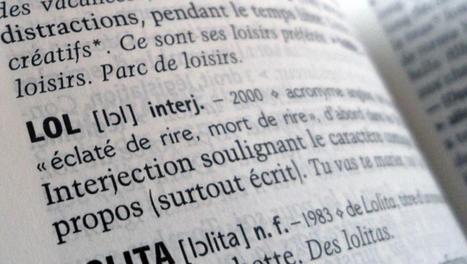







Ce jeudi 5 juin paraîssent en librairie les nouvelles éditions des deux dictionnaires français les plus populaires : le Larousse et le Petit Robert. Deux ouvrages de référence pour la langue et la culture qui, comme chaque année, accueillent plus de 200 nouveaux mots et expressions ; de nouvelles personnalités du monde politique et culturel y trouvent également place.
Ces nouveaux dictionnaires, on peut dire que c'est « une tuerie » ! L'expression très en vogue chez les jeunes, qu'on pourrait traduire par « c'est formidable », est donc validée par le Larousse qui, pour ses 110 ans, intègre un vocabulaire à la pointe des nouvelles tendances avec « vapoter » par exemple, qui désigne l'acte de fumer une cigarette électronique ou « se loguer » terme informatique, sans oublier « la cachaça », Coupe du monde oblige, nom de l'eau de vie brésilienne.
De son côté, le Petit Robert ouvre la porte aux « abdo-fessiers », « pilates », « vétetiste » et autre « zumba » pour les amateurs de sport, et bien sûr c'est la consécration pour le « selfie », autoportrait posté sur les réseaux sociaux qui a explosé cette année.
Dans les pages personnalités, Manuel Valls, le Premier ministre français, fait, comme le veut la tradition, son entrée, accompagné - entre autres - de l'actrice américaine Nicole Kidman. Enfin, les mots de la francophonie fleurissent dans les deux dictionnnaires. A retenir « emmieuter », employé par les Canadiens pour signifier améliorer, améliorer notre connaissance du français par exemple, objectif visé autant par le Larousse que le Petit Robert.