 Your new post is loading...

|
Scooped by
Charles Tiayon
October 14, 10:03 PM
|
AI dominates the translation business, but for high-stakes work, humans are still needed. Google's translation service handles one trillion words per month
That doesn't count the others: DeepL, Microsoft, Claude, ChatGPT and Gemini, not to mention made-to-measure corporate translation systems. "How long will humans be needed for translation?... In April, Google said people are now translating one trillion words a month with Google Translate. That doesn't count the others: DeepL, Microsoft, Claude, ChatGPT and Gemini, not to mention made-to-measure corporate translation systems. Direct sales of machine translation (i.e. outside general AI subscriptions) were worth an estimated $1.4bn (£1bn) last year. AI translation is the "right call" in many cases says John Zimmerman
"For plenty of use cases, raw AI translation is now the right call: multiplying your costs by 100 to catch the last few percent of errors isn't rational if you're translating internal documents or product listings," says John Zimmerman, founder of OKA (Open Knowledge Association), a Swiss non-profit that translates Wikipedia articles into other languages. "For an encyclopedia it's different. Wikipedia runs on trust. A wrong fact can sit there for years and get cited by journalists and AI systems," he says. With more than 10,000 published pieces, mostly into Spanish, Portuguese and English, OKA is, Zimmerman says, the single largest contributor of translated articles to the collaborative online encyclopedia. Which is something it absolutely could not have become without AI. "Translating 10,000 articles the traditional way would cost millions. In our process, the AI produces the draft, then a human translator checks every sentence," he explains. But that human input is required less and less. "The machine output is now good enough that skipping the human entirely has become a serious option, and a real temptation across the industry. Two or three years ago, with tools like DeepL, our translators still rewrote a good chunk of every draft. "Today the prose often doesn't need fixing at all. So, the question is no longer whether AI translation is good, it clearly is, but whether it's good enough to remove the human," says Zimmerman. Not yet, translators argue... Last year OKA ran a study, funded by Wikimedia. It studied 119 articles, 10 language pairs and more than 1,000 hours of translator work. "27% of the AI-generated text still got corrected before publication. Three quarters of those corrections were errors the AI introduced, and 5 to 6% of errors changed the meaning of the original text," says Zimmerman. Eradicating those errors is likely to be challenging... This is because probability is a crucial part of the way AI translates each word rather than another and what is probably correct is not the same as what is correct. Especially in the realm of something as subtle and surprising as language... But perhaps the big moment will be when AI can show doubt..." John Laurenson
Business reporter, Paris
https://www.bbc.com/news/articles/c1wxdjx27ypo
#metaglossia
#metaglossia_mundus
This week, public institutions met machine translation head-on. Canada’s federal AI translation tool made visible errors in its first six months, from “TB” turned into tuberculosis to a colleague renamed Stéphanie, while New Zealand’s police run two AI models side by side so investigators can pick the better one for each language. Both stories are about checking. Who checks the machine, and in which language?
The Hausa story shows why the question is sharp for African languages: tools that miss idiom, innuendo and praise poetry can misread speech, and a new study finds that even the language of the prompt changes a model’s answer. Against this, lexicographers add Ugandan and Ethiopian words to the OED, and a Congolese linguist reminds us that no language is intrinsically poor, only marginalised.
That is the thread of this issue and of our header line: bridges need people who know both banks.
For Metaglossia, interculturation means that communities and professionals keep the last word.
#metaglossia
#metaglossia_mundus

Use “plain English” to avoid confusing international students
"A style guide issued by the University of Oxford advises staff to use “plain English” to avoid confusing international students. The style guide is designed to ensure clear communication from University staff.
In the guide, which was published earlier this year, the University suggested that staff “be mindful of idioms that may not be familiar to international readers”. Phrases and idioms to avoid include “learn the ropes” and “find your feet”.
This guidance is intended to benefit international students. A University spokesperson told Cherwell: “As a global university with staff and students from around the world, we write for a wide international audience. The guide provides practical advice for written University communications, from punctuation to choosing language that readers will readily understand.” International students make up 43% of Oxford students overall and 60% of graduate students.
While recognising the advice’s intention, some international students have criticised the guide as “a bit overdone”. Speaking with Cherwell, one student said that “idioms [sic] are integral parts of the English language. It makes Oxford, Oxford.”
Another student, Juniper Chan, told Cherwell: “It’s kind of anti-integration, anti-naturalisation… to baby people. When I first got to the UK, I didn’t get a lot of stuff, but you have to kind of pick it up.”
Students have acknowledged the difficulties language barriers create at university. Chan told Cherwell: “There is a certain level of shame that comes with it [but Oxford] is a very international place.You could always ask your friends for help.”
Oxford requires non-native English speakers to prove their proficiency when they apply, requesting evidence of C1 or C2 level ability on the Common European Framework of Reference for Languages. The British Council defines C1 as the ability to “understand a wide range of more difficult, longer texts” and to “recognise implicit meanings”, a skill that should enable students to understand the idioms the University advises against.
The guidance has created controversy online. For example, Lord Young of the Free Speech Union said: “One of the reasons international students come to Oxford is so that they can immerse themselves in our culture and master colloquial English.”
The University also added that its style guide is non-proscriptive. A University spokesperson told Cherwell: “Its writing guidance is advisory and supports staff in exercising their own judgement about the language they use and the audience they are writing for.”
Miriam Ilderton
28th October 2026
https://cherwell.org/2026/10/28/oxford-style-guide-criticised-international-students/
#metaglossia
#metaglossia_mundus

More than words: what is lost when a language dies
Language diversity 28 October 2026 text: Tim Senden image: Jan-Joseph Stok / DoBeS Yurakare
"When languages die, more is lost than words alone: knowledge, traditions and community also come under pressure. In his inaugural lecture, Professor by Special Appointment Rik van Gijn explains why linguistic diversity matters and what language tells us about the past.
Van Gijn spent years in the Bolivian interior searching for a ritual mourning language. The grandparents of the people he spoke to had still used this language, but they no longer did. Then, one day, a Yurakaré man suddenly said to him: ‘Sit down and get your recording equipment ready.’
‘For five minutes I listened spellbound to what was believed to be a lost ritual language.
I didn’t understand a word of it because it was so different from the everyday language’, Van Gijn recalls of a memorable moment during his fieldwork. ‘I’d gained their trust, and it was an incredibly emotional moment.’
‘People don’t give up their language for the fun of it’
The disappearing language of the Yurakaré
For over 20 years, Van Gijn has studied the disappearing language of the Yurakaré, an indigenous group of a few thousand people living in small communities across an area the size of Belgium. They live along the Isiboro and Sécure rivers and in Chapare Province in central Bolivia, and make their living from agriculture, fishing, hunting and seasonal work. In many of these small communities, Spanish has become the common language, placing Yurakaré under increasing pressure. And that has consequences.
Language loss is closely linked to the breakdown of communities, says Van Gijn. ‘People don’t give up their language for the fun of it’, he says. People hope that another language will give them a better life or shield them from racism. But relinquishing a language comes at the expense of cultural heritage and social cohesion, to the point where a grandfather can no longer speak with his grandchild.
Knowledge disappears with language
As a language disappears, so does knowledge, for example about traditional medicine. Among the Tsimane, neighbours of the Yurakaré, treatment of a disease was less effective in a village where traditional knowledge of medicinal plants had been lost than in a village where it had been maintained.
Languages, says Van Gijn, contain small, efficient units of information about the environment in which they originated, which children naturally absorb as they learn the language. When people switch to Spanish, these distinctions disappear. The same applies to ritual language and the knowledge needed to weave traditional Yurakaré tunics.
Your own language is a human right
Van Gijn does not want to dictate which language people should speak. ‘If I were Yurakaré, I would also learn Spanish. The question is: should you give up your own language or can you continue to use it alongside Spanish?’
More countries are recognising that the right to your own language, and to education in that language, is a human right. According to Van Gijn, it helps if children are taught all their subjects in Yurakaré at primary school. ‘It’s a valuable language, and that in turn boosts cultural self-confidence.’
He does not see it as a problem that traditions change. The problem is that ‘there’s a hard break’, and that people, often out of necessity, distance themselves from those traditions.
Traces of the past
Language also tells us about the past. Anyone who migrates or comes into contact with other groups leaves traces in the language, such as loanwords and grammatical changes. Van Gijn compares that with what genetics and archaeology reveal.
A workshop on the history of Bolivia, involving anthropologists, archaeologists and geneticists, highlighted the deep history of both cultural diversity and contact in the region. In languages, this is reflected in the many small language families that share grammatical features.
Sometimes disciplines contradict one another. Genetics and archaeology place the first human crossing from Siberia to Alaska and the Americas at around 20,000 years ago, while some linguists argue that so many language families could not have emerged in such a relatively short time. ‘Then you have a mismatch, and that makes it all the more interesting because you have to resolve that paradox.’ To unravel that early human history, he believes further collaboration between disciplines is needed.
Influence on research
Van Gijn also wants to break down the barrier that still exists between researchers and the linguistic communities they study. ‘We come from a tradition where the professor goes into the field, collects data, returns home and then publishes in academic journals. That is changing.’ Speaker communities are gradually gaining more influence over research agendas. ‘More research based on co-creation and collaboration, so that it also benefits them, seems like a positive development to me.’
Rik van Gijn gave his inaugural lecture, ‘Linguistic Diversity Forever!’ in the Academy Building on Friday 23 October at 16.00."
https://www.universiteitleiden.nl/en/news/2026/10/more-than-words-what-is-lost-when-a-language-dies
#metaglossia
#metaglossia_mundus
"CfP: Interculturality and Hospitality in Times of Crisis
International Association for Translation and Intercultural Studies
9th International Conference
University of Canterbury | Te Whare Wānanga o Waitaha
Christchurch, New Zealand
7-10 December 2027
Interculturality and Hospitality in Times of Crisis
Conference Theme
Language, hospitality, and crisis are, and always have been, historically and globally intertwined concepts.
The notion of hospitality is deeply rooted in complex and long-standing histories of encounters; of conflict and persecution; but also of travel and adventure. The specular relationship between alterity and subjectivity is at its core, and so too is the very fabric of sociability. The closest Te Reo Māori equivalent to hospitality, manaakitanga, echoes this dynamic, as it implies the collective nurturing of relationships in which the mana (dignity, prestige, and spiritual power) of all those involved is upheld and elevated. From these histories and terms, we are confronted with the (unwritten) rules, obligations, and laws related to hospitality which encapsulate examples on a micro- and macrostructural level: from welcoming guests into a nation—as immigrants or refugees—to providing shelter and support in the community in times of crisis, right down to individual acts of kindness and aid, such as welcoming a friend, family-member or stranger into one’s home. However, not all guests and hosts are created equal, and hospitality is not always synonymous with kindness and welcoming. The (de)colonial perspectives evident from Latin America to Oceania and beyond, where indigenous peoples were constructed as ‘unwelcome guests’ in their own land, offer fruitful examples of how historically, as well as in contemporary contexts, hospitality has often functioned as a lens through which asymmetrical power relations can be understood.
Several linguists and philosophers have scrutinized the ambivalence inherent to hospitality, elucidating its semantic and pragmatic conceptions, as well as its etymological misunderstandings and polysemy. Paola Zaccaria summarizes this dynamic as follows: “In Latin, the guest, being a stranger, was called both hospes (whence the etymological root of hospitality) and hostis, which means “enemy.” [Émile] Benveniste argued that the notion of favorable stranger evolved into guest, while a hostile stranger was considered an enemy" (Zaccaria, 2022, p. 182). Such etymological linkage led Jacques Derrida to coin the neologism “hostipitality” (Derrida & Dufourmantelle, 2000), suggesting that welcoming the Other can lead to a host’s vulnerability, and that embedded within hospitality are the very seeds of its own potential destruction. Welcoming the guest—the Other, a frenemy, AI—can lead to the host’s sovereignty unravelling, where sovereignty can be understood in its broadest conceptual sense possible: one’s space (or home) as well as one’s identity and integrity. This intersubjective blending is even more apparent when we take into consideration that Derrida writes in French where the term hôte can denote, depending on the context, either guest or host. Interpretations and translations of hospitality continue today: whether it be as a pragmatic form or an abstract, philosophical construct, the concept will (and arguably should) never be laid to rest.
While the very notion of hospitality, the givenness of its communal veracity is obviously enabling, we do not need to look too far in our current climate to witness how conceptually, at least, it has been called into crisis. ‘Crisis,’ at its very root, indicates a turning point and a decision. Not all crises are therefore inherently bad or negative, and yet the term is rarely shrouded in positivity. In a post-truth era; as we explore the use and limits of AI; as we further communicate through the semiotics of emojis; as teeter-tottering governments modify language policies, and as institutional settings regulate and enact the boundaries in which we work and live, we must ask: is language—and are languages—in crisis? And can the same be said of hospitality? Translation, Interpreting, and interculturality are at the very heart of both hospitality and crisis, as the latter inevitably creates contexts of language contact due to globalization, as well as chosen and forced migration.
With this conference topic, there are two potential thematic avenues for presenters to explore in relation to Translation, Interpreting, as well as Intercultural Studies: one more aligned with the multifaceted notion and voices of ‘hospitality’ and the other with ‘crisis.’ This conference therefore calls on scholars, educators, and practitioners to reflect and present on these disciplines and their interaction with these themes as they play out in their professional, creative, and scholarly reflections and important work.
Possible subthemes to explore include:
· T&I and the guest-host dynamic
· Violence in/and T&I
· Language(s) in crisis
· Hospitality and crisis
· Regional and minority languages
· Data Sovereignty and indigenous languages
· AI and/in crisis – trust, machine translation, and language access in crisis situations
· T&I in hospitality & tourism
· T&I in regional conflicts
· T&I in natural disasters
· Hospitality and ethics in relation to volunteer translation, AI-assisted translation, and the sustainability of the profession
· The translation/non-translation of literature as examples of hostipitality
· Rethinking T&I and sovereignty through Indigenous Knowledges
· The ethics and politics of translation and intercultural studies research, education, and practice: a turning point?
· (Feminist) ethics of care
· Disability Studies and the Politics of language(s) in translation and interpretation – who gets to speak?
· Lost languages – linguistic preservation, hospitality, and ethics
· Resisting the status quo – rethinking dissemination of translations as a question of the commons
Language Policy
· All abstracts/proposals for individual papers (20 minutes each) and panels must be submitted in English or Te Reo Māori for peer-review by the Advisory Board, and all papers will be presented in English or Te Reo Māori. Interpreting will be provided contingent on available funds.
· Workshop proposals must be submitted in English or Te Reo Māori for peer-review by the Scientific Committee; however, presentations during workshops in languages other than English or Te Reo Māori are welcome. A minimum of two presenters is required for workshops. Interpreting will be provided contingent on available funds.
Key Deadlines
· 15 November 2026: Deadline for potential convenors to submit panel, workshop, roundtable or artistic initiatives
· 20 December 2026: Announcement of the accepted proposals (panels, workshops, roundtables and artistic initiatives) & call for papers and performances.
· 20 March 2027: Individual abstract submission to accepted panels and general sessions
· 5 June 2027: Notification of acceptance of proposals (all formats).
· 5 June 2027: Registration opens
· 1 August 2027: Closing date for early registration
Registration
· 5 June 2027: Registration opens
· 1 August 2027: Early-bird registration closes
Link to registration: to be provided soon.
Solidarity Fund and Bursaries for Band 3 & 4 Countries
More information to be provided soon.
CALL FOR PANELS
Panels
Panels will serve as the cornerstone for structuring the conference programme. Panels are thematic, integrated discussions for 6 to 12 sessions on a clearly identified theme or topic within the larger theme of the conference (“Interculturality and Hospitality in Times of Crisis”). They should provide attendees with an opportunity to hear presenters engage in dialogue amongst themselves as well as with attendees about cutting-edge research, practice, theory building, and/or policy development.
Important: at this stage, you do not need to have a list of speakers or abstracts. Your panel proposal will be assessed by the Scientific Committee. If accepted, your panel will then be posted on the IATIS website and turned into a thematic call for papers open for anyone to submit. Panel convenors will be in charge of reviewing all abstracts submitted to their panel. The members of the scientific committee will review panel convenors’ selection before a notification of acceptance of abstracts can be issued.
Timeline for Panels
· Submission of panel proposals: 15 November 2026
· Announcement of accepted panel proposals: 20 December 2026
· Submission to accepted panels: 20 March 2027
· Acceptance notification: 1 June 2027
Link to the submission platform: https://easychair.org/conferences/?conf=iatis9
The following information will be required:
· Details about the convenor(s): name, surname, affiliation, bionote (approx..100 words) and contact address
· Details about the proposal: abstract (approx. 500 words)
· Optional: Tentative list of speakers and subtopics covered, if any. Please note that even if you have a list of possible speakers, all accepted panels remain open to submissions by interested IATIS delegates
See examples of IATIS panels in previous conferences:
· Oman Panels 2025
· Barcelona Panels 2021
· Hong Kong Panels 2018
CALL FOR WORKSHOPS
Pre-conference workshops run for a day or half a day on Dec 6 (or Dec 7, subject to enrolment numbers). These workshops are designed to be training sessions on a topic of interest to conference attendees, such as teaching and professional development, with a special emphasis on learning or developing new skills.
Timeline for Workshops
· Submission of workshop proposals: 15 November 2026
· Announcement of acceptance: 20 December 2026
· Workshop Registration: 5 June 2027
Link to the submission platform: https://easychair.org/conferences/?conf=iatis9
CALL FOR ARTISTIC INITIATIVES
These initiatives will reflect the cultures of the world. Artistic initiatives come from conference delegates and can be about or across cultures. They should address the topic of the conference (“Interculturality and Hospitality in Times of Crisis”).
Timeline for Artistic Initiatives
· Submission of artistic initiative proposals: 15 November 2026
· Announcement of acceptance: 20 December 2026
Link to the submission platform: https://easychair.org/conferences/?conf=iatis9
CALL FOR PAPERS
These are individual presentations that form the backbone of the conference's parallel sessions. Researchers can send abstracts to be presented as papers in thematic panels (accepted panels, see above) or independent of any panel in the conference. Papers are given the same amount of time given to panel session papers, and they may be added by the conference scientific committee to an established conference panel, if relevant, and in consultation with the convenor.
Timeline for Papers
· Call for individual papers: 20 December 2026
· Deadline for potential presenters to submit abstracts for papers in and beyond thematic panels: 20 March 2027
· Announcement of accepted papers: 1 June 2027
The following information will be required:
· Details about the presenter(s): name, surname, affiliation, bionote (100 words approx.) and contact address
· Abstract (250 words approx.)
See examples of IATIS papers in previous conferences
· Oman Papers 2025
· Barcelona Papers 2021
· Hong Kong Papers 2018
IATIS https://www.iatis.org/9th-conference-christchurch-2027

Why There Can Never Be a Perfect Bible Translation
Cy Kellett welcomes Jimmy Akin to discuss the upcoming Catholic American Bible. Jimmy explains the complexities of translating biblical texts and why no translation can be considered perfect, highlighting the challenges that arise from language differences.
Transcript:
Cy Kellett: Will, thank you for waiting. Go ahead with your question.
Caller: Hey, Jimmy. And it sounds like we’ve got a new version of the Bible coming up or a new edition. Excuse me. The Catholic American Bible. And I’m excited about it. Sounds great. And I looked at the panel and the people that have contributed to the Midwest Theological Forum. I think it looks great. Looks like new translation of the Greek and updating the Old Testament as well from the Nabre version and a new version of the Psalms. But you know, looking at the Catholic American Bible when it comes out, you know, how should we compare or assess, a new translation when it comes out?
Jimmy Akin: Well, I guess the first thing is, we should be realistic in what we expect because there are no perfect translations. Languages, just can’t be mapped onto each other in a one to one fashion. an example I often use is, for example, the translation of idioms. for example, in English we have this idiom. And Cy knows, I’m sure Where I’m going, we have this idiom in English, roll out the red carpet, which does not mean. Does not mean there is a literal red carpet that needs to be rolled out. It’s a way of saying we need to take great pains because a dignitary is visiting if we need to roll out the red carpet for someone. But if you translated that literally into Spanish, it wouldn’t mean anything. People would think there is a literal red carpet because that expression is not, is not one that is found in Spanish. There is a Spanish equivalent idiom, though, and I wonder if Sa Kellet remembers what that one is. Do you happen to remember the Spanish equivalent of roll out the red carpet,
Cy Kellett: Throw everything out the window?
Jimmy Akin: Yeah, throw the house out.
Cy Kellett: Okay, yeah.
Caller: Yeah. Okay.
Jimmy Akin: Yeah. So that’s one example. And it doesn’t just operate on the level of expressions like that. It also operates even on the level of individual words. And we’ve seen two examples of that already in today’s show. Cy Kellett.
Cy Kellett: Yes, sir?
Jimmy Akin: When you asked me the question about, women teaching, what terms exist in Greek now, I’m not asking for the word, but what are their English equivalents that translators have to make a choice. Do we translate it this way or that? Just about 40 minutes ago, like wife
Cy Kellett: Or woman, husband or man?
Jimmy Akin: Exactly. When you encounter gune, which is the Greek word for woman or wife, you’ve got to make a choice. Which way do I translate it? And when you encounter the word aner, which means either man or husband, you’ve got to make a choice. How do I do it? We also saw another example of that in our most recent call, because we hit the word Torah, which you could translate law like the Septuagint translators did, or you could translate it instruction. So even just on the level of individual words, you’ve got to make choices. And humans, you know, most of them are human. Wouldn’t you agree? Psychalic? Most humans are human.
Cy Kellett: I’ve noticed most are, yes.
Jimmy Akin: Well, they have to make these tough calls, and there’s not a single right choice. You know, like in the previous call, if you go with the Septuagint translation and say, we’re going to translate Torah as namas or law, well, then that’s going to suggest something to the reader that’s slightly different than would be suggested by instruction. You’re going to lose some of the connotations and you’re going to create other connotations that the word law has so, there’s always a trade off and different translators make different trade offs and sometimes they make mistakes. So there are no perfect translations. As they say, in Italian, translator, traitor. In other words, every time you translate, you in some sense betray what was said in the original language. So we shouldn’t expect perfection, but how much can we expect? Well, we actually can expect a good bit these days. In fact, all professionally published translations by major publishers, they’re all pretty good. There aren’t any that are just horrible. Now there are, some translations that are just horrible, like the Jehovah’s Witness New World translation, that’s just a bad translation, but it’s not a professionally published one. when you have actual scholarly committees that are doing these things, scholars today are very competent and they use the best scholarship that we have available. And so all the translations are pretty good. What they differ on is the choices they make in translation. And there are a variety of these. Kind of at the top level you have to make a decision of are we going to use what’s called a formal equivalence translation philosophy or a dynamic equivalence translation philosophy. Formal translation tries to stick to the word order as closely as possible in the language you’re translating into, which, so it’s kind of a word for word translation. Whereas dynamic equivalence tries to focus on the thoughts, but allow the word order and such to vary. And so it’s often described as not a word for word translation, but a thought for thought translation. Well, both of those have advantages. The word for word translation is going to preserve details from the original language that dynamic equivalence won’t preserve. On the other hand, that makes it a little more obscure and harder to read. Whereas with dynamic equivalence it’s easier to read and maybe more clearly understood, but it does mean sacrificing some of the detail. So there’s no right or wrong here. Personally, for Bible reading I have no just absorbing text in bulk. I have no problem with dynamic equivalence. But for Bible study where you’re focusing more on details, I would use formal equivalence rather than dynamic. Then there are other translation choices that have to be made. Like one that’s been controversial in recent years is what’s called inclusive language, where there are some translations, like the New Revised Standard Version, that will try to avoid gendered language whenever possible. so they will not say he or she. In many cases, the opposite of that would be using traditional gendered language, which just uses he as the default for everything. And then there’s kind of a middle position that says what we’re going to try to do is use the language that, that’s there in the original. So if we won’t, we won’t fuzz away he’s and she’s when they’re in the original. But when it uses a neutral, a gender neutral term like human, you know, the Greek word for which is anthropos, it’s different than gune, which means woman, and it’s different than anair, which means man. But. But anthropos just means person or human. Well, we’ll just translate it as person or human there without assuming he as the default. And so there’s kind of a range of translation choices on this level. And I would say that since they’re all basically good these days, if they’re professionally published by teams of scholars, I wouldn’t worry about it too much. I would. Rather than asking, is it okay to use this? I would try to find out what translation choices, did the translators make. And one of the ways to find that out is by reading the literature that is released with the Bible translation, either as an introduction, like a preface, in the translation itself or in publicity material. it’ll say, we did this and we did this. And you can get a sense of it and decide do you like it or not? And in individual verses, you will find things that are just wrong or arguably wrong. But, for me, if I’m evaluating a new translation, I’m not looking for perfection. And I am more thinking about what would this be useful for? Because to me, the best is to go straight to the original languages. But if you’re going to be using translations, which I do, because I can read English faster than I can read Greek and Hebrew. I mean, I can go to the Greek and the Hebrew when I need to, but it’s faster to just read English most of the time. And when I use translations, the best translation is actually having multiple translations. So I can see how different people read the same passage. And that can open up interpretive possibilities that might not have occurred to me otherwise. Like in the first question we had today, if all I’d ever seen are translations of, First Timothy 2:12 that say woman and man, and had never seen a translation that uses wife and husband, I might have entirely missed that translation option and that interpretive option. So it’s valuable to have not just one translation, but multiple translations that all can be consulted.
Cy Kellett: Will, I got to leave it there because I got to get to the break."
Jimmy Akin • 10/27/2026
https://www.catholic.com/video/why-there-can-never-be-a-perfect-bible-translation
#metaglossia
#metaglossia_mundus

UNIGE scientists reveal in mice, the role of a small brain structure in holding information in mind so it can be used a few moments later.
Reading a sentence, following a conversation, solving a problem or deciding what to do next: all of these rely on working memory. It allows the brain to hold information in mind for a few seconds, even after the stimulus has disappeared, to be able to compare it with new information, manipulate it and use it to guide our behaviour. It therefore plays an essential role in the transition from perception to thought, and from thought to action. UNIGE scientists show that this function relies in part on a small, deep brain structure, the claustrum, whose neurons help keep a trace of information for tens of seconds. Moreover, inhibiting the claustrum leads to a marked drop in working memory performance. These results, published in Nature Communications, add a piece to the puzzle of the circuits underlying thought, a key issue for disorders in which working memory is impaired, notably ADHD and schizophrenia.
Without working memory, it would be difficult to think, understand, decide or adapt our behaviour. Indispensable, it is also extremely demanding for the brain. Sensory information vanishes within moments once the stimulus ends, yet its representation must remain stable enough to be used later.
How does the brain manage to retain information that is no longer there? We now know that working memory does not depend on a single brain region, but on the interaction of vast networks involving, among others, the prefrontal cortex, sensory regions, the parietal cortex, the thalamus and other subcortical structures. However, how these networks maintain a representation of information over time remains largely unknown.
To decipher these mechanisms, the teams led by Alan Carleton, Full Professor in the Department of Basic Neurosciences at the Faculty of Medicine, and Ivan Rodriguez, Full Professor in the Department of Genetics and Evolution at the Faculty of Science, set out to explore the role of the claustrum in working memory. This thin structure lies deep within the brain, between the insular cortex and the striatum. “Its neurons are connected to almost all regions of the cortex, which puts it in a good position to receive and influence information from very different networks,” explains Alan Carleton.
A trace that outlasts the wait
To test this, the scientists studied mice that received a first piece of information, either an odour or a tactile stimulation. They then had to wait several seconds before receiving a second stimulus and determine whether it was identical to or different from the first one. During this interval, the initial stimulus had disappeared. Yet to succeed at the task, the mice had to keep an internal representation of it. “Our live recordings of claustrum neuron activity showed that a trace of the initial information persisted throughout the entire waiting period,” describes Ivan Rodriguez. “Far from being a static memory, neuronal activity changed over time. Nevertheless, the identity of the stimulus remained sufficiently present to be decoded up to 30 seconds later.”
Without the claustrum, memory falters
To determine whether this structure is truly necessary for working memory, or merely accompanies it, the scientists temporarily reduced the activity of claustrum neurons. The team notably used optogenetics, a technique that makes certain neurons sensitive to light through specific proteins, allowing their activity to be controlled with an optical fibre at precise moments of the task. When this neuronal activity was disrupted, the mice’s working memory performance was halved.
“The result was similar regardless of the type of stimulus, olfactory or tactile, and regardless of when the disruption occurred during the waiting period between the two stimuli,” adds Alan Carleton. “Moreover, disrupting the claustrum specifically impairs the ability to use temporarily held information to guide behaviour, without affecting perception itself.”
What does this mean for cognitive disorders?
Working memory thus relies on the dynamic activity of neuronal networks, which must preserve information while allowing the brain to keep perceiving, thinking and acting. The claustrum plays a central role in this complex architecture thanks to its connections with many of the cortical regions involved.
“Our discovery could help us better understand cognitive disorders in which working memory is impaired, such as schizophrenia or ADHD,” explains Alan Carleton. “Identifying the brain circuits that allow information to be maintained over time is an important step towards understanding how these functions can be disrupted. We now need to determine how the claustrum communicates with cortical networks, and how this interaction preserves the fidelity of the representations held in working memory.”
Journal
Nature Communications
DOI
10.1038/s41467-026-78363-6"
26-Oct-2026
How the brain holds information in mind
Peer-Reviewed Publication
Université de Genève
https://www.eurekalert.org/news-releases/1149219
#metaglossia
#metaglossia_mundus

Premios Nacionales a las mejores traducciones en 2026
"El jurado ha reconocido a Olivia de Miguel Crespo y a Pablo Martín Sánchez por sus traducciones.
Olivia de Miguel Crespo ha sido galardonada con el Premio Nacional a la Obra de un Traductor, correspondiente al año 2026 y Pablo Martín Sánchez con el Premio Nacional a la Mejor Traducción, correspondiente al año 2026, por la traducción de ‘Lugares’, de Georges Perec (Anagrama), a propuesta del jurado. Cada uno de los premios está dotado con 30.000 euros.
El jurado reconoce a Olivia de Miguel Crespo por “la fidelidad estética y la sensibilidad idiomática con la que captura el ritmo y los matices tonales del original. Olivia de Miguel, toda una institución de la profesión, tiene un curriculum abrumador en el que sobresale el rigor y meticulosidad con los que aborda la traducción de obras complejas de escritoras como Marianne Moore o Virginia Woolf, cuyas voces fragmentarias, innovadoras y a menudo herméticas plantean desafíos singulares al traductor. A ello se suma su asombrosa versatilidad para plasmar con idéntica maestría las ideas políticas y filosóficas de Chesterton o George Orwell”.
Asimismo, el jurado ha señalado que “en su dilatada trayectoria, De Miguel, maestra de traductores, ha sabido mantener la excelencia en su trabajo gracias a la reflexión rigurosa, el dominio de los recursos expresivos y una pasión inquebrantable por un oficio que entiende como una vía constante de búsqueda, curiosidad, descubrimiento y acceso al conocimiento”.
Por su parte, el jurado ha propuesto la traducción de Pablo Martín Sánchez de la obra ‘Lugares’, de Georges Perec “por la calidad, creatividad e ingenio con la que ha superado las múltiples dificultades que entraña transmitir un texto de enorme complejidad”.
Además, el jurado ha expresado que “el minucioso trabajo de Pablo Martín Sánchez destaca por la destreza para abordar una obra inacabada, lo que exige detectar y respetar con rigor sus inherentes incoherencias. Asimismo, la estructura recurrente de la obra obliga a un arduo y constante cotejo de fragmentos dispersos a lo largo de ochocientas páginas. A ello se suma la impecable conservación del rico aparato crítico de la edición original, plasmado en las abundantes notas e introducción que dan visibilidad al traductor y evidencian una profunda solvencia y conocimiento sobre el autor”.
Por último, el jurado ha destacado que “finalmente, ante el desafío de una obra de naturaleza oulipiana, Martín Sánchez demuestra una brillante capacidad para recrear los juegos de palabras originales, forzando los límites del propio idioma y enriqueciéndolo mediante la creación de neologismos. Un trabajo de excelencia que denota la trayectoria y el buen hacer de quien cree firmemente que su profesión va más allá del simple trasvase de palabras, convirtiéndola en un profundo proceso de investigación, documentación y transformación”.
Biografías
Olivia de Miguel Crespo (Logroño, 1948)Traductora y profesora en la Facultad de Traducción e Interpretación de la Universidad Pompeu Fabra. Licenciada en Filología Anglogermánica por la Universidad de Zaragoza, es asimismo doctora en Teoría de la Traducción por la Universidad Autónoma de Barcelona con la tesis ‘La traducción del Modernismo norteamericano al castellano: el caso de Marianne Moore’.
En 2001 pone en marcha el Máster de traducción literaria y audiovisual y el Posgrado en línea en Traducción literaria del BSM/Pompeu Fabra, de los que ha sido directora hasta 2022. Actualmente sigue traduciendo literatura, dando cursos y conferencias.
Ha recibido el Premio Ángel Crespo de traducción 2005 por ‘Autobiografía’ de G.K. Chesterton (Acantilado, 2003), y el Premio Nacional de Traducción a la Mejor Traducción por ‘Poesía Completa’ de Marianne Moore, en 2011. Como traductora literaria ha trabajado con diversas editoriales, como Acantilado, Siruela, Alba, Tusquets, Destino, Hiperión, Galaxia Gutenberg, Edhasa, Ediciones del Bronce, Random House Mondadori, Global Rhythm, Tres Hermanas Editorial, Lamicro y J. Olañeta.
Pablo Martín Sánchez (Reus, 1977)Es doctor en Lengua y Literatura Francesas por la Université de Lille y doctor en Teoría de la Literatura y del Arte y Literatura Comparada por la Universidad de Granada. Miembro del Ouvroir de Littérature Potentielle (Oulipo), trabaja habitualmente como traductor y profesor de escritura.
Como traductor, ha vertido al castellano obras de Marcel Schwob, Wajdi Mouawad, Marta Carnicero, Adeline Dieudonné, Édouard Louis, Delphine de Vigan, Yannick Haenel, Joan Benesiu, Violaine Bérot o Georges Perec. En 2022, ganó el premio de traducción Ángel Crespo por ‘La anomalía’, de Hervé Le Tellier.
Además, como autor ha publicado obras como ‘Fricciones’ (2024), ‘El anarquista que se llamaba como yo’ (Acantilado, 2012), ‘Tuyo es el mañana’ (Acantilado, 2016) y ‘Diario de un viejo cabezota’ (Acantilado, 2020), así como ‘Agatha’ (2017), una obra escrita en colaboración con Sara Mesa. Parte de su obra ha sido traducida al francés, inglés, checo y neerlandés.
Jurado
Los jurados de ambos premios, han estado presididos por María José Gálvez Salvador, directora general del Libro, del Cómic y de la Lectura del Ministerio de Cultura; como vicepresidente ha actuado Jesús González González, subdirector general de Promoción del Libro, la Lectura y las Letras Españolas, y han tenido como vocales a Arantzazu Etxebarria Iturrate, por la Real Academia de la Lengua Vasca/Euskaltzaindia; Xosé Antonio Palacio Sánchez (Antón Palacio Sánchez), por la Real Academia de la Lengua Gallega / Real Academia Galega; Joan Rafael Ramos Alfajarín, por la Academia Valenciana de la Lengua/ Acadèmia Valenciana de la Llengua; David Paradela López por la Asociación Colegial de Escritores de España. Sección Autónoma de Traductores (ACETT); José Ignacio Sánchez Sánchez (Ignacio Sánchez), por la Escuela de Traductores de Toledo y Carmen Francí Ventosa, por el Ministerio de Cultura.
Adicionalmente, el jurado del Premio Nacional a la Obra de un Traductor ha tenido como vocales a Montserrat Bacardí Tomàs, por el Instituto de Estudios Catalanes/Institut d’Estudis Catalans; Inmaculada Senra Silva, por el Centro de Estudios de Género de la UNED y Xabier Olarra Lizaso, traductor galardonado en la convocatoria de 2025.Probar traductor
Por su parte, el jurado del Premio Nacional de la Mejor Traducción ha tenido como vocales a Richard Mansell, por el Instituto de Estudios Catalanes/Institut d’Estudis Catalans; José María Díaz Lage, por el Centro de Estudios de Género de la UNED y a Marian Ochoa de Eribe, galardonada en la convocatoria de 2025."
Por Redacción Revista de Arte - 18 de octubre de 2026 0
https://revistadearte.com/noticia-destacada/premios-nacionales-a-las-mejores-traducciones-en-2026/
#metaglossia
#metaglossia_mundus

The EMT (European Master’s in Translation) competence framework
The 2026 edition – updated to reflect the increasingly important role of AI and language technologies – sees translation competences as multidimensional
"Developed by academics and industry experts, the EMT competence framework defines what students need to learn and what universities should teach. The 2026 edition – updated to reflect the increasingly important role of AI and language technologies – sees translation competences as multidimensional.
The 2026 framework identifies 5 interdependent areas of competence:
linguistic and cultural competence
transfer competence
digital and technological competence
thematic and information research competence
(inter)personal and service provision competence"
"The European Master’s in Translation (EMT) is a quality label for university translation programmes at master’s level. It was created by the European Commission's DG Translation for programmes that meet agreed professional standards and reflect current market needs.
The EMT network includes 81 programmes offered by 79 universities across 24 countries in Europe and beyond.
Universities awarded the EMT quality label can use the EMT logo, which is a registered EU trademark.
EMT member universities are part of a network committed to high-quality translator training.
The main goal is to improve the quality of translator training in Europe and beyond, in all eligible countries. Highly skilled graduates have better job prospects in the competitive language services market, and are better able to adapt as the profession evolves."
https://translation.ec.europa.eu/get-involved-european-language-activities-and-initiatives/european-masters-translation_en
#metaglossia
#metaglossia_mundus

Sublimé par la traduction d’Abdelkader Chaoui, Le roman de Youssef El Maimouni rappelle que la littérature possède un pouvoir singulier : celui de soigner les mémoires blessées
"Tous ces auteurs, et les traducteurs qui les font circuler d’une rive à l’autre, obligent le Maroc et l’Espagne à se regarder en face, dans toute leur complexité, leur douleur, mais aussi leur indéniable fraternité.
C’est pourquoi il faut appeler de nos vœux que les Chaoui, Lahchiri, Rajae Boumediane Metni, Akhrif, Bendriss, Limami et tant d’autres poursuivent leur œuvre de traduction et de transmission.
Chaque traduction est un pont jeté entre deux mémoires.
Sur le territoire de la littérature, les montagnes accepteraient enfin de marcher ensemble."
https://quid.ma/culture/les-montagnes-qui-marchent-la-litterature-pour-redresser-lhistoire-par-samir-belahsen
#metaglossia
#metaglossia_mundus

Langues, traduction et engagement
Écrire en wolof : leurres, plaisirs et transmission
Boris Diop : la charge et les chemins de l’écriture
"Le mardi 27 octobre s’ouvre à 9h par une conférence de l’écrivain Mohamed Mbougar Sarr, intitulée « Comment tuer le père Boris ». Trois sessions suivent : « Langues, traduction et engagement », « Les chemins de l’histoire : tirailleurs, colonialité et dialogues transatlantiques », qui évoque un dialogue entre Diop et Senghor sur Thiaroye, puis « Écrire en wolof : leurres, plaisirs et transmission ».
La journée s’achève par une première table ronde, conduite en wolof, sur la création, l’innovation et la transmission dans l’écriture en wolof de l’auteur. Elle réunit notamment Sokhna Bao Diop, de l’Université Gaston Berger, et Adramé Diakhaté, président de l’association Fonk Sunuy Làmmiñ.
Le mercredi 28 octobre, la session 6, « L’écrivain dans la cité : de la fiction au débat public », examine l’engagement de l’auteur, ses prises de position face à des intellectuels comme Achille Mbembe ou Souleymane Bachir Diagne, et le roman La gloire des imposteurs, coécrit avec Aminata Dramane Traoré.
Deux tables rondes suivent. « Les écrivains lisent Boris » réunit Marouba Fall, Rahmatou Seck Samb, Djibril Diallo Falémé et Khalil Diallo. « Boris Diop, journaliste » rassemble Pape Samba Kane, Baba Diop, Massamba Mbaye et Aboubacar Demba Cissokho.
La cérémonie de clôture, de 16h45 à 18h30, comprendra une projection de film et une prise de parole de Boubacar Boris Diop. À partir de 21h, au Goethe-Institut de Fann Résidence, une soirée artistique proposera une création théâtrale mise en scène par Madiaw Ndiaye, des performances musicales inspirées de la bande-son des romans, avec le groupe Jàmm Jazz et DJ Torodo, ainsi qu’un cocktail de célébration du 80e anniversaire de l’écrivain."
https://www.seneplus.com/article/loeuvre-de-boubacar-boris-diop-au-coeur-dun-colloque-international
#metaglossia
#metaglossia_mundus
Une orthographe unifiée pour intégrer les langues locales à l’école
La Bibliothèque universitaire centrale de l’Université Omar Bongo (UOB) a servi de cadre, le mercredi 21 octobre 2026, à la clôture du Symposium national sur l’Alphabet et l’Orthographe des Langues Gabonaises (AOLG). En réunissant universitaires, linguistes, responsables ministériels et acteurs éducatifs, l’événement a permis de franchir une étape décisive dans la préservation et la valorisation du patrimoine verbal du pays.
Face à l’érosion progressive de la transmission orale, la création d’un système d’écriture unifié et accessible s’imposait comme une urgence. Durant plusieurs journées intensives, neuf ateliers de travail ont passé au crible 53 parlers locaux. Les experts ont analysé avec rigueur les structures vocaliques, consonantiques et tonales pour dégager des convergences solides, sans pour autant gommer la richesse spatiale des spécificités locales.
S’inspirant des travaux fondateurs de l’abbé Raponda-Walker en 1932 et des réformes de 1989, ce symposium a permis d’harmoniser les propositions historiques. Le résultat se traduit par une feuille de route alphabétique simplifiée, conçue pour un usage pratique et quotidien par les pédagogues, les chercheurs, les médias et les locuteurs.
Des orientations stratégiques pour le système éducatif
Cette démarche scientifique résonne directement avec les recommandations des États généraux de l’éducation de 2010. Elle remet au centre du débat national l’intégration des réalités socioculturelles au cœur des programmes scolaires. Pour passer de la théorie à la pratique, les participants ont formulé cinq axes prioritaires notamment la définition d’une stratégie linguistique nationale claire et ambitieuse; l’introduction progressive des langues nationales de la maternelle à l’université; la formalisation de l’alphabet retenu par un décret officiel instaurant sa portée normative; la formation massive des corps enseignants et des relais communautaires et l’édition des manuels, des lexiques et le développement des supports numériques adaptés.
Ancrer la recherche dans le développement culturel
En orchestrant ces travaux, l’UOB réaffirme sa mission fondamentale d’éclairage de la société. Les langues ne représentent pas de simples véhicules de communication ; elles abritent la mémoire collective, les savoirs ancestraux et l’identité profonde du Gabon.
Comme le souligne le document de synthèse de la rencontre : « Ce document ne clôt pas la réflexion […] il en pose les bases renouvelées et consensuelles et ouvre la voie à une appropriation collective, condition indispensable à la préservation et à la valorisation du patrimoine linguistique national. » La réussite de cette entreprise reposera désormais sur la promptitude des pouvoirs publics à transformer ces avancées universitaires en outils d’enseignement pérennes."
Henriette Lembet
25 octobre 2026
https://gabonmediatime.com/gabon-luob-table-sur-une-orthographe-unifiee-pour-integrer-les-langues-locales-a-lecole/
#metaglossia
#metaglossia_mundus
Pourquoi écrit-on « monsieur » ce qui se dit « meussieu » ?
"Le dernier dimanche de chaque mois, le service de Correction du « Monde » propose sa sélection de curiosités, de trésors et de perles du français. Place, cette fois, à des mots du quotidien dont l’orthographe suscite l’interrogation des francophones, fait trébucher leurs enfants, et plonge les étrangers dans des abîmes de perplexité.
Vous souvenez-vous du jour où vous avez compris, sans doute au cours préparatoire, que ce mot que vous entendiez cinquante fois par jour et que tout le monde prononçait « meussieu », c’était celui-là, dans votre livre de lecture, et il s’écrivait « M.O.N.S.I.E.U.R. ». La maîtresse avait bien expliqué pourtant que O + N se lisait « on ». Ne parlons même pas de ce R final qui ne s’entendait pas. Vous avez peut-être demandé pourquoi, et l’on vous a sans doute répondu : parce que c’est comme ça. Voici la réponse à quelques « pourquoi » oubliés de notre enfance.
Pourquoi écrit-on « monsieur » ce qui se dit « meussieu » ?
« Monsieur » s’est un temps écrit en deux mots et prononcé naturellement, comme le possessif « mon » suivi du nom « sieur » – idem pour son équivalent féminin, « madame », qui a d’abord été « ma dame ». C’est d’ailleurs à l’entrée « sieur » que l’on retrouve « monsieur » dans le Dictionnaire historique de la langue française d’Alain Rey (éditions Le Robert).
« Sieur » descend du latin senior, comme sa presque-anagramme « sire » – qui, au passage, est aussi à l’origine du « sir » anglais. « Dans ses premiers emplois, “monsieur”, qui équivaut à “monseigneur” et à “messire”, est un titre d’honneur », explique le Dictionnaire historique, titre seulement attribuable à un noble, à un prince ou à un important..."
Muriel Gilbert
25.10.2026
https://www.lemonde.fr/la-matinale/article/2026/10/25/orthographe-francaise-mais-pourquoi-ca-s-ecrit-comme-ca_6799997_4866763.html
#metaglossia
#metaglossia_mundus
https://www.lemonde.fr/la-matinale/article/2026/10/25/orthographe-francaise-mais-pourquoi-ca-secrit-comme-ca_6799997_4866763.html?lmd_medium=lm&lmd_campaign=partager
#metaglossia #metaglossia_mundus

"Plan to expand AI translation at courthouses halted after advocates find fault with lengthy pilot project
California’s Judicial Council has canceled a plan to roll out AI translation at court counters statewide, saying the service must undergo a review of its accuracy and efficiency.
San Diego Superior Court, one of more than 30 courts that piloted the voice-to-text tool, used it about once a month in its Civil Business Office from 2022 until this spring, but clerks preferred a telephone translation service, officials said.
The court collected informal feedback on the AI tool from staff, said Emily Cox, a spokesperson for San Diego Superior Court. Cox said staff reported that “it was difficult for the application to capture information from people who spoke quickly,” and that the tool occasionally required software updates that delayed service. In addition, she said the tool was unavailable in Mandarin and Haitian.
After a public records request, critics compiled numerous instances in which AI translation tools did not accurately depict statements by court workers or members of the public and provided alternative translations from human interpreters. (Times of San Diego illustration from photo by Thomas Murphy)
While the pilot has ended, staff at the San Diego court continues to use a telephone translation service offered through a private vendor, United Language Group, which Cox said uses human interpreters. The service was available throughout the pilot, alongside the tool.
The pilot program began in 2021 and ended in April 2026, according to public records obtained by legal aid groups. Before launching the pilot, a work group of the Judicial Council explored available technologies, including Google, Amazon, IBM and Microsoft. Google had the highest average score in tests the council ran for accuracy and responsiveness.
The Judicial Council, which oversees policymaking for California courts, released a request for proposals in late August seeking vendors to roll out AI translation statewide at public-facing service points such as clerk’s counters, with a contract starting Dec. 1. Vendors submitted proposals in late September, and the council was scheduled to announce its intent to award a contract Oct. 26. Instead, it published a notice of cancellation on Oct. 15.
A spokesperson for the Judicial Council said in an email that the request for proposals was cancelled, citing evolving technology as the reason. The council plans to seek an internal review relating to “accuracy, efficiency, and effectiveness” before considering any new voice-to-text options.
The council has said, however, that it conducted a preliminary evaluation of the pilot but has not made the results public.
ADVERTISEMENT
SCROLL TO CONTINUE READING
The cancellation notice came the day before the council’s Friday, Oct. 16, meeting, where advocates raised concerns about the rollout after reviewing transcripts from the pilot project.
Legal aid groups, including the Legal Aid Foundation of Los Angeles and California Rural Legal Assistance Inc., obtained hundreds of pages of transcripts of the program’s translations through public records requests. They said professional translators who reviewed the transcripts found multiple errors across different languages.
The transcripts do not identify which courts they came from, so the errors cannot be tied to San Diego or any other individual court"
Sophia Sleap
Oct. 24, 2026
https://timesofsandiego.com/tech/2026/10/24/ai-translation-california-courts-pilot-project-rfp/
#metaglossia
#metaglossia_mundus

Can AI really understand Arabic dialects?
Talking your language: UAE unveils AI tool designed to master Arabic dialects
Jais 3 has been developed by Mohamed bin Zayed University of Artificial Intelligence and Abu Dhabi's Inception42
A cutting-edge Abu Dhabi university has unveiled an Arabic AI tool designed to decode a variety of regional dialects and respond to rapid shifts in language.
Jais 3 – built by the Mohamed bin Zayed University of Artificial Intelligence, in partnership with Abu Dhabi's Inception42 – is able to field queries and carry out tasks such as transcribing conversations and creating documents and presentations.
It features Jais speech, a voice recognition model for the Arabic language and its varying dialects from across the Gulf and North Africa.
The advanced AI platform was developed through the university's Institute of Foundation Models (IFM) with the goal of keeping pace with the nuances of a language spoken by more than 400 million people around the world. The tech is also able to deal with code-switching, which refers to when a bilingual person alternates from one language to another.
"Arabic AI needs to understand the language in its everyday context, which varies by geography and across generations," said Haonan Li, senior research scientist at IFM. "For example, we need to account for the many nuances in spoken Arabic, including when speakers slip into English or French mid-sentence and back again. We built Jais 3 for Arabic as it's really used."
High-tech training
Jais Speech transcribes Modern Standard Arabic and dialects spoken across 19 Arab countries. It follows speakers as they switch between Arabic and languages such as English or French, keeping those words in their original script. It also identifies the dialect being spoken and can add Arabic vowel marks to a transcript.
Paired with the language models, Jais Speech enables Jais 3 to take spoken instructions in Arabic or English and act on them.
Mr Li said the team worked extensively to ensure strong representation of the many forms of Arabic spoken in the region and beyond.
“One of the key challenges was ensuring broad and balanced representation across regional dialects," he said. "For Gulf dialects, this involved working with a more limited pool of existing open data and addressing the tendency of open models to default to Modern Standard Arabic rather than maintaining the requested dialect when generating synthetic data.
"This required additional work in data synthesis and filtering to ensure the quality and relevance of the resulting data set."
A similar challenge was faced by the Jais 3 team for Morocco, where available data tended to be heavily weighted towards Moroccan Darija, leaving other dialects in the region less represented.
Embracing technology
Richard Morton, vice president and executive director of IFM, said the launch of Jais 3 showed the importance of investing in rapidly evolving technology.
"Jais has shown what the UAE's long-term investment in open AI research can deliver for the Arabic-speaking world," he said. "With Jais 3, we are extending that foundation into speech and agents at a time when the UAE is putting AI to work across government and society – reflecting MBZUAI's commitment to the UAE National AI Strategy 2031 and to building the research capability and national talent that will carry it forward."
IFM and Inception42 evaluated the models on an audited suite of 24 Arabic benchmarks, which they are releasing publicly alongside the models. The results showed the largest Jais 3 model leads open models on agentic tasks and matches the strongest on Arabic understanding.
Jais Speech recorded the lowest average word and character error rates among all models compared, while the seven billion and 32 billion-parameter models earned the highest average Arabic scores among open models of comparable sizes.
"Jais 3 makes Arabic AI more practical for business use," said Dr Larry Murray, senior vice president of Applied Science at Inception42. "Stronger reasoning and instruction following, combined with tool use, provide a foundation for multi-step agentic workflows. With open models across a range of sizes, organisations can match these capabilities to their computing budgets and deployment needs.""
Salma Arafa
October 24, 2026
https://www.thenationalnews.com/news/uae/2026/10/24/talking-your-language-uae-unveils-ai-tool-designed-to-master-arabic-dialects/
#metaglossia
#metaglossia_mundus
Recognition for Words Without Borders and the work of literary translators and translation publishers
"Words Without Borders’ Elisabeth Jaquette Named Femmes de Culture Laureate
This international recognition for Words Without Borders and the work of literary translators and translation publishers highlights the importance of connecting the world through literature.
Words Without Borders Executive Director Elisabeth Jaquette, 2026 100 Femmes de Culture Award ceremony
On October 12th at the Palais de Tokyo in Paris, Words Without Borders Executive Director Elisabeth Jaquette was named a 2026 100 Femmes de Culture laureate in the Publishing & Press category. This honor comes on the heels of Words Without Borders winning this year’s Aficionado Award at Frankfurter Buchmesse earlier this month.
Held under the patronage of the French Ministry of Culture, the 100 Femmes de Culture award celebrates the women who bring culture to life in all its forms. The 2026 edition of the award was co-organized with the J. Paul Getty Trust and Villa Albertine, and marks 250 years of French-American partnership. The 2026 jury was co-chaired by Katherine E. Fleming and Patricia Barbizet, and included Mélanie Biessy, Bonnie Brennan, Mati Diop, Tatyana Franck, Anne-Claire Legendre, Tania de Montaigne, and Marie Christine Saragosse. Other 2026 Publishing & Press laureates include novelist Anne Berest, artist and teacher Chouf, editor and publisher of New Directions Barbara Epler, novelist Lauren Groff, New Yorker Art Editor Françoise Mouly, novelist and co-founder of Transit Books Ashley Nelson-Levy, Translator Emma Ramadan, and Publisher of Archipelago Books Jill Schoolman.
In an email to Publishing Perspectives, Jaquette said, “This major international recognition for our organization shows the importance of the work Words Without Borders and literary translators do to connect the world through literature. And while the US may be retreating from the global stage, our vision of an interconnected, empathetic world is still deeply valued abroad.”
At the award ceremony in Paris, Katherine E. Fleming, President and CEO of the Getty, and Honorary Co-Chair of the Prix 100 Femmes de Culture 2026, said, “The 100 women honored this year demonstrate the extraordinary breadth of that leadership…They are forging new paths, building bridges, and expanding the role that culture can play in our societies.”
Jaquette is an Arabic-to-English literary translator whose work has been nominated for the National Book Awards, International Booker Prize, and other honors. She has served as executive director of Words Without Borders since 2024. Prior to joining the organization, Jaquette was Executive Director of the American Literary Translators Association from 2017-2024. In 2026 she was named a National Endowment for the Arts Translation Fellow.
“All of us at Words Without Borders are immensely proud to see Lissie recognized for bringing world cultures to life, both as an award-winning translator and as a talented arts administrator who has worked hard to strengthen the literary arts community in the USA for the past decade. This award is richly deserved,” said Samantha Schnee, WWB’s board chair and founding editor.
“This recognition uplifts the craft of literary translation. While often overlooked, translators are vital towards creating a richer, more inclusive world of letters—and a richer, more interconnected world,” said Jaquette.
By Erin L. Cox, Publisher | @erinlcox
About the Author
Erin L. Cox is the Publisher of Publishing Perspectives...
https://publishingperspectives.com/2026/10/words-without-borders-elisabeth-jaquette-named-femmes-de-culture-laureate/
#metaglossia
#metaglossia_mundus

Languages in fight to not get lost in AI translation
Nic Mitchell 23 October 2026
Despite the amazing advances in technology, which allow foreigners to get directions in another country without speaking the language or understand an alien restaurant menu through an app on their phone, there are still powerful reasons why learning another language is vital to avoid the true meaning of words being ‘lost in translation’, say campaigners fighting to reverse the decline in numbers studying foreign languages in schools and universities in the United Kingdom.
The ‘wake-up’ call to policymakers and university leaders comes after another cull of modern language programmes, which is now hitting the so-called ‘elite’ Russell Group of research-intensive universities, with the University of Nottingham being the latest to axe full degree programmes in foreign languages, as University World News reported this month.
The pace of closures and restructurings for modern languages across UK higher education is quickening, with the University of Exeter consulting on reducing its academic workforce by around 150 full-time roles, with modern languages among the disciplines reported as facing a reduction of up to 25% in teaching-related staffing, according to a soon-to-be-published 2026 update to a survey for the University Council For Languages (UCFL).
The report by Wendy Ayres-Bennett, emerita professor at Cambridge University and associate fellow at the Institute of Languages, Cultures and Societies, will highlight how the previous relatively stable Russell Group picture (for languages), described in 2024 UCFL survey, has changed for the worse.
Fightbacks save some provision
Despite this, fight-backs by university staff and students have saved some provision.
At Cardiff University, for example, plans were announced in January 2025 to close Modern Languages and Translation. Following consultation, modern languages were absorbed within a new School of Global Humanities but with a smaller staff base, smaller cohorts and provision primarily in French, Spanish, Mandarin and Japanese. However, German, Italian and Portuguese are not offered anymore.
The picture in other pre-1992 universities continues to worsen, says the UCFL, although often not with complete closures, including at the University of Leicester, where modern languages degree programmes closed to new entrants from September 2026, but “wider language learning will continue through Languages at Leicester” offering short courses in 16 languages at different levels.
Other pre-1992 universities announcing partial closures of their language provision include Bangor, Essex and Heriot-Watt.
The biggest decline in modern language degrees has already happened in the post-1992 (modern) universities, according to the report from Ayres-Bennett, “with Modern Languages degrees surviving in only a small number of institutions”.
Language learning in the age of AI
So what can be done to save foreign language learning, particularly in the age of AI where many people believe that everyone speaks some English and that Google Translate or some other app can save the day if one gets lost in some foreign parts?
Megan Bowler, a postgraduate student in Classics at the University of Oxford and lecturer in Ancient Greek Language and Literature at Oriel College, is among the language policy advocates leading the fight-back.
She has given evidence to the All-Party Parliamentary Group (APPG) on Modern Languages and written reports, including one for the Higher Education Policy Institute (HEPI), titled ‘The Language Crisis: Arresting Decline’, sponsored by Duolingo, one of the world’s most popular language-learning platforms and mobile-first educational apps.
She told University World News: “‘There is a common misconception that Google Translate and now AI tools are making language capabilities redundant. On the contrary, the skills and intellectual values that a ‘linguistic mindset’ can instil are even more important in this age of rapid technological change.”
“It is the precisely close and critical analysis, cultural adaptability and precision and clarity that ChatGPT struggles to replace.
Human translator role shifting
“The role of the human translator continues to shift to that of a human linguistic consultant: making use of digital technology but providing crucial oversight in the form of imaginative flair, cultural nuance and geopolitical awareness.
“Human linguists also contribute trustworthiness in contexts where precise details are consequential, such as legal contracts or international policy and diplomacy.”
Bowler’s report for HEPI offers 13 reasons why the ‘linguistic mindset’ cultivated by learning languages is even more important in the age of AI.
These include cultivating lateral and creative modes of thinking in other languages; intercultural awareness by engaging thoughtfully with traditions, history and current affairs and international relations; and gaining different perspectives.”
Languages face vicious circle
However, Bowler warns that language disciplines are facing a vicious circle.
“For the majority of schools, problems with teacher recruitment are leading to even lower rates of participation in language learning.
“Low uptake in higher education is leading to cuts in university language provision and degree programmes.
“The shortage of language skills is holding employers back, and the teacher recruitment crisis continues to worsen. Intervention and investment are needed to prevent a critical skills deficit,” said Bowler.
Strengthening the pipeline
But all is not lost, as the examples from Leeds University and its new approaches to language learning demonstrate.
The University at Leeds runs one of the largest university language schools in the UK, with 165 staff teaching on degrees in ten foreign languages (French, German, Spanish, Italian, Chinese, Japanese, Thai, Russian, Portuguese and Arabic) and offering language modules in ten other languages through an institution-wide language programme called ‘Languages for All’ with 80 additional staff.
In an interview with University World News, Professor Emma Cayley, head of the University’s School of Languages, Cultures and Societies and chair of the University Council For Languages (UCFL), said: “We have a total of around 2,400 students studying one or more languages to degree level, with a further 1,600 taking modules as part of their degrees.
“But we’re not complacent and we are certainly not getting as many students coming through from schools, with the patchy provision of languages at A-level and negative public rhetoric about languages and the wider Arts and Humanities driving student choice.”
Among the tactics being employed at Leeds is to accept students starting language degrees from scratch, including those who have not been able to take an A-level in a language that they want to learn because their school didn’t offer it.
‘Languages for All’ hub
“Another initiative, which I think is fantastic, is the ‘Languages for All’ hubs, set up by the Reach Foundation and its director Michael Slavinsky.
This has so far seen two local universities work together with schools to help open access to language learning at A-level and beyond for pupils who otherwise wouldn’t be able to learn a foreign language.
“This helps to provide A-level language across a pool of schools in a region and inspire future linguists,” said Cayley.
The first hub was launched by Royal Holloway University working with a group of schools in Hounslow in London.
The second was in the Southwest in Devon with the University of Exeter, where a network of state schools in Cornwall and Devon have been working together to make advanced modern language study possible and normalised in one of the more remote regions of England.
Out-of-hours or online courses are on offer through schools working together to deliver A-level classes, and the universities involved offering access to events on campus and visits to major employers to explore the role of languages in various careers, trips to cultural and political institutions and an affordable residential experience in Europe.
“We're about to launch the third hub in Leeds this November,” said Cayley, who strongly believes novel thinking is required to turn round the fortunes of languages in UK schools and universities
“At Leeds, we’re not just teaching modern languages – but also Classics and Ancient History, Film Studies, Linguistics and Translation Studies.
Learning from the revival of classics
“I believe one of the answers to turning around the fortunes is to offer languages with social sciences, such as a language combination with international relations, politics, or business studies.
“These degrees are usually four years with a compulsory year abroad, but increasingly the year abroad is becoming optional for many degree programmes. That’s one way of meeting the challenge, particularly for those who haven't already got a language but are keen to become more employable through taking a joint honours degree.”
The UK rejoining the EU’s Erasmus programme from January 2027 should boost the attraction of learning a foreign language at university, with Cayley saying: “Erasmus could help access accessibility and include inclusivity and will mean more money will be coming into languages. Erasmus was one of the big selling points in a degree in a modern language before Brexit.”
Cayley’s department calls itself the School of Languages, Cultures and Societies and includes film studies, Linguistics and Classics to widen its appeal.
Cayley said: “The revival of Classics can show us how to re-invent and re-invigorate a discipline like Modern Languages with intense interest in Christopher Nolan’s new action film, The Odyssey, the big-screen adaptation of Homer’s ancient Greek epic poem and the story of Troy and classical mythology and literature.”
As to why we still need languages in the modern age of AI, Cayley told University World News: “The economic cost to the UK of not speaking other languages is huge, as highlighted in a report called, ‘The economic value to the UK of speaking other languages’, which highlighted the importance of languages for diplomacy, security and trade.”
This point was emphasised in Megan Bowler’s report for HEPI and in her more recent contribution to a collection of ‘Linguists’ Voices’, published recently by the Chartered Institute of Linguists (COIL).
Bowler also said that for English-speaking people: “The study of languages invites the learner to step outside Anglophone perspectives and assumptions, something that is necessary if efforts at inclusion and decolonisation are to have meaningful depth.
“Gaining new perspectives and cultivating a global mindset encourages empathy and emotional intelligence towards people of different linguistic and cultural backgrounds.”
“In sum, a shift in how we ‘reframe’ languages subjects – in terms of irreplaceable and cognitive value, rather than merely an ability to convert words in one language to another – is needed to improve public perceptions of what languages offer.
“The value of a ‘mathematical mindset’, for example, is widely accepted. Even though we all have calculators on our phones and can now use AI to handle complex mathematical problems with accuracy, numeracy and the ability to ‘think mathematically’ remain relevant,” said Bowler.
Nic Mitchell is a UK-based freelance journalist and PR consultant specialising in European and international higher education. He blogs at www.delacourcommunications.com"
https://www.universityworldnews.com/post-mobile.php?story=20261023181917197
#metaglossia
#metaglossia_mundus

Qualité des traductions de l’albanais vers d’autres langues et formation des traducteurs
"Les ateliers organisés par le Centre des publications pour la diaspora ont porté sur la qualité des traductions de l’albanais vers d’autres langues et la formation des traducteurs, tandis que la première journée s’est achevée par une table ronde réunissant des écrivains albanais.
Le séminaire de traduction “La parole albanaise dans les langues étrangères” s’est poursuivi avec les ateliers “Tungjatjeta” et “Guides culturels: Gjirokastra”, organisés par le Centre des publications pour la diaspora (QBD), rapporte albinfo.ch.
Les ateliers se sont déroulés en deux sessions chacun, sous la direction de Mimoza Hysa, Aljula Jubani et Manjola Nasi. Les traducteurs et les mentors ont examiné des exemples concrets liés à la prononciation, à la grammaire, aux jeux pédagogiques, aux dénominations, aux jeux de mots et aux références culturelles.
Inscrites dans le programme de publications bilingues du QBD, ces activités visent à améliorer la qualité des traductions de l’albanais vers d’autres langues et à soutenir la formation des traducteurs, en associant l’expérience professionnelle à la contribution de la jeune génération de la diaspora.
La première journée du séminaire s’est achevée par une table ronde réunissant des écrivains, offrant un espace d’échange direct entre auteurs et traducteurs. À travers des questions, des réponses et des lectures d’extraits de leurs œuvres, les échanges ont porté sur les écrivains Ben Blushi, Rita Petro, Vera Bekteshi et Ardian Vehbiu, ce dernier ayant participé en ligne depuis les États-Unis.
Le séminaire se poursuit avec des activités destinées à renforcer les liens entre la langue albanaise, la littérature et la diaspora, ainsi qu’à soutenir la diffusion de la création littéraire albanaise dans les langues étrangères./Albinfo.ch"
24 Octobre 2026
https://www.albinfo.ch/fr/seminari-fjala-shqipe-ne-gjuhe-te-huaja-perkthyesit-diskutojne-sfidat-e-perkthimit-dhe-ruajtjen-e-referencave-kulturore/
#metaglossia
#metaglossia_mundus

Le patrimoine au prisme de l’altérité et de la diversité (Tlemcen)
Date de tombée (deadline) : 10 Novembre 2026
À : Université de Tlemcen
Publié le 24 Octobre 2026 par Faculté des lettres - Université de Lausanne (Source : Latifa Sari)
Appel à communications
Le patrimoine au prisme de l’altérité et de la diversité
Colloque national (Hybride)
Date limite d’envoi des propositions : 10 novembre 2026
Notifications : 13 novembre 2026
Tenue du colloque : 17 novembre 2026
17 novembre 2026
Site des 30 labos/Nouveau Pôle
Coordonné par Pre. AMMI ABBACI Amal
Le laboratoire Diversité des Langues, Expressions Littéraires, Interactions culturelles ‘’L.L.C’’ organise un colloque national sur « Le patrimoine au prisme de l’altérité et de la diversité ». Inscrit dans la continuité des travaux de recherche de l’équipe 2 ‘’Langues en contact, discours et médiations’’, ce colloque sera l’occasion d’approfondir la réflexion des chercheurs sur le patrimoine en tant qu’héritage historique, social et culturel façonné par des échanges, des contacts, des interactions et des conflits entre les peuples et les communautés.
Envisagé sous le prisme de l’altérité et de la diversité, le patrimoine se présente comme une réalité plurielle et dynamique, dont les formes et les significations évoluent en fonction des contextes historiques, sociaux et culturels.
La langue et la culture occupent une place essentielle dans cette dynamique dans la mesure où elles constituent des vecteurs de transmission et de circulation des savoirs, des valeurs et des traditions. Le contact entre les langues et les cultures contribue à la construction, à la transformation et à la réappropriation des héritages patrimoniaux, tout en révélant les influences réciproques et les rapports de tensions entre les communautés en contact.
Penser le patrimoine au prisme de l’altérité et de la diversité, c’est aussi admettre que sa signification se construit dans la rencontre avec l’Autre, dans la confrontation des mémoires et dans la reconnaissance des différences. Le patrimoine peut ainsi constituer un espace de médiation et de dialogue susceptible de favoriser le vivre-ensemble dans la différence. Il peut toutefois générer des tensions et des conflits et faire l’objet de revendications identitaires.
Qu’il soit matériel ou immatériel, le patrimoine ne constitue pas un héritage figé et statique ; il se construit, se transforme et se renouvèle au gré des contacts, des mobilités et des mutations sociales, culturelles et linguistiques. Les mutations contemporaines, liées notamment à la mondialisation, aux mobilités et aux progrès technologiques renouvèlent profondément les enjeux de protection, de valorisation et de transmission du patrimoine. Dans cette perspective, il importe d’interroger les processus de patrimonialisation ainsi que les mécanismes par lesquels certains héritages sont reconnus, légitimés et transmis tandis que d’autres restent marginalisés.
Ce colloque, à vocation pluridisciplinaire, se donne pour objectif d’explorer les différentes facettes du patrimoine et d’interroger la manière dont il est perçu, reconnu, valorisé, transmis et mobilisé dans la gestion des relations à l’Autre. L’altérité et la diversité linguistique et culturelle soulèvent des questions essentielles relatives à la reconnaissance des identités, à la préservation des langues et des pratiques culturelles ainsi qu’à la prise en compte des héritages minorés.
Quelques axes sont proposés à titre indicatif et non exhaustif.
Axe 1 : Patrimoine et altérité
Patrimoine et altérité
Représentations de soi et de l’autre dans les discours sur le patrimoine
Axe 2 : Plurilinguisme, contact des langues et patrimoine
-Plurilinguisme et héritages patrimoniaux
-Plurilinguisme et transmission des patrimoines linguistiques et culturels.
Langues minorées et préservation des patrimoines
Contacts de langues : emprunts, interférences, hybridations, etc.
Langues, cultures et transmission des patrimoines
Axe 3 : Oralités et dynamiques de transmission
Oralités et transmission du patrimoine : chants populaires, contes populaires, proverbes, adages, récits traditionnels, etc.
Femme et patrimoine : Rôle, représentations et pratiques
Mobilités migratoires et circulation des patrimoines
Transmission intergénérationnelle des langues-cultures
Axe 4 : Patrimoine à l’ère du numérique
archivage et numérisation comme processus de patrimonialisation
Rôle du numérique dans la préservation du patrimoine linguistique et culturel
Numérique et nouvelles formes de médiation du patrimoine
-Intelligence artificielle et patrimoine : préservation ou minoration ?
Axe 5 : Patrimoine, littérature, médias et éducation
Représentations du patrimoine dans les textes littéraires
Médias, représentations et transmission des héritages
Place du patrimoine dans le système éducatif
Patrimoine, enseignement des langues et diversité culturelle
—
Bibliographie indicative
ABRIC, J. C. (1994). Pratiques sociales et représentations [Social Practices and Representations]. Presses Universitaires de France.
BONOLI, L. (2008). Lire les cultures : La connaissance de l’altérité culturelle à travers les textes. Éditions Kimé.
BAOUALI, Ratiba & al (2020) : « La préservation du patrimoine gastronomique Algérien, levier pour le développement du tourisme durable », in revue Albahith, Volume 12, Numéro 2, Pages 153-153
CUCHE, D. (2010). La notion de culture dans les sciences sociales. (4 éd.). La Découverte.
GAYMARD, S. (2021). Les fondements des représentations sociales : Sources, théories et pratiques. Dunod.
GERAUD, M.-O., Leservoisier, O. et Pottier, R. (2016). Les notions clés de l’ethnologie : Analyses et textes (4eéd.). Armand Colin.
GUERN, P. L. (2021). Comment ne pas altérer l’altérité ? Art contemporain et indigénéités. Marges, 33 (2) ,144-158.
HARIG, Fatima Zohra (2022) : « Lexique et identité culturelle de la gastronomie Algérienne d’expression française », in Revue Aleph, Langues, médias et sociétés.
JEANNIN, M. (2017). L’identité au risque de l’altérité : Littérature et interculturation. Le français aujourd’hui, 197(2), 51-62.
JODELET, D. (2005). Chapitre 1. Formes et figures de l’altérité. In M. Sanchez-Mazas & L. Licata, L’Autre : Regards psychosociaux (p. 23-47), Presses universitaires de Grenoble.
SELLAM, Yasmina (2011) Mémoire culinaire de l’Algérie, aux origines de l’art culinaire algérien, Editions ANEP.
—
Comité scientifique
Sari Mohammed Latifa- Benamar Rabia - Benmansour Smain – Kherbouche Ghouti – Zenasni Amal – Belkaid Amaria – Ammi Abbaci Amal
Comité d’organisation
Kherbouche Ghouti – Mansouri Asma- Ammi Abdelghani – Mezerreg Amina – Rahoui Khadija.
—
Modalités de participation
Langues du colloque : Français
Modalités de soumission : Les propositions de communication qui ne dépassent pas 500 signes (espaces compris) sont à envoyer à l’adresse latefa_amel@yahoo.fr
Les propositions seront examinées par le comité scientifique. Les participants préciseront l’axe dans lequel ils inscrivent leur communication.
Calendrier indicatif :
Date limite d’envoi des propositions : 10 novembre 2026
Notifications : 13 novembre 2026
Tenue du colloque : 17 novembre 2026
L’appel est accessible ici : https://llc.univ-tlemcen.dz/fr
Laboratoire de recherche L.L.C : https://llc.univ-tlemcen.dz/fr
Adresse : Université Abou Bakr Belkaïd, Tlemcen : https://www.univ-tlemcen.dz/fr
Responsable :
Amal AMMI ABBACI
Url de référence :
https://llc.univ-tlemcen.dz/fr
Adresse :
Université de Tlemcen"
https://www.fabula.org/actualites/137331/le-patrimoine-au-prisme-de-l-alterite-et-de-la-diversite.html
#metaglossia
#metaglossia_mundus

Speech recognition in 36 languages, translation in 103 languages, and speech synthesis in 45 languages—all running with no connection, no data bundle, and no cloud token bills
"VoxNexus (www.VoxNexus.ai) released VoxEdge, an on-device voice stack that brings speech recognition, translation and speech synthesis to affordable Android devices, entirely offline. VoxEdge supports speech recognition in 36 languages, translation in 103 languages, and speech synthesis in 45 languages—all running with no connection, no data bundle, and no cloud token bills.
AI should work for everyone, not just for speakers of a handful of mainstream languages. Yet across much of Africa, voice AI has been held back by scarce training data and the lack of targeted fine-tuning. Everyday speech also includes code-switching and dialect variation, while cloud-based inference costs can make deployment at scale expensive.
VoxNexus’s solutions run entirely on device, and every query is free once the model is installed on the device. Its speech recognition model has as few as 65 million parameters and achieves a lower word error rate than open-source models nearly ten times its size.
“Under-resource languages aren’t small languages. Hundreds of millions of people speak them. Until now, AI models just haven’t learned them yet,” said Charles Shi, CEO of VoxNexus.
VoxNexus also launched VoxSense, an on-device ambient listening solution that uses only 162 mAh for 12 hours of continuous listening, around 2.5% of a 6,500 mAh phone battery. By keeping all processing on device, VoxSense makes always-on listening practical without draining the battery and without sending any audio to the cloud. Developers and device makers can easily integrate it through a license and a simple SDK. Developers can request a free trial here: www.VoxNexus.ai.
VoxSense and VoxEdge were unveiled at the MediaTek Dimensity 9600 launch in Madrid on October 19.
Distributed by APO Group on behalf of VoxNexus AI.
About VoxNexus:
VoxNexus builds AI that hears and speaks — for everyone, everywhere, all the time. Its audio intelligence runs entirely on-device, delivering low latency, built-in privacy, and zero token cost across any device with a chip. VoxNexus is headquartered in Singapore. Website: www.VoxNexus.ai. Contact: public@voxnexus.ai"
https://www.socialnews.xyz/2026/10/23/speaks-your-language-no-internet-needed-voxnexus-brings-on-device-voice-artificial-intelligence-ai-in-100-languages-to-affordable-android-devices/
#metaglossia
#metaglossia_mundus
When translations don’t feel natural, customers walk away
Brands usually get translation right, Liferay’s Yotam Levy said. “The problem is they don’t necessarily do a great job of localization.”
"Localization problems are nearly universal for non-English experiences, a Liferay survey found.
More than half of multilingual shoppers say they have walked away from a potential purchase because the digital experience felt poorly localized, according to a survey of 800 U.S. consumers released last week by Liferay.
Companies underestimate the difference between translation and localization, according to Yotam Levy, senior manager of customer insights and analyst relations at Liferay. An accurate translation can feel awkward if its content isn’t adjusted to match the nuances of the new language.
More than half of respondents have walked away from purchases at brands even when they rated the non-English translations as good or excellent, and less than a quarter say non-English websites usually feel like they were written for them.
Dive Insight:
It’s easy to translate content into another language. The challenge lies in editing the altered content until it looks and sounds natural.
Localization problems are nearly universal for non-English experiences, as 9 in 10 respondents reported that they have noticed at least one issue with a website or app, according to Liferay’s survey.
“Brands actually generally do a pretty good job of literal translation,” Levy told CX Dive. “The problem is they don’t necessarily do a great job of localization.”
Levy shared the example of translating the phrase “turn on the light” into Hebrew. A literal translation results in the phrase “open the light” — which will feel off to a proficient reader.
The question brands should ask when designing a multilingual experience is “what’s going to feel natural to the reader,” Levy said. In some cases, a straightforward translation is enough, but many times the process is a little more complex.
The best way to fix localization issues is to hear from the affected customers, according to Levy. Once a brand determines that something is off with a translated experience — for instance, if cart completion rates are significantly lower — they can reach out to users and get their thoughts.
Surveys can do a good job here, according to Levy. Brands can include specific questions about the general problem, whether that’s translation or localization, as well as text boxes for more specific feedback.
“Many people won’t necessarily fill that out, to be fair, but for the folks that do, that’s often a goldmine,” Levy said. “They’ll often be very specific in saying, ‘Hey, you know, I was reading this, and the translation didn’t make sense, and I didn’t really understand what the brand was about.’”
What can’t solve the problem, at least alone, is AI. Only 1 in 5 consumers give credit to AI alone for strong localization, while 2 in 5 credit human involvement.
That’s not to say brands should eschew AI, according to Levy. The key is to use it as a starting point, not the end product. AI can efficiently translate a page, and then a native speaker can review the work and ensure the wording feels natural.
One company taking this two-pronged approach is Walmart, which uses AI to flag common search terms and sends that information to linguists to update the translation on the retailer’s platform. For example, this ensures customers in Chile and Mexico can each use their country’s word for “t-shirt” and have it parsed by the search engine.
“The idea here is, again, about what’s going to feel natural to the user in their native language,” Yotam said. “That could be a simple fix, but in many cases it could be a little bit more complex.”"
Oct. 23, 2026
Bryan Wassel
https://www.customerexperiencedive.com/news/when-translations-dont-feel-natural-customers-walk-away/833877/
#metaglossia
#metaglossia_mundus
Breaking Down Language Barriers: Why Web-Based Document Translation is Transforming Global Communication
In an increasingly interconnected global economy, the ability to communicate seamlessly across linguistic divides has evolved from a luxury into an absolute necessity. Whether you are a multinational enterprise coordinating supply chains across three continents, a legal team parsing foreign compliance paperwork, or an independent researcher reviewing international case studies, information moves at lightning speed. Yet, language barriers have historically created massive friction points, turning simple document sharing into tedious, expensive bottlenecks.
Enter the era of advanced, browser-accessible localization tools. The demand for rapid, high-fidelity translation solutions has exploded, driving millions of users to seek out streamlined platforms like a Free Online Document Translator to bridge the gap without installing bloated software or paying steep subscription fees.
The Evolution of Digital Localization
For decades, translating a formal document meant copying and pasting text segment-by-segment into basic translation boxes, or hiring traditional translation agencies that required days or weeks to return a localized file. Even when early machine translation tools emerged, they came with major flaws:
Formatting Disasters: Tables, columns, charts, and bullet points routinely broke, requiring hours of manual reformatting.
Context Blindness: Literal word-for-word translation engines frequently butchered idioms, technical jargon, and cultural tone.
Friction and Frictionless Paywalls: Many professional tools locked core features behind heavy enterprise logins or prohibitive licensing fees.
Today, modern web-based document translation has completely transformed the workflow. Driven by sophisticated neural machine translation (NMT) and contextual artificial intelligence, current platforms allow users to upload entire files-spanning formats like PDF, Microsoft Word, Excel, and PowerPoint-and receive fully translated versions that retain their structural integrity.
Why Professionals and Students Are Flocking to Web-Based Tools
The shift toward cloud-based translation utilities is driven by several key advantages that cater to modern productivity demands:
1. Preservation of Original Formatting
One of the most significant historical pain points of digital translation was layout corruption. When translating a complex PDF or a heavily styled corporate presentation, losing alignment or messing up image placements rendered the output unusable. Advanced web translators now analyze underlying file architecture, ensuring that headers, footers, fonts, and graphical alignments stay precisely where they belong.
2. Instant Accessibility Without Software Bloat
In fast-paced corporate and academic environments, waiting for IT approvals to install specialized desktop software slows projects to a crawl. Web utilities bypass this obstacle entirely. Users can access robust translation suites directly through any standard browser, making cross-border collaboration as simple as dragging and dropping a file.
3. Cost-Effective Scaling
Traditional human translation services remain vital for certified legal or highly creative publishing needs, but they are rarely viable for high-volume, day-to-day internal documents. Free or freemium online options democratize access to global information, allowing startups, freelancers, and students to process foreign texts instantly without inflating overhead costs.
Practical Applications Across Industries
The versatility of modern document translation tools impacts virtually every major sector:
Legal and Compliance: Reviewing international contracts, regulatory guidelines, and patent applications requires precise wording. While final legal filings demand human verification, instant translation tools allow legal professionals to screen foreign documents for relevance in seconds.
Academic Research: Scholars frequently need to draw insights from international journals published in foreign languages. Web translation tools accelerate literature reviews by making global research accessible immediately.
Global E-Commerce and Marketing: Businesses expanding into new regional markets can rapidly localize product sheets, user manuals, and inventory catalogs to test new audiences with minimal friction.
Navigating the Future of Cross-Lingual Collaboration
As machine learning models continue to grow more nuanced, understanding regional dialects, professional jargon, and subtext, the gap between human and automated translation narrows further. For everyday workflows, the emphasis has shifted entirely toward speed, user experience, and structural accuracy.
When deadlines loom and critical information is locked behind an unfamiliar language, having immediate access to a reliable, friction-free platform makes all the difference. By removing technical barriers and preserving the visual layout of complex files, modern web translation utilities empower anyone to participate in the global conversation effortlessly.
Source: Busines NewsWire
https://www.bignewsnetwork.com/news/279395100/breaking-down-language-barriers-why-web-based-document-translation-is-transforming-global-communication
#metaglossia
#metaglossia_mundus

La traduction œcuménique de la Bible ou le rêve d'une Bible commune à tous les croyants
Comprendre la Bible
La traduction œcuménique de la Bible ou le rêve d'une Bible commune à tous les croyants
La traduction œcuménique de la Bible est l’une des cinq versions de la Bible proposées par l’Alliance biblique française. Retour sur l’histoire de cette traduction.
Alors que le chantier de sa révision a été lancé en 2025 pour une durée prévisionnelle de cinq ans, nous vous proposons au travers de cet article de revenir sur l’histoire de cette traduction.
« Jamais je n’ai été plus heureux de perdre un pari ! » C’est par ces mots que le linguiste américain Eugène Nida saluait en 1975 l’aboutissement de la Traduction œcuménique de la Bible (TOB). Il pensait que la première traduction française de la Bible réalisée en commun par des exégètes catholiques, protestants et orthodoxes ne pourrait voir le jour en moins de dix ans. Il s’était trompé.
Les premiers jalons
L’initiative n’est venue ni des hiérarchies ecclésiastiques ni des maisons d’édition, mais d’une rencontre fraternelle entre le pasteur André Morel et l’abbé Jean Starcky, spécialiste des écrits de Qumrân. Avant même l’élan œcuménique officiel du concile de Vatican II, ils lancent l’idée d’une traduction commune de la Bible. En décembre 1961, les deux hommes réunissent les éditions du Cerf et l’Alliance biblique française pour évoquer le projet. Les débuts sont lents : chaque institution est alors engagée dans d’autres chantiers éditoriaux.
Une création originale
En 1964, l’impulsion est relancée par Olivier Béguin, alors secrétaire général de l’Alliance biblique universelle. Une révision commune de la Bible de Jérusalem, traduction catholique de référence, est d’abord envisagée. Des essais sont menés, mais le constat s’impose rapidement : les modifications nécessaires sont si nombreuses qu’elles altèrent profondément l’équilibre et l’identité de cette version. Le projet ne peut aboutir dans ce cadre. Il devient évident qu’il faut entreprendre une traduction nouvelle, directement à partir des textes hébreux et grecs. Le 23 janvier 1965, le lancement officiel de la TOB est acté. Catholiques et protestants s’engagent pleinement dans l’aventure. Les orthodoxes donnent leur accord de principe, mais signalent leur manque de spécialistes disponibles pour s’impliquer de manière équivalente.
Un chantier de dix ans
D’un commun accord, il est décidé que l’épître aux Romains serait le premier livre traduit, à titre d’épreuve. Selon le père Refoulé, « elle avait été au XVIe siècle le texte de nos divisions ; pouvait-elle devenir aujourd’hui le texte de notre rencontre ? ». L’essai est concluant et le travail se poursuit. Le 6 novembre 1972, la parution du Nouveau Testament complet de la Traduction œcuménique de la Bible est célébrée en […]
Lire la suite de l'article sur
Alliance biblique française"
Nicolas Fouquet
24/10/2026
Alliance biblique française
https://regardsprotestants.com/bible-theologie/comprendre-bible/la-traduction-oecumenique-de-la-bible-ou-le-reve-dune-bible-commune-a-tous-les-croyants/
#metaglossia
#metaglossia_mundus

La traduction de la nouvelle Carte du monde en langues africaines constitue donc une nouvelle étape de cette initiative portée par le Togo. "Elle vise à rendre les connaissances géographiques plus accessibles aux populations dans leurs propres langues. Le travail attendu comprend la traduction des noms des continents, des océans, des pays, des capitales et des grandes régions géographiques, ainsi que l’adaptation du titre et de la légende de la carte en projection Equal Earth. Les traducteurs devront également rédiger une courte notice explicative et établir un glossaire justifiant leurs choix terminologiques et orthographiques. « L’Afrique doit se raconter dans ses propres langues. Une Afrique qui parle dans ses propres langues est une Afrique qui transmet son histoire, affirme son identité et prépare son avenir. Du swahili au wolof, du yoruba au haoussa, de l’amharique au lingala, du bambara à l’éwé, du Kabyé au dioula, en passant par le Sango, le Fon et toutes les autres langues de notre continent, faisons de cette carte, un outil de connaissance, de vérité, d’équité, de dignité, d’éducation et de fierté collective », motive le ministre togolais des Affaires étrangères, cité par la première agence de presse privée au Togo, Savoir News.
L’appel international à candidatures s’adresse aux traducteurs professionnels, linguistes, enseignants, chercheurs, universités, associations culturelles et autres personnes disposant de compétences reconnues dans une ou plusieurs langues africaines, informe le média, précisant que les candidatures, aussi individuelles que collectives sont acceptées.
« Les langues ciblées comprennent notamment l’éwé, le kabyè, le kotokoli, l’haoussa, le yoruba, l’igbo, l’amharique, l’oromo, le wolof, le fulfulde, le lingala, le zoulou, le malgache, le bambara et le somali. La liste reste ouverte à toutes les autres langues africaines, y compris celles parlées dans les communautés de la diaspora. Une version en kiswahili est déjà en cours. Les versions traduites seront publiées sous licence ouverte et mises gratuitement à la disposition des écoles, des administrations, des médias et des plateformes numériques », affiche Savoir News, ajoutant que les contributeurs retenus bénéficieront d’une rémunération forfaitaire, d’une attestation officielle du ministère, de la mention de leur nom sur chaque carte publiée ainsi que d’une invitation à la cérémonie officielle de présentation.
Les candidatures doivent être soumises exclusivement par voie électronique au plus tard le 30 décembre 2026 et les dossiers doivent, liste Savoir News, comprendre une lettre de motivation, les curriculums vitae des traducteurs et relecteurs, ainsi que des références et des preuves d’expérience.
Les résultats de la sélection sont prévus pour le 15 janvier 2027, le dépôt des travaux attendu pour fin février 2027 tandis que la présentation publique des cartes traduites est, selon la publication, annoncée pour le second semestre 2027."
https://lefaso.net/spip.php?article150093
#metaglossia
#metaglossia_mundus

"Un syndicat dénonce les coupes budgétaires au Bureau de la traduction
OTTAWA — Un syndicat fédéral s’élève contre les coupes budgétaires imposées au Bureau fédéral de la traduction et accuse le gouvernement Carney d’hypocrisie, alors qu’Ottawa défend les normes linguistiques francophones dans le cadre des négociations commerciales avec les États-Unis.
Le Bureau de la traduction est un service du gouvernement fédéral relevant de Services publics et Approvisionnement Canada qui fournit des services de traduction et d’interprétation aux ministères et à des clients privés.
Un document gouvernemental présentant les grandes lignes du plan d’activité du Bureau de la traduction pour la période 2025-2030 indique que celui-ci prévoit de réduire ses effectifs de 339 employés par le biais de l’attrition naturelle sur cinq ans afin d’assurer sa viabilité financière.
L’attrition désigne la réduction progressive des postes par le biais des départs à la retraite et des démissions.
Le document précise que ce plan reflète «une baisse générale» de la demande de services de traduction traditionnels.
Il mentionne également que les ministères se tournent vers des services de traduction en ligne «via des outils internet gratuits» ou «investissent de leur propre initiative pour déployer des outils de traduction basés sur l’intelligence artificielle».
Mario Morneau, porte-parole de Services publics et Approvisionnement Canada, a déclaré dans un courriel que le plan prévoyait de réaliser cette réduction par le biais de l’attrition et que, comme celle-ci dépend de la demande des clients, le nombre final pourrait varier.
«Ces départs naturels devraient concerner divers groupes professionnels, notamment les postes de traduction, d’administration et de direction», a-t-il précisé.
Les langues officielles en péril
L’Association canadienne des employés professionnels condamne ce plan et affirme que cette décision met en péril les langues officielles du Canada.
Le syndicat a indiqué que plus de 90 % des traductions au sein du gouvernement fédéral se font de l’anglais vers le français et que, lorsque la qualité de la traduction baisse, ce sont les francophones qui en subissent les conséquences.
«Il en résulte un système à deux vitesses, car cela dégrade les services linguistiques dont dépendent les francophones pour accéder aux services publics et aux institutions démocratiques du Canada dans leur propre langue», a souligné le syndicat.
Après plusieurs semaines de négociations intenses, le premier ministre Mark Carney a suspendu les négociations commerciales avec les États-Unis le 21 août et a rappelé au Canada le ministre du Commerce Canada-États-Unis, Dominic LeBlanc, ainsi que le reste de l’équipe de négociation.
Lors d’une conférence de presse, M. Carney a accusé les négociateurs américains de tenter de limiter la capacité du Canada à négocier d’autres accords commerciaux, de restreindre ses mesures de protection en matière de langue et de culture, et de réduire les droits de douane sur les voitures, mais pas sur les camions.
M. Carney a évoqué à la fois la visibilité du contenu canadien sur les services de diffusion en continu et l’étiquetage des produits en français lorsqu’il a décrit l’échec des négociations commerciales. Quatre jours plus tard, un responsable gouvernemental, qui a refusé d’être cité nommément, a déclaré à La Presse Canadienne que les étiquettes en français n’avaient jamais fait l’objet de discussions.
M. LeBlanc a ensuite expliqué à Radio-Canada que, bien que les États-Unis aient par le passé qualifié les étiquettes en français de source de friction commerciale, la question qui était sur la table juste avant la fin des négociations portait sur la visibilité en ligne.
Ces règles, actuellement en cours d’élaboration au Conseil de la radiodiffusion et des télécommunications canadiennes (CRTC), garantiraient que les contenus canadiens et en langue française soient disponibles et visibles sur les plateformes en ligne de diffusion en continu.
Les représentants américains ont toujours affirmé qu’ils n’avaient aucun problème avec les mesures de protection de la langue française.
Le député du Bloc québécois, Yves Perron, a expliqué le mois dernier à la Chambre des communes qu’il n’est pas possible d’utiliser le français comme bouclier contre Donald Trump, de faire volte-face et de le considérer comme une dépense inutile à réduire.
Il a ajouté que l’intelligence artificielle ne pourra jamais remplacer le jugement humain.
Kelly Burke, commissaire aux langues officielles du Canada, a déclaré que le gouvernement devait garantir l’égalité de fond entre les deux langues officielles du Canada dans les services et les communications fédéraux.
Le rapport annuel 2025-2026 du Bureau du commissaire aux langues officielles indique que les institutions fédérales doivent veiller à ce que leurs obligations linguistiques et les droits linguistiques de leurs employés soient respectés et pris en compte lors de tout exercice de réduction budgétaire.
Mme Burke a ajouté que, bien que l’intelligence artificielle puisse s’avérer utile pour la traduction et l’interprétation lorsqu’elle est déployée correctement, il est nécessaire de faire appel à un professionnel qualifié pour éviter les erreurs.
M. Morneau a indiqué que le Bureau de la traduction adapterait ses plans si la demande de services de traduction venait à augmenter.
«Le Bureau reste pleinement engagé à fournir des services linguistiques de qualité dans les deux langues officielles, adaptés aux besoins de nos clients, aux réalités budgétaires et aux attentes des Canadiens, a-t-il dit. Il maintiendra la capacité interne nécessaire pour répondre à la demande de traductions de haute qualité tout en continuant à faire appel à l’expertise du secteur linguistique canadien lorsque cela s’avérera nécessaire.»
— Avec des informations d’Anja Karadeglija
Catherine Morrison, La Presse Canadienne
19 octobre 2026
https://www.lhebdojournal.com/nouvelles-nationales/un-syndicat-denonce-les-coupes-budgetaires-au-bureau-de-la-traduction/
#metaglossia
#metaglossia_mundus

Contre la pénurie de traducteurs juridiques
"Trois universités canadiennes se sont unies pour lutter contre la pénurie de traducteurs juridiques et promouvoir cette profession. L’Alliance interuniversitaire canadienne pour l’avancement des professions jurilangagières réunit les programmes en traduction juridique de l’Université McGill et de l’Université de Saint-Boniface ainsi que ceux en interprétation juridique et judiciaire de l’Université Sainte-Anne, en Nouvelle-Écosse.
L'objectif est de mieux faire connaître les professions jurilangagières et de promouvoir la formation et les possibilités de carrière dans ce domaine.
Selon le coordonnateur du programme d'études supérieures en traduction juridique de l'Université McGill, Éric Dupont, le projet vise à susciter l'intérêt des traducteurs généralistes pour le métier de traduction juridique, mais aussi de combler le manque de formation.
Un des grands problèmes, c'est la formation. C'est une formation spécialisée qui exige plusieurs cours à l'université. Et les employeurs n'ont pas toujours les moyens et les ressources pour former les traducteurs qu'ils voudraient embaucher. L’Alliance interuniversitaire canadienne pour l’avancement des professions jurilangagières veut donc essayer de pallier ce manque, souligne-t-il.
Pour renverser cette tendance, l'Alliance compte organiser des activités pour faire connaître le métier de traduction juridique auprès des traducteurs généralistes et des juristes.
Nous voudrions aussi les inviter à observer les traducteurs juridiques au travail afin de comprendre leur réalité, dit Éric Dupont. Cette démarche vise à lever les barrières qui empêchent certaines personnes de se tourner vers cette profession.
Vous savez, quand on parle de langage juridique, il y a beaucoup de gens qui trouvent ça intimidant et qui se disent, je n'ai pas suivi de formation en droit donc je ne pourrais pas faire ça. Mais la plupart des traducteurs juridiques sont des linguistes qui n'ont pas étudié le droit. Ils se sont formés grâce à des programmes de traduction juridique ou en milieu de travail où on leur a montré les spécificités de cette profession, fait-il remarquer.
Il ajoute que l'Alliance ambitionne de bâtir des ponts entre la traduction juridique et le bassin de traducteurs et traductrices potentiels. Pour parvenir à cet objectif, les trois universités comptent mettre en place plusieurs activités, entre autres, des conférences en ligne qui mobiliseront leurs ressources et leurs expertises.
Parce que chacun dans son coin est capable de faire quelque chose de petit, mais si on s'unit, on pourra toucher un public plus grand, indique Éric Dupont.
D'autres initiatives sont également au programme comme des activités en personne qui permettraient, d'après lui, aux traducteurs généralistes de se familiariser avec la traduction juridique. Les trois universités travaillent depuis deux ans pour la création de cette Alliance qui a reçu le financement de Justice Canada.
Le lancement a lieu mardi à 17 h à l'Université de Saint-Boniface, en présence, entre autres, des représentants de l'Association des traducteurs, terminologues et interprètes du Manitoba et de l'Association des juristes d'expression française du Manitoba."
Abdoulaye Cissoko
20 octobre 2026
https://ici.radio-canada.ca/nouvelle/2294382/traduction-juridique-alliance-universites
#metaglossia
#metaglossia_mundus

Palimpsestes, n° 40 : "Des récits d’exploration aux écritures ethnographiques : perspectives traductologiques"
Paris, Presses Sorbonne Nouvelle, 2026
EAN : 9782379061738
ISSN : 2109-943X
Numéro : 40
134 pages
Prix : Accessible gratuitement sur Open Edition Journals
Date de publication : 21 Octobre 2026
Publié le 21 Octobre 2026 par Léo Mesguich (Source : Justine Delassus)
Palimpsestes n°40
Des récits d’exploration aux écritures ethnographiques : perspectives traductologiques
Eva Roques (dir.)
Ce numéro de Palimpsestes explore les liens étroits entre récit de voyage, traduction et anthropologie, en envisageant la traduction comme une expérience de l’altérité et comme une opération de construction des savoirs.
La première partie, « Récits viatiques et mises en scène de l’altérité », examine les formes de médiation par lesquelles le voyageur donne à voir et à comprendre l’Autre. De la relativité linguistique aux pratiques de l’interprétation, de l’écriture ethnographique de Beryl de Zoete aux rencontres linguistiques de l’expédition de Lewis et Clark, les contributions montrent comment langues, corps et cultures se trouvent engagés dans des processus de traduction qui excèdent largement le simple transfert linguistique.
La deuxième partie, « Circulation des savoirs et consolidation du pouvoir », déplace l’attention vers les conditions historiques et politiques de cette médiation. L’étude de la traduction française de la description de l’Amérique de Blome et celle des récits de voyage par l’abbé Prévost et Jean-Nicolas Démeunier mettent en évidence le rôle des traductions dans la circulation des savoirs européens, mais aussi dans la construction de représentations marquées par l’appropriation et la colonialité.
Enfin, la troisième partie, « Quand l’ailleurs devient l’ici », s’intéresse au retour du récit viatique vers son espace d’origine. Les traductions, vers l’italien du Radeau de la Gorgone de Dominique Fernandez et vers l’espagnol du Journal of a Residence in Chile de Maria Graham, montrent comment le changement de langue et de lectorat transforme le regard porté sur l’ailleurs — et sur soi-même.
Date de publication : 30 octobre 2026"
https://www.fabula.org/actualites/137278/palimpsestes.html
#metaglossia
#metaglossia_mundus
|


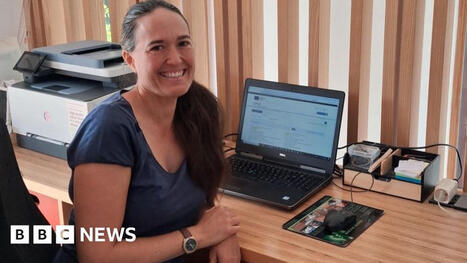







Google's translation service handles one trillion words per month
That doesn't count the others: DeepL, Microsoft, Claude, ChatGPT and Gemini, not to mention made-to-measure corporate translation systems.
"How long will humans be needed for translation?...
In April, Google said people are now translating one trillion words a month with Google Translate.
That doesn't count the others: DeepL, Microsoft, Claude, ChatGPT and Gemini, not to mention made-to-measure corporate translation systems.
Direct sales of machine translation (i.e. outside general AI subscriptions) were worth an estimated $1.4bn (£1bn) last year.
AI translation is the "right call" in many cases says John Zimmerman
"For plenty of use cases, raw AI translation is now the right call: multiplying your costs by 100 to catch the last few percent of errors isn't rational if you're translating internal documents or product listings," says John Zimmerman, founder of OKA (Open Knowledge Association), a Swiss non-profit that translates Wikipedia articles into other languages.
"For an encyclopedia it's different. Wikipedia runs on trust. A wrong fact can sit there for years and get cited by journalists and AI systems," he says.
With more than 10,000 published pieces, mostly into Spanish, Portuguese and English, OKA is, Zimmerman says, the single largest contributor of translated articles to the collaborative online encyclopedia.
Which is something it absolutely could not have become without AI.
"Translating 10,000 articles the traditional way would cost millions. In our process, the AI produces the draft, then a human translator checks every sentence," he explains.
But that human input is required less and less.
"The machine output is now good enough that skipping the human entirely has become a serious option, and a real temptation across the industry. Two or three years ago, with tools like DeepL, our translators still rewrote a good chunk of every draft.
"Today the prose often doesn't need fixing at all. So, the question is no longer whether AI translation is good, it clearly is, but whether it's good enough to remove the human," says Zimmerman.
Not yet, translators argue...
Last year OKA ran a study, funded by Wikimedia. It studied 119 articles, 10 language pairs and more than 1,000 hours of translator work.
"27% of the AI-generated text still got corrected before publication. Three quarters of those corrections were errors the AI introduced, and 5 to 6% of errors changed the meaning of the original text," says Zimmerman.
Eradicating those errors is likely to be challenging...
This is because probability is a crucial part of the way AI translates each word rather than another and what is probably correct is not the same as what is correct. Especially in the realm of something as subtle and surprising as language...
But perhaps the big moment will be when AI can show doubt..."
John Laurenson
Business reporter, Paris
https://www.bbc.com/news/articles/c1wxdjx27ypo
#metaglossia
#metaglossia_mundus