


This infographic will show you the wise habits of successful people. They are the reason why they are set apart from the rest.


 Your new post is loading...
 Scoop.it! This infographic will show you the wise habits of successful people. They are the reason why they are set apart from the rest. 
No comment yet.
Sign up to comment
Scoop.it!

Why do business initiatives fail? Barriers to organizational change? Organizational culture is the most common barriers
Scoop.it!

This infographic is a brilliant way to get you into the right frame of mind to achieve all the goals you are set to accomplish: It goes over 10 powerful habits of ultra successful people and include some real-life cases where famous people have used them to achieve success. Via The Learning Factor

Hugo de la Rosa's curator insight,
March 9, 2015 11:08 AM
Diferentes autores proponen hábitos para ser exitosos, sin embargo, la clave de todo es que realmente se vuelvan HÁBITOS y no tan solo buenos deseos de inicio de año. Estos 10 hábitos que se proponen me parecen buenos, iniciemos con disciplina y fortaleza a implementarlos. Después de un mes, valoremos el avance y hagamos los ajustes hasta que se vuelvan parte de nuestra vida diaria. 
Lisa Gorman's curator insight,
March 10, 2015 11:07 PM
At different times I've used all of these strategies! Right now my focus is on exercise and diet (or it will be as soon as I'm out of Indonesia!), visualisation (or meditation for me) and I'm going to pick up on the 'get up one hour earlier' idea again... this is tough for me but the benefits are enormous... I wonder what you will do after you read this? Best success to you! 
Tania Tytherleigh's curator insight,
March 29, 2015 7:02 AM
Great infographic sums up what we should all be doing to be more successful.
Scoop.it!

Great leaders choose their leadership style like a golfer chooses his or her club, with a calculated analysis of the matter at hand, the end goal, and...
Scoop.it!

From
www

Ben Huh, CEO of The Cheezburger Network, explains why fear is all in your head and how you can defeat whatever is holding you back.
Scoop.it!

Leaders in the digital age are different from leaders in the past. They prototype an agile strategy and learn from their experiences. They attack their own businesses before disrupters do. At the same time, they digitize their core business and get the most value from both their existing and external data, all the while mastering the digital ecosystems they operate in. Via Becky Willmoth, juandoming

Becky Willmoth's curator insight,
March 4, 2015 6:45 AM
This article from the Boston Consulting Group highlights how entire industries are being disrupted by bold digital entrants and suggests that leaders of established organisations must adapt to to take advantage of the digital age, or risk extinction. There are five key recommendations for leaders:
Looking across these recommendations it appears that an ability to take risks, be that in prototyping, collaborating or creating new business models, and to learn and adapt to the resulting successes and failures is essential for leadership in the digital age.
Scoop.it!

A 16-month longitudinal study at a long-term health care facility with 185 employees, 108 patients, and 42 of the patients' family members was conducted to test how the employees treated the patients and families versus their colleagues.
The researchers found that there was lower absenteeism and employee burnout, as well as higher levels of employee engagement with their work with greater teamwork and employee satisfaction. In addition, the culture of compassion spread to patients and their families. Then, to see if the same positive results would be found in industries such as real estate, finance, and public utilities, they performed a second study involving 3,201 employees in seven different industries.
Again, a greater culture of compassion in the workplace led to greater work satisfaction, commitment, and accountability.
...What steps can we take to develop or increase a compassionate workplace?
1. Try a morning ritual where you literally set a positive tone for your day.... 2. Look for what you have in common with others today. ... 3. Practice intentional, but random, acts of kindness... 4. Start a gratitude journal where each day you write three new things you are grateful for at work.... 5. Each night write about your day....
Susie Wolbe Via Edwin Rutsch
Scoop.it!

Often, organizations find themselves in the following predicament: A mission is in place, and desired behaviors have been identified and agreed upon, yet a disconnect...
Scoop.it!

The leaked Apple training manual tells us more of how Apple provides a consistently good customer experience.
Scoop.it!

Corporate boards of directors are increasingly reaching down below the second layer of management to name new chief executive officers. By accelerating the promotion of these executives, boards hope that the new CEOs’ ability to understand and act upon signals in today’s unpredictable environment will more than offset their relative inexperience.
Many of these new CEOs were only in their thirties when they were appointed. Marissa Mayer was 37 when Yahoo! named her CEO. She had been a vice president at Google. Burger King selected 33-year-old Daniel Schwartz to be CEO even though he had only three years of fast-food experience. The board of Electronic Arts passed over two older internal candidates to name Andrew Wilson, 39 at the time, as CEO.
Via The Learning Factor

The Learning Factor's curator insight,
February 9, 2015 7:57 PM
Corporate boards seem increasingly willing to appoint CEOs who are relatively unseasoned but forward-looking executives. The success of such fast-track promotions relies heavily on a rigorous CEO-readiness program.
Scoop.it!

And, what are our results? In three years, not one employee has voluntarily left, which is a phenomenon that we believe can be replicated at any organization. Via Anne Leong

John Ludike's curator insight,
February 10, 2015 7:39 AM
So important to consider as huge amounts spendt on embedding it and hiring for" culture fit" not to mention many a line manager unable to differentiate between competencies, capabilities and or culture.
Scoop.it!
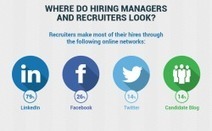
Today, recruiters are taking to social media profiles to check out their candidates potential before offering them the job. For those fresh out of university or just those who have just not been keeping track of their activity, cleaning up your social profiles is a definitely a priority. If you want to make a good impression upon your potential future employer, then you must check your pages thoroughly as social recruitment appears to be on the rise. According to a study by Jobvite, 73% of recruiters have hired a candidate through social media and 93% of hiring managers will review social profiles before offering a job. Via The Learning Factor
The Learning Factor's curator insight,
February 8, 2015 4:35 AM
This infographic shows just how recruiters and hiring mangers are going through our social media profiles. 
Stuart Bysouth's curator insight,
February 9, 2015 4:13 PM
Some valuable insight here. Before you click on that next NSFW link on FB, keep this in mind. 
rodrick rajive lal's curator insight,
February 10, 2015 2:40 AM
Social networking sites seem to be the proverbial manna from heaven for recruiters these days! An easy means of 'checking out' prospective employee profiles, they can also be a curse for those who don't take care about what they post on social networking sites. For the shrewd and more alert ones however, these sites might prove helpful as a means for showcasing talent, skills and abilities. Prospective employees, job seekers, and those intending to jump,j beware of what you post on FB, Uncle Jim is watching you!
|
Scoop.it!

Why do extroverts like action, and introverts like calm? Via The Learning Factor
The Learning Factor's curator insight,
March 8, 2015 6:06 PM
You’re not imagining it. That extrovert who seems so different from you? It’s because his brain is different.
rodrick rajive lal's curator insight,
March 9, 2015 1:36 AM
So it ultimately boils down to sensitivity to Dopamine! Well if science says this is so then I guess this is it! I wonder, however if Dopamine Sensitivity can be controlled through medicines, then it goes without saying that one can transform and introvert into an extrovert and vice versa? Well, would one really want to change one's prediliction towards Extrovertism or Introvertism? It is a misnomer however to label any of these tendencies wrong or unacceptable because they both belong to different but necessary characteristics of behaviour!
Scoop.it!

In this blog piece, Bhudeb Chakrabarti highlights six different theories of leadership that been developed over the years to explain how people lead others.
He highlights: Trait theoriesBehvaioural theoriesContigency theories such as those proposed by Fred Fiedler and Hersley-BlanchardCharismatic LeadershipTransactional TheoryTransformational Leadership
He describes leading as the art of influencing and motivating people to perform in a manner to achieve a common goal. The sum total of a leader’s roles, tasks and responsibilities and interpersonal influences constitutes leadership in his opinion. Via Matthew Farmer, Kenneth Mikkelsen

Jean Marc Santi's curator insight,
March 10, 2015 2:34 AM
Leader = personne ayant un rêve dans lequel d'autres se retrouvent.... 
Owen Roper's curator insight,
March 19, 2015 9:19 AM
This is great information for Leaders to get continued knowledge, you can always learn something new. 
Bernard Guévorts Authentis's curator insight,
February 14, 2016 11:31 AM
Difficile de définir le leadership.... Il y a différents angles possibles.
Scoop.it!

Social media is often used for personal expression; to show special interests, proud moments, something informative, and personal statements. Social media accounts can be an extension of who were are. We live in a time where we can reach more people than in person. It can be tempting to tell everyone everything... Via Lauren Moss

Emily Brooker's curator insight,
June 2, 2021 1:53 AM
While not completely education-related, I found this source very interesting. I think as an educator we should be aware of the impacts of social media and if appropriate inform our students on how to conduct themselves appropriately online.

Ash Sartor's comment,
June 8, 2021 7:35 AM
I think this is such a good read! It is so important to education today's society about the impacts of social media. It is becoming more evident that it educator's need to be demonstrating good practices in their classrooms in relation to safe, legal and privacy regulations.
Scoop.it!


Sandeep Gautam's curator insight,
March 3, 2015 11:15 AM
a really fresh perspective on employee engagement! 
Saskia Langenberg's curator insight,
March 11, 2015 3:55 AM
Mooi en simpel overzicht: hoe maak je je organisatie onweerstaanbaar?
Scoop.it!

After decades of corporate discourse about the war for talent, it appears that the battle is over, and talent has won. Employees today have increased bargaining power, the job market is highly transparent, and attracting top-skilled workers is a highly competitive activity. Companies are now investing in analytics tools to figure out why people leave, and the topics of purpose, engagement, and culture weigh on the minds of business leaders everywhere.Our research suggests that the issues of “ret
Scoop.it!

Advancement in digital technologies has disrupted everything, including leadership styles.
Employees want more ownership rather than to follow instruction; customers want to participate in the marketing and development process; and leaders are finding that open and agile organizations are able to maneuver more effectively than organizations where all insight and direction comes from the top. In short, the autocratic Commander, whether brilliant or misguided, just won’t cut it anymore.
Via Kenneth Mikkelsen

Shannon Banks's curator insight,
February 22, 2015 5:29 PM
Top-down leadership is no longer viable in the digital age. This article gives great context for technological reasons behind this shift. 
Abel Linares's curator insight,
May 24, 2016 4:13 PM
Digital business transformation: disruption, optimization, integration and humanization

Adele Taylor's curator insight,
August 28, 2016 7:20 PM
What type of leader are you? What works best for your team? The Commander, Communicator, Collaborator or Co-Creator?
Scoop.it!

Is the traditional 40-hour work week dead? Today’s nine-to-fiver can only look at all of the alternative proposals being bandied about and savor the possibilities: the four-day work week, the 30-hour work week, the 21-hour work week, and even the no-day work week. With the advent of telecommuting, flexible hours, globalization and answering emails after hours and on vacation, the American worker has entered the era of the fuzzy work-home divide. Via The Learning Factor

Paul Mendelsohn's curator insight,
February 18, 2015 11:47 AM
Check out this fascinating read on current thinking regarding the modern day work week. Lots of great insights into why more is not always better. Could that 3 day work week that George Jetson always complained about become the norm? Time will tell. 
John Norman's curator insight,
February 19, 2015 4:42 AM
There is still a clear division between those that work for themselves and those that work for someone else. How many hours a week does the self employed person work, particularly when they are first starting out compared the person in say a middle management position? I would be great to get some feedback. Is it still a fundamental equation of What's In It For Me (WIIFM) or is there more to it? 
TalentFinders-TX's curator insight,
February 19, 2015 12:38 PM
The ‘No Hour’ Work Week is the reality today
Scoop.it!

Performance tools. skills. slides. inventories, four-way view chart, stakeholder dialogues guide
Scoop.it!
From
hbr
It was Daniel Goleman who first brought the term “emotional intelligence” to a wide audience with his 1995 book of that name, and it was Goleman who first applied the concept to business with his 1998 HBR article, reprinted here. In his research at nearly 200 large, global companies, Goleman found that while the qualities traditionally associated with leadership—such as intelligence, toughness, determination, and vision—are required for success, they are insufficient. Truly effective leaders are also distinguished by a high degree of emotional intelligence, which includes self-awareness, self-regulation, motivation, empathy, and social skill. Via The Learning Factor

Momentum Factor's curator insight,
February 9, 2015 4:59 PM
'Daniel Goleman found direct ties between emotional intelligence and measurable business results.' He outlines them here for some interesting reading. |






