Your new post is loading...

|
Rescooped by
Jess Chalmers
from Leadership
April 9, 2015 5:29 PM
|
Developing this crucial ‘seeing things early’ side of your strategic leadership is not about becoming a great predictor of the future. What it comes down to is sparking and fine-tuning your alertness to early warning signals of change...
Via Anne Leong
Shifting Through 2 Million Résumés It's no secret the company is incredibly choosy with who it picks to become "Googlers." Bock says the company gets more than 2 million applications every year, a flood of correspondence that also includes the occasional oddity. He got the job, in addition to something rare: an extraordinary perch from which to watch and eventually exert some influence over how a fast-moving web company with plenty of money to spend and people to study conducts itself and maintains its idiosyncratic culture.
Via The Learning Factor
|
|
Scooped by
Jess Chalmers
April 2, 2015 1:38 AM
|
Relationship capital isn't built quickly or easily, so here's what you can do to hone your skills.
|
|
Scooped by
Jess Chalmers
March 31, 2015 5:36 PM
|
New research suggests that the secret to developing effective leaders is to encourage four types of behavior. A McKinsey Quarterly article.
|
|
Scooped by
Jess Chalmers
March 26, 2015 6:38 PM
|
A Stanford Business School professor offers a treasure trove of tips on how to be a better public speaker.
By and large, tolerance is a good trait. The differences we encounter enrich our lives and organizations. But to attain a successful life and meaningful leadership, we must refuse to tolerate the things that deplete, and ultimately destroy, us. Start by declaring these things intolerable in yourself and those around you - and see what changes as a result.
Via The Learning Factor
|
|
Scooped by
Jess Chalmers
March 25, 2015 8:05 PM
|
|
|
Scooped by
Jess Chalmers
March 25, 2015 7:08 PM
|
Emotional intelligence is a huge driver of success.
|
|
Scooped by
Jess Chalmers
March 25, 2015 7:02 PM
|
Our bodies have a language of their own, and their words aren’t always kind. Your body language has likely become an integral part of who you are, to the point where you might not even think about it.If that’s the case, it’s time to start, because you could be sabotaging your career.TalentSmart has tested more than a million people and found that the upper echelons of top performance are filled with people who are high in emotional intelligence (90% of top performers, to be exact). These people
|
|
Scooped by
Jess Chalmers
March 25, 2015 1:25 AM
|
Random ramblings that might, or might not, relate to training, learning, development, and management
|
|
Rescooped by
Jess Chalmers
from Digital Delights
March 24, 2015 6:47 AM
|
There's a new buzzword in town, and it's name is microlearning. Like its predecessors social learning, mobile learning, and blended learning, it's being tossed around as the new big thing, somethin...
Via Ana Cristina Pratas
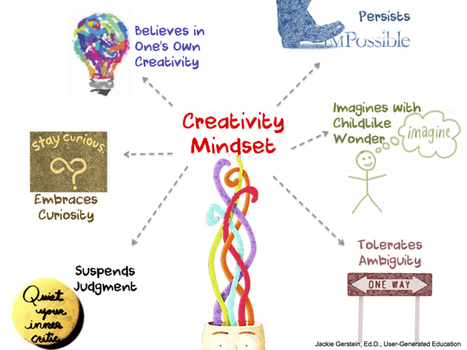
Suspends Judgment – Silences the Inner Critic The ability to hold off on judging or critiquing an idea is important in the process of creativity. Often great ideas start as crazy ones – if critique is applied too early the idea will be killed and never developed into something useful and useable. (note – this doesn’t mean there is never a time for critique or judgement in the creative process – it’s actually key – but there is a time and place for it). (http://www.problogger.net/archives/2007/05/09/9-attitudes-of-highly-creative-people/) Many new ideas, because they are new and unfamiliar, seem strange, odd, bizarre, even repulsive. Only later do they become “obviously” great. Other ideas, in their original incarnations, are indeed weird, but they lead to practical, beautiful, elegant things. Thus, it is important for the creative thinker to be able to suspend judgment when new ideas are arriving, to have an optimistic attitude toward ideas in general. Tolerates Ambiguity Ambiguity tolerance may be… the “willingness to accept a state of affairs capable of alternate interpretations, or of alternate outcomes,” (English & English 1958). In other words, ambiguity tolerance may be central to creative thinking. (http://knowinnovation.com/tolerating-ambiguity/#sthash.XqxhaQh3.dpuf) With the toleration of ambiguity, creativity gives way to new ideas, stimulates the acceptance of others’ viewpoints, and thus raises tolerance, understanding and cooperation. (http://www.academia.edu/2506344/Creative_climate_as_a_means_to_promote_creativity_in_the_classroom Persists Even When Confronted with Skepticism & Rejection Learn more: - http://www.scoop.it/t/21st-century-learning-and-teaching/?tag=Creativity
Via Gust MEES
|
|
|
Rescooped by
Jess Chalmers
from Leadership
April 9, 2015 5:29 PM
|
Developing this crucial ‘seeing things early’ side of your strategic leadership is not about becoming a great predictor of the future. What it comes down to is sparking and fine-tuning your alertness to early warning signals of change...
Via Anne Leong
Your best workers can inspire others to work harder, too, but only if you use them this way.
Via Anne Leong
|
|
Scooped by
Jess Chalmers
April 6, 2015 6:49 PM
|
Sometimes, reaching the next level of success isn't hard -- it just requires discipline, time, and consistency.
|
|
Scooped by
Jess Chalmers
April 2, 2015 1:36 AM
|
Solid tips to help you unwind and breathe — anytime, anywhere.
|
|
Scooped by
Jess Chalmers
March 31, 2015 5:35 PM
|
In author Charlene Li’s new book, she challenges leaders to use social technologies to connect with their customers and employees.
|
|
Scooped by
Jess Chalmers
March 26, 2015 6:37 PM
|
Effectively use your calendar to save time and free yourself from stress.
|
|
Rescooped by
Jess Chalmers
from Educational Technology News
March 26, 2015 6:34 PM
|
"By finding and perfecting your narrative voice for your eLearning course, you gain the ability to create an eLearning experience that is polished, organized, and complete. In this article, I'll explore how you can discover your narrative voice for your eLearning content, so that your eLearning courses can offer real value to your audience, instead of creating disjointed eLearning courses that fail to meet their learning objectives."
Via EDTECH@UTRGV
|
|
Scooped by
Jess Chalmers
March 25, 2015 7:10 PM
|
You have to understand people.
|
|
Scooped by
Jess Chalmers
March 25, 2015 7:05 PM
|
I think the way Deloitte has reimagined its approach to performance management is remarkable.You should read the full article at Harvard Business Review.Honestly, you shouldn't even read the rest of this post -- just go see the article.If you're sticking around, my two cents...Even if studying employee performance isn't your full-time job (it's not mine either), anyone who's given or received a performance review will find something in here that might make you re-think how reviews are done.I'm s
|
|
Scooped by
Jess Chalmers
March 25, 2015 7:00 PM
|
I think the way Deloitte has reimagined its approach to performance management is remarkable.You should read the full article at Harvard Business Review.Honestly, you shouldn't even read the rest of this post -- just go see the article.If you're sticking around, my two cents...Even if studying employee performance isn't your full-time job (it's not mine either), anyone who's given or received a performance review will find something in here that might make you re-think how reviews are done.I'm s
|
|
Scooped by
Jess Chalmers
March 25, 2015 1:18 AM
|
The 2014 Global Workforce Study covers over 32,000 employee perspectives on drivers of attraction, retention and engagement.
|
|
Scooped by
Jess Chalmers
March 16, 2015 6:49 PM
|
Culture is the new black. Why is it such an important new topic in business and how do we define it?
|