


"It has never been easier to sell courses online. We see it every day with people using LearnDash. It’s also quite visible on sites that cater to that entire industry (such as Udemy)."
Via EDTECH@UTRGV


 Your new post is loading...
 Scoop.it! "It has never been easier to sell courses online. We see it every day with people using LearnDash. It’s also quite visible on sites that cater to that entire industry (such as Udemy)." Via EDTECH@UTRGV 
No comment yet.
Sign up to comment
Scoop.it!

#1 Productivity: The difference between success and failure is doing things others put off. Protect time with priorities. Some things feel urgent but they don’t matter. Urgencies control weak leade... Via Anne Leong
Scoop.it!

Is 70:20:10 fact or myth? In reality, leaders spend their time on--and prefer--a different ratio.
Scoop.it!

These 50 ice breakers should help making introductions a little easier, allowing you to eventually move on to business.
Scoop.it!

Defensiveness. It’s ugly. We don’t want to do it, but we do it nonetheless. Driven by fear and emotion, our brains shut down and we lose the ability to think and relate to others. Being defensive has derailed many careers, as it impedes one’s ability to learn from mistakes, build strong interpersonal relationships, accept and benefit from differing perspectives, accept accountability for poor outcomes, or take initiative. To illustrate the negative impact of defensive behavior, consider the real-life story of an executive I’ll call Ron (not his real name). Via The Learning Factor

The Learning Factor's curator insight,
January 18, 2015 6:53 PM
Leaders need to make sure they themselves, aren’t provoking the defensive behavior, and must work to foster self-reflection rather than self-recrimination.
Scoop.it!
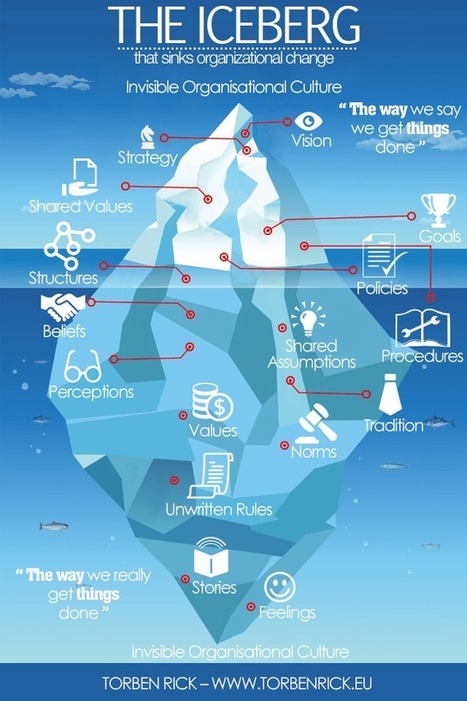
Some aspects of organizational culture are visible on the surface, like the tip of an iceberg, while others are implicit and submerged within the organization. Because these ingrained assumptions are tacit and below the surface, they are not easy to see or deal with, although they affect everything the organization does. Via The Learning Factor

Gudrun Hoehne's curator insight,
May 20, 2015 4:49 AM
In global companies sometime the organizational cultures differ according to the subsidiaries. This is also of importance for virtual tems who work acroos different subsidiaries and countries. 
Javier Antonio Bellina's curator insight,
June 8, 2015 11:07 AM
Lo que hay bajo el Currículum: El Currículum Oculto
Scoop.it!
Check the important eLearning statistics and facts for 2015! Check also the The Top eLearning Statistics and Facts For 2015 You Need To Know Infographic! Via Marta Torán, juandoming
Scoop.it!

A variety of human group behaviors can undermine innovation. For best results, we need to be aware of them and mitigate those that can derail innovation efforts. Via The Learning Factor

Paul Mendelsohn's curator insight,
November 14, 2014 10:12 AM
Insightful article on how human nature often skews group think processes to result in a herd mentality that quashes innovation, and how to overcome this phenom by striving for collective intelligence. Very useful observations for any organization striving for true innovation around change rather than inadvertently gaining less than optimal results through acquiesence by the flock.
Scoop.it!

"When social media-using faculty were asked to cite their biggest concerns for education, what topped the list were technology in the classroom (cited by 65 percent of teachers) and professional development (specified by 58 percent)." Via EDTECH@UTRGV
Scoop.it!

The first thing you might be wondering is how the heck you pronounce Cynefin. I know that was my first question. It is Kih-neh-vihn (/ˈkʌnɨvɪn/). The word is Welsh in origin and was coined by Dave ...
Scoop.it!

Everything about doing business with a company can potentially affect the customer’s attitude. Customers who feel valued and appreciated stay longer and spend more with a company over time. There a...
Scoop.it!

Everyone agrees that it’s a smart practice to ask for feedback. Don’t walk through life with blinders on. Show them that you’re proactive. Assume that you always have room to grow. But how do we actually get up the gumption to ask for criticism when deep down, we don’t want to hear the answer [...]
Scoop.it!

One of two things is going to happen when a newcomer joins your team. They're going to see right away how to plug into their own power source on the job and feel great about coming to work, or they're not. When you make it easy for a person to learn, [...] Via Anne Leong
|
Scoop.it!

A glance at today’s headlines leaves little doubt that we have entered a new era of geopolitical turbulence. Acts of terror and violence, humanitarian crises, and public health emergencies are rarely localized events. Instead, these shocks transcend borders, presenting global challenges. Just as one crisis fades, another rises to take its place. Via Kenneth Mikkelsen

Kenneth Mikkelsen's curator insight,
February 6, 2015 9:49 PM
Stability, resilience, and relationships are the keys to thriving amid geopolitical crises. 
María Dolores Díaz Noguera's curator insight,
February 8, 2015 1:39 PM
Claves para la dirección...How to Lead in Ambiguous Times | @scoopit via @LeadershipABC http://sco.lt/...
Scoop.it!

Research shows 85 per cent of your team wants to jump ship. And it's all your fault.
Scoop.it!
Sign up to be one of the first to receive the Global Leadership Forecast by DDI and The Conference Board.
Scoop.it!

We all know that living under stressful conditions has serious physical and emotional consequences. So why do we have so much trouble taking action to reduce our stress levels and improve our lives? Researchers at Yale University have the answer. They found that intense stress actually reduces the volume of [...]
Scoop.it!

The capabilities that companies need most have evolved, but methods of building those skills have not. Our survey finds that the most effective companies focus on sustaining skills and linking learning to business performance. A McKinsey & Company article.
Scoop.it!

"For the first time ever, Khan Academy has released all of its classes specifically for the iPad. This is great for anyone interested in getting some free education, but it’s much more than that. In fact, Khan Academy’s decision is big news for human civilization." Via EDTECH@UTRGV

Jason Robert LeClair's curator insight,
January 28, 2015 10:56 AM
A good resource for math, science, and the humanities!

Ula Rutter's curator insight,
January 28, 2015 2:26 PM
I've been recommending this resource to a number of students recently; it has lessons in many subjects now, but was originally started by a mathematician who posted explanations of maths topic.
Scoop.it!

Just a decade ago, experts warned of labor shortages in the United States and other countries as the baby boomers marched into retirement en masse. But with an aging population facing the prospect of living for decades on shrunken retirement funds, graying individuals plan to keep on working. Via The Learning Factor

Sebastian Jacquin's curator insight,
November 20, 2014 3:55 AM
Great article. I wish companies would embrace the chance to employ "older" employees in Belgium and benefit from their experience. Everyone is chasing young graduates with Master's degree and ignoring and whole other section of potential candidates.
Scoop.it!

Sally Tilley's curator insight,
November 16, 2014 4:31 PM
All school leaders could learn from this... thanks for sharing Dr. Susan Bainbridge #weareteachers 
Miguel Damiani's curator insight,
November 16, 2014 9:17 PM
Infografía sobre el aprendizaje en clase
Scoop.it!
The Cynefin Framework is central to Cognitive Edge methods and tools. It allows executives to see things from new viewpoints, assimilate complex concepts, an...
Scoop.it!

Self-evident and self-validating natural laws that don’t change or shift, providing true north direction for our lives. All are elegantly simple words that much like a compass, always show us the way. So simple however, that maybe, just maybe t [...]
Scoop.it!

How To Be The Best Boss [Infographic] by the team at Computers In Personnel Ltd.
|






