

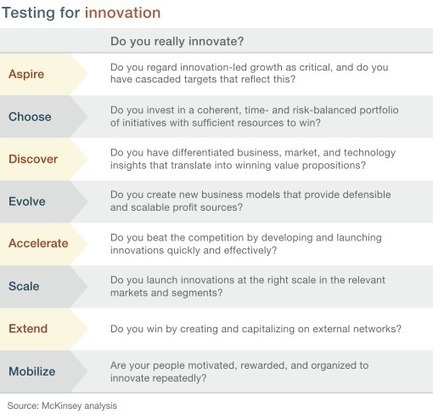
Strategic and organizational factors are what separate successful big-company innovators from the rest of the field. A McKinsey Quarterly article.


 Your new post is loading...
 Scoop.it! Strategic and organizational factors are what separate successful big-company innovators from the rest of the field. A McKinsey Quarterly article. 
No comment yet.
Sign up to comment
Scoop.it!

Author and marketing consultant Dorie Clark explains the basic tenets of thought leadership. Via Ana Cristina Pratas

Sandeep Gautam's curator insight,
April 30, 2015 1:34 AM
become a thought leader in your chosen field - have an impact on the world!!
Scoop.it!

One of the most popular Dilbert comic strips in the cartoon’s history begins with Dilbert’s boss relaying senior leadership’s explanation for the company’s low profits. In response to his boss, Dilbert asks incredulously, “So they’re saying that profits went up because of great leadership and down because of a weak economy?” To which Dilbert’s boss replies, “These meetings will go faster if you stop putting things in context.” Great leadership is indeed a difficult thing to pin down and understand. You know a great leader when you’re working for one, but even they can have a hard time explaining the specifics of what they do that makes their leadership so effective. Great leadership is dynamic; it melds a variety of unique skills into an integrated whole. Via The Learning Factor
Scoop.it!

"Power is a subject that makes many people extremely uncomfortable," Stanford professor Jeffrey Pfeffer argues, but just because we don't like to think about power doesn't mean it's not the lifeblood of business. "Power is in fact all around...like air and water and gravity," he insists. Ignoring power, therefore, won't make it disappear any more than wishing away gravity will help you fly. Instead of sticking your head in the sand, Pfeffer suggests you get real and start thinking constructively about accumulating power. How can you do that? In the video he offers a handful of actionable (if not necessarily universally palatable) tips. . Via The Learning Factor

The Learning Factor's curator insight,
April 19, 2015 6:51 PM
Power makes lots of us uncomfortable, but that's no excuse for sticking your head in the sand and not cultivating your professional clout
Scoop.it!

Stay sought-after by enabling others to proudly use their best talents together on things that matter to them. As William Butler Yeats wrote, "Because I helped to wind the clock, I come to hear it strike."... Via Anne Leong
Scoop.it!

Explore ways to help get your team inspired for the New Year.
Scoop.it!

If you said “no” to any of the above, you’re probably not indispensable to your employer. But you should strive to be, says Chris Gaborit, managing director and cofounder of The Learning Factor, in a recent LinkedIn post.
In the post, Gaborit offers keys to becoming indispensable at work.
“I decided to get some wisdom from people I respect,” he says. “I asked some of our best clients — senior managers who work for global companies. These people have walked the walk; they have been bulletproof when it comes to restructuring.”
Here are two ways to become indispensable at work: Via The Learning Factor
The Learning Factor's curator insight,
April 14, 2015 7:40 PM
Does your company value you? Do you think you’d survive multiple rounds of layoffs? Would your employer miss you if you were to leave? 
Elías Manuel Sánchez Castañeda's curator insight,
April 15, 2015 12:03 PM
The title of the post of Chris Gaborit is very suggestive "five keys to becoming an indispensable at work" frankly I think that no employee may become necessary but increase the likelihood that in times of crisis and organizational restructuring is one of the employees that the company wants to retain an employee who has also developed specific expertise of their work, the skills to be kept longer in a company that knows increase their employability. For these five tips Gaborit seem very important: Hold the mindset that change provides opportunity.Do not overfocus on the next job position but rather on the skills to be developed.Building relationships with key decision makers.Exhibit the ability to get ‘stuff’ done.Treat everyone with genuine respect
Scoop.it!

Alex Bryson examines the latest research establishing a link between the wellbeing of a company's employees and its profits and productivity.
Scoop.it!

Perfectionists are often reminded that "done is better than perfect." But it turns out there’s another reason we should all try to create more "done" moments in our workdays. Saying the word done can help you get more accomplished on your to-do list. "Telling ourselves that we’re done creates not only an emotional reaction but a physiological response as well," says Leslie Sherlin, a psychologist, neuroperformance specialist, and the cofounder of the brain-training company SenseLabs. Via The Learning Factor

Susan Bender Phelps's curator insight,
April 14, 2015 8:16 PM
When we are mentoring someone who has a pattern of being overwhelmed, helping them to see that a task or project is done and declaring that it is done is a very powerful tool. 
wimi-teamwork.com's curator insight,
April 19, 2015 5:48 PM
This article brings up something we could all use reminding of sometimes! 'Done is better than perfect'.
Scoop.it!

A critical aspect of helping employees find meaning in their work is effective, tailored communication. Here’s how to do it well. Via Anne Leong
|
Scoop.it!
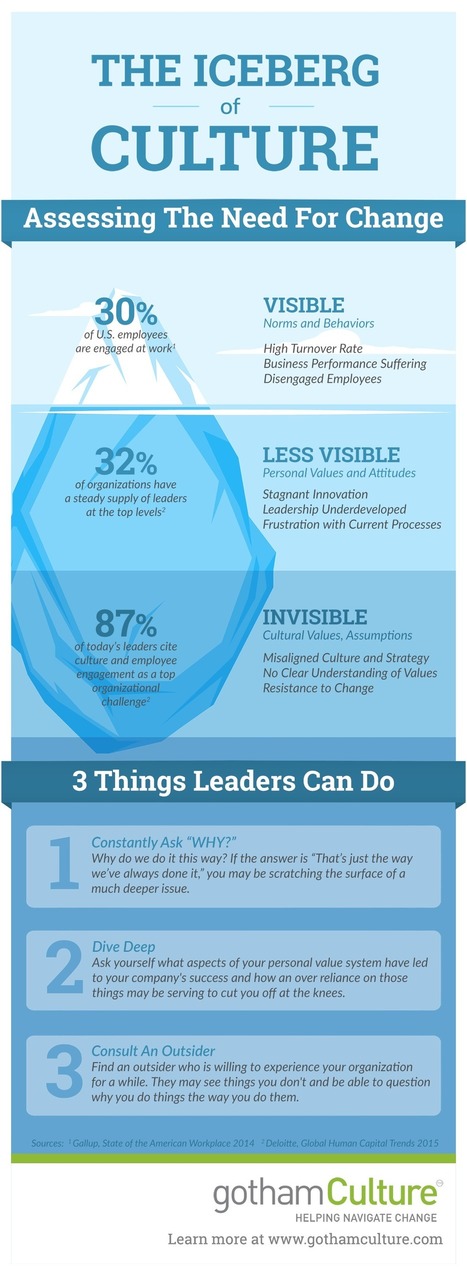
87% of today’s leaders around the world cite culture and employee engagement as one of their top organizational challenges. This is according to a recent report from Deloitte, who interviewed over 3,300 executives and HR leaders in 106 countries. The data in this and other large-scale studies weave together an alarming trend around today’s changing corporate landscape: Changing demands of the emerging workforce and looming leadership development challenges are growing risks for business today. Organizations must find ways to change and adapt to the changing needs of their stakeholders in order to maintain high performance. Organizational culture change at any scale can be challenging. And in order to overcome challenges like these, we often have to start diving into the depths the organization and figure out what is truly driving the culture. But, what does that mean to you as a leader? As Deloitte’s study highlights; many business leaders know the importance of organizational culture, Via Anne Leong

James D Johnson's curator insight,
May 2, 2015 4:37 PM
Drucker's famous quote on Culture revisited...critical stuff
Scoop.it!

The world economy’s operating system is being rewritten. In this exclusive excerpt from the new book No Ordinary Disruption, its authors explain the trends reshaping the world and why leaders must adjust to a new reality. A McKinsey Global Institute article.
Scoop.it!

No matter how much time we spend trying to optimize our inbox — from batch checking messages to adding bells and whistles — email takes over our lives. Looking at my stats from last month, I received and processed over 10,000 emails (eek!), so finding the right way to manage all this online correspondence has been critical for my day-to-day sanity. Turns out, though, the "right way" to manage email depends a lot on your own personal style. I've rounded up some of the most popular and successful strategies so that you can decide which one is best for you. Via The Learning Factor

DrAlfonso Orozco C.'s curator insight,
April 29, 2015 1:13 PM
4 Estrategias para empresar. Just do business...<<<<<<<<< 
Jesús López's curator insight,
April 30, 2015 4:07 AM
"...critical for my day-to-day sanity." Yours?
Scoop.it!

Performance reviews twice a year do little to help people improve. Here's how to give constant feedback and and still get things done.
Scoop.it!

Gary Vaynerchuk, CEO of social media consultancy VaynerMedia, talks about what it takes to manage a team, social media influencers, and more.
Scoop.it!
Out with the old assumptions, in with McKinsey Global Institute's new book on the four disruptive forces reshaping the world, "No Ordinary Disruption": http://… Via Ana Cristina Pratas
Scoop.it!

From
hbr

In today’s fast-paced, fiercely competitive world of commercial new product development, speed and flexibility are essential. Via Andrew Norton, juandoming

CIM Academy's curator insight,
April 17, 2015 5:52 AM
This article suggests that modern day new product development requires a cross functional approach.
Scoop.it!

Coaching is conversation. Read on for a few things all managers should know about coaching.
Scoop.it!

There are no secrets to success. It is the result of preparation, hard work, persistence, and learning from failure -- Colin Powell .
Scoop.it!

“The Rise of HR: Wisdom from 73 Thought Leaders,” is a recent anthology published by the HR Certification Institute in collaboration with Dave Ulrich, Professor, University of Michigan and Co-founder of The RBL Group, Bill Schiemann, CEO, Metrus Group, Inc. and Libby Sartain, Business Advisor and Board Member. Via Kenneth Mikkelsen

Kenneth Mikkelsen's curator insight,
April 12, 2015 2:17 PM
The following ten themes from the book offer valuable reflection, action and further reading for HR professionals around the world.
Scoop.it!

After years of hard work, you’ve landed your first position as a manager. It’s now time to prove yourself in your new role, but that may be a challenging task if you haven’t been trained to manage. If you’re feeling unprepared for your new duties, you’re not alone. According to Development Dimensions International, Inc., roughly 60% of new managers say they learned how to do their jobs through trial and error. Many described their leadership transitions as challenging, stressful or overwhelming. Via The Learning Factor
The Learning Factor's curator insight,
April 12, 2015 6:50 PM
Some integral tips for new managers to develop their techniques.
Scoop.it!
Trust begets trust. The best way to get your team to trust you is to trust them. Hire for trust. Require trust. Rid your team of untrustworthy players. And then, show your team how much you trust t... Via Anne Leong
|






