


Google Cardboard helps transform a smartphone into a wearable virtual reality device -- all for a few dollars or less.
Via EDTECH@UTRGV


 Your new post is loading...
 Scoop.it! Google Cardboard helps transform a smartphone into a wearable virtual reality device -- all for a few dollars or less. Via EDTECH@UTRGV 
No comment yet.
Sign up to comment
Scoop.it!

New research suggests that the secret to developing effective leaders is to encourage four types of behavior. A McKinsey Quarterly article.
Scoop.it!

From
99u

Micromanagers don't inspire those around them. Instead, aim to push authority as far down in the hierarchy as possible.
Scoop.it!

From
www
Emotional intelligence is the "something" in each of us that is a bit intangible. It affects how we manage behavior, navigate social complexities, and make personal decisions that achieve positive results. Emotional intelligence consists four core skills that pair up under two primary competencies: personal competence and social competence.
Learn more:
- http://www.scoop.it/t/21st-century-learning-and-teaching/?tag=EQ
Via Gust MEES

Gust MEES's curator insight,
June 19, 2015 7:59 AM
Emotional intelligence is the "something" in each of us that is a bit intangible. It affects how we manage behavior, navigate social complexities, and make personal decisions that achieve positive results. Emotional intelligence consists four core skills that pair up under two primary competencies: personal competence and social competence. Learn more: - http://www.scoop.it/t/21st-century-learning-and-teaching/?tag=EQ 
EM Matthews's curator insight,
June 20, 2015 6:01 AM
EQ is easily one of the most necessary, yet under-sought character skill sets for effective leadership and management! EQ was once the result of years of trial and error regarding effective social interactions. As the article suggests we all have the capacity for EQ, the challenge rests, however in actively nurturing (through targeted practice) our efforts at successfully employing and improving our EQ abilities, or characteristics.
Scoop.it!

From
www
It only takes seven minutes to change how you approach your day. Using the routine described below when you get to work will make a world of difference in your productivity, your attitude, your success, and your health. It's like the approach you make to the tee on a golf course. You plan out how you will hit the shot, which is more important than the actual swing. Before you start your day, this routine will provide the right mindset. Will you follow it? Note: I'm going to call this routine "The Seven," as in, "Did you do your Seven this morning?" Feel free to borrow that term or send me ideas on a better name. Via The Learning Factor

The Learning Factor's curator insight,
May 31, 2015 9:09 PM
This routine takes seven minutes each morning before you start work. Will you follow it? 
Ian Berry's curator insight,
June 1, 2015 6:43 PM
Something we can all do You may like this too http://blog.ianberry.biz/2012/10/are-you-focused-on-goals-or-standards_15.html and this http://blog.ianberry.biz/2015/05/as-within-so-without.html It's all about who before do 
Suntech iPark's curator insight,
June 1, 2015 9:03 PM
Want to start a brand new day? Check out this article. Good morning! :)
Scoop.it!

Web tool that calculates the most likely age for someone given their name.
Scoop.it!

From
www
We talk about happiness as if it were a thing to be discovered and acquired. But happiness can never be found externally. It is not a possession to be acquired or a set of conditions, but a state of mind. The happiest people don't necessarily have the best of everything, but they have learned to make the best of whatever they have. The happiest leaders aren't necessarily focused on success or failure but live by a different perspective--and that outlook makes all the difference. Here's how they live. Via The Learning Factor
The Learning Factor's curator insight,
May 21, 2015 6:49 PM
Too many of us are missing a critical element when it comes to our lives - happiness. Read on for the amazing secrets of the happiest leaders.
Scoop.it!

Until now, there have been a variety of tools for managers who wish to measure the emotional cues of individuals, such as the Brief Affect Recognition Test to understand cross-cultural facial expressions. Facial expressions provide a wealth of reliable information about how others are making sense of the world around them, and allow us to tailor our responses to the individual in a one-on-one situation.
This represents one of the key measures of emotional intelligence, which evaluates how well individuals perceive and deal with affectively charged interpersonal situations.
Learn more:
- http://www.scoop.it/t/21st-century-learning-and-teaching/?tag=Empathy
- http://www.scoop.it/t/21st-century-learning-and-teaching/?tag=Daniel+Goleman
- http://www.scoop.it/t/21st-century-learning-and-teaching/?tag=EQ
Via Mark E. Deschaine, PhD, Gust MEES

María Dolores Díaz Noguera's curator insight,
May 17, 2015 1:00 PM
Inteligencia Emocional y Liderazgo...Leaders Who Can Read Collective Emotions Are More Effective -- INSEAD | @scoopit via @hohhof http://sco.lt/... 
Eloquens's curator insight,
May 17, 2015 4:37 PM
How does your emotional intelligence help you to implement your strategy? 
Miguel Herrera E.'s curator insight,
May 18, 2015 8:56 AM
"Los Lideres detectan y re orientan las Emociones colectivas, percibiendo las actitudes de miembros Emergentes de grandes Grupos, quienes tienen Actitudes Significativas, Consistentes y Poderosas, que muestran su Influencia hacia la Mayoría y son respetados por ellas" -MHE-
Scoop.it!

New CEOs and senior executives often take over with a mandate for change. A structured four-step process can help them launch a transformation program and improve performance in a sustainable way.
Via Kenneth Mikkelsen

Hanne Alsen's curator insight,
June 17, 2015 3:15 PM
Hvilken OVERGANG er du / din virksomhed i lige nu ? 
Ghita Benkirane's curator insight,
July 20, 2015 2:52 AM
Un guide pour la transformation managériale
Scoop.it!
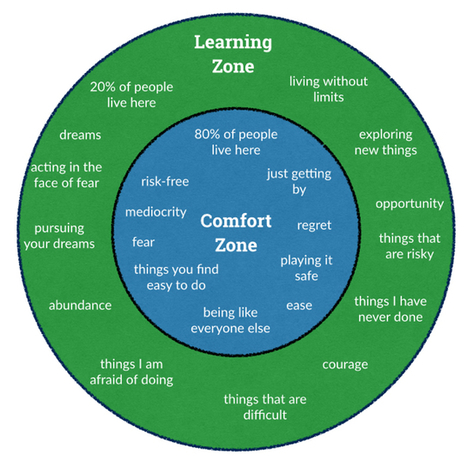
Successful leaders know that they must get out of their comfort zone to succeed. Great leaders from history are those who have spent a large amount of their time outside their comfort zone. . Leaders who take risks and step into their learning zone are those that succeed. It’s only when you can give up what’s safe and familiar that you create opportunities and develop new capabilities. As you do, you expand your influence and gain the skills required to take on bigger and bigger challenges. . In this sense, leaders are self-made and not born, they are developed, not promoted. Leadership is a learned skill that is developed as you step out of your comfort zone. . Learn more: . - http://www.scoop.it/t/21st-century-learning-and-teaching/?tag=LeaderShip Via Patti Kinney, Gust MEES

Marlena Gross-Taylor's curator insight,
May 17, 2015 10:24 AM
To be a fearless, 360 leader you have to step outside of your comfort zone. The experience provides the opportunity for growth! #leadupchat #edchat #mschat 
Dr. Deborah Brennan's curator insight,
May 17, 2015 11:54 AM
Vygotsky talked of the Zone of Proximal Development, and this article is in line with that foundational philosophy about learning. When we think about improving schools, both of Vygotsky and this article apply. We need leaders, teachers, and students operating outside their comfort zone, taking risks, setting goals, and learning. There is a danger in struggling schools to push too hard and move buying the productive zone for learning. This article speaks well to that aspect of learning. With good intentions, leaders at building, district, and state level often push a school and omits staff beyond the productive learning zone into the danger zone. This is done through programs, initiatives, and monitoring often with the goal of providing support, but with the result of overwhelming the school and staff.
Scoop.it!

From
mashable
Networking can feel like the professional equivalent of speed dating. And, like speed dating, you don't just want to make a good impression — you want to make a lasting one. So, how can you present yourself well and make meaningful connections when it feels like you're making small talk with people who are only half-listening? The first step is to reframe your concept of networking. At your next event, remind yourself that it's less about empty chit-chat and more about making connections. How do you make those? By forgetting everything you thought you knew about networking small talk and, instead, tapping into the science of good conversation! Here are six strategies for being the most popular person to talk to at your next networking event. Via The Learning Factor

Maggie Lawlor's curator insight,
May 8, 2015 7:06 PM
Networking often feels challenging. These are helpful tips.... 
BombshellConsultancy's curator insight,
March 14, 2016 8:27 AM
Here are six #strategies for being the most popular person to talk to at your next #networking #event!
Scoop.it!

Before doing so, executives should ask themselves two sets of questions. A McKinsey Quarterly article.
|
Scoop.it!
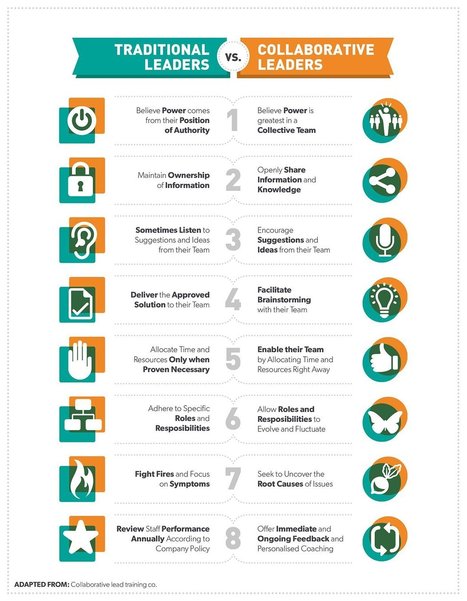
So what does tomorrow’s leader look like? Here are four traits on the rise: Part of the team. For a millennial workforce, working collaboratively is key – and that includes the chance to challenge and question the boss. Great leaders will spend time meeting their staff and really listening to what they have to say.Admitting mistakes. Authenticity rules, and that might mean having the courage and conviction to admit lack of knowledge or making the wrong call. Humility is critical, particularly in an age of transparency and public accountability.Multi-sector experience. Millennials are far more likely to move between jobs and sectors as they develop their career, and they’ll expect their leaders to have the same breadth of experience. The journey from shop floor to CEO isn’t as relevant for tomorrow’s workforce.Female characteristics. It’s still a shocking truth that 5% of Fortune 500 positions go to women, but the evidence shows that businesses benefit enormously from behavioural traits often considered to be female, such as emotional intelligence, diplomacy and complex social skills. Women make great leaders. Via Gust MEES

Sm_english's curator insight,
July 6, 2015 5:17 PM
I strongly belief that this applies also to school principals
Ian Berry's curator insight,
July 6, 2015 7:20 PM
Good infographic. Collaborative leadership is a feature of the new world of work. 
daniel truran's curator insight,
July 7, 2015 4:55 AM
An additional trait I love to see in a collaborative leader is the belief in #HumanNobility : believing that each individual has unlimited potential and that I as a leader need to allow that potential to contribute to the team in a collaborative natural flowing way.
Scoop.it!

From
www
Many of my clients deal with a fear of criticism. I see it in several aspects of their lives. At work, people fear criticism from their managers and colleagues, so they keep quiet and don't share their opinions. They play it safe. At home, people fear that they'll be criticized by their spouse or partner, so they don't speak their mind. They back down when they sense conflict. In friendships, people often don't have boundaries because they fear that establishing them would lead to criticism or that they would be viewed as selfish.
Whatever the setting, it's this fear that keeps people stuck. For example, by not speaking up and not sharing your ideas, you'll never advance. People won't know your thoughts and will have no reason to recognize your worth and promote you. Via The Learning Factor

The Clear Thinking Partnership's curator insight,
July 1, 2015 5:27 AM
This continues to be a tricky area of performance for so many leaders......... 
Michael Anderson's curator insight,
July 1, 2015 6:57 AM
A very positive article. Well worth reading. 
Edwin Abdiel Rodz's curator insight,
July 9, 2015 2:13 PM
We all go through the fear of criticism. Be it about your business, video or even your talent in general. Fear in itself is a very paralyzing thing, but when it reaches the topic that will source your future it tends to be taking even more seriously than it really is. There's this phrase that really calmed me down when I launched my first android app and started receiving negative ratings (not even many... just 2 out of 50). "Don't sweat it; you have knowledge now". Knowledge is the antidote of fear after all. Criticism shouldn't become a fear because it's actual knowledge of something that could be modified. Here are a few tips of how to handle criticism correctly. There's never any reason to be scared of criticism.
Scoop.it!
Scoop.it!
“DeAnne Aguirre, senior partner with Strategy&, discusses techniques that can help companies transform quickly and effectively. For more insights, read "10 ...” Via DennisOwen1

DennisOwen1's curator insight,
June 11, 2015 7:23 AM
Understanding the important elements of successful organisational change is the key.
Scoop.it!

From
www
Taking lots of breaks might not sound like the route to incredible productivity, but according to tons of research, giving yourself regular breathers is a sure-fire way to get more done. One study showed 20 minutes of yoga could significantly improve brain functioning, another that a quick nap would seriously boost memory, while a third suggested that just shy of an hour of work followed by around a 15-minute pause was the ideal work pattern. But what if you don't have 40 minutes to nap or even 15 minutes to kick back and reset? If that sounds like you, don't worry. Science has an alternative that even the most maniacally busy entrepreneur can take advantage of. According to a recent study out of Australia, even 40 seconds is enough to refresh your brain, as long as you do the right thing with those seconds. Via The Learning Factor
The Learning Factor's curator insight,
June 8, 2015 6:55 PM
Got 40 seconds? Then try this incredibly easy activity to give yourself a productivity boost.
Scoop.it!

View the featured presentations, documents, infographics and videos in the Leadership & Management category.
Scoop.it!
"The notion of openness in education is usually associated just with resources - whether content or technologies - and initiatives in tis field have often focused too narrowly on the mere generation of those resources, paying little attention to the "social life" of materials and relevant cultural practices. Via Edumorfosis, juandoming

ANA PAULA SENA DE ALMEIDA's curator insight,
June 29, 2015 3:14 PM
Tendência. Para os Professores e Gestores de Educação.
Scoop.it!

Toxic employees can be detrimental to the workplace. This infographic describes the negative behaviors employers might face, and how to deal with them.
Scoop.it!

From smartphone apps that can do seemingly everything to driverless cars and eerily humanlike robots, the past decade has seen dramatic advances in science and technology. What amazing advances ar
Scoop.it!
Successful leaders know that they must get out of their comfort zone to succeed. Great leaders from history are those who have spent a large amount of their time outside their comfort zone. . Leaders who take risks and step into their learning zone are those that succeed. It’s only when you can give up what’s safe and familiar that you create opportunities and develop new capabilities. As you do, you expand your influence and gain the skills required to take on bigger and bigger challenges. . In this sense, leaders are self-made and not born, they are developed, not promoted. Leadership is a learned skill that is developed as you step out of your comfort zone. . Learn more: . - http://www.scoop.it/t/21st-century-learning-and-teaching/?tag=LeaderShip Via Patti Kinney, Gust MEES
Marlena Gross-Taylor's curator insight,
May 17, 2015 10:24 AM
To be a fearless, 360 leader you have to step outside of your comfort zone. The experience provides the opportunity for growth! #leadupchat #edchat #mschat
Dr. Deborah Brennan's curator insight,
May 17, 2015 11:54 AM
Vygotsky talked of the Zone of Proximal Development, and this article is in line with that foundational philosophy about learning. When we think about improving schools, both of Vygotsky and this article apply. We need leaders, teachers, and students operating outside their comfort zone, taking risks, setting goals, and learning. There is a danger in struggling schools to push too hard and move buying the productive zone for learning. This article speaks well to that aspect of learning. With good intentions, leaders at building, district, and state level often push a school and omits staff beyond the productive learning zone into the danger zone. This is done through programs, initiatives, and monitoring often with the goal of providing support, but with the result of overwhelming the school and staff.
Scoop.it!
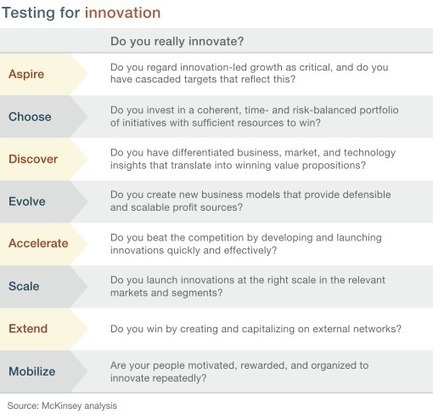
Strategic and organizational factors are what separate successful big-company innovators from the rest of the field.
Scoop.it!

YEC (Young Entrepreneur Council) surveyed some more folks about the best leadership advice they've ever received. Here are the responses.
|






