


Every successful company and organization inevitably must confront a key question: Is what got us to where we are today helping us to move forward, ... Read More »


 Your new post is loading...
 Scoop.it! Every successful company and organization inevitably must confront a key question: Is what got us to where we are today helping us to move forward, ... Read More » 
No comment yet.
Sign up to comment
Scoop.it!

When you learn to anticipate game-changers, you can become the game-changer in your own industry. Anticipation is a very powerful strategy.
Scoop.it!
Learn about the Critical Thinking University, Pearson TalentLens' online learning portal devoted to helping you improve your critical thinking, decisio
Scoop.it!

From
hbr

While a laudable effort in principle, measuring a company’s tendency to make myopic operating and investing decisions is fiendishly complex. Getting the measurement right is central to providing convincing evidence on the debate over short-termism.
Scoop.it!

We fall victim to “thinking traps” that influence our feelings and impact our behavior. How do you see the world? Do these 20 filters sound familiar?
Scoop.it!

[William] Clifford argued that we are morally responsible not merely for what we do and say, but also for what we believe… When we show ourselves to be uncritical and careless with own our beliefs, we implicitly invite others to do the same. And, perhaps more obviously, we invite others to fool us. We encourage dishonesty and deception. Each time we believe something that we lack the right to believe, in other words, we spread an intellectual and moral disease: an epistemic shamelessness that threatens the very possibility of meaningful, rational discourse… Among the most pernicious and perilous immoralities of our own age is our apparent surrender to the lowest standards of belief and communication… But it will take tens of thousands of us to really make a difference and drag our civil discourse back from the brink. Should all freshmen across the land be required to study critical thinking and symbolic logic? It is a thought. It’s a thought of Michael Ventimiglia, associate professor of philosophy at Sacred Heart University, who directs what sounds like a terrific program at the school that introduces every first-year student to critical thinking and introductory formal logic, in an essay at Times Higher Education. He is understandably disappointed and frustrated with the level of public discourse, as well as its political results, and he thinks that teaching every student logic could make a difference. I want to believe this. So I should be suspicious of it. (Note: being on the lookout for motivated reasoning is not something typically covered in logic or philosopher-taught critical thinking courses.) Professor Ventimiglia’s case is an explicitly moral one based on the value of “meaningful, rational discourse.” Whether such discourse is valuable in itself, or for the realization of other goods, or both, we can leave aside. Let’s also leave aside the many interesting questions about the extent and degree to which we can plausibly be held responsible for our beliefs. Grant all that. Questions remain. For example: Do people’s improved skills in critical thinking and symbolic logic lead to better, more meaningful, rational discourse among them? Does taking a course in critical thinking and symbolic logic lead to improved skills in critical thinking and symbolic logic? Do enough people attend college such that their..
James Schreier's insight:
Logic was a required freshman course at my university (way back in the day). While I did not do well in the course, I will strongly admit it turned out to be one of the most important and most valuable courses in my entire career -- both educationally and professionally!
Scoop.it!

--- Time for a new edition of SharpBrains’ e-newsletter exploring the latest in brain health. New research: Study debunks 4 common myths about brain
Scoop.it!
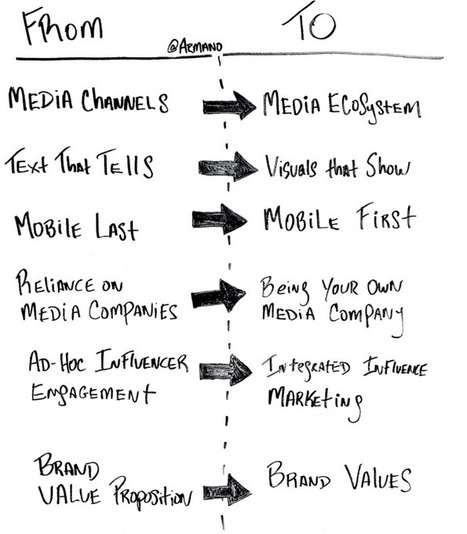
David Armano's personal blog: Logic+Emotion explores the thinking and practice of building responsive & resilient brands in a connected world
Scoop.it!

Professor Earl Miller, a neuroscientist at MIT in Cambridge, Massachusetts, advises that attention is limited resource, and the brain has a limited capacity for multitasking.
Scoop.it!

Research spanning several cognitive science disciplines shows a strong connection between early spatial reasoning training and future academic success.
Scoop.it!

We spend so much time discussing what critical thinking is and how to do it that we often overlook an important conversation: what skills do good critical
James Schreier's insight:
An older but solid piece of information on thinking clearly!
Scoop.it!

See why organizations worldwide are realizing the magic of combining big data with design thinking to generate value for powerful business use cases.
Scoop.it!

"Never Assume (ASS-U-ME) because when you do you make an A?? of U and ME.
James Schreier's insight:
Assumption are necessary! And the "ASS out of U and M" is a inaccurate assessment. But this article does conclude that it is possible to make positive assumptions.
|
Scoop.it!

On their own, amyloids don't seem to explain the memory and learning declines linked to Alzheimer’s disease. New research suggests a second factor. Via Joel Barker

Joel Barker's curator insight,
June 1, 2017 5:23 PM
Surprising new pathway to Alzheimer's from this research. JB
Scoop.it!

Isaac Lidsky may have lost his eyesight, but his vision is extraordinary. Here are lessons on how we can all live eyes wide open.
Scoop.it!

Google is currently testing driverless cars in Arizona. The two of us had lunch one afternoon in Scottsdale and watched the noticeable cars (with their rooftop honing devices) pass by our restaurant. As the car passed we heard a gentleman at a nearby table say, “Not a chance I’d get in that car.” As unnerving as driverless cars may seem, change can be hard for many people to accept. We often fear the worst — that music videos would be the end of radio, and tablets would eliminate traditional books. Just consider how many people find it concerning every time Apple changes its charging cord on the iPhone. Yes, it’s concerning. But, we adapt…because we have to. Change, in all areas of life, can be daunting, and especially at work where our natural tendency is to find a groove that works for us. Still, the resistance to change can be dangerous — as the way we work, the when we work, and the things we work on are consistently in a state of flux. Via The Learning Factor, James Schreier

The Learning Factor's curator insight,
April 18, 2017 7:28 PM
In a world with driverless cars, drone package delivery, and technology advancing like never before, it can feel like everything, especially our work, is changing. But, there are some things that actually never change—like the five mindsets that could inspire your boss to ask you to ‘take a hike.’ 
rodrick rajive lal's curator insight,
April 18, 2017 11:06 PM
Somehow, the human brain is averse to change, and disruption tests it severely. It will take some time getting used to riding in driverless cars or any new technology that challenges accepted beliefs and norms. To say that you hate change is a sure way to get fired. You need to get over your hatred for change and accept that there might be other ways to do things.
Scoop.it!

Children must be taught about fake news in schools to stop them from turning to extremism, a major international think-tank has said.
Scoop.it!

Steps and techniques for listening to both your gut and head to calculate your next best move.
Scoop.it!

This book by Nik Peachey is an excellent resource book for teachers of
Scoop.it!

We'd like to share this critical thinking skills cheatsheet for you to use with your students. Get them asking questions on any topic! Via Dr. Tom D'Amico (@TDOttawa)

Character Minutes's curator insight,
May 5, 2017 12:34 PM
Great tool for teachers to use in the classroom.

Julian F Calvo's curator insight,
February 19, 2020 9:59 AM
This is an excellent idea for us to check how we can implement our topics and also, how learners can be interested on due to the fact that we are taking into account all the benefits they can have (this as an example of the WH questions) and also since they can discuss about what they like to learn and share in classes. In adition, thi is something I can implement in classes since learners will have the opportunity to improve this speaking skill trhough the discussion of this kind of topics and also, the ones their are interested on. Finally, students will be able to participate more ought to the increase of motivation they will have since our duty is to encourage them to use the second language they are learning.

Harold Quintero's curator insight,
September 26, 2020 2:37 AM
This is a very complete guide related to critical thinking questions that can allow us to help our students reflecting on the content we present them. These questions are also very useful for teachers in development to keep in mind while planning classes and preparing the material they are presenting to their students as it leads them to better select and adapt the content to students' needs and interests and have them engaged.
Scoop.it!

The giant puzzle, created by German artist Clemens Habicht, features all the colours in the CMYK spectrum. This means tiles next to each other are almost identical in colour, but not exactly the same.
Scoop.it!

According to experts, from getting out of bed early to completing tasks on your commute, there's ten vital signs that prove you're a go-getter.
Scoop.it!

Playbuzz has devised a list of infuriating word riddles, otherwise known as dingbats, to put your logistical knowledge to the test.
James Schreier's insight:
A major part of my training programs on "Thinking Clearly and Analytically" is teaching specific techniques for solving puzzles like this. Logical thinking is a skill to be learned!
Scoop.it!

Some people caution that one should never make assumptions. When it comes to your career, is making assumptions good or bad?
Scoop.it!

Some of the key lessons from Dan Ariely's new book, 'Payoff.'
James Schreier's insight:
According to this post, there's some "hidden logic" to our thinking. That's always interesting.
|





