Thinking Clearly and Analytically
3.5K views | +8 today
Thinking Clearly and Analytically
Insights on Logical Thinking for Leaders -- with a Puzzling Perspective
Curated by James Schreier
Your new post is loading...
Scooped by James Schreier
July 6, 9:00 AM
Scoop.it!

How technology affects your memory and changes your brain

How technology affects your memory and changes your brain | Thinking Clearly and Analytically | Scoop.it
Psychologists call it cognitive offloading, and it has upsides and downsides for your memory.
No comment yet.
Scooped by James Schreier
June 29, 9:00 AM
Scoop.it!

Study: It's Not Being Alone That Hurts The Brain. It's Feeling Alone.

Study: It's Not Being Alone That Hurts The Brain. It's Feeling Alone. | Thinking Clearly and Analytically | Scoop.it
A study of 175,000 people finds feeling lonely predicts dementia and death more strongly than being socially isolated.
No comment yet.
Scooped by James Schreier
June 15, 9:00 AM
Scoop.it!

A psychologist's 5 signs your cognitive load is too high at work

A psychologist's 5 signs your cognitive load is too high at work | Thinking Clearly and Analytically | Scoop.it
When cognitive load climbs beyond a certain threshold, the quality of thinking degrades in ways we can’t detect from the inside. The brain doesn’t send a notification. What it sends instead is a set of signals, many of which look like the opposite of the problem. Five stand out.
No comment yet.
Scooped by James Schreier
June 8, 9:01 AM
Scoop.it!

I built a daily logic puzzle site with open-answer checking

I built a daily logic puzzle site with open-answer checking | Thinking Clearly and Analytically | Scoop.it
I built Riddle of the day, a bilingual daily logic puzzle site: https://acertijodeldia.com/en/ The... Tagged with ai, webdev, gamedev, programming.
No comment yet.
Scooped by James Schreier
May 26, 9:52 AM
Scoop.it!

Handwriting changes signal early age-related cognitive decline

Handwriting changes signal early age-related cognitive decline | Thinking Clearly and Analytically | Scoop.it
Many of us probably don't get much time to put pen to paper these days, with our world of correspondence now dominated by digital communication. But a new study from Portugal's University of Évora suggests that changes in handwriting could be an early red flag of serious age-related cognitive…
No comment yet.
Scooped by James Schreier
May 18, 1:25 PM
Scoop.it!

Developing our cognitive maps and how to navigate them

Developing our cognitive maps and how to navigate them | Thinking Clearly and Analytically | Scoop.it
When was the last time you paid atten­tion to your com­mute? And I don’t mean a cou­ple of feet in front of you, at the car merg­ing into your lane with­out a blink­er. I mean real­ly paid atten­tion to the route you take. Did you see the land­marks in the dis­tance that make up the city…
No comment yet.
Scooped by James Schreier
May 4, 9:00 AM
Scoop.it!

In Defense of Thinking

In Defense of Thinking | Thinking Clearly and Analytically | Scoop.it
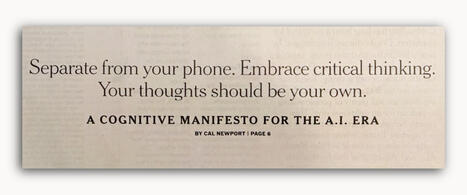
“The problems I focused on in Deep Work, and in my writing since, have been getting steadily worse. In 2016 my main concern was helping people find enough free time for deep work. Today I think we’re rapidly losing the ability to think deeply at all, regardless of how much space we can find in our schedules for these efforts.”
No comment yet.
Scooped by James Schreier
April 27, 4:16 PM
Scoop.it!

Can brain training defuse a potential dementia time bomb? A new study may have the answer

Can brain training defuse a potential dementia time bomb? A new study may have the answer | Thinking Clearly and Analytically | Scoop.it
45 years ago, the first cases of AIDS were identified in the US. In the early years, an AIDS diagnosis was almost always a devastating death sentence. But thanks to tremendous work by the global scientific community, treatments for the physical effects of HIV infection have come light years since then. Now, many people are able to live life to the fullest despite an HIV infection.
No comment yet.
Scooped by James Schreier
April 20, 9:00 AM
Scoop.it!

"Cognitive surrender" leads AI users to abandon logical thinking, research finds

"Cognitive surrender" leads AI users to abandon logical thinking, research finds | Thinking Clearly and Analytically | Scoop.it
When it comes to large language model-powered tools, there are generally two broad categories of users. On one side are those who treat AI as a powerful but sometimes faulty service that needs careful human oversight and review to detect reasoning or factual flaws in responses. On the other side are those who routinely outsource their critical thinking to what they see as an all-knowing machine.

Recent research goes a long way to forming a new psychological framework for that second group, which regularly engages in “cognitive surrender” to AI’s seemingly authoritative answers.
No comment yet.
Scooped by James Schreier
April 6, 9:00 AM
Scoop.it!

AI Uncovers Ancient Roman Game Rules from Limestone Slab

AI Uncovers Ancient Roman Game Rules from Limestone Slab | Thinking Clearly and Analytically | Scoop.it
A slab of limestone excavated in 1984 from the ancient Coriovallum settlement in the Netherlands presented a puzzle for researchers of Roman history. Because of its distinct grooves and marks, the stone piece was believed to be some kind of board game – but obviously no rulebook was dug up to…
No comment yet.
Scooped by James Schreier
March 23, 10:07 AM
Scoop.it!

Getting Older Messed With My Gaming. So I Changed How I Play

Getting Older Messed With My Gaming. So I Changed How I Play | Thinking Clearly and Analytically | Scoop.it
Don't give up something you love out of fear or frustration. You may have to explore and adapt, but ultimately it's still about having fun.
No comment yet.
Scooped by James Schreier
March 16, 9:00 AM
Scoop.it!

3-2-1: The price of compromise, the magic of art, and how to improve in the modern world

3-2-1: The price of compromise, the magic of art, and how to improve in the modern world | Thinking Clearly and Analytically | Scoop.it
“Questions are answered as you move, not before you move. Moving forward with an answer that is partially correct will usually fill in the gaps faster than waiting until you come up with a plan that is perfectly correct.”
James Schreier's insight:

The importance of questions has always been a major part of many of my workshops, etc.

No comment yet.
Scooped by James Schreier
March 2, 9:00 AM
Scoop.it!

How an Avalanche of Science Buried Brain Exercise Skeptics in 2025

How an Avalanche of Science Buried Brain Exercise Skeptics in 2025 | Thinking Clearly and Analytically | Scoop.it
Brain training reached a turning point in 2025, after years of growing evidence snowballed into an avalanche of scientific proof. A surge of new research about BrainHQ helped erode long-standing skepticism, with a record-breaking 70 peer-reviewed publications in science and medical journals in 2025.
No comment yet.
Scooped by James Schreier
June 29, 9:00 AM
Scoop.it!

I Let a Brain-Scanning Headset ‘Prime’ My Focus to Make Me a Better Gamer

I Let a Brain-Scanning Headset ‘Prime’ My Focus to Make Me a Better Gamer | Thinking Clearly and Analytically | Scoop.it
The next wearable health metric you'll obsess over may be your brain's actual level of focus.
James Schreier's insight:

This is interesting and important -- way beyond gaming!

No comment yet.
Scooped by James Schreier
June 22, 9:00 AM
Scoop.it!

“You’re a Moron”: An Angry Client Embraces Therapy at 92 

“You’re a Moron”: An Angry Client Embraces Therapy at 92  | Thinking Clearly and Analytically | Scoop.it
Discover the powerful story of a 92-year-old litigator's late-life emotional awakening through therapy. A journey of rediscovering memory, connection, and joy—proof that it’s never too late to change.
No comment yet.
Scooped by James Schreier
June 15, 9:00 AM
Scoop.it!

Work has outpaced human capacity

Work has outpaced human capacity | Thinking Clearly and Analytically | Scoop.it
Leaders often assume burnout looks like absenteeism. More often, it looks like presenteeism. People are at their desks. They are in the meetings. But they are operating at a fraction of their capacity. Roadmaps slip, releases stall, and nobody connects it back to how the work was designed.
No comment yet.
Scooped by James Schreier
June 1, 9:00 AM
Scoop.it!

What a neurologist does for better brain health

What a neurologist does for better brain health | Thinking Clearly and Analytically | Scoop.it
Brain atrophy tends to begin in your 30s and 40s, but certain lifestyle changes can slow or even reverse shrinkage.
No comment yet.
Scooped by James Schreier
May 25, 9:00 AM
Scoop.it!

Why humans need fiction, according to neuroscience

We created this video in partnership with Unlikely Collaborators.

What if the voice in your head is less of a witness and more of an interpreter? Two neuroscientists discuss the brain’s drive to explain, narrate, and make everything add up.

Subscribe to Big Think on YouTube ► https://www.youtube.com/channel/UCvQECJukTDE2i6aCoMnS-Vg?sub_confirmation=1
Watch the full Perception Box series ► https://youtube.com/playlist?list=PL5uULy4b0kV4iomWS7CzqCdOCwj0lFnLr&si=yCY6E
e7m6bpj7E-y

Stories do not just entertain us; they may be one of the main ways our brains rehearse experience, assign meaning, and turn scattered moments into something that feels like a self. We are constantly sorting actions, memories and emotion into a version of events that feels coherent enough to live inside. Neuroscientists Michael Gazzaniga, PhD and Dean Buonomano, PhD draw on split-brain research to explain the left hemisphere’s “Interpreter”: the brain’s tendency to create explanations for behavior, even when it does not have the full picture. The instinct to create narratives likely shapes far more than self-understanding. It may underpin identity, belief, and the desire to belong in the world.

No comment yet.
Scooped by James Schreier
May 11, 9:00 AM
Scoop.it!

Cognitive Science meets Meditation: Why I developed a new approach to help improve Attention and Emotional Regulation and Executive Control

Cognitive Science meets Meditation: Why I developed a new approach to help improve Attention and Emotional Regulation and Executive Control | Thinking Clearly and Analytically | Scoop.it
As a cog­ni­tive sci­en­tist and entre­pre­neur who devel­ops appli­ca­tions of inte­gra­tive cog­ni­tive sci­ence, I devel­oped a tech­nique designed to facil­i­tate sleep onset, called the cog­ni­tive shuf­fle, and also apps like mySleep­But­ton and Hook­mark. More recent­ly, I have turned to a dif­fer­ent ques­tion: why don’t we design a med­i­ta­tion for every­day life that is more engag­ing…
No comment yet.
Scooped by James Schreier
May 4, 9:00 AM
Scoop.it!

Why you should stop asking 'why' at work

Why you should stop asking 'why' at work | Thinking Clearly and Analytically | Scoop.it
In business, 'why' questions often trigger defensiveness instead of insight. Here's what you should do instead.
No comment yet.
Scooped by James Schreier
April 20, 9:00 AM
Scoop.it!

How I Rewired My Brain to Become Fluent in Math - Nautilus

How I Rewired My Brain to Become Fluent in Math - Nautilus | Thinking Clearly and Analytically | Scoop.it
Sorry, education reformers, it’s still memorization and repetition we need.
No comment yet.
Scooped by James Schreier
April 14, 8:29 AM
Scoop.it!

Study: AI can enhance, and also harm, human cognition. Beware "cognitive surrender"

Study: AI can enhance, and also harm, human cognition. Beware "cognitive surrender" | Thinking Clearly and Analytically | Scoop.it
“Cog­ni­tive sur­ren­der” leads AI users to aban­don log­i­cal think­ing, research finds (ars technica): When it comes to large lan­guage mod­el-pow­ered tools, there are gen­er­al­ly two broad cat­e­gories of users. On one side are those who treat AI as a pow­er­ful but some­times faulty ser­vice that needs care­ful human over­sight and review to detect rea­son­ing or…
No comment yet.
Scooped by James Schreier
March 30, 9:00 AM
Scoop.it!

How to read books again, backed by neuroscience

How to read books again, backed by neuroscience | Thinking Clearly and Analytically | Scoop.it
Losing our capacity for deep reading means losing some of our capacity for deep thought.
No comment yet.
Scooped by James Schreier
March 23, 7:34 AM
Scoop.it!

Brain teasers and resources to celebrate Brain Awareness Week (March 16-22, 2026)

We invite you to pre­pare for the upcom­ing 2026 Brain Aware­ness Week (March 16–22) by learn­ing about our incred­i­ble human minds and brains and by putting them to good use via some fun brain teasers, puz­zles and illu­sions for adults and teens alike :-) To warm-up, let’s try this men­tal rotation: Draw the let­ter J in your mind.…
No comment yet.
Scooped by James Schreier
March 9, 10:00 AM
Scoop.it!

A “sea change” in brain health

A “sea change” in brain health | Thinking Clearly and Analytically | Scoop.it
Can brain training “rewire” the brain to prevent dementia? What about repair the brain following an injury? Or turn back the clock on brain aging?
No comment yet.