The presentation and facilitated session describe the evolution of TOC from OPT, drum-buffer-rope (DBR), buffer management (BM), simplified drum-buffer-rope (SDBR) and make-to-availability (MTA) and reliable and rapid replenishment (RRR) strategy and tactics (S&T) tree. The assumptions of SDBR in make-to order (MTO) are provided. A MTA, MTO (MTA/MTS/RRR S&T) overview is provided.
Reference: D'Anci, A. (2008). ABB - Towards operational excellence. TOCICO International Conference.
TOC in Production Online Course extract: The 5 Focusing Steps. A Marris Consulting online service.
This course, that we launched one year ago, has been a great success. We continue to add to it continuously by enriching the appendices with more and more recent examples drawn from our unique experience of implementing the Theory Of Constraints in over 350 organisations throughout the world.
We have worked in: cars, bicycles, rockets, planes, trains, buses, medical devices, software development, missiles, chemicals, insurance, oil & gas, batteries, airlines, food & beverages, Swiss watches, auto OEMs, cardboard, aluminum, pharmaceuticals, steel, recycling, dog food, armament, tax services, public transport, e-commerce, industrial equipment, aeronautical MRO, nuclear industry, vacuum pumps, ERP editors and implementors, glass production, ball bearings, air conditioning, global logistics, semiconductors, bank note production, railway MRO, satellites, fast food, mining, armed forces, luxury goods, farming equipment, lampposts, luxury hotels …
A brief 5 minute summary of how one applies the Theory of Constraints in a production environment. It covers: the axiom of the unbalanced plant, the existence of bottlenecks, the Drum – Buffer – Rope flow control mechanism and the improvement strategy (the 5 focusing steps). Philip Marris has been applying the Theory of Constraints and Lean in production for over 35 years (since 1986), over 400 times in over 35 countries.
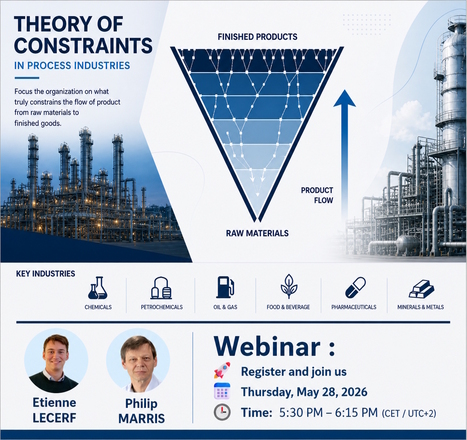
The Theory Of Constraints applied to process industries. Presented by Philip Marris and Etienne Lecerf.
In sectors such as metallurgy, steel-making, foundries, plastics processing, and chemicals, industrial flows are often based on a V-shaped model: a limited number of raw materials at the input stage and a wide diversity of finished products at the output stage.
In these highly capital-intensive environments, where capacity decisions are costly and resources are relatively inflexible, flow management becomes particularly complex, especially [...] MRP quickly show their limitations. [...] This rigidity often leads companies to produce in large batches, generating excess inventory, reduced agility, and operational tensions. [...] Drawing on Marris Consulting's experience of process industries, this presentation shares practical insights for better managing and optimizing flows in V-shaped plants ...
Clarke Ching — author of The Bottleneck Detective — joins Rory Sutherland and Elfried Samba to unpack why progress stalls, how leaders quietly become constraints, and why fixing the obvious problem often makes things worse.
Most organisations don’t fail because of a lack of effort. They fail because effort is applied in the wrong place. From traffic systems and hospitals to founders, governments and scaling teams, this conversation explores how bottlenecks hide in plain sight — and why seeing them requires a different kind of thinking.
You want to get more things done in life. So you become an early riser, buy a planner, and download a to-do list app. You maintain inbox zero by answering email the minute it lands in your inbox.You stay busy from the second your feet hit the floor until you rest your weary head […]...
MrBeast is the worlds most popular Youtuber. In this video he talks about the book The Goal and how he addresses the question of bottlenecks. Go to 19 mins and 50 seconds "Don’t Be The Bottleneck"
Marris Consulting has reached 600 videos and 750,000 views it’s YouTube channel. The videos are mostly about the Theory Of Constraints, Critical Chain Project Management, and the Thinking Process. There are also many videos about Lean including a series with an ex-VP of Toyota Motor Manufacturing. Many tutorials. Dozens of conference recordings. Etc.
In this session, we’ll show you a new way to plan manufacturing using the Theory of Constraints (TOC) inside ERPNext, so you can move away from rigid rules, messy spreadsheets, and last-minute 1. A practical, TOC-inspired approach to production planning 2. How to manage manufacturing using flow, not forecasts 3. Live demo: Smart stock buffers & task priorities in ERPNext 4. How to eliminate delays, stockouts, and overproduction 5. Tools that replace spreadsheets and disconnected systems
The presentation and facilitated session describe the evolution of TOC from OPT, drum-buffer-rope (DBR), buffer management (BM), simplified drum-buffer-rope (SDBR) and make-to-availability (MTA) and reliable and rapid replenishment (RRR) strategy and tactics (S&T) tree. The assumptions of SDBR in make-to order (MTO) are provided. A MTA, MTO (MTA/MTS/RRR S&T) overview is provided.
Reference: D'Anci, A. (2008). ABB - Towards operational excellence. TOCICO International Conference.
📅 Webinar : Theory Of Constraints in process Industries and V-plants.
👉 In many process industries — such as metallurgy, steel-making, foundry, plastics, and chemicals — industrial flows follow a V-shaped model: limited raw materials on the input side, but a wide diversity of products on the output side.
👉 This model, combined with highly capital-intensive environments and low-flexibility resources, makes operations management particularly complex.
Traditional approaches such as MRP quickly reach their limits, leading to well-known consequences: large batch production, excess inventory, lack of agility… and sometimes even a critical paradox — warehouses full of finished goods, yet dissatisfied customers.
This webinar offers a perspective on managing flows in V-shaped environments, based on real-world industrial experience.
🎯 Objective: gain better control over your flows to reduce inventory, improve customer service, and sustainably enhance overall operational performance.
An Introduction to Buffer Management This presentation explores the conceptual origins of buffer management in the context of TOC developments across make to order, engineer to order, make to availability (MTO, ETO, MTA) manufacturing environments and more recently in the service sector. The presentation relates the buffer management concept to the seminal work of Shewhart (1931) and Ohno (1978) and discusses the practical and theoretical basis for extending the buffer management concept to enhance ‘lean’ developments, with particular reference to construction and healthcare management.
Aeronautical industry: How to master your ramp-up with the Theory Of Constraints. How to produce more despite a stressed-out Supply Chain. Watch the video recording of my recent webinar on the subject. A 22-minute executive summary. This is our point of view based on the 40% of our assignments that are in the aeronautical industry.
The Theory Of Constraints is all about finding what element prevents you reaching your goal. In this case the goal is to produce more. So, the approach is simple: find the “bottleneck” and focus on how it can produce more.
Often, but not always, another important thing that needs to be done in parallel is to reduce the level of inventory. We do this using the “2 for 1 rule”.
I talk not only about producing more but also how to accelerate project portfolios since ramp-ups often require Capex projects, production transfers from one plant to another, new product industrialization, etc.
To Never Run Out. Isn’t that “The Objective” everyone wants right now? [...] with Henry Fitzhugh Camp and Jake Lanning for the latest Episode of the Supply UnChained Podcast [...] They are now bringing to life their Material-as-a-Service concept called SupplyStream, which predicts the part demand, but also supplies the physical part at the right time. [...] We spoke about: -How a few $100Ms of pooled aircraft parts can unlock $50 BN+ of value for the airlines and aerospace primes, and cheaper airfares. [...] -How software alone does not solve the parts problem, [...] -How SupplyStream can serve almost any industry in the US -How they are maintaining 99.99% OTIF with their current set up -How tethering an MRP with Demand Forecasts or Consumptions is not enough, [...]
I once spent quite some time optimizing a database query that was bringing our API to its knees. We... Tagged with programming, architecture, performance.
I was just reading an article on CNCReport.com titled "Never Enough Magnetic Mounts". The author was calculating how much money you'd save if you invested in
A quick manufacturing riddle that reframes how you should think about scaling any business. Theory of constraints, business strategy, AI, entrepreneurship, systems thinking.
This is an extract from the 6-hour online course by Bill Dettmer on the Logical Thinking Process (of the Theory Of Constraints).
Stemming from the Theory of Constraints, the Logical Thinking Process consists of a structured way of reasoning and a set of tools or processes to help executives and system managers to design their organizational strategy, to plan its deployment, to evaluate its effectiveness, and to make corrections as needed in the shortest possible time.
Is 'TLS' – the integration or combination of TOC (T) with lean (L) and six sigma (S) – a good idea? What does it mean exactly? How do they reinforce each other? What are the incompatibilities? What are the case studies? Is it an opportunity or a threat for the TOC movement? Industrial improvement efforts over the past 20 years have been handicapped by quarrels concerning the relative merits of the different approaches and of the supposed incompatibilities or fundamental differences among them. TLS considers, on the contrary, that we should seek to combine them thereby creating a system that contains the best aspects of each movement. By Philip Marris
The long name of the Theory Of Constraints should be: the Theory Of Constraints and of the management of uncertainty. TOC has always included buffers to absorb uncertainty and variability. This is especially important in project Management (Critical Chain) where there is intrinsically a lot of uncertainty.
Too many people are getting world-class at solving the wrong thing. A woman at my event last week was DEAD set on using AI for customer support.She runs...
What can an obscure theory of industrial productivity teach us about producing better results in a distracted world? In this episode, Cal is joined by the #1 New York Times bestselling author David Epstein to explore this question. They dive deep into a chapter of Epstein’s new book, INSIDE THE BOX, that makes a surprising connection between the so-called “Theory of Constraints” and personal productivity.
[...] a systematic overview of how to: - Identify the Constraint (AKA: The Bottleneck): (See slides 4 & 6) The entire organizational flow is limited by the single tightest restriction. If you aren't optimizing only the constraint first, every other effort is waste. - Practice "Creativity Before Capital": (Slide 8) In 90% of cases, the bottleneck solution is free or extremely low-cost. Moving from chaos to Phase I success does not require significant capital expenditure or additions to headcount. It requires ruthless 改善 (Kaizen) prioritization. - Implement systematic, multi-phase growth sprints: Double EBITDA in 90 to 180 days (Phase I), then transition through continuing 90-day phases that multiply EBITDA again and again (see our projected EBITDA multiplication curve). [...]
This presentation highlights some of the core developments over the last thirty years and in particular focuses on areas where modification of the standard applications was not sufficient and a different approach was required (one that remains firmly rooted in the underpinning theory). In each instance Alex Knight demonstrates that the breakthrough has come purely from the derivation of the underlying theory and has never required the addition or integration with other theories.
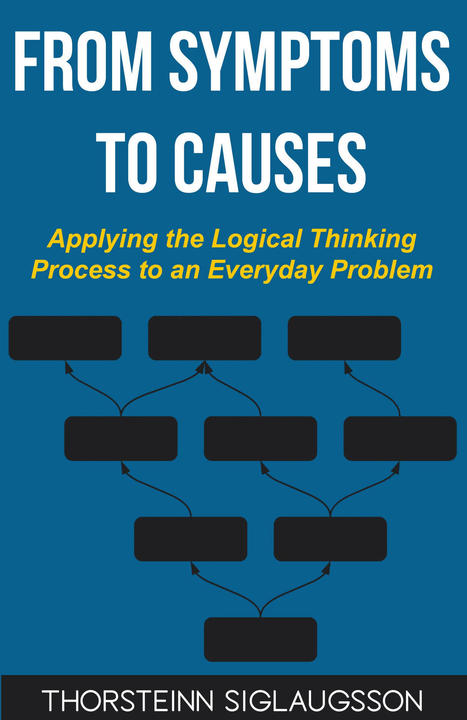
This is a booklet that describes the process of thinking through a situation, using the TOC Logical Thinking Processes, to show how systems thinking plays an important role in really developing lasting solutions to problems, whether they bedevil the homeowner as in this example, or a business. Think
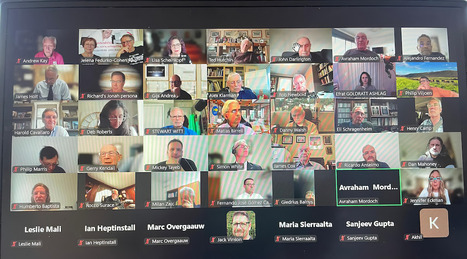
An online conference of over 20 TOC oldies to speak about their time with Eliyahu Goldratt, and Eli’s impact on their lives. The link includes time stamping to go to a specific testimonial.
To get content containing either thought or leadership enter:
To get content containing both thought and leadership enter:
To get content containing the expression thought leadership enter:
You can enter several keywords and you can refine them whenever you want. Our suggestion engine uses more signals but entering a few keywords here will rapidly give you great content to curate.


 Your new post is loading...


![TOC Tips by Lisa Lang [AI generated] | Theory Of Constraints | Scoop.it](https://img.scoop.it/9vZlgK-2yK9z9HQIvE1vDDl72eJkfbmt4t8yenImKBVvK0kTmF0xjctABnaLJIm9)


![Focus for Impact [with TOC] - Michael Asbury | Acceleration Summit | Theory Of Constraints | Scoop.it](https://img.scoop.it/HsqKsc5hANhaLwYAHIKuPTl72eJkfbmt4t8yenImKBVvK0kTmF0xjctABnaLJIm9)