In this presentation Etienne Lecerf explains how to apply proven delivery principles from Agile, Lean, and the Theory of Constraints to improve flow, reduce friction, and deliver more consistently — across projects, teams, and functions.
You will understand:
- how to manage bottlenecks in a project portfolio, - how to fix the orga. root causes leading to projects delays, - how to scale Agile without heavyweight frameworks.
TOC in Production Online Course extract: The 5 Focusing Steps. A Marris Consulting online service.
This course, that we launched one year ago, has been a great success. We continue to add to it continuously by enriching the appendices with more and more recent examples drawn from our unique experience of implementing the Theory Of Constraints in over 350 organisations throughout the world.
We have worked in: cars, bicycles, rockets, planes, trains, buses, medical devices, software development, missiles, chemicals, insurance, oil & gas, batteries, airlines, food & beverages, Swiss watches, auto OEMs, cardboard, aluminum, pharmaceuticals, steel, recycling, dog food, armament, tax services, public transport, e-commerce, industrial equipment, aeronautical MRO, nuclear industry, vacuum pumps, ERP editors and implementors, glass production, ball bearings, air conditioning, global logistics, semiconductors, bank note production, railway MRO, satellites, fast food, mining, armed forces, luxury goods, farming equipment, lampposts, luxury hotels …
The Theory Of Constraints applied to Sales. Some companies suffer from a lack of activity, and we often hear: "The constraint is in the market." This phrase is often expressed as inevitable, even though it is often possible to pull internal levers to overcome this constraint. [....] hosted by Philip Marris and Etienne Lecerf, illustrates the application of the Theory of Constraints to Sales, or how to sell more in industries with a high product diversity, and presents simple tips and solutions to increase revenue. [....]
In B2B sectors with a high product/customer mix, sales teams often face a paradox: a multitude of opportunities, but too little time, focus, and operational alignment to convert them. [....] it would be misleading to think that the responsibility for selling more only falls to sales departments [....] the joint responsibility of sales and operations to increase revenue. [....]
In this webinar, discover how: - The cluster analysis and the white space analysis reveal the [....] - Throughput accounting transforms pricing into [....] - Operations and Supply Chain can maximize [....] - Sales flow mapping clarifies the real constraint [....]
Short, stand-alone stories inspired by the Theory of Constraints that reveal why systems fail despite smart people, hard work, and good intentions.
Over 100 stories that you can read in any order. 405 pages. A collection of short stories about systems that look busy, responsible, and well-managed—yet quietly fail to move toward their goal. Each story offers a moment of recognition where seeing differently matters more than working harder. These stories can be read in any order. You can pick and choose the ones that interest you or read them all.
Philip Marris presents the graphic edition of the international best seller "The Goal". Based on the business novel "The Goal" by Eliyahu M. Goldratt and Jeff Cox, this book is a graphic novel. It is an original and pertinent introduction to the Theory of Constraints.
The story is basically unchanged: same story line, sames messages, sames characters, etc.
Authors of original 1984 edition: Eliyahu M. Goldratt and Jeff Cox. Authors of the graphic edition, 2017: Dwight Jon Zimmerman (Editor), Dean Motter (Illustrator)
Operational excellence in the agri-food industry. A lot of the solutions proposed to improve operational excellence are aimed at the manufacturing industry. The specific constraints of the food industry are too often ignored. [...] Philip Marris presents how to adapt classical Operational Excellence to this industry, perspective supported by numerous missions in this industry over the past 20 years. [...] the products must remain fresh has historically forced these businesses to ensure good, rapid flow through their processes. [...] The factory type is nearly always a “V-Plant” with many more references of finished goods as there are different types of raw material. The classic pull flow control mechanisms such as Kanban will often be inapplicable. [...] For those industries that own the raw material (be it the apple trees or herds of cows) they are inexorably in a “push environment" where the challenge is to get the best margin from a given and uncontrollable quantity of incoming material. [...] The material yield (kilos sold / kilos incoming) is key [...] there are change-over constraints [...] In this webinar Philip Marris, with his wide-ranging experience of hundreds of different production environments and the experienced gained by Marris Consulting in the food industry shares his lessons learned and his recommendations.
Those who apply the Theory Of Constraints (TOC) have a tendency to confuse the capacity constraint of the organisation (the bottleneck) and punctual or chronic problems.
Those who apply the Theory Of Constraints (TOC) have a tendency to confuse the capacity constraint of the organisation (the bottleneck) and punctual or chronic problems.
Test your knowledge of The Theory of Constraints! Do you know the basics of the approach first described in the bestselling the novel "The Goal" by Eliyahu Goldratt? Take the test! 10 questions. With fully explained answers.
The "2 for 1" rule to reduce Work In Progress and accelerate flow. A webinar hosted by Philip Marris, the founder and CEO of Marris Consulting. [...] The "2 for 1" rule is very simple: a new unit (such as a production order, an order, or a project) can only be launched into the system if two units have been previously released (finished).
Stop starting and start finishing!
The emphasis is on completing activities already underway before starting new work. [...]
About the speaker: Philip Marris Philip started his Lean and Theory Of Constraints journey in 1984. He worked with Eliyahu Goldratt, the founder of TOC and author of the worldwide bestseller “The Goal”. He is also a recognized Lean expert and combines Lean (Manufacturing/Engineering/Management) with TOC. ...
Why you should not use VSMs (Value Stream Mapping) to try and find the bottleneck in your factory. VSM is a powerful and widely used tool. It can be used to improve the speed and efficiency of the production of one product. But is is not the right tool to identify the bottleneck or capacity constraint in a production system. This short video explains why.
The Theory of Constraints provides a compelling framework for consulting firms seeking to improve delivery, scale operations, or simply gain clarity on what’s holding them back.
Semiconductors run on compressed schedules, global teams across 3 or more time zones, 12h apart, and the constant pressure of tape-outs and customer milestones. [...] And yet, the Theory of Constraints (TOC) — a methodology built precisely to manage flow, reduce overload, and protect what truly matters — is almost invisible in semiconductor companies.
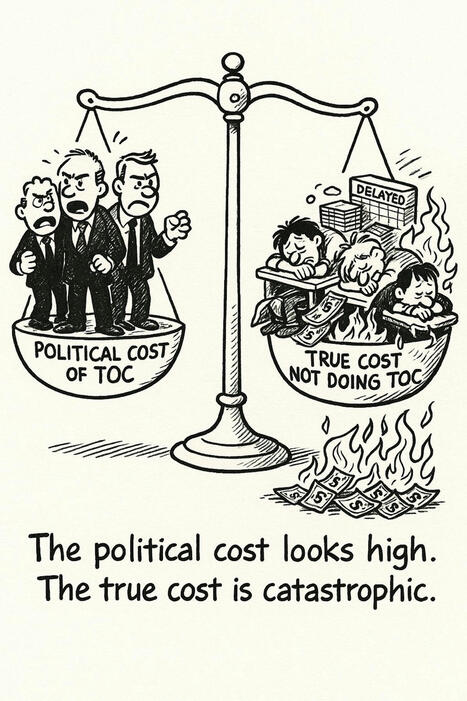
Why? Not because it doesn’t work, but because often the political cost of implementing TOC is seen as higher than the pain of the current system.
To key to manage people is mutual respect. Not just between the manager and their team, but between team members. How do you build respect and team spirit. This is the challenge Dr Goldratt addresses in this short extract from his "Goldratt Satellite Program - Part 7 - How to manage People the TOC way".
Webinar presented by Philip Marris, CEO of Marris Consulting, sharing his experience supporting numerous aerospace equipment manufacturers in their ramp-up projects.
Aeronautical OEMs: How to produce more despite a stressed-out Supply Chain. [...] Often singled out are the OEMs - Original Equipment Manufacturers -, who are struggling to keep up with the steep ramp up in demand. And the entire supply chain is impacted: lack of materials, but also often a lack of capacity and resources with rare skills. [...] This webinar provides you with the keys to successfully increasing production rates and delivery volumes, while simultaneously improving working conditions.
A brief 5 minute summary of how one applies the Theory of Constraints in a production environment. It covers: the axiom of the unbalanced plant, the existence of bottlenecks, the Drum – Buffer – Rope flow control mechanism and the improvement strategy (the 5 focusing steps). Philip Marris has been applying the Theory of Constraints in production since 1986. He is the CEO of Marris Consulting.
TOC4Finland has invited Philip Marris, CEO of Marris Consulting and a renowned expert in the Theory of Constraints and Lean, to their next meeting in March 2026. This is the continuation of Philip Marris' collaboration with the TOC community in Finland that dates back to his first conference in Helsinki in 2017.
The event brings together several international experts who will present advancements in the use of the Theory of Constraints, particularly with Artificial Intelligence, and case studies of the implementation of the Theory of Constraints and Critical Chain:
1) Case study: How Goldratt's rules were implemented at Fingrid (electricity transmission system operator), by Rami Saajoranta (in Finnish)
2) Case studies: Goldratt's Rules of Flow and Critical Chain by Georgijs Buklovskis (in English)
3) Relevance of the Theory of Constraints when using AI, by Sari Torkkola (in Finnish)
4) Combining the Theory of Constraints and Lean: 1 + 1 = 3, by Philip Marris (in English)
TOC was called in for what may be the worst environmental disaster in the USA. BP’s Deepwater Horizon platform exploded, [...] sending oil gushing into the Gulf of Mexico. Pinnacle Strategies was called upon by BP to rapidly improve supply chain availability and decontamination efforts. Less than 48 hours after the initial inquiry, they began a marathon of visits [...] in one case 10 fold increase, of manufacturing capacity for boom, skimmers, and absorbents. Later, after the well was capped, Pinnacle Strategies led improvement activities at decontamination sites across five states where thousands of boats, ships, and rigs were decontaminated before returning to their normal service. ...
Despite its well-known origins in production, popularized through The Goal, Theory of Constraints (TOC) is far more than a production philosophy – it can be applied to many other areas. ...
Mabin, V. (2013). The thinking processes basics workshop. TOCICO International Conference, Bad Nauheim, Germany, TOCICO
TOCPA is an international professional platform aimed to share experience of bringing companies and organizations to operational excellence using Theory of Constraints. TOCPA is aimed to give TOC practitioners and those interested in TOC the opportunity and ability to grow their knowledge and address practical issues and challenges that they face in their quest of bringing TOC to their organizations or to their clients.
How to improve flow in knowledge work with the Theory of Constraints
The first time I heard the term Theory of Constraints (ToC), I imagined something as exciting as watching laundry dry. Years later, the Five Focusing Steps of ToC are some of the most powerful tools I know for improving delivery performance—whether in manufacturing, software, or government IT.
The Theory Of Constraints (TOC) is more and more pertinent in today's increasingly volatile, uncertain, complex and ambiguous (VUCA) environment that businesses operate in.
There are now often big bad bottlenecks in organizations.
TOCICO offers three levels of professional certification: Level 1 Fundamentals Certification for the basic knowledge, Level 2 Practitioner Certification for more advanced knowledge, and Level 3 Implementer Certification for those who actually apply TOC in their own work. For an overview of our certification marks, watch this webinar.
Level 1 (L1) TOC Fundamentals Certified (TOCFC™) — individuals demonstrate their recognition and understanding of TOC’s basic concepts and terminology, either for TOC overall, or in a specific TOC Solution area by passing any L1 exam.
This presentation describes a method for constraint identification (questions to be asked about the market, production facility, and the suppliers), defines cash constraint, describes issues with cash constraints, discusses how to manage a cash constraint and provides a case study illustrating the concepts. Reference: Gilani, R. (2006). Evaporating cash constraint. TOCICO International Conference: 4th Annual Worldwide Gathering of TOC Professionals, Miami, Fl, Goldratt Marketing Group.
Marris Consulting has reached 600 videos and 750,000 views it’s YouTube channel. The videos are mostly about the Theory Of Constraints, Critical Chain Project Management, and the Thinking Process. There are also many videos about Lean including a series with an ex-VP of Toyota Motor Manufacturing. Many tutorials. Dozens of conference recordings. Etc.
Eli Schragenheim explains the “6 questions on the value of technology” of the Theory Of Constraints that guide or frame development of new products or services. He claims that: "These have huge potential. [...] They are as powerful as the Theory Of Constraints 5 focusing steps.[…] They are a goal mine. […] They don’t give you the answers but they give you the right questions."
The six questions are: What is the power of the new technology? What current limitation or barrier does the new technology eliminate or vastly reduce? What policies, norms and behavior patterns are used today to bypass the limitation? What policies, norms and behavior patterns should be used once the new technology is in place? In view of the above, what changes/additions to the new technology should be introduced? How to cause the change?
These questions appeared initially and partially in the book "Necessary but not sufficient" he co-authored with Eli Goldratt and Carol Ptak. The book was published in 2000 but the 6 framing questions are still very pertinent nowadays with regards for instance start-ups, disruptive innovation and "app" development.
In this presentation Etienne Lecerf explains how to apply proven delivery principles from Agile, Lean, and the Theory of Constraints to improve flow, reduce friction, and deliver more consistently — across projects, teams, and functions.
You will understand:
- how to manage bottlenecks in a project portfolio, - how to fix the orga. root causes leading to projects delays, - how to scale Agile without heavyweight frameworks.
To get content containing either thought or leadership enter:
To get content containing both thought and leadership enter:
To get content containing the expression thought leadership enter:
You can enter several keywords and you can refine them whenever you want. Our suggestion engine uses more signals but entering a few keywords here will rapidly give you great content to curate.


 Your new post is loading...