From Siri to self-driving cars, buzz has been building around artificial intelligence (AI). But Siri is far from able to answer every question or perform every task, and due to regulations it will still be years before most of us climb into a fully autonomous, self-driving car. In the meantime, there are many other products and services primed to be transformed by AI.
Machine learning is a tool, and like any tool, we need to learn how and when to use it. Machine learning requires large, structured datasets for training. And the types of problems that machine learning can help us solve need to be tightly scoped and clearly defined.
In the short term, our work lives are better suited to benefit from AI than our personal lives. This is because our work lives contain troves of structured data, and because our goals and intended outcomes at work are often more quantifiable. From scheduling meetings, to prospecting potential customers, to managing expenses, there are numerous applications in the enterprise where AI would be advantageous.
There's one skill, though, that will make humans essential in a highly automated "smart" world, which needs to be taught and practiced. You could see it as a complement to both critical thinking and problem-solving. It's what I call "problem listening". Problem-solving will be more and more automated, but humans must take the advantage of their problem listening potential.
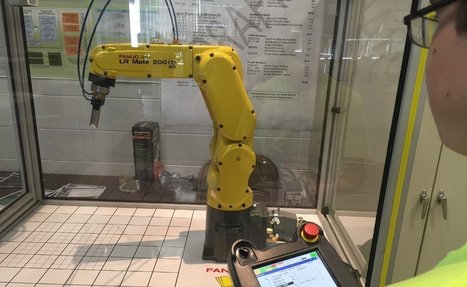
Michigan Technological University is working with Bay College to educate a highly skilled workforce in industrial robotics, a field in growing need of well-trained workers.
A new agreement between the community college and the university will enable students who earn an Associate in Applied Science degree in Mechatronics and Robotics Systems to transfer their credits into the Bachelor of Science in Electrical Engineering Technology program at Michigan Tech.
La tecnología ofrece muchas posibilidades para investigación, información, comunicación y un largo etcétera, y no podía ser menos, también ofrece muchas posibilidades para que los profesionales de la educación puedan mejorar sus clases, convertirlas en más dinámicas y conectar con los alumnos. Hay que conseguir que nuestros alumnos consigan un aprendizaje significativo, y en ese sentido podemos hacer uso de muchas aplicaciones educativas que dinamicen el proceso de enseñanza-aprendizaje. A continuación, facilito una serie de aplicaciones que pueden ayudar a los profesores en su día a día.
With online information expanding at an exponential rate, both educators and students are turning towards online content for research and education. The Internet provides easy access to articles, white-papers, books, videos, educational tools, etc. that help to enhance offline education and teaching methods. By exposing students to traditional classroom methods and incorporating online learning, students are able to think about topics from a wide variety of perspectives. It also helps students learn by tapping into their preferred learning styles (audio, visual, etc.).
Educators all over the world handpick supplemental online information on various topics to help their students learn, think and absorb relevant information in creative ways. More often than not there are multiple links that need to be shared. There are many bookmarking tools to collect online links however, to meet the needs of educators it’s equally important to be able to share that information in an engaging manner.
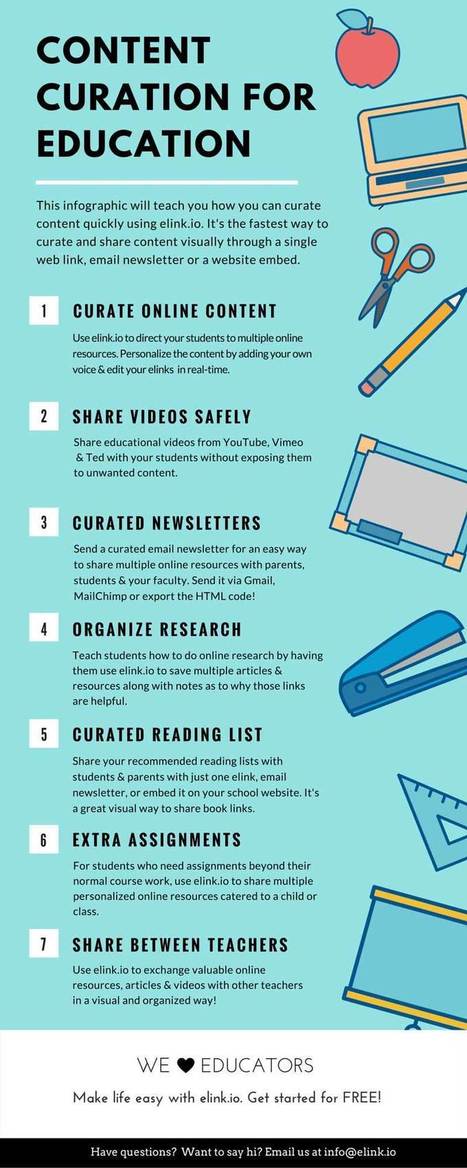
elink.io is a visual bookmarking tool that allows any online content with a URL to be collected and shared around any topic. elinks can be shared as a visual web page, sent as a curated visual email newsletter or embedded onto any website. elink also has a Chrome extension that makes it incredibly easy to save important online content on-the-go. Educators from around the world are turning to elink to help them share the best of the web with their students and colleagues.
The tsunami of technological innovation will continue to change profoundly how we live and work, and how our societies operate. In what is now called the Fourth Industrial Revolution, technologies that are coming of age-such as robotics, nanotechnology, virtual reality, 3D printing, the Internet of Things, artificial intelligence and advanced biology-will converge. And as these technologies continue to be developed and widely adopted, they will bring about radical shifts in all disciplines, industries and economies-in the way that individuals, companies and societies produce, distribute, consume and dispose of goods and services.
These developments have given rise to questions about what role humans will play in a technology-driven world. A 2013 University of Oxford study estimates that close to half of all jobs in the United States could be lost to automation over the next two decades. On the other hand, economists such as Boston University's James Bessen argue that automation often goes hand in hand with the creation of new jobs. So which is it-new jobs or massive structural unemployment?
With recent unemployment figures at historic lows, candidates are eager to find the hottest positions in 2017. Randstad US, one of the largest HR services and staffing companies in the United States, is helping those seekers determine the most promising industries and fields with insight and predictions in its annual 2017 Hot Jobs report.
Randstad worked with its national recruiting experts to review the current workforce trends, including available positions, number of qualified candidates, market growth, salary range and specific skillsets to provide timely projections for the year.
When you read about the dangers of artificial intelligence in the popular media, most of the writing focus on the dangers of superintelligent machines developed by man who decided on their own that they know better than humans how to run the world, or of something as simple as tiny single-celled artificial nanotechnology that becomes a threat to the environment that man simply can’t control. Given the current state of AI, it seems as though we are fortunately far away from being able to bring about either of these dystopias, at least for now, given the current state of technology and the expected rates of growth in the field. To some extent, it seems clear that the risk of these dangers is most likely overstated. For one thing, as long as humanity continues to have the power to turn machines off the possibility of some all-encompassing global intelligence remains fairly low. In addition, researchers are working on safeguards that would hopefully prevent such things from happening. At the very least, it seems clear that these dangers will remain, for the time being, between the pages of a science fiction novel and may not be as realistic as many dystopian views of the future would have you believe. As a recent article in Wired notes, though, the more immediate concern is far closer in time and far more likely to happen, and in fact has been in the works for about the past thirty years now:
When I ask people to picture a coder, they usually imagine someone like Mark Zuckerberg: a hoodied college dropout who builds an app in a feverish 72-hour programming jag—with the goal of getting insanely rich and, as they say, “changing the world.”
But this Silicon Valley stereotype isn’t even geographically accurate. The Valley employs only 8 percent of the nation’s coders. All the other millions? They’re more like Devon, a programmer I met who helps maintain a security-software service in Portland, Oregon. He isn’t going to get fabulously rich, but his job is stable and rewarding: It’s 40 hours a week, well paid, and intellectually challenging. “My dad was a blue-collar guy,” he tells me—and in many ways, Devon is too.
Today’s workforce faces a greater range of threats to their livelihoods than ever before. Many jobs will come under threat in the next decade from trends such as globalization, automation and robotics. However, the growing digital workforce doesn’t necessarily mean the end for today’s workers. With the abundance of education and training classes now available online, employees can stay ahead of the game and safeguard their futures by developing new skills and talents, making them indispensable to their employers.
Education has long been seen as something which you do at the start of your career, jamming as much training as possible into the early part of your life, before moving into the world of work. However, with today’s digital workforce and the trend of continuing education gaining pace, employees — and employers — are beginning to see the benefits of upgrading skills while on the job.
Today’s increasingly connected world has introduced a slew of new digital media platforms, each jostling for the attention of ‘digital-native’ consumers. This has put immense pressure on content providers to redefine their value chains.
In fact, by 2020, the information, media and entertainment (IME) industry will see even greater shifts as content providers align their business with today’s ‘digital first’ imperative. Yet, many companies are unsure what true transformation requires—in terms of culture, process and technology—and where to begin.
The key is to ‘be’ digital, not just ‘do’ digital. Businesses will need to learn how to leverage customers’ digital footprints to draw more insights, improve consumer experiences, and enrich learning.
As we move into 2017, the current IME landscape will restructure into three “mega-segments” in the near term:
Information providers will become purveyors of insights.
Entertainment companies will deliver holistic experiences.
Education providers will focus on enabling students to achieve their ultimate learning outcomes.
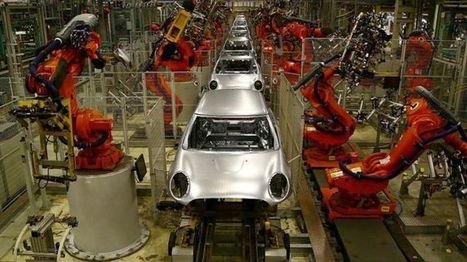
La fábrica Changying Precision Technology Company, que se dedica a la producción de teléfonos móviles, ha hecho realidad el tan esperado temor de la sociedad actual, sustituyendo casi la totalidad de su plantilla por robots que llevaran a cabo la fabricación de los dispositivos sin ninguna intervención humana.
La nueva maquinaria ha pasado a ocupar los puestos en la cadena de montaje e incluso se usan vehículos automáticos para llevar a cabo el transporte de las mercancías. Los 60 empleados restantes se encargaran meramente de la supervisión y mantenimiento de los mecanismos, ocupándose aproximadamente 3 trabajadores de cada cadena de producción mientras que los demás controlaran el sistema informático central.
While humankind will likely never reach the speed or accuracy of AI in performing certain tasks, employees of the future will need to function in similar ways. They will need to pull from a broad range of knowledge to find the right answers, deliver results quickly, offer a variety of solutions to a single problem, be adaptable, consider the whole market or subject before offering a suggestion, and be consistent in their performance.
Is this too much to ask? Not if they rely on technology to help. And in many ways, the capabilities of today’s technology provide a glimpse of the traits required in tomorrow’s best leaders and employees.
A new study that was conducted by researchers from the University of York and the Centre for Research and Analysis of Migration at the University of London – published in the journal American Economic Review – have found that workplace peer pressure is a phenomenon that exists.
According to the study, the presence of high-performing co-workers are quite likely to increase the performance of another individual due to what the study refers to as peer pressure.
The study states the chief reason for this is probably because of the pressure one co-worker may feel to keep up with a co-worker that’s perceived to be better.
“We would expect that some positive practices would ‘rub-off’ on co-workers, and in fact we knew from previous research that such effects exist for specific occupations,” Dr Thomas Cornelissen, one of the study researchers, said in a statement.
El mundo de la tecnología está avanzando a pasos agigantados, y si bien para la mayoría de nosotros eso es algo positivo, también es cierto que no lo es para muchas profesiones y oficios que están en grave riesgo a raíz de la irrupción de Internet, de los smartphones y de otros tantos dispositivos que nos hacen la vida más fácil. Al igual que oficios como lechero o sereno desaparecieron hace años. Otros que hoy están en activo, tienen tendencia a quedarse atrás antes de 2040. El portal web de formación especializada cursos.com ha publicado recientemente un estudio donde destacan algunas de las profesiones que desaparecerán en España en estos 23 años. Aquí van 5 de ellas.
In her talk she talks how she sees the Classroom of Tomorrow. Mentioning technology as one “language”, she quoted, “My generation in the 90’s did not use technology into the classroom. But then arrived mobile phones and emails and Internet. Slowly, but surely, this technology entered houses, privates rooms, bags and finally… classrooms! Very rapidly, everybody noticed a change in the way people were communicating through these new media. Therefore, there was a need to study (what we thought was) a new kind of language.”
Talking about integration of technology in the classroom and digital presence in terms of its utilization she brings forward some practical ideas to open a discussion on what could be a new and better school.
Below are 4 points on reinventing schools and use of technology in the same:
1st Problem at School: Each child uses technology (personal smartphones, tablets and laptops) in the classroom to work alone (read, memorise, listen…), as it was already the case with his or her book. Idea for the Future: Learning has to be made up of collective activities, not individual ones.
2nd Problem at School: We place our students in front of digital tools in passive positions that are boring and cause physical problems (backache, stiff neck, migraine, stress…). Idea for the Future: Learning has to offer an open and active environment in which each student will be a real actor of his own education.
3rd Problem at School: We think that education and fun are two very separate worlds. School is still seen as a strict environment to which each of our children must defer. Idea for the Future: Serious game applications offer a wide range of funny activities that will have to be used in the classroom of the future in order to offer a pleasurable environment to the child.
4th Problem at School: We use the same activities for all students, even since we know that all learners are so different from each other. The numerous technology tools and group activities today offer very different needs that can be filled by different skills. Idea for the Future: We have been talking about differentiated learning for a long time; now, let’s really apply this concept to classrooms, where each student will be a potential genius of his own domain.
Louise provided an overview of how technology can be used in our classroom and she talks from her specialty which are languages. On her classes she saw that students were using technology all the time, sometimes just to chat with friends, so she implemented a way to use it for the class. For instance she prepared an activity to connect people from another class with a different language. Both classrooms needed to interact by twitter, sharing sentences and other other group correcting them. We also saw how she used surveys of what students think about a topic or a question, and then she shows the real answers based on research to find out if they were wrong or not. Those interactive ways of using technology provided ways to engage students, make them work together in a collaborative way, and activate their creativity, innovation and motivation. To sum up, we need to prepare the students for tomorrow, and using technology will help us to achieve those goals easier.
A few days ago we featured a collection of some of the best web tools teachers can use to create non-traditional quizzes and today we are sharing another collection but this time for creating video quizzes. These are tools you can use to design quizzes based on selected video content. They allow you to import video clips, add a variety of interactive features to them (e,g different question types, comments, notes, links etc) and share them with your students. Some of these tools include the option to track student progress and access stats on how students are interacting with your video quizzes. Share with us in our Facebook page if you have other suggestions to add to the list.
Hay lujos que es difícil permitirse cuando se está arrancando un negocio y uno de ellos es tener una oficina propia. La solución viene de la mano del coworking, una opción cada vez más popular ya que permite tener el espacio de trabajo que se necesita y además, ahorrar costes.
Las cuentas salen. Según los expertos del sector, compartir local permite un ahorro de hasta el 60% en gastos fijos como la electricidad, la limpieza o el teléfono. Además, los espacios de coworking tienen otras ventajas.
The future of work will see many disruptive changes, with automation, robotics and Artificial Intelligence all radically reshaping the professional landscape. But these changes are already happening, and we must adapt our working patterns now if we’re to be successful tomorrow. Since the Industrial Revolution, there has been much focus on how to achieve a better work/life balance. However, in the new digital era, where 24/7 connectivity, mobility and cloud-based apps are the norm, we need to talk about work/life integration, whereby personal and professional lives can be seamlessly integrated and flexible. Here, I offer my top tips on how to be successful in the future of work, while having an energised home and social life.
At a time when the Trump administration is promising to make America great again by restoring old-school manufacturing jobs, AI researchers aren’t taking him too seriously. They know that these jobs are never coming back, thanks in no small part to their own research, which will eliminate so many other kinds of jobs in the years to come, as well. At Asilomar, they looked at the real US economy, the real reasons for the “hollowing out” of the middle class. The problem isn’t immigration—far from it. The problem isn’t offshoring or taxes or regulation. It’s technology.
Primero fueron trabajadores como los cajeros de supermercados o los obreros de las cadenas de montaje los que vieron como la automatización les quitaban puestos de trabajo.
Pero el desarrollo de la robótica y la inteligencia artificial cada vez amenaza más profesiones, incluyendo muchas de las típicamente consideradas "de cuello blanco".
De hecho, según un estudio de la Universidad de Oxford, en países como Estados Unidos esta tendencia ya amenaza a aproximadamente el 47% de toda la fuerza laboral.
The vast majority of millennials believe that after acquiring a college degree, their next big step should be to get a job and work for a salary throughout their active years.
Related: 12 Ways to Hack Your 9-to-5 Job and Live Worry Free
This doesn’t sound so bad when you consider the traditional education-to-job path that schools and communities put us on.
However, the fact that as a millennial, you trade your time for money and get paid only when you work is enough to make you realize that everything is wrong with this approach. As Warren Buffett said, “If you don't find a way to make money while you sleep, you will work until you die.”
Despite the endless inconveniences, most individuals still depend on their stressful, low-paying 9-to-5 jobs for a number of reasons, one of which is that they are ignorant of reasons to create a side fix or some other way to earn money.
Many believe that technological change only strengthens the case for more formal education. Jobs made up of routine tasks that are easy to automate or offshore have been in decline. The usual flipside of that observation is that the number of jobs requiring greater cognitive skill has been growing. The labour market is forking, and those with college degrees will naturally shift into the lane that leads to higher-paying jobs.
The reality seems to be more complex. The returns to education, even for the high-skilled, have become less clear-cut. Between 1982 and 2001 the average wages earned by American workers with a bachelor’s degree rose by 31%, whereas those of high-school graduates did not budge, according to the New York Federal Reserve. But in the following 12 years the wages of college graduates fell by more than those of their less educated peers. Meanwhile, tuition costs at universities have been rising.
Thanks to QRCodes, iBeacons or language, workers can call up the learning contents intuitively and within the context of the production or assembly station. By means of diagrams, videos or instructions by an augmented reality, new employees are trained and the knowledge of existing personnel is refreshed.
„Production and assembly at modern companies is becoming increasingly complex. Through “AmbiWise”, we replace standard instructions and enable employees to create specific descriptions for machines and work steps,” explains Fabian Quint, Project Manager for the German Research Center for Artificial Intelligence. Thus, employees pass on their knowledge not only within the team but, thanks to digitalization, content can be used across sites as well. Departing employees can document their knowledge based on experience and new employees can be familiarized with their jobs more easily.
Despite concerns that artificial intelligence and robots will one day replace workers—a Pew survey found that 65% of Americans expect most jobs will be automated by 2065—several companies are using AI like Amy to increase productivity. Digital agents assist with information gathering and automated tasks such as scheduling meetings or answering customer questions and requests. While these sound like small tasks, the companies that use them are reporting greater employee productivity.
To get content containing either thought or leadership enter:
To get content containing both thought and leadership enter:
To get content containing the expression thought leadership enter:
You can enter several keywords and you can refine them whenever you want. Our suggestion engine uses more signals but entering a few keywords here will rapidly give you great content to curate.


 Your new post is loading...