Your new post is loading...

|
Scooped by
Edumorfosis
January 27, 2017 11:29 AM
|
Who wouldn’t want to work from home? In addition to giving you the freedom to work in your pajamas, telecommuting saves money and frustration, cutting out both the commute and dry-cleaning costs (to say nothing of the savings to your fancy coffee budget). But working from home isn’t without its pitfalls.
|
|
Scooped by
Edumorfosis
January 27, 2017 10:48 AM
|
It seems that artificial intelligence (AI) and robotics are moving at lightning speed from the laboratory and are touching every single part of our lives – the way we read the news and hail a taxi has changed, and soon the way we work, and the skills needed to do our jobs will evolve. As the World Economic Forum puts it, we’re on the brink of a Fourth Industrial Revolution – and the technology that underpins it will have a huge, and some would say, unpredictable impact on business. As Andrew McAfee, explains in this Economist podcast, there is no clear distinction of the level of automation and indeed transformation of jobs. However, one thing is for sure – with digitalisation and automation such a high priority, the impact on the role of the CIO and their IT departments the world over will be profound.
|
|
Scooped by
Edumorfosis
January 27, 2017 6:57 AM
|
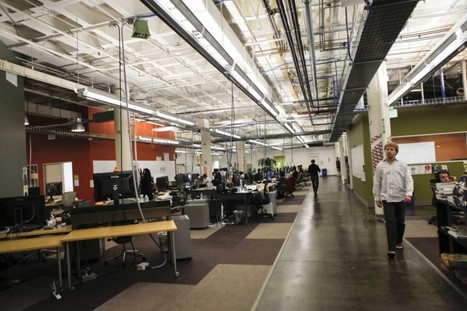
A 2013 study found that many workers in open offices are frustrated by distractions that lead to poorer work performance. Nearly half of the surveyed workers in open offices said the lack of sound privacy was a significant problem for them and more than 30 percent complained about the lack of visual privacy. Meanwhile, “ease of interaction” with colleagues — the problem that open offices profess to fix — was cited as a problem by fewer than 10 percent of workers in any type of office setting. In fact, those with private offices were least likely to identify their ability to communicate with colleagues as an issue. In a previous study, researchers concluded that “the loss of productivity due to noise distraction … was doubled in open-plan offices compared to private offices.”
|
|
Scooped by
Edumorfosis
January 26, 2017 5:41 PM
|
“Technology is not the only disrupter,” said Brett Walsh, Deloitte’s global human capital leader. “Another disrupter is the shortening in the half-life of skills.”
In conversation with Matthew Bishop, senior editor at The Economist, lifelong learning was a major talking point for the future of work.
“Lifetime learning is certainly something that we have to get used to,” said Walsh.
|
|
Scooped by
Edumorfosis
January 24, 2017 7:22 PM
|
Identifying employees with the right soft skills is crucial to building a strong talent mix and setting your team up for success, and yet leaders are struggling to find and nurture these skills. In fact, LinkedIn’s 2016 Soft Skills Report found that 61 per cent of Canadian hiring managers feel that the lack of soft skills among candidates limits their company’s productivity.
|
|
Scooped by
Edumorfosis
January 24, 2017 7:22 AM
|
2017 va a ser definitivamente el año de los perfiles profesionales digitales y capaces de poner la tecnología al servicio de la empresa.
Las compañías necesitan aprovechar todo el potencial que les ofrece el uso de la información y en sus plantillas carecen de la mano de obra capacitada para ello, por eso este año buscarán perfiles profesionales muy especializados y relacionados con las Tecnologías de la Información y las Telecomunicaciones, como especialistas en Big Data, vídeo engineer o ingeniero en seguridad.
|
|
Scooped by
Edumorfosis
January 22, 2017 9:24 AM
|
t’s something that you try to tap into every time you design new training content. Some might say you either have it or you don’t. I would like to think that each of us can be creative if we work hard enough. If you disagree and think it’s all in the genes, I encourage you to read the research findings of Marvin Reznikoff.
Another myth about creativity has to do with a lack of resources. If you had enough money and time, you could be more creative. Unfortunately, a lack of resources is not impacting your creativity. Constraints can actually make you more creative and force you to think outside the box.
Don’t you feel much better? Genetics and a lack of resources are no longer obstacles to your creativity. Here are four things I do to boost my creativity.
|
|
Scooped by
Edumorfosis
January 22, 2017 7:50 AM
|
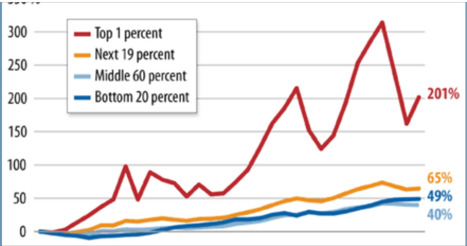
Broadly speaking, income inequality refers to the fact that different people earn different amounts of money. The wider those earnings are dispersed, the more unequal they are. But that intuitive concept of dispersal can be defined in several different ways. Indeed, income itself is a somewhat ambiguous idea that can be defined in different ways.
All that said, in the contemporary United States income inequality has been increasing for several decades by essentially any measure. Similar trends are observed in most other rich countries. At the same time, on a global scale inequality is probably declining.
|
|
Scooped by
Edumorfosis
January 21, 2017 11:12 AM
|
Robots are to be blamed for job losses over the last decade, CEOs of companies across the globe have said.
Business leaders gathered at the annual World Economic Forum (WEF) in Davos warned this week that the collateral damage to jobs needs to be addressed more seriously.
From taxi drivers to healthcare professionals more and more jobs are at risk, down to technologies including robotics, driverless cars, artificial intelligence and 3-D printing.
|
|
Scooped by
Edumorfosis
January 21, 2017 9:06 AM
|
A lo largo de la historia, la humanidad siempre ha buscado nuevas maneras de hacer que el proceso evolutivo no encuentre ningún obstáculo en su paso de una generación a otra. Las herencias que han recibido con el tiempo los sucesores son un ejemplo de que la creatividad, inteligencia o las habilidades de los antepasados han sido unos de los más importantes recursos que les han servido para abrirse camino delante de los desafíos y continuar su ascenso. Pero ¿qué pasa cuando, animados por el mismo deseo de superación, llegamos a construir una estructura que al final atrapa a todos los participantes en un sistema muy complejo?
|
|
Scooped by
Edumorfosis
January 20, 2017 11:31 PM
|
- The growth and evolution of automation threatens to spread joblessness and economic uncertainty in its wake; up to 47% of jobs in the US are at risk of automation.
- One plan to tackle the social and economic disjunction is to institute a universal basic income (UBI); pilot programs in Europe and India are already experimenting with the implementation such a system.
|
|
Scooped by
Edumorfosis
January 20, 2017 11:22 PM
|
We have already experienced increased automation in manufacturing, replacing manual skills for instance in the automotive industry. But this replacement of skills is even today moving beyond manual skills. The next level of automation is going to affect “white-collar, knowledge work” jobs. The sort of jobs that many aspire to, getting good grades at school and university, and applying for careers in large corporations.
|
|
Scooped by
Edumorfosis
January 20, 2017 1:26 PM
|
DAVOS, Switzerland: Open markets and global trade have been blamed for job losses over the last decade, but global CEOs say the real culprits are increasingly machines. And while business leaders gathered at the annual World Economic Forum (WEF) in Davos relish the productivity gains technology can bring, they warned this week that the collateral damage to jobs needs to be addressed more seriously. From taxi drivers to health care professionals, technologies such as robotics, driverless cars, artificial intelligence and 3-D printing mean more and more types of jobs are at risk.
|
|
|
Scooped by
Edumorfosis
January 27, 2017 11:28 AM
|
Despite technological progress promising to solve many of Europe’s problems, people still worry about robots and automation costing jobs. But this anxiety is based on fear, not reason, warns Thilo Brodtmann.
|
|
Scooped by
Edumorfosis
January 27, 2017 7:09 AM
|
Trabajar desde casa suena bastante tentador. Puedes vestirte como quieras, comer cuando te apetezca, enviar mensajes a tus amigos, hacer recados y estar en casa con tu familia. Sin embargo, esta lista de beneficios a menudo puede jugar en tu contra y hacer que no cumplas con tus tareas diarias.
Si te encuentras en esta situación y quieres marcarte un calendario que te ayude a mejorar tu productividad, ten en cuenta estos 9 consejos:
|
|
Scooped by
Edumorfosis
January 26, 2017 5:59 PM
|
The Fourth Industrial Revolution will create winners and losers. Both organizations and individuals. Seismic shifts will wreak havoc in some local and national economies and may even contribute to social unrest. Tackling myriad issues involved in organizations won’t be easy. And the global economic context isn’t helping. At the very moment the global economy should have achieved a boost thanks to digital—from 2004 to 2014—labor productivity growth slowed significantly. In 30 of the 31 advanced economies it declined from a 2 percent average annual growth rate from 1994 to 2004 to a 1 percent average. Leaders need to leverage every advantage at their disposal—including one which risks being overlooked as companies focus on technology investment: ensuring people are relevant and adaptable to rise to the challenge of this new revolution. If this sounds like an HR issue—don’t be fooled. Creating the future workforce—now—is the responsibility of the very highest levels of an organization because of the complexity and the urgency of the challenge and opportunity. Navigating the path towards the workforce of the future will require leaders to ask tough questions. How do we: Attract and develop the new talent we need? Scale and accelerate the pace of change? Make sure the people with us now don’t get left behind? Secure the right amount and type of investment in our people to prepare them?
|
|
Scooped by
Edumorfosis
January 25, 2017 8:36 AM
|
Old-school educators may feel intimidated by the new trends involved in the classroom, but that should only challenge them to make their classes more interesting for the students. There are various online solutions that can really promote the process of education by enabling teachers to organize the classroom activities and inspire students to get more involved. This article will list 20 new apps that promise great potential in terms of education enhancement.
|
|
Scooped by
Edumorfosis
January 24, 2017 9:37 AM
|
Economist Andrew McAfee suggests that, yes, probably, droids will take our jobs — or at least the kinds of jobs we know now. In this far-seeing talk, he thinks through what future jobs might look like, and how to educate coming generations to hold them.
|
|
Scooped by
Edumorfosis
January 22, 2017 11:07 AM
|
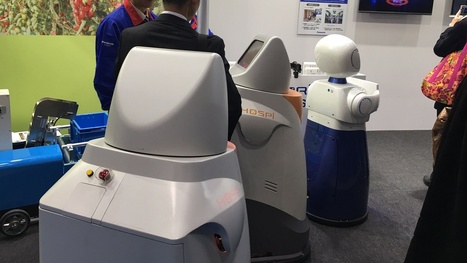
Hospi se desliza a paso lento hasta el cliente y le ofrece su surtido de bebidas. El cliente abre una pequeña nevera, donde estaría el estómago del robot si fuera una persona, y escoge una de las botellas. En su pantalla, donde estaría la cara si fuera un camarero de verdad, Hospi exhibe una sonrisa. El autómata de Panasonic demuestra sus dotes asistenciales en un hotel y en un aeropuerto de Japón.
El diseño del robot se remonta a 2004, cuando Panasonic decidió empezar a trabajar en el proyecto. Diez años más tarde salía a la luz el resultado: un robot asistencial. Las tareas que desempeña Hospi consisten en trasladar objetos y en informar a través de un altavoz.
|
|
Scooped by
Edumorfosis
January 22, 2017 8:48 AM
|
There is no denying that we live in the age of technology. It is an essential part of everyday life and is constantly improving to do more and more impressive things. Along with the shift if technology, a shift in society and the way that we think and operate is also coming along as a consequence to the technological advances. There has been much debate on whether the effects of technology on society as a whole have been beneficial or not. Arguments are heated on both sides, but in order to truly develop your own opinion, you have to hear them both out.
|
|
Scooped by
Edumorfosis
January 21, 2017 9:25 PM
|
Ahora ha llegado la cuarta revolución industrial. Pero ¿en qué consiste si en el último medio siglo no ha aparecido ninguna invención realmente revolucionaria? Las últimas innovaciones han sido los viajes al espacio e Internet. Pero si recordamos la segunda revolución industrial, veremos que tampoco estaba vinculada con ningún invento, sino que era una modificación de la primera, de manera que el desarrollo de la producción llevó a una nueva revolución sin la acción de un invento revolucionario. Lo mismo vemos aquí.
|
|
Scooped by
Edumorfosis
January 21, 2017 9:30 AM
|
The challenge with the loss of jobs on the scale we are likely to face is that at the moment we have nothing to replace them with. Our lives are so structured around work that having nothing is intimidating. Not everyone can be a freelance consultant. You yourselves will be facing similar challenges. Your jobs are just as much at risk as anyone else’s. What would help you? What would it take to make you feel more confident about your future?
One of the main reasons that people react violently to change is fear of the unknown. What frightens people most is not being treated like grown-ups. They will know when their jobs are routine and boring. They may even be grateful for the opportunity to move on to something more interesting and challenging. This was certainly the case during redundancies I presided over when a manager at the BBC. People who had been discarded by the system, and were feeling uncomfortable and disrespected, suddenly became entrepreneurial and found a new lease of life when made redundant.
|
|
Scooped by
Edumorfosis
January 21, 2017 9:05 AM
|
Hay razones para dejar a un lado los temores: la automatización no tiene que ser -necesariamente- una amenaza a nuestros puestos de trabajo.
Es uno de los debates más agitados que se viven en estos convulsos tiempos de transformación digital: ¿podrá o no podrá la inteligencia artificial, la robótica y la automatización de tareas -en sus distintas vertientes- acabar con el empleo tal cual lo entendemos? Pues bien, dejando a un lado las consideraciones personales o ideológicas de cada cual, ya comenzamos a tener casos concretos donde podemos vislumbrar lo que está a punto de ocurrir en nuestro mercado laboral.
|
|
Scooped by
Edumorfosis
January 20, 2017 11:23 PM
|
A future in which human workers are replaced by machines is about to become a reality at an insurance firm in Japan, where more than 30 employees are being laid off and replaced with an artificial intelligence system that can calculate payouts to policyholders.
|
|
Scooped by
Edumorfosis
January 20, 2017 9:49 PM
|
While there is little doubt that business processes are changing, it’s not the business that’s influencing the shift in operations. It’s prospective and existing customers who are empowered by regular access to information and interactions. Companies that succeed in this new competitive landscape are the ones that realize the power of their customers and reinvent their business models and processes to systematically understand and serve them. However, when such change is concentrated in only customer-facing areas and doesn’t happen quickly enough in behind-the-scenes functions such as HR, it can hold back the business.
|










![[PDF] Harnessing revolution: Creating the future workforces | Edumorfosis.Work | Scoop.it](https://img.scoop.it/FRo8wlCsK8OOTGaAT19k4jl72eJkfbmt4t8yenImKBVvK0kTmF0xjctABnaLJIm9)


![[TEDxTalks] What will future jobs look like? | Edumorfosis.Work | Scoop.it](https://img.scoop.it/Y_ZP72udbkn8hYm_5vcXxDl72eJkfbmt4t8yenImKBVvK0kTmF0xjctABnaLJIm9)