 Your new post is loading...

|
Scooped by
Edumorfosis
September 21, 1:28 PM
|
Interesante lectura de Bernard Marr sobre las habilidades IA más demandadas en 2026: - Ingeniería de Prompts
- Gestores de Agentes Autónomos
- Gobernanza IA
- Machine Learning
- Chatbots conversacionales
Lo que destaca su artículo es que la IA todavía no está creando nuevas carreras laborales, como se predijo que iba a suceder. En cambio, las habilidades IA se están absorbiendo en empleos existentes y pasando a formar parte de las competencias que se espera que tenga todo profesional.
|
|
Scooped by
Edumorfosis
September 8, 10:33 AM
|
La IA está transformando el trabajo intelectual y creativo de manera directa. Programadores, abogados, médicos, escritores, investigadores y profesionales administrativos ya sienten los efectos. El informe de la ONU recuerda que históricamente la tecnología crea más empleos de los que destruye —“en 2018, aproximadamente el 60 % del empleo en los Estados Unidos correspondía a ocupaciones que no existían en 1940”—, pero esta vez el problema no es la cantidad de empleos, sino la calidad y la distribución de las ganancias.
|
|
Scooped by
Edumorfosis
August 28, 7:30 PM
|
We’re already seeing the market signals. Harvard University research indicates junior employment has fallen 9%, with entry-level hiring dipping 80% per quarter since 2023, at organizations adopting generative AI. ZipRecruiter’s 2026 Graduate Report found the share of entry-level jobs dropped to 38.6% at the start of 2026, down from over 44% three years ago.
Starter tasks are being automated or pushed upward, creating workload strain in the layers above that will become a clog in the leadership pipeline.
AI has an optics problem. For years, surveys have shown that public perception of AI is largely negative. When the Pew Research Center polled thousands of U.S. adults in 2024, only 17% of them thought the technology would have a positive impact in the years to come. Most of them were especially concerned with job losses, with 64% of respondents saying they believed AI would eliminate jobs in the near future.
Via James Schreier, Ricard Lloria
|
|
Scooped by
Edumorfosis
July 24, 4:46 PM
|
Organizations need to understand how individuals create value beyond the AI baseline in real organizational settings, particularly in higher-stakes professional work requiring judgment, domain expertise, and decision-ready outputs. KPMG and researchers from the University of Texas conducted a large-scale field study with 523 early-career professionals where participants completed business-specific tasks using an AI agent built for the domain. This research can help answer two questions: - What enables early career employees to add value in AI‑enabled workflows?
- How can those capabilities be intentionally developed in ways that sustain continuous improvement as AI continues to advance?
The findings sorted participants into three groups: AI apprentices, AI delegators, and AI amplifiers. A surprise in the findings was that foundational skills such as critical thinking abilities, AI literacy, and domain knowledge weren’t clear signals for who fell into which group. This can help leaders rethink how to design entry-level work and how to hire for these jobs.
|
|
Scooped by
Edumorfosis
July 13, 2:23 PM
|
Economists are sounding alarms that the AI talk is masking a different problem. It’s not that there won’t be enough jobs, these experts say — it’s that the United States is already facing what’s projected to be the biggest shortage of workers in its history.
|
|
Scooped by
Edumorfosis
July 10, 8:07 AM
|
The adoption of AI tools has accelerated rapidly across European workplaces since 2022, and employers are increasingly weaving AI into job titles across a wider range of occupations. While this trend was initially concentrated in software and data roles, AI now appears in job titles in many other categories, such as sales, HR, legal services, customer support, and administrative assistance, suggesting that AI-related skills, tasks, and tools are becoming mainstream in the labor market.
|
|
Scooped by
Edumorfosis
June 21, 10:20 AM
|
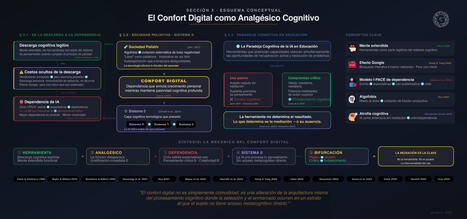
La convergencia entre sesgos metacognitivos, dependencia tecnológica y mediación algorítmica configura un escenario educativo paradójico: las herramientas diseñadas para potenciar el aprendizaje pueden, simultáneamente, erosionar las capacidades cognitivas que pretenden desarrollar. El presente artículo analiza cómo el efecto Dunning-Kruger se transforma —sin desaparecer— en contextos mediados por inteligencia artificial, dando lugar a un estado de confort digital que funciona como analgésico cognitivo. Desde una perspectiva integradora que articula la neurociencia de la atención, la teoría de la mente extendida y los marcos de competencia digital, se argumenta que la amenaza central no reside en la tecnología misma, sino en la opacidad de su mediación sobre el prisma atencional y lingüístico del sujeto.
|
|
Scooped by
Edumorfosis
June 4, 2:36 PM
|
In a new paper from our Interpretability team, we analyzed the internal mechanisms of Claude Sonnet 4.5 and found emotion-related representations that shape its behavior. These correspond to specific patterns of artificial “neurons” which activate in situations—and promote behaviors—that the model has learned to associate with the concept of a particular emotion (e.g., “happy” or “afraid”). The patterns themselves are organized in a fashion that echoes human psychology, with more similar emotions corresponding to more similar representations. In contexts where you might expect a certain emotion to arise for a human, the corresponding representations are active. Note that none of this tells us whether language models actually feel anything or have subjective experiences. But our key finding is that these representations are functional, in that they influence the model’s behavior in ways that matter.
|
|
Scooped by
Edumorfosis
April 19, 9:59 AM
|
The report, “Labor market impacts of AI: A new measure and early evidence,” was based on real-life enterprise usage of Anthropic’s popular Claude large-language model. It broke down a host of professions by their “observed exposure” and “theoretical exposure” to AI—in essence, what share of the work in a given occupation Al systems can already do, and how much more they could theoretically take on.
For a wide range of previously secure and well-paying white-collar occupations, including computer programming, market research, and financial management, the theoretical exposure is very high—and perhaps inevitably, the report stoked worries about a white-collar recession.
|
|
Scooped by
Edumorfosis
March 19, 11:38 AM
|
Anthropic says it is building an early-warning system for a potential AI-driven white-collar jobs bust. Why it matters: While the new index from Claude's maker shows "limited evidence" that AI has affected joblessness so far, the effort enters a larger debate among economists over how a possible "AI labor doom and gloom" scenario should be tracked in the first place. What they're saying: "By laying this groundwork now, before meaningful effects have emerged, we hope future findings will more reliably identify economic disruption than post-hoc analyses," Anthropic economists Maxim Massenkoff and Peter McCrory write in a new paper.
|
|
Scooped by
Edumorfosis
March 12, 8:46 AM
|
Técnicamente, la predicción del siguiente token es una fase del entrenamiento, no la totalidad del sistema. Lo que hacían GPT-2 o GPT-3 está muy lejos de lo que tenemos ahora mismo a nuestra disposición con Claude Code o Codex: modelos base que luego pasan por ajuste fino y aprendizaje por refuerzo, son capaces de interpretar instrucciones, rechazarlas cuando corresponde, utilizar herrramientas, planificar para alcanzar un objetivo, revisar sus propios resultados en búsqueda de errores e incluso generar texto deliberadamente impredecible si se les pide. Un loro que puede hacer todo esto ha dejado de ser un loro.
|
|
Scooped by
Edumorfosis
February 27, 12:48 PM
|
There are many paths AI evolution could take. On one end of the spectrum, AI is dismissed as a marginal fad, another bubble fueled by notoriety and misallocated capital. On the other end, it’s cast as a dystopian force, destined to eliminate jobs on a large scale and destabilize economies. Markets oscillate between skepticism and the fear of missing out, while the technology itself evolves quickly and investment dollars flow at a rate not seen in decades.
|
|
|
Scooped by
Edumorfosis
September 21, 1:11 PM
|
Different surveys told a more nuanced story. Employers clearly valued those skills, but they consistently ranked even higher qualities such as interpersonal skills and willingness to learn.
No matter the size of the organization, the results were similar. The rankings showed what employers valued, and their comments explained their reasoning. One theme surfaced repeatedly: Employers want to hire people who they believe will grow with their organizations.
|
|
Scooped by
Edumorfosis
September 7, 10:27 AM
|
As AI Agents acquire greater autonomy, the environments they operate in are growing in complexity. Increasingly, these agents make decisions, access sensitive data, and reach across organizational boundaries—raising new questions about governance, accountability, and control. For both public- and private-sector leaders, the challenge goes beyond deploying AI to ensuring the technology can be governed, secured, and trusted at scale. In the agentic AI era, operational security cannot be separated from the issue of sovereignty. And sovereignty is the ability to prove observability, bounded authority, auditability, reversibility, and resilience across AI systems that no single entity fully owns.
|
|
Scooped by
Edumorfosis
August 27, 4:58 PM
|
|
|
Scooped by
Edumorfosis
July 24, 4:57 PM
|
Midyear data suggest organizations see the strongest employee engagement when they pair AI with clear expectations, thoughtful implementation and manager support. Organizations are investing heavily in AI adoption to improve employee productivity and efficiency, but Gallup's latest findings suggest that access alone does not improve or weaken the employee experience. Employees are substantially more likely to be engaged when leaders introduce AI with clear expectations, a thoughtful implementation plan and active manager support. These conditions help employees understand what is expected of them, how AI fits into their work and how they should use it.
|
|
Scooped by
Edumorfosis
July 17, 12:06 PM
|
Some of the lessons that philosophy can offer AI researchers are ancient. The Socratic method—as described by Plato, an ancient Greek philosopher—uses feigned ignorance and sequential questioning to clarify meanings, spot contradictions and reveal ramifications. Many current AI systems tend towards sycophancy. Models trained in the Socratic method, says Jörg Noller, an expert on philosophy and AI at Ludwig Maximilian University of Munich, are less keen on people-pleasing and more willing to pursue the truth.
|
|
Scooped by
Edumorfosis
July 10, 6:53 PM
|
“La IA es ridículamente barata y supremamente inteligente”, afirma Vázquez. “Cuando una tecnología con un costo tan bajo presenta una brecha tan grande, te das cuenta de que existe un problema cultural.” Es una observación incómoda, porque desplaza la responsabilidad del acceso (algo que se podría resolver con más inversión) hacia la manera en que las organizaciones toman decisiones. Y la consecuencia estructural es que la región todavía depende casi por completo de tecnología desarrollada afuera, sin construir autonomía propia.
|
|
Scooped by
Edumorfosis
July 4, 10:38 AM
|
Andrés Oppenheimer analiza junto a diferentes expertos el impacto que puede tener la inteligencia artificial en el mercado laboral y en nuestras capacidades como humanos. ¿Nos convertiremos en zombis dependientes de la IA? ¿Habrá menos oferta laboral? ¿Qué trabajos reemplazará?
|
|
Scooped by
Edumorfosis
June 8, 9:14 AM
|
Meta just laid off 8,000 employees to pay for its AI infrastructure — and started tracking the keystrokes of those who remain, according to The Wall Street Journal.
The company began cutting 10% of its workforce while simultaneously monitoring employees’ mouse clicks and keystrokes to train AI models. When workers asked if they could opt out of the tracking program, a Meta executive said no. More than 1,500 employees have signed a petition demanding that the company stop collecting their computer-use data.
|
|
Scooped by
Edumorfosis
April 19, 1:12 PM
|
This paper examines a fundamental shift in AI progress: from scaling the intelligence of individual agentic systems to scaling distributed superintelligence. It argues that today’s AI agents, despite their growing capabilities, remain constrained because of semantic isolation. Beyond vertically scaling agents, the next frontier requires new foundational infrastructure for horizontal scaling of intelligence. Such infrastructure would enable shared intent and shared context, accelerate collective innovation, and unlock genuinely emergent capabilities in multi-agent human–AI systems. Together, these systems can address a far broader class of intelligence problems with greater accuracy and robustness.
|
|
Scooped by
Edumorfosis
March 27, 1:59 PM
|
Uno de los mayores problemas con la tecnología en educación de siempre, y ahora nos vuelve a pasar, una vez más, con la inteligencia artificial, ha sido su incorporación y traslación directa a las aulas y a la educación, desde otros contextos no educativos sin suficiente problematización y crítica. Asumiendo sin reflexión la retórica de la enseñanza eficaz y el aspecto más performativo de la educación. Sufrimos, de nuevo, un sorprendente episodio de amnesia, agravada por una gran falta de imaginación.
A medida que estas herramientas se asientan en nuestras aulas y entornos de trabajo, la realidad se revela mucho más compleja. Lejos de ofrecer soluciones mágicas, simples y sin costuras, la IA nos enfrenta a una serie de contradicciones y paradojas. Comparto seis de estas paradojas.
|
|
Scooped by
Edumorfosis
March 12, 11:39 AM
|
For years, Industry 4.0 transformation has centered on the convergence of intelligent technologies like AI, cloud, the internet of things, robotics, and digital twins. Industry 5.0 marks a pivotal shift from integrating emerging technologies to orchestrating them at scale. With Industry 5.0, the purpose of this interconnected web of technologies is more nuanced: to augment human potential, not just automate work, and enhance environmental sustainability. “To realize the promise of Industry 5.0, companies must move beyond cost and efficiency to focus on growth, resilience, and human-centric outcomes,” says Sachin Lulla, EY Americas industrials and energy transformation leader. “This requires not just new technologies, but new ways of working—where people and machines collaborate, and where value is measured not just in dollars saved, but in new opportunities created.”
|
|
Scooped by
Edumorfosis
February 28, 10:10 AM
|
Durante años, la automatización se vendió como algo que iba a «afectar sobre todo a tareas repetitivas», con una insinuación implícita: lo que va a caer es lo manual, lo rutinario, lo de menor cualificación. La generación de IA actual rompe esa narrativa: por primera vez, lo escalable no es el brazo, sino el texto. No es la fuerza, sino la oficina. El «trabajo de teclado», desde informes a análisis, presentaciones, revisión legal, atención al cliente, marketing, recursos humanos, etc. resulta alarmantemente compatible con lo que los modelos generativos saben hacer. Y en esa compatibilidad hay un cambio cultural profundo: muchas empresas ya no están pensando en cómo usar IA para que sus empleados hagan más, sino en cuántos empleados pueden dejar de necesitar.
|





![[Research] Why some Junior Employees work well with AI—and others don’t | Edumorfosis.Work | Scoop.it](https://img.scoop.it/g_YPOIvrZmrMeeGJNgMYhzl72eJkfbmt4t8yenImKBVvK0kTmF0xjctABnaLJIm9)








![[PDF] Scaling out superintelligence: Building an Internet of Cognition for distributed artificial superintelligence | Edumorfosis.Work | Scoop.it](https://img.scoop.it/gsR7ldOHYIwhx-o-t5X30zl72eJkfbmt4t8yenImKBVvK0kTmF0xjctABnaLJIm9)

![[PDF] Finding value with AI and Industry 5.0 transformation | Edumorfosis.Work | Scoop.it](https://img.scoop.it/kvHi0MOim9wXbMdAG772pzl72eJkfbmt4t8yenImKBVvK0kTmF0xjctABnaLJIm9)






El informe de Anthropic se basó en estudiar el uso real que las empresas hicieron con su modelo Claude. Se hizo un desglose de diversas profesiones según la "exposición observada" y la "exposición teórica". Lo que busca es concer con mayor exactitud la distancia existente entre las tareas automatizadas que ya se pueden realizar en determinadas ocupaciones y las capacidades teóricas que se pueden asumir que están en etapas de desarrollo y adopción.
El informe detectó niveles adopción desproporcionados. Pero al observar los detalles subyacentes, se dieron cuenta de que hubo una concentración extrema de adopción entre un conjunto de tareas relativamente pequeñas realizadas por trabajadores especializados.