There are two ways you can invest your discretionary time and money. You can invest in trying to make a profit, in which case, your investment is subject to all the market forces and the corresponding risks. And/or, you could invest in the capacity to provide for yourself, in which case, for those things, you don't care what happens in the market.
In the market we have a feed back loop that rewards efficiency of scale, resulting in bigger companies making fewer products. Local systems of production, owned by the consumers of what they produce, create a feed back loop that rewards efficiencies of integration. We can use each resource for many purposes, stacking functions and reducing costs.
Imagine a system of gardens and greenhouses that produced enough food for the entire neighborhood (Neighborhoods already own much of what is required).
Imagine that anyone in the neighborhood could get a share of that food by doing what they enjoy . . . fixing cars, reading to kids, cooking, sewing, carpentry, home repair, gardening, making cheese . . .
Every Dollar that a neighborhood saves, producing for itself what its members would otherwise purchase in the market, is a Dollar that could be invested in more capacity to produce, creating the opportunity for even more savings.
We have to re-think our reliance on multinationals doing everything for us and get into producing at least some of the things we need ourselves. And if it's done in a community setting, everything gets much easier...
People used to assume that the United States government was held in check by the constitution, which prohibits unreasonable searches and seizures and which demands due process in criminal investigations, but such illusions have evaporated in recent years.
It turns out that the NSA considers itself above the law in every respect and feels entitled to spy on anyone anywhere in the world without warrants, and without any real oversight.
Whether petitions and protests will have any real impact on how the U.S. government operates is questionable, however some very smart people have decided not to wait around and find out. Instead they're focusing on making the NSA's job impossible. In the process they may fundamentally alter the way the internet operates.
Rather than grovel and beg for the U.S. government to respect our privacy, these innovators have taken matters into their own hands, and their work may change the playing field completely.
When the internet started out, it was a de-centralized network of computers acting as peers. Little by little, this has changed where central servers and data highways became choke points, opening the way for censorship and massive surveillance.
If these programmers have their way, this will all change. The internet will once more be de-centralized. Each one of our own computers may be an important link, a node in a network that does not need server farms and our data will either avoid the main highways or travel incognito...
Instead of bypassing external censors, the new tool will create its own P2P network through which sites can be accessed without restrictions.
“The goal is to create a browser-like client to circumvent censorship, including domain blocking, domain confiscation, IP-blocking. This will be accomplished by sharing all of a site’s indexed data as P2P downloadable packages, that are then browsed/rendered locally,” a Pirate Bay insider explains.
The new software will be released as a standalone application as well as Firefox and Chrome plugins.
Since the site data comes from other peers, there is no central IP-address that can be blocked by Internet providers. Site owners will still offer webseeds to speed up loading, but sites are fully accessible when these are blocked.
It can't come soon enough for me, I am getting very tired of my IP blocking the sites I want to visit and not everything on P2P torrent sites is copyrighted, the law in the UK is an ass! Has anyone else used MEGA, I am finding that very useful and the 50GB of free cloud storage is an added bonus - https://mega.co.nz/
The European Commission is drawing up a new law to regulate the sale of all seeds, plants and plant material. This has brought widespread concern and unease among farmers, plant breeders, and the general public.
Biodynamic food company Demeter International and its partnersorganized a conference on the seed legislation with the support of many NGOs.
The conference “Challenges for producers, consumers and citizens: Who will own the seeds?” took place in Brussels on 22 January 2014 with more than 120 participants including representatives of the European institutions, Member State Authorities, farmers’ associations, breeders, seed savers, university academics, the clergy, and journalists.
MEP Martin Häusling said that seeds are a public good and hence of public interest. Their regulation must be further discussed in public, not only in the European Commission, the European Parliament (EP) and the Council. The Commission’s proposal doesn’t really begin to address sustainable farming and agro-biodiversity.
Silke Helfrich, author and co-founder of the “Commons-Strategies-Group” presented a new concept “Commons vs. commodities – a new framework for seed handling”.
She said that the current legal and political framework is based on the idea of seeds as commodities. But what we really need is legal protection of seeds and breeding as the commons.
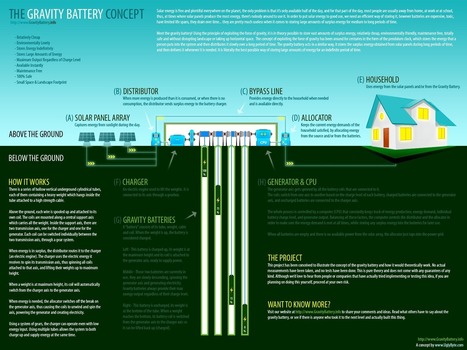
What a great idea! Store intermittent solar and wind energy in gravity by using weights. Re-convert into electricity when needed. Mechanical battery. Simple and environmentally friendly.
it always amazes me on the innovative ideas that the bright minds of today are coming up with. everybody has heard about the alternative energy in solar panels but they take it a step further. addressing the flaw in solar panels and working to improve the storage of energy. the only section i would ask to be elaborated is the cost and installation aspects due to the vagueness of "relatively cheap"
Last week's announcement of Bitcloud, a theoretical peer-to-peer network project that bypasses centralised servers and uses individual devices as secure nodes for routing and distributing network traffic captured significant media attention.
It is certainly not the first time that the idea of a peer-to-peer redesign of the whole internet has been vaunted, and it holds great appeal to those who think end-to-end encryption is needed. But such a system, workable at scale, is still just a thought experiment. Or is it?
A Scottish company, MaidSafe, claims that it has nearly finished building a system that does what Bitcloud is proposing.
Can our data be sitting not just on our own computers and not even on centralized server farms but on all kinds of devices that compute and store? A Scottish company thinks so and they say it could be safer that way.
MaidSafe has been doing some important work on making a decentralized internet a real possibility.
Coming soon, MaidSafe is a mixed effort in that it seeks to accomodate open source development as well as commercial applications.
Curated source-language content from Guerrilla Translations
This is a collection of links of the original articles (in english) that Guerrilla Translations voluntarily translated to make the information available to the Spanish speaking world...
The ideas presented in this paper developed in response to help resolve some of the problems which will result from technological unemployment. We believe that as machines become more intelligent and work currently done by human beings become automated there will be a sharp increase in the unemployment rate as humans are laid off to be replaced by intelligent machines.
We believe that intelligent machines can be leveraged to provide a basic dividend to a decentralized pseudo-anonymous group of owners as a means of providing an axillary safety-net which cannot be shut down by any government or corporation.
This is a long and rather technical read but nevertheless an interesting excursion into a possible future where we need to work much less than today, and where having a job is not going to be the only way for people to obtain the means of survival.
Cryptocurrencies as a means to enable distributed ownership and spread the riches a bit...
“Farmers’ rights advocates have the potential to evolve into what the open source software movement has become, i.e., a commons-based peer-production network that facilitates the sharing of plant genetic information and biotechnological tools.
One of the most active of these groups is the Philippines-based MASIPAG, an organization that brings together farmers, scientists, and NGOs to engage in agricultural research.
For software read seed. Some farmers are seed “hackers.” Although their source code—the DNA coding—is closed to them, nature itself or human intervention generates new “hacks” by crosses and mutation, and farmers select hacks that they judge beneficial.
The tantalising prospect opens up that [participatory plant breeding] might be able to capture the power of the “bazaar” development model in the same way that the open-source software movement has. . . .
If [participatory plant breeding] can harness the creativity of farmer “hackers,” wouldn’t this be a better and safer way of trying to double rice production in the next twenty years than relying on Big Science to pull off a second Green Revolution?
Commotion 1.0 is an open-source toolkit that provides users software and training materials to adapt mobile phones, computers, and other wireless devices to create decentralized mesh networks so they can connect and share local services.
A mesh network can function locally making local sites and services available, but when one user connects to the Internet, all users will have access to it as well.
“A mesh network is stronger when more people participate, so we designed Commotion and the Commotion Construction Kit so an entire town or neighborhood can take part in designing, building and using the network. It's family friendly technology.”
Linking up local communities - think what locally useful content and services can all of a sudden become available in a community ... no internet connection is needed for those local bits.
Project Censored specializes in covering the top stories which were subjected to media censorship either by being ignored or downplayed by the mainstream media each year.
The 5 top stories chosen this year include Bradley Manning and his courageous act of whistleblowing, tax havens where the 1% hide away their money, the secret negotiations for a trans-pacific partnership not subject to democratic controls, the fact that Obama has come after whistleblowers with heavy handed action, and the rise of groups in the US that preach hate and intolerance.
Other interesting stories: Interest on money inflates global prices by 35%, lots of hungry people in America (a fifth of Americans go hungry), the looming health threat of wireless technologies, journalists are under attack ... can't protect their sources any more, the ten-year anniversary of the Creative Commons providing an alternative to copyright, the dangers of fracking, Monsanto's trail of suicided farmers in India, and a proposed transaction tax that could curb speculation while bringing huge tax income...
See the stories and summaries by following the headline...
Project censored is an academic project that is holding a mirror up to the face of journalism and the media. Every year, 25 stories are chosen that did not get the media attention they deserved...
Per capita Switzerland is one of the richest countries in the world, and voted ‘no’ to a maximum wage for execs in November, but early next year will vote on a $2,800 basic income for every adult, employed or unemployed.
Under Swiss direct democracy, citizens can bring about popular proposals as long as they gather the needed 100,000 signatures to initiate a public vote.
A group of members of the European Parliament urge all citizens to join us them in supporting the european citizens initiative for basic income.
Universal basic income is a regular, universal payment to everyone without means-testing or work conditions.
It should be high enough to guarantee everyone a dignified existence. It would let people make choices about what to do in life without fear of poverty.
It would act as a cushion for the increasing numbers of people who have short-term or zero-hour contracts, and those starting up their own businesses.
Across the planet, new technologies and business models are decentralizing power and placing it in the hands of communities and individuals.
"We are seeing technology-driven networks replacing bureacratically-driven hierarchies," says VC and futurist Fred Wilson, speaking on what to expect in the next ten years.
View the entire 25-minute video below (it's worth it!) and then check out the 21 innovations below.
Gittip is a way to give small weekly cash gifts to people you love and are inspired by. Gifts are weekly. The intention is for people to depend on money received through Gittip in order to pay their bills, and bills are recurring.
Gifts come with no strings attached. You don’t know exactly where your gifts come from, and the maximum gift from one person to another is $100 per week.
Tip your favorite activists for what they do ... Gittip provides a way to give small weekly (continuous) support to people who work to make the world a better place.
Local data is often the most relevant to citizens on a daily basis – be it rubbish collection times, local tax rates or zoning information. However, at the moment it’s difficult to know which key local datasets are openly available and where. Now, you can help change that.
We know there is huge variability in how much local data is available not just across countries but within countries, with some cities and municipalities making major open data efforts, while in others there’s little or no progress visible.
If we can find out what open data is out there, we can encourage more cities to open up key information, helping businesses and citizens understand their cities and making life easier.
You can help by tracking down Open Data from a city or region where you live or that you’re interested in. All you need to do is register your interest and we’ll get your Local Open Data Census set up and ready to use.
Researchers from the University of Massachusetts have launched a torrent site which allows academics to share papers and datasets. AcademicTorrents provides researchers with a reliable and decentralized platform to share their work with peers, as well as the rest of the world. The site currently indexes over 1.5 petabytes of data, including NASA's map of Mars.
One of the core pillars of academic research is sharing. By letting other researchers know what you do, ideas are criticized, improved upon and extended. Unfortunately it’s not always easy for academics to share their work, for a variety of reasons.
One of the goals of the project is to give research back to the researchers, instead of having it locked away behind paywalls. Currently most of the top publications are being monetized by publishers, but with AcademicTorrents any journal can distribute papers for free.
Academic data aren't free. Magazine publishers charge exorbitant prices for access. Ask a university.
Here are some researchers who have had a novel idea. Just put the data on Bittorrent and let it be distributed without need for further infrastructure such as dedicated websites or print publications...
Raising €1.3 million in just thirteen hours, 1700 Dutch households that came together to buy shares in a wind turbine have set a new world record for crowdfunding.
All 6,648 shares in the electricity from the Vestas V80 2-MW wind turbine were sold, at a share price of €200. Each household bought single shares or blocks of shares, with each share corresponding to an output of around 500 kWh/share per year.
The purchase was organised by Windcentrale, a company that facilitates cooperative wind turbine purchases.
An inspiring story ... decentralizing the ownership of energy production. For sure it's a small start, but it could catch on and we could all soon own a piece of either a windmill or a solar or other sustainable electricity generating facility...
Bitcloud aims to harness the same methods used to mine Bitcoins, to provide services currently controlled by internet service providers (ISPs) and corporations.
Individuals would perform tasks such as storing, routing and providing bandwidth, in return for payment.
The team behind Bitcloud acknowledged they were only at the beginning of the project.
"There are still many key decisions that need to be made in the Bitcloud protocol. We have a basic idea of how everything will work, but we need assistance from programmers and thinkers from around the world who want to help," they said.
Wonderful. We are starting to figure out how to bring services like storage and routing on the internet to the edges.
This gives hope for a real p2p internet of the future, where the importance of centralized servers and internet service providers is greatly reduced... as well as the possibility for governments and malicious groups to monitor and interfere with data traffic.
Here is a visionary and concrete proposal on how humanity can create a truly free and peaceful society without coercion of any kind. A decentralized, networked society of rising collective intelligence that transcends any need for laws, legal codes, lawyers, police, courts, prisons or military force.
It presents the idea of how laws are not only becoming unenforceable, but eventually unnecessary given sufficient forkability, transparency and radical material abundance.
The best way to think of a how a highly peaceful and harmonious society could emerge without a legal code is the concept of Stigmergy.
A school of fish is a good example. Each fish is acting in their own best interest and yet they spontaneously collaborate - creating a collectively intelligent order without orderers, an evolutionary adaptation that serves them well! When you try to punch or harm a school of fish, the school forms a hole immediately where your hand went, allowing the fish to escape your grasp. This is how networks route around damage.
The internet is weak, yet we keep ignoring that fact. Which is why I believe it’s time to reconsider the potential of mesh networking, and make mesh networks a reality.
Tails is an operating system that can be installed on a USB stick (or DVD or SD card) which can be used on any computer, anywhere without using the computer’s native operating system. It also keeps your identity and activities secret by using Tor.
It’s safe anonymity in your pocket—and can be brought along to a library, Internet café, work or wherever else you might want to go to use the Internet anonymously.
It is a complete operating system designed to be used from a DVD, USB stick, or SD card independently of the computer’s original operating system. It is Free Software and based on Debian GNU/Linux…
Using Tails on a computer doesn’t alter or depend on the operating system installed on it. So you can use it in the same way on your computer, a friend’s or one at your local library. After shutting down Tails, the computer can start again on its usual operating system.
“If you want to find the secrets of the universe, think in terms of energy, frequency and vibration.”
– Nikola Tesla
“What we have called matter is energy, whose vibration has been so lowered as to be perceptible to the senses. There is no matter.”
– Albert Einstein
“From my own observations, some of the harmonic overtone partials of A=432hz 12T5 appear to line up to natural patterns and also the resonance of solitons. Solitons need a specific range to form into the realm of density and span from the micro to the macro cosmos. Solitons are not only found in water mechanics, but also in the ion-acoustic breath between electrons and protons.”
– Brian T. Collins
“The overall sound difference was noticeable, the 432 version sounding warmer, clearer and instantly sounded more listenable but the 440 version felt tighter, with more aggressive energy.”
– Anonymous guitarist
“Music based on C=128hz (C note in concert A=432hz) will support humanity on its way towards spiritual freedom. The inner ear of the human being is built on C=128 hz”
– Rudolf Steiner
As always, to read the whole article follow the headline (it's a link)...
The old standard pitch tone was 432 Hz and it was changed to 440 Hz back in the early 1900's. 432 Hz is considered as the natural frequency and 440 is disharmonic, it does not resonate to humans in a healthy way.
Bitcoin Neutrality - a talk by Andreas Antonopolus
at the Latin American Bitcoin Conference
"Bitcoin is a network, and it's a protocol and more importantly it's an invention in distributed computing science that truly revolutionizes distributed computing because it allows, for the first time, to achieve consensus across a distributed network without a trusted third party.
We haven't even begun to understand the implications of that invention, but it includes a lot more than just currency.
Currency is just the first app on the bitcoin network... "
There is a European Citizens' Initiative to force the EU to investigate the feasibility of a Universal Basic Income. The UBI would provide to every citizen, regardless of their economic status, a monthly check for basic expenses. It would put an end to the economic crisis and to the suffering that comes with it.
The results of the signature collection are shown on an interactive map and in a table are compiled from live data from the EC database.
Check out your country's participation and if you agree that a Basic Income would be a good idea, make the idea and the signature collection known among your friends and colleagues ...
To get content containing either thought or leadership enter:
To get content containing both thought and leadership enter:
To get content containing the expression thought leadership enter:
You can enter several keywords and you can refine them whenever you want. Our suggestion engine uses more signals but entering a few keywords here will rapidly give you great content to curate.


 Your new post is loading...












We have to re-think our reliance on multinationals doing everything for us and get into producing at least some of the things we need ourselves. And if it's done in a community setting, everything gets much easier...