Here’s where the ongoing communications revolution comes in. It’s facilitated the possibility of Phyles.
Phyles
The concept of phyles originated with the sci-fi writer Neil Stephenson, in his seminal book Diamond Age. I’ve always been a big fan of quality science fiction. There’s no question sci-fi has been, and still is, a vastly better predictor of social and technological trends than anything else—including full-time “think tanks.”
The book, set mostly in China in the near future, posits that while states still exist, they’ve been overwhelmed in importance by the formation of phyles. Phyles are groups of people bound by whatever is important to them. Maybe it will be their race, religion, or culture. Maybe their occupation or hobby. Maybe their worldview or what they want to accomplish in life. Maybe it’s a fairly short-term objective. There are thousands—millions—of possibilities.
The key is that a phyle might provide much more than a fraternal or beneficial organization (like Rotary or Lions) does. I take the concept quite seriously. It’s one reason I believe organized charity is on its way out. “Big charity” is mostly a scam to benefit its managers and allow its enablers to feel righteous, while generally degrading its supposed beneficiaries.
Phyles would know their members personally, obviating most fraud and self-aggrandizement.
In the same vein, phyles might provide insurance services very effectively, since a like-minded group—held together by peer pressure and social approbation—eliminates a lot of moral risk. It might very well offer protection services; a criminal might readily harm a citizen “protected” by a State. But they’ll think twice before attacking members of the Mafia—which is, in fact, a criminal variety of phyle.
People are social. They’ll inevitably organize themselves into groups for all the reasons you can imagine.
Are nation states in trouble? One might be forgiven for thinking so when observing the absolutely assinine and frankly destructive reactions to a "deadly virus", all dictated from some back room at the WHO ... With economic breakdowns in the offing, something must give, and the author of this piece thinks it is the nation state...
I wrapped up my previous post about the Alice.si blockchain social impact platform noting that digital identity is THE KEY element required to make speculative markets in human capital data function. The game of gambling on life outcomes requires:
1) unique personal identifiers
2) predictive analytics protocols to set the odds
3) constant monitoring of those receiving services, including inputs and outputs
4) fluid cross-border payment systems tied to real-time data flows, and
5) data aggregation and deal fulfillment platforms.
If you don’t have the first item, the unique identifier, the game cannot even start...
The nutritional content per calorie of the modern diet has declined significantly over the last 100 years, thanks to the predominance of ultra-processed food, the filling of many mass-produced products with simple carbohydrates and non-nutritional fillers, changes in varieties of crops grown to increase yields, and a decline in the quality of fresh food as a result of soil depletion and possibly even increased carbon in the atmosphere.
But what if…
…these surface-level problems exist because there are structural issues with the very mechanisms by which food is created, sold, and distributed? What if the soil is depleted and the food is overprocessed because of enclosed-carrier dynamics that have created big-ag and big-food giants who control much of the market — and whose incentives are directly misaligned with our nutritional needs?
Our access to food is controlled by centralized market players that we don’t get to choose. Mega-corporations like Kraft & Nestle control companies up and down the whole supply chain. Shelves at supermarket chains display the products that most serve the interests of the industry’s major stakeholders, and those products are filled with ingredients that do the same. Farmers are paid simply for pounds of yield, and so they understandably favor the cheapest way to achieve high outputs, without regard to the nutritional content of the food or the harmful effects of chemical herbicides or fertilizers.
Even as healthier growing practices become theoretically more profitable as a result of rising consumer demand, many farmers remain entrenched in low-nutrition, high-chemical growing practices because they lack access to the funding required to make the requisite shifts in their operations. It’s the biggest agriculture companies that have access to the cheapest funding, and they make that funding available to growers who buy the company’s products, sell the company their yields, or both.
Projects like JOOLES turn these downward-spiral economics on their heads by providing funding needed for growers to tap into new, profitable markets based on high-quality (not just high-quantity) output metrics. And they help us begin to imagine a world of unenclosable carriers in which consumers are empowered to reinvent incentive structures that encourage the existence of the nutrition they actually want, free from the enclosures of entrenched interests that today serve to protect the status quo.
To read the whole article, which is part of a series that explains what Holochain will be doing, go here...
Is food production rigged to favour Big-Ag and Big-Food? Certainly. Will it be possible to change that? The people behind Holochain think so. Here is an article, part of a series, explaining how food could and should be produced differently.
The FSF is a charity with a worldwide mission to advance software freedom.
Free software developers guarantee everyone equal rights to their programs; any user can study the source code, modify it, and share the program. By contrast, most software carries fine print that denies users these basic rights, leaving them susceptible to the whims of its owners and vulnerable to surveillance.
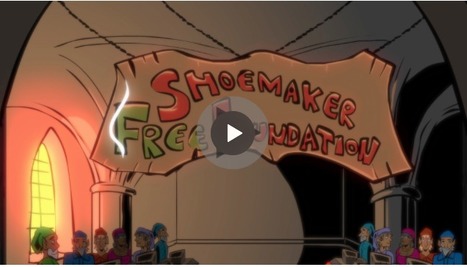
ShoeTool is an animated fairy tale about an elf shoemaker who thinks he buys a machine to help him make shoes... only to find out that there are there are strings attached to his "purchase."
Please show your support for free software and this video by promoting it on your social media using the #shoetool hashtag.
Free software seeks to give users control over the programs they use. It's all about the restrictive licenses that constrain use and re-use in pretty much everything these days...
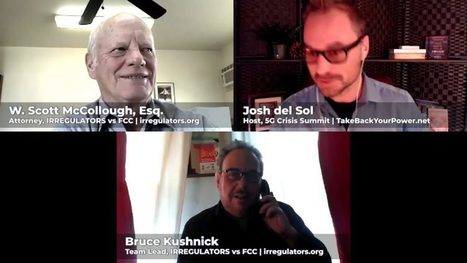
A groundbreaking conversation with the IRREGULATORS. This may be the most significant development since our 5G Crisis Summit, to redirect 5G in the United States.
Scott McCollough is a career telecom legal expert, and former Assistant Texas Attorney General and Contract Consumer Advocate. Reminding me of “Red” from That 70s Show, Scott is a lovable Texan hardass with a big heart underneath. He also happens to know the legal side of telecom and utilities better than virtually anyone else in the nation.
In the highlights compiled in the first 3 minutes of the interview, Scott outlined some key points in this scandal involving misappropriated funds which he estimates now totals a shocking $1 Trillion over the last 16 years:
“We had a bait and switch. We paid for a bunch of fiber to the home, and now we’re getting 5G instead.”
“We started this accounting thing not because we wanted to kill 5G, but because it was the right thing to do, once we figured out how badly local and intra-state wireline ratepayers were getting screwed.”
In the interview, Bruce Kushnick reveals how they have obtained financial documents from Verizon NY — which has previously been quietly designated as New York’s official telecom utility — that clearly show several billion dollars per year in misappropriation and theft.
Scott estimates the amount of funds that wireless giants are stealing from wireline ratepayers to be $60 Billion per year, and sees this as a cash cow that has illegally funded 5G deployments.
“[The IRREGULATORS’ suit] is a knife in the heart of the underlying economics that currently drive 5G.
“If we are successful… 5G cannot sustain itself on an economic basis if it has to pay its own way.”
Legal challenge to the rollout of 5G in the USA. “We had a bait and switch. We paid for a bunch of fiber to the home, and now we’re getting 5G instead...”
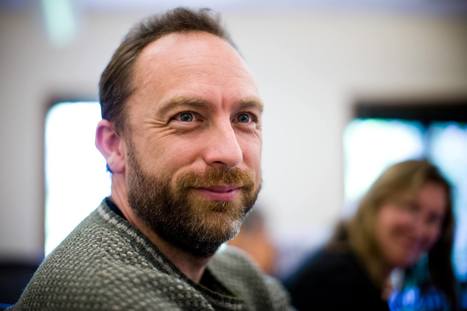
Wikipedia co-founder Jimmy Wales is launching a social-media website called WT: Social. The platform aims to compete with Facebook and Twitter, except instead of funding it using advertising, Wales is taking a page from the Wikipedia playbook and financing it through user donations.
"The business model of social media companies, of pure advertising, is problematic," Wales told Financial Times. "It turns out the huge winner is low-quality content."
WT: Social got its start as Wikitribune, a site that published original news stories with the community fact-checking and sub-editing articles. The venture never gained much traction, so Wales is moving it to the new platform with a more social networking focus.
This is like a pre-announcement, the site is in no way ready for prime time yet. You can sign up and contribute to the development, but it is far away from feeling like either Facebook or Twitter. Still, a laudable initiative.
Let’s face it: reflecting on the substantial patterns of the last twenty years of digital economic culture returns a bleak assessment. That promise to connect us that we call the “sharing economy” has turned out to be the perfect set of business practices to extract corporate profits while remaining indifferent to the well-being of participants and public infrastructure.
Meanwhile, cryptocurrency players, who ostensibly set out to level the playing field of the digital economy, ended up delivering a hyper-capitalist gambling ring with precious few useful or usable apps …
Imagine replacing extractive sharing economy platforms with a new type of cooperative model that uses crypto-accounting methods to create distributed networks of providers…of energy, food, housing, transportation…who knows what else? Holochain’s architecture is lightweight enough to process tens of thousands of transactions a minute.
What’s more, a federation of exchangeable asset-backed currencies using the Holo/Holochain pattern could have sufficient force to propel mainstream economic activity into directly peer-to-peer means.
To read the whole article, click in the headline...
A fast-growing open hardware movement is creating ingenious versions of all sorts of technologies, and freely sharing them through social media.
CERN is home to some of the largest and most complex scientific equipment on the planet. Yet back in March, scientists gathered there for a conference about DIY laboratory tools. Scientists in poorly funded labs, particularly in the global south, have used DIY tools for many years. But well-resourced institutes are increasingly interested in the collaborative possibilities of open labware. Citizen scientists are also using it to build instruments for tasks like environmental monitoring, which can then be used to support community demands for justice from polluters.
It is not only scientists – citizen or professional – who are going DIY. An open hardware movement of hobbyists, activists, geeks, designers, engineers, students and social entrepreneurs is creating ingenious versions of all sorts of technologies, and freely sharing the know-how through social media.
Open hardware is also encroaching upon centres of manufacturing. In August, for instance, the global gathering of FabLabs met in Shenzhen (already host to Maker Faires) to review how their network can help to decentralise design and manufacture.
The explosive growth of the organic food industry represents an ethical response to the conventional agro-chemical world, one projected to continue through 2018 and beyond. But the organic movement doesn’t just stop at food. Let’s consider another thing we consume every day: information.
For anyone who has bought into the food revolution, it’s not much of a stretch to see we’re ripe for an open information revolution. Not one defined simply by the omnipresence of information via the Internet, but one — like the food revolution — in which people demand accountability, transparency, and participation in the dissemination and consumption of information. Likewise, the outcome would be a new set of practices and players contributing to more healthy and sustainable environmental and personal practices.
If information is like food, packaged in technological bits and bytes, then you might say free and open source software is equivalent to organic, labeled products. Just as we care about what we put into our bodies, we should care about what we install in our technology systems. Some of the big players we currently know and trust are, frankly, serving up a bunch of cookies that aren’t great for us. They help advertisers track us, compromise our privacy, and in some cases, make us susceptible to infections in the form of viruses and malware. When you navigate the app market, what do you put in your basket? What are you allowing into your life?
Transparency and accountability in the world of information.
Our "walled garden" social networks - facebook is a prime example - actually isolate us from the world by putting us into a bubble of their construction. So do the big search engines, Google ahead of them all.
The algorithm rules, and by hiding some information and highlighting other bits and pieces, elections are skewed and social movements are effectively killed off or deviated.
We do need a revolution in the way we obtain and exchange data, and open source software is the antidote we are looking for, similar to the organic revolution that has already transformed our eating habits...
Flux is a new political party designed to connect Australians directly to Parliament and change politics forever!
Flux will operate in the form of an app you can access right from your computer or smartphone. You’ll be given a vote on every bill put before Federal Parliament, and can use that vote immediately on the issue at hand, give it to a trusted third party to cast on your behalf, or save it for an issue you care more passionately about later...
If we are going to have a say in politics, we need a way to express our views and preferences. Flux, an app for direct democracy is now being tried out in Australia...
I’m pleased to introduce Peer-to-Peer Digital Networking as a free digital book, and to invite public and private feedback on its further development.
For years, I’ve been looking beyond the technical and economic limits which we’ve developed during our fast few decades of personal computing and digital networking. I’ve looked at co-creative potentials envisioned by Internet pioneers, and added ideas on the basic nature of communication and community. This book reflects all of that research– but in most ways, it’s just a beginning.
We can rebuild communications technologies (tools, techniques and systems) to foster the emergence of communities and inter-communities of autonomous peers. It’s an immense challenge, however, because we must displace corporations which marry communities to software platforms based on financially extractive models.
We need to have control of our communications infrastructure, and Greg Cassel has written a book outlining the current situation and how to proceed from here. The book is a free download and Greg wants your comments and suggestions...
Every wonder why and how major media can cover up enormous scandals about vaccines, Benghazi, the creation and funding of ISIS, the complicity of the federal government in drug trafficking, the failure of the $2 trillion war on poverty, the private Federal Reserve banking cartel?
33 years ago, 50 companies owned 90% of US media.
Now, 6 companies own 90% of US media.
They are: Comcast; The Walt Disney Company; 21st Century Fox; Time Warner; Viacom; CBS.
PeerPlays Is The World’s First Decentralized eSports Tournament & Online Gaming Platform Built Entirely on the Blockchain That You Can Take Part In Today
Platforms and big tech determine much of our lives, it is only just they should be transparent to users. Algorithms and rules must be transparent.
It has become abundantly clear in these times that the major social media platforms and search engines we use to get information and to communicate with our friends the world over, are less than transparent and that several of them actually engage in censorship of “unwelcome” views and information.
Since many of our interactions happen through these electronic means of communication, this is a less than satisfactory state of affairs. It actually constitutes serious interference in our freedom of expression and our ability to form views to express.
Censorship of views, the skewing of search results and deliberate deviation away from certain topics of discussion, have no place in a free society. I would therefore like to introduce a concept, a principle that needs to find its way into our legislation and perhaps more than that, into networking codes of practice. It is the concept of platform transparency...
We are aware of the phenomenon called “Metcalfe’s Law.” Roughly that the value of a network is proportional to the square of the number of users connected to the system. This “network effect” is perhaps the most important value driver in the world today. Because the value of the network increases with the number of people on the network, there is a self fulfilling prophecy. Past a critical point the biggest network is more attractive than any other competing network. Which means that it gets more users. Which means that it gets more valuable. Which means that it is more attractive.
It can be a pretty quick ride to monopolistic vastness. Just ask Facebook, YouTube and Twitter.
OK. Lets call this feedback loop the “network attractor.” Once you have achieved some critical point, your platform is like a black hole that sucks in everything and makes escape increasingly impossible.
Now I would like to introduce a new concept. Perhaps even a new law.
Any for-profit entity that is founded on the value of network effects must maximally extract that value to the limit of the network attractor. This produces an ‘extractive repulsor’ force. As the limit is approached, the network becomes poised at fragility.
The straw that will break the camel's back ... "Any for-profit entity that is founded on the value of network effects must maximally extract that value..."
All communication relies on one or more carriers. At the most basic level, when you’re speaking to a group of people in a room, the air is the carrier for the sound waves moving through it. You pass breath through your vocal chords and shape your mouth in funny ways, and a bunch of compression waves emerge and fill the room with information that others then decode. No one can just grab the words out of the air to stop them from reaching someone else. The carrier is unenclosable.
As the speed and scale of communication has increased, so have the layers of enclosable carriers on which our communication relies. In newsprint and on television, it’s the advertisers, as well as executives who are bound to the interests of boards and shareholders, who exert both apparent and hidden control over the content we receive.
And of course we have the internet, which has given us a taste of radical participation and democratized access to information, but whose filters on access and information have caused increasing alarm.
One key ingredient in making any system fundamentally unenclosable is the ability for anyone to create segmented spaces of coherence into and out of which people can freely associate, with rulesets that are particular to those spaces.
Another key ingredient of our unenclosable system is forkability, which means that anyone is free to leave any space, create another based on the same (or similar) source codes and rulesets, and invite people to the new version.
For true forkability, users need to be able to migrate easily between versions, taking their data from one version — for example their complete activity on a social network or search engine — and load it into the new version.
Holochain is designed precisely to foster the kind of ecosystem we’ve been describing, with the ‘islands’ being applications that anyone can easily spin up by creating or forking code. Holochain also makes it simple to move between ‘islands’ by allowing users to control their data in such a way that it’s easy to bring along to new applications.
We believe that by providing an unenclosable carrier for an unlimited range of applications, Holochain will enable the next internet — one that doesn’t involve corporations, governments, or surveillance systems in the middle of our communication and collaboration.
To read the whole article from which this has been excerpted, go here...
Our communications and our interactions are controlled in various ways by those who think they know what's best for us and who can profit from having such controling power. How would it be if we had ways to interact directly with each other, that were outside of anyone's ability to control? Some people are working on this, and here is an article - first in a series of three - describing how this will be achieved.
"The music industry is broken,” has been said many times. Built upon models designed in a pre-digital world, the back-end infrastructure of the music business has failed to adapt to the needs of musicians, markets, and industry organizations.
Systems of rights management, accounting, and payment distributions used in the industry have not upgraded along with the other internet technologies that have changed the industry, becoming a fragmented mess, leaving countless artists unable to make any sort of decent living off their work, and delivering equally-damaging blows to the profitability of record labels and publishers.
While the problems plaguing the music industry are broad and complex, the emergence of blockchain technology has been foreseen to be THE disruptive, transformative force in solving the challenges faced.
Not only will the blockchain level the playing field for artists, granting them direct access to markets and means to get paid instantly for the sale of their art - versus middlemen taking huge cuts and slowing payments through overcomplicated processes - industry-wide infrastructural evolution built upon blockchain developments hold the potentially for massively increasing organizational accounting & payment efficiencies, while simultaneously unlocking billions worth of assets through new licensing structures possible though an integrated, collaborative ecosystem utilizing a transparent distributed ledger, smart contracts, and digital-identity-based reputation systems.
The article is a collection of the information of what is happening with music in the blockchain space.
Musicians want clear rules and a simple-to-use system for distributing their music and getting paid for it. Blockchain technology offers a way to achieve that.
This site is reliable because the links within works. This subject talks about how advances in technology has completely changed the way in which it strongly effects the music industry. I got this site from searching on scoop it.
For some time, I’d heard rumors that Wikipedia was not the open-source knowledge utopia it claimed to be. Despite a comprehensive set of rules replete with checks and balances and a seemingly open democratic editing process, stories of pay-for-play editing, character assassinations, ideologically-driven trolling, and other offenses against public knowledge suggested all was not right in Jimmy Wales’ empire.
Authors and public figures in fields as diverse as Complementary and Alternative Medicine and progressive politics (including Deepak Chopra, Rupert Sheldrake, Gary Null, John Pilger, and George Galloway) have complained of persistent negative coverage on Wikipedia despite the site’s vaunted neutrality and the promise that “Biographies of Living Persons” are held to the highest standard. Efforts to have misinformation corrected were fruitless and their reputations have suffered as a result.
This seemed implausible. How could a site with over 100,000 volunteer editors, with open access for anyone looking to get involved, be engaged in such widespread bias? As an investigative journalist and activist who has spent many years seeking the truth in a landscape of obfuscation and lies, I decided to find out exactly what was going on at Wikipedia...
We think of Wikipedia as a good and impartial source of information, but there is nothing impartial about the information we get. Senior editors and administrators are having their own, at times paid-for, agendas and they enforce those with all means available. The result ... fake information on many important topics. This in-depth article has the facts.
Helium Hotspots make up the foundation of a new type of network, one that rewards individuals for providing wireless connectivity. Using an approach similar to Airbnb, this peer-to-peer wireless network can rapidly deploy complete coverage for cities at a speed not possible by large centralized entities.
The result? A secure, ubiquitous, and affordable network that enables companies to focus on applications and use cases, not cellular plans for devices or managing network infrastructure.
Owned and operated by a community of individuals means this network eliminates the chance that a single company can monitor data, throttle traffic, or be a central point for attackers.
With an ambitious decentralized platform, the father of the web hopes it’s game on for corporate tech giants like Facebook and Google.
This week, Berners-Lee will launch Inrupt, a startup that he has been building, in stealth mode, for the past nine months. Backed by Glasswing Ventures, its mission is to turbocharge a broader movement afoot, among developers around the world, to decentralize the web and take back power from the forces that have profited from centralizing it. In other words, it’s game on for Facebook, Google, Amazon.
For years now, Berners-Lee and other internet activists have been dreaming of a digital utopia where individuals control their own data and the internet remains free and open. But for Berners-Lee, the time for dreaming is over.
“We have to do it now,” he says, displaying an intensity and urgency that is uncharacteristic for this soft-spoken academic. “It’s a historical moment.”
Ever since revelations emerged that Facebook had allowed people’s data to be misused by political operatives, Berners-Lee has felt an imperative to get this digital idyll into the real world. In a post published this weekend, Berners-Lee explains that he is taking a sabbatical from MIT to work full time on Inrupt...
Berners-Lee, the inventor of the Internet, is working on a cure ... something that can replace the closed social spaces and search giants that see us and our data as their "product"...
As long as these platforms have to generate significant revenue to maintain or grow themselves, they will reasonably use every available and creative option to trigger human engagement. And we can’t change how humans are wired with any degree of speed or accuracy (and would we want to — it sounds like a recipe for cascading unintended side effects).
What we can change is the business models those platforms are based on. Since Holochain is run by a community, there isn’t a requirement for a business model to support the heavy costs of servers. We can do things differently and magnify different signals.
Holochain can save democracy by encouraging organization models that don’t depend on the outcome of a manipulation.
Holochain can help enable payment direct to journalists.
Holochain is an emerging model of internet based networking that isn't married to a business model which needs to maximize profits and therefore sell us down the drain in the process.
So far, local, community-based initiatives have been, by their nature, fragmented, and often have had little contact with or support from outside. There have been some efforts to address this, especially at regional and national level, but the effectiveness of these efforts has been limited.
A key requirement, therefore, is to nurture and support this local dimension, while also facilitating greater inter-connectedness and networking between groups, and with other organizations.
Our aim must be to lead, culturally and practically, a worldwide transition away from the big cities and back towards an essentially rural lifestyle, where technology, transportation and commodities will be accessible to everyone through a distributed inter-network.
This looks like a well worked out plan to get us from the present world that doesn't function for many to ... a world that we can all contribute to forming and that will allow us to live, love and create...
A more democratic internet is possible via personal and community networking. Find out how to build your own connection to the world.
DIY networking is an umbrella term for different types of grassroots networking, such as mesh networks. According to Vice magazine, mesh networks not only allow wifi routers to provide signals to wifi-enabled devices, as usual, but also, “routers have the ability to connect to and talk to each other. By ‘meshing’ them, or connecting them together, you are creating a larger wifi zone.”
Artists have been looking at these networks as a way to expand and diversify our communication abilities, while questioning mainstream access to internet.
A wireless router, in essence a special purpose computer, can do more than just connect your devices to the internet. It could host a wide variety of web services, from a simple site to a fully fledged collaborative platform, accessible only to those in physical proximity.
These include a virtual announcement board for a block of apartments, an online guestbook for an urban garden, a file-sharing platform for a workshop, and many more creative uses of “self-hosted” web applications, like Wordpress, Owncloud and Etherpad that anyone can host on a private web server.
OpenBazaar is the next brick in place for a globally open commercial infrastructure, scalable to the whole of the human population and functioning outside any existing legal structure of any nation-state.
The technology that makes it possible is not a website but rather an application that anyone can download and run. It has just come out of Beta and is already in use by many thousands of people around the world...
Political adviser and author Jeremy Rifkin believes that the creation of a super internet heralds new economic system that could solve society’s sustainability challenges
“This is the first new economic system since the advent of capitalism and socialism in the early 19th century so it’s a remarkable historical event and it’s going to transform our way of life fundamentally over the coming years,” Rifkin says. “It already is; we just haven’t framed it.”
Some sectors, such as music and media, have already been disrupted as a result of the internet’s ability to let individuals and small groups compete with the major established players. Meanwhile, the mainstreaming of 3D printing and tech advances in logistics – such as the installation of billions of intelligent sensors across supply chains – means this phenomenon is now spreading from the virtual to the physical world, Rifkin says.
To get content containing either thought or leadership enter:
To get content containing both thought and leadership enter:
To get content containing the expression thought leadership enter:
You can enter several keywords and you can refine them whenever you want. Our suggestion engine uses more signals but entering a few keywords here will rapidly give you great content to curate.


 Your new post is loading...
















Are nation states in trouble? One might be forgiven for thinking so when observing the absolutely assinine and frankly destructive reactions to a "deadly virus", all dictated from some back room at the WHO ... With economic breakdowns in the offing, something must give, and the author of this piece thinks it is the nation state...