Your new post is loading...
For more than 1,000 years people of Fukushima Prefecture in Japan have gathered every summer to celebrate an ancient tradition of the samurai. The Soma Namaoi festival is as much a part of their heritage as the warrior and equestrian culture it reenacts and honors, and in the face of radiation from the nearby Daiichi nuclear reactor, they’ve decided the show must go on.
Tokyo photographer Noriki Takasugi’s series Fukushima Samurai — The Story of Identity captures the samurai of the Soma Nomaoi festival as they risk their own health to sustain a tradition that largely defines them.
Many of the men in Takasugi’s photos are from the hard-hit town of Odaka-ku, who along with thousands of others in Fukushima were displaced or saw their homes destroyed when its residential coastlines were swept away in the tsunami of 2011. Along with the houses went the accoutrements of Soma Nomaoi — their weapons, their ceremonial Jinbaori clothing, and, sadly, their horses. Much of what they’ve worn for the festival since the tsunami is borrowed or otherwise cobbled together, and after spending months in the vicinity of the Daiichi plant before daytime visits were again allowed, many of the clothes they did retrieve were likely irradiated. In the Odaku-ku area, Takasugi says her geiger counter measures radiation between five and 50 times the levels registered in her Tokyo neighborhood.
“None of the people I asked cared about the irradiated clothes,” says Takasugi. “It was my impression that it was more important for them to have their weapons and their ceremonial costumes.”
Click headline to read more--
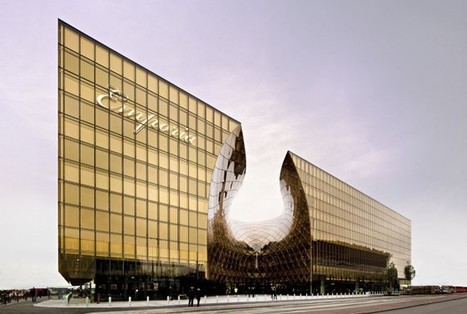
The developers of Emporia, a new mixed-used development in Malmö, Sweden, wanted to attract commuters from the local train station to the combination mall, supermarket, office tower, and apartment building they planned to create.
Realizing that a stunning design could be a way to attract pedestrians they commissioned Wingårdhs a 170 person architecture firm based in Göteborg, Sweden to use the $390,000,000 construction budget to create a landmark that would act like a beacon to pedestrians. The result is a colorful collection of interior spaces, wrapped in a sinuous, psychedelic surface that appears to be on fire when the sun strikes it right.
The structure’s most distinctive features are two colorful glass-clad entrances inspired by nature—an amber colored entrance pays homage to Sweden’s trees and the semi-precious stones produced by their resin and a swirling blue entry that echoes a nearby strait. The serpentine surfaces of the building are jolting, but are also notable achievements in structural engineering.
Click headline to read more--
U.S. regulators have given the green light to Microsoft's acquisition of Nokia's handset business, moving the deal a major step closer to wrapping up.
The Department of Justice (DOJ) approved the transaction on Friday, Nov. 29, and the Federal Trade Commission (FTC) published the notice today on its website.
"We look forward to the date when our partners at Nokia will become members of the Microsoft family, and are pleased that the Department of Justice has cleared the deal unconditionally," a Microsoft spokesperson said in an emailed statement.
Microsoft announced the acquisition of Nokia's Devices and Services business Sept. 3, when it said it would pay the Finnish firm a total of $7.2 billion, a figure that included $2.2 billion to license Nokia's patents.
At the time, analysts contended that the purchase was a defensive move to keep the phone maker from going under or falling into the hands of an Android-first rival.
Nokia sells the bulk of the world's smartphones powered by Microsoft's Windows Phone operating system.
Nokia's shareholders approved the deal two weeks ago at an emotional meeting in Helsinki, where shareholders grilled company executives for several hours before voting.
Regulators in India, Israel, Russia and Turkey have also okayed the acquisition.
Still outstanding is approval by European Union (EU) antitrust authorities, who are to announce their decision Wednesday. Ten days ago, Reuters, quoting anonymous sources, said that the EU would clear the deal.
Click headline to read more--
David Thodey, CEO of Telstra, gave the welcome address in which he paid tribute to Mike Quigley, his formidable achievements at NBN Co and his integity throughout the working relationship between the two companies.
At this event Mike was formally awarded the Charles Todd Medal of 2013 which had been announced at the Charles Todd Oration on 23 October. Michael Malone, CEO and Founder of iiNet and speaker at that event, was the other recipient.
Click headline to read the text of Mike Quigley's presentation--
It's no secret that Chinese telecom gear maker Huawei and the US government aren't exactly best friends -- for the past couple of years, the US has accused Huawei of cyberespionage on behalf of the Chinese military.
It appears this spat may now have escalated into a full-fledged falling-out.
Huawei CEO Ren Zhengfei told French news site Les Echos last week that he no longer wanted to stay in the US market.
"If Huawei gets in the middle of US-China relations," and causes problems, "it's not worth it," Ren reportedly said, according to a Chinese transcript of the interview translated by Foreign Policy. "Therefore, we have decided to exit the US market, and not stay in the middle."
It's unclear how serious Ren's threats are or if there's any timeline to Huawei possibly pulling out of the US market. When contacted by CNET, a Huawei spokesperson was vague regarding Ren's statement.
"We remain committed to our customers, employees, investments, and operations and more than $1 billion in sales in the US," the spokesperson said, "and we stand ready to deliver additional competition and innovative solutions as desired by customers and allowed by authorities."
Click headline to read more--
We’re gradually entering the age of the small cell, tiny mobile cell sites that are mounted on walls and light poles rather than high up on towers. But as the topology of the network changes so do the logistics of deploying it. Carriers can’t just stick these cells anywhere they choose. They have to figure out how to get them power and how to connect them back to their networks as well as get local government approval to install them.
Alcatel-Lucent believes it has an answer to that problem: Around the world there are innumerable ISPs, utilities, cable companies, fiber backhaul providers and even outdoor advertisers that have the both the real estate and the infrastructure to host small cells. Why not pair them with carriers looking to shrink down their networks?
The Franco-American network equipment maker on Tuesday launched a new small cite certification program with the aim of pre-designating millions of outdoor and indoor locations as small cell-ready. For instance, a company that hosts outdoor advertising would show that its billboard locations not only have the space to mount a small cell, but have the necessary power and accessible nearby fiber lines to backhaul the cell’s traffic. It would also have to prove that any small cell deployed there would meet the local community’s zoning and planning regulations.
Alcatel-Lucent has already pre-certified 600,000 sites in Europe and the U.S. and has signed up about a dozen site providers, including tower real-estate firm Crown Castle, backhaul provider EdgeConneX and fiber ISP Zayo. According to Alcatel-Lucent VP of small cells Mike Schabel, the program is also working with several large cable companies, which are of particular note since their coax is practically everywhere. Carriers partnering with a cable provider could literally hang their small cell networks off of cable lines.
Click headline to read more--
A year and a half ago, we thought this plan was dead in the water, but apparently while we weren't paying attention, a plan moved forward in Italy to take significant copyright enforcement powers out of the courts and, instead, give it to the Italian regulator AGCOM.
If you want to see a recipe for a bad idea, this is it. Regulators are very much subject to regulatory capture, and a regulatory board entirely focused on copyright enforcement will almost certainly be controlled by maximalists who come from industry, rather than those with the public benefit in mind.
As it stands, the proposal is currently being reviewed by the EU to see if it complies with EU directives. A ruling in favor of the AGCOM plan would have a huge negative impact on Italy, innovation and culture.
Click headline to read more--
A Japanese firm has come up with the idea of constructing an array of solar cells around the Moon's equator to harvest solar energy and beam it back to Earth. The Shimizu Corporation proposes creating a "Luna Ring" using materials derived from lunar soil along its 11,000-km (6,800-mile) equator. The plan involves starting with an array that's a few kilometers wide and eventually increasing that to around 400 km (250 miles).
The goal is to generate a continuous stream of power from the Moon's lunar equator, which receives a steady amount of exposure to the Sun, and beam it down to Earth from the near side of the Moon. It's an ambitious idea that calls for assembling machinery transported from Earth and using tele-operated robots to do the actual construction on the Moon's surface, once it arrives.
The multi-phase project, to be spread out over a period of 30 years, envisions creating construction materials using a combination of strategies. Water, the firm claims, could be produced by reducing lunar soil with hydrogen imported from Earth. The company also proposes making lunar concrete by extracting cementing material, and utilizing solar-heat treatment processes to create bricks, ceramics, and glass fibers.
The concept also calls for remotely-controlled robots to undertake tasks such as excavating the surroundings, leveling the ground and laying out solar panel-studded concrete. Embedded cables could transfer the collected solar energy and send it to transmission stations that are located on the near side of the Moon.
Click headline to read more, view pix gallery and watch video clip--
As evidenced by our friend carbon fiber, composite materials get a big boost in strength when fibers are part of the recipe. Examples include composites made with plastic, wood pulp, and flax fibers. Husband-and-wife design team Jen Carlson and Josh Shear have taken this concept to a funky new level, by using shredded old blue jeans to create a denim fiber composite known as Denimite.
Along with the recycled jeans, Denimite also consists of a partially bio-based thermoset resin, that contains no volatile organic compounds. By controlling the pressure at which these two key ingredients are combined, the density and thus the strength of any one item can be tweaked.
The material is reportedly lightweight, water impervious, and because of the random nature in which the denim fibers are distributed, exhibits mechanical strength in all directions. Additionally, the raw materials are relatively cheap and plentiful ... plus it has a cool "blue-jeany" look to it.
Click headline to read more and view pix gallery--
Microsoft yesterday announced the appointment of Otema Yirenkyi as the company's first country manager for Ghana.
This is even as the company shifts its global focus to a devices and services offering, as Ghana remains one of its critical investment markets in Africa.
Otema, a native Ghanaian with over 14 years of ICT experience, will take the helm of its increasing investment in the country.
Otema is Microsoft's first female country manager on the African continent and holds a BSc degree in Industrial and Labour Relations, as well as an MA in Development Studies.
"We have seen tremendous growth in broadband availability and internet penetration in Ghana, as well as the introduction of newer devices such as tablets and smartphones, which have fundamentally changed how consumers experience and use technology," says Otema.
Ghana's current mobile penetration rate is at an estimated 112%, after the country hit the 100% mark at the end of 2012. These numbers are the highest in Africa, placing Ghana 49th in the world, according to the International Telecommunications Union (ITU).
"This always-on, always-connected era that we find ourselves in holds new promise for what technology can bring to people's lives and to businesses. And it gives us an opportunity to use our technology, talent, time and money to help create sustainable growth in the country and across the African continent."
Click headline to read more--
UK cellcos EE, Vodafone UK and Hutchison 3G UK (H3G UK), as well as mobile virtual network operator (MVNO) Virgin Mobile, have all agreed to government proposals, under which they will allow customers to break contracts without penalty if their tariffs are increased mid-contract.
According to Reuters, the quartet has said they will also cap bills linked to stolen or lost phones. The market’s second-largest operator in terms of subscribers, O2 UK, remains in talks with the state regarding the matter, however. In a statement the cellco noted: ‘We need clarity on what the guidance means for us and our customers before we can sign up to all the commitments referred to by [the] government.’
Meanwhile, it is also understood that the four aforementioned mobile service providers, along with fixed line operators BT, BSkyB and TalkTalk, have pledged to support European Commission-led plans to eliminate roaming charges within Europe by 2016.
C-DOCSIS, a modification of cable’s IP platform that was originally developed for China’s high-density multi-dwelling unit (MDU) environment, has made some strides this year and is on the cusp of reaching a deployment milestone, according to Broadcom, the chipmaker that is championing the technology.
The C-DOCSIS network footprint, comprised of deployments of a device called the Coax Media Converter (CMC), will be capable of serving about 1 million modems by the end of 2013, predicts Ernie Bahm, the senior director of product marketing for Broadcom’s Broadband Communications Group.
“Step one is getting the footprint out there, and then working on the attachment rate,” he said. “We’re forecasting significant growth next year.”
According to Broadcom, a handful of China-based operators have already adopted C-DOCSIS during this early deployment phase, including Guangzhou Digital Media, Cable Networks of Inner Mongolia, Guangxi, and Shanxi Province, as well as Nanjing City and Kunshan City of Jiangsu Province. China’s State Administration of Radio, Film and Television (SARFT) has accepted C-DOCSIS as an access standard for the country’s next-generation broadband project aimed at sparking more competition for the nation’s telcos. SARFT has also stamped two other Ethernet-over-coax technologies: HiNOC (High Performance Network Over Coax) and C-HomePlug.
Although China currently represents about 95% of Broadcom’s C-DOCSIS deployments, the company is also seeing interest in the technology from operators in other regions, including in Northern Europe, where municipal providers are pulling fiber closer to apartment buildings, as well as from the hospitality services sector, Bahm said.
That fits well with the fiber deep C-DOCSIS architecture, which relies on the CMC, a stripped-down, router-less version of a cable modem termination system (CMTS) that can work with traditional DOCSIS 2.0- and DOCSIS 3.0-certified cable modems.
Click headline to read more--
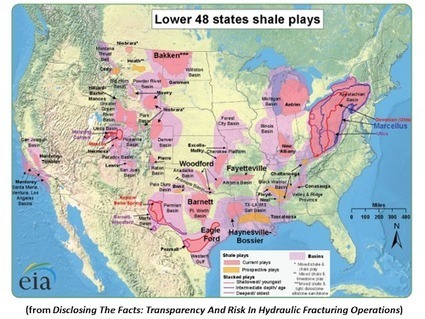
Since 2009, institutional investors have been pressing oil and gas companies to be more transparent in reporting how they manage and mitigate the environmental risks and community impacts of their hydraulic fracturing operations. Measurement and disclosure of best management practices and impacts are the primary means by which investors gauge how companies are addressing the business risks of their operations.
This inaugural scorecard is a collaborative effort of As You Sow, Boston Common Asset Management, Green Century Capital Management, and the Investor Environmental Health Network. The scorecard analyzes and benchmarks the public disclosures of 24 oil and gas companies on the use and effectiveness of best management practices for reducing and managing environmental risks and community impacts from hydraulic fracturing operations. It does so by examining overall industry performance on use of quantitative metrics for disclosure, identifying those indicators most commonly reported, and distinguishing companies disclosing more about their practices and impacts from those disclosing less. The scorecard specifically measures company disclosures across five areas of environmental, social, and governance metrics: (1) toxic chemicals; (2) water and waste management; (3) air emissions; (4) community impacts; and (5) management accountability, on a play-by-play basis.
Click headline to read more and access the green hot link to report--
|
Researchers at the University of Stuttgart are preparing to test a solar heating system capable of long term storage as part of "Solspaces," a three-year project that kicked off in March 2012. The heating concept uses a solar thermal system in conjunction with a sorption tank for storing heat from solar collectors throughout the warmer months that can then be released when the mercury drops.
The Solspaces concept has the potential to reduce the required storage space for solar heating systems and address the issue of heat retention. It involves a thermochemical heat storage tank with three to four times the energy density of water and improved thermal insulation, enabling more compact storage with less susceptibility to heat loss than conventional solar thermal systems relying on water as the heat storage medium.
Integral to the process is the microporous mineral zeolite, which boasts high energy density, low drying temperature and the ability to uptake large amounts of water vapor. During winter, the zeolite acts as a sorbent, adsorbing humidity from the moist air flowing through the reservoir. The binding of the water vapor with the sorbent produces heat energy, which is used to heat the building.
Click headline to read more and view graphic--
China overtook Japan in IT spending this year to become the world's second largest IT market, according to market research firm IDC.
The U.S. remains the largest IT market the world, still more than three times the size of China. But China's IT spending is increasing by double digits, and technology industry investment is a high priority thre.
China's IT spending increased by 8.3% this year, nearly double that of the U.S., and is forecast to further grow by 14.1% next year, said Frank Gens, chief analyst at IDC.
The clearest evidence of China's interest in building a technology market is its development of the world's fastest supercomputer, topping the Top 500 list.
China's overall IT spending is projected to hit $204 billion in 2014, versus $686 billion in the U.S., said Gens.
U.S. IT spending grew 4.7% in 2013, and is forecast to rise by 3.8% next year.
China's IT spending will increase by $25 billion in 2014, the same dollar increase as in the U.S.
"It's going to be quite a while before it (China) closes the gap" with the U.S., said Gens, who expects China's IT growth rate to slow as it grows.
In 2013, China's IT spending will total $179 billion, beating Japan's $173 billion by $5 billion.
China's rate of spending says "that China is the place you have to be if you are in the IT market," said Gens.
In the global market, IDC expects global IT spending to rise by 5.1% next year to over $2.1 trillion.
Click headline to read more--
Back in May Network World reported on the discovery of Trojan code in client-side gaming software published by the Commack, NY-based, E-Sports Entertainment Association. ESEA provides gaming services including matchmaking, league play, and cheat prevention for games such as League of Legends and Starcraft 2 for $6.95 per user per month.
What ESEA did with the Trojan code was to create a botnet of some 14,000 of their claimed 586,000+ client base to mine for Bitcoins but, in the process, managed to damage some users’ computers by overheating due to unthrottled GPU processing.
The Trojan code in question was OpenCL miner, “a bitcoin miner that uses the OpenCL framework to perform the hashing computations. When used with a modern GPU, this can produce hash rates orders of magnitude higher than what can be achieved with a CPU.” Originally authored by Apple, the core of the miner, OpenCL, is “a framework for writing programs that execute across heterogeneous platforms consisting of central processing units (CPUs), graphics processing units (GPUs), digital signal processors (DSPs) and other processors.”
When the issue first came to light ESEA claimed it was an April Fool’s joke but the company changed its story and eventually ESEA co-owner Eric Thunberg ‘fessed up and admitted that the bit coin mining had been going on for two weeks and netted a total of 29 bitcoins worth, at the time, about $4,000 (today those 29 bitcoins are worth in excess of $30,000). It was claimed that a rogue engineer, Sean Hunczak, was responsible. ESEA said it would donate double the value of the bitcoins to chairty and began a program to compensate users whose hardware had been damaged.
But that wasn't the end of it for ESEA and at the end of November the New Jersey attorney general’s office announced that it had come to a $1,000,000 settlement with ESEA and placed them on a 10-year probation. The company must immediately pay $325,000 but if they behave during the probation period the remainder of the fine will be waived.
Click headline to read more--
In April 2009, Australia’s then prime minister, Kevin Rudd, dropped a bombshell on the press and the global technology community: His social democrat Labor administration was going to deliver broadband Internet to every single resident of Australia. It was an audacious goal, not least of all because Australia is one of the most sparsely populated countries on Earth.
The National Broadband Network (NBN), as the project is known, would extend high-speed optical fiber directly into the homes, schools, and workplaces of 93 percent of Australians. The remaining 7 percent, living out of fiber’s reach in rural areas and remote pockets of the vast outback in the middle of the continent, would be linked to the Internet via state-of-the-art wireless and satellite technology.
Governments and telecom carriers in other countries, such as Japan, New Zealand, Singapore, and South Korea, have similarly embarked on endeavors to deploy widespread fiber-to-the-premises (FTTP) networks. But those countries are much smaller and more densely populated than Australia. The country has roughly the landmass of the contiguous United States but only 7 percent as many people—fewer, in fact, than the state of Texas. To lay a nationwide fiber footprint, the government would need armies of workers and unprecedented access to rights-of-way, utility poles, and underground ducts.
And indeed, the NBN’s estimated cost was high: The latest figure was AU $45.6 billion (US $44.1 billion). It would be one of the largest, most pervasive FTTP rollouts any government has ever attempted. But although the price would be great, so would the impact: The network would bring broadband access to underserved areas, but it would also raise standards of living everywhere by driving innovations in telemedicine, remote education, e-commerce, and e-governance. A government-funded report released this year by Deloitte Access Economics concluded that the NBN would provide job opportunities, time savings, and other benefits worth, on average, AU $3800 (US $3600) per household per year by 2020, when construction would be nearly complete. In addition, fiber’s enormous bandwidth capacity means that transmitting and receiving equipment could be upgraded indefinitely at low cost, allowing the NBN to keep pace for decades with the incessant demand for higher data rates.
Yet despite these benefits, some conservative politicians and media outlets vehemently opposed the plan. In the campaign leading up to a national election this September, the fate of the NBN was vigorously debated. Although polls showed that the majority of voters supported the project, they nevertheless rejected the Labor Party and ushered into power an alliance of moderate conservative parties known as the Coalition, whose leader and now prime minister, Tony Abbott, promised to drastically scale back the national network.
So now, after three years of planning and construction, during which workers connected some 210 000 premises (out of an anticipated 13.2 million), Australia’s visionary and trailblazing initiative is at a crossroads. The new government plans to deploy fiber only to the premises of new housing developments. For the remaining homes and businesses—about 71 percent—it will bring fiber only as far as curbside cabinets, called nodes. Existing copper-wire pairs will cover the so-called last mile to individual buildings.
Click headline to read more--
As you should know by now, there are people in this world that think an addiction to the internet and/or video games is a thing. As in, a real thing, a real disorder. This, despite all the evidence that there is no such disorder and that video games are no more addictive than work or school. But scaring the hell out of people with official-sounding terminology makes for great business, leading to care-givers and hospitals opening up entirely new practices for treating these heretofore unproven "diseases."
However, lest you think that fact-less platforms are the exclusive realm of the medical profession, take a look at how some South Korean politicians are trying to craft legislation that places video game addiction as the lunch-meat in their alcohol and drugs sandwich.
Click headline to read more--
All it took to reach a more realistic estimate of how much fish is being harvested from the sea was one scientist with an Internet connection and an inquisitive mind.
Researchers at the University of British Columbia used satellite imagery from Google Earth to discover that large fish traps in the Persian Gulf could be netting nearly six times more fish than official statistics report.
The study began with a PhD student messing around on the Internet.
”I was just playing around with Google Earth, doing what most people do when they first get on, which is try to find their house,” said Dalal Al-Abdulrazzak, a doctoral student at the university’s Fisheries Center and lead author of the study.
The Kuwait native noticed that three fish traps, known as weirs, could be seen near her parents’ home on the Persian Gulf. “I had a light-bulb moment,” she said.
Click headline to read more--
Tom Steyer, the billionaire hedge fund executive and environmental activist from San Francisco, chose his venue carefully.
“It is here President Obama drew his own personal line in the sand,” Steyer said as he convened a conference on the Keystone XL pipeline Monday at Georgetown University.
The reference was to a speech by Obama in June in which the president declared he would approve Keystone only if backers of the pipeline could prove that the project would not accelerate climate change. The pipeline is designed to move hundreds of thousands of barrels of oil daily 1,200 miles from Canadian tar sands to Gulf Coast refineries.
The conclusion reached at Steyer’s conference was unanimous and hardly surprising. Experts invited by Steyer and other conference organizers, all of whom oppose the project, declared that it would not meet the president’s test.
The event was another reminder of how politically awkward Keystone has become for Obama. Steyer is one of the president’s biggest donors. A fundraising event he held at his home during the reelection campaign was one of Obama’s most successful. Other deep-pocketed donors listen to Steyer. Democrats in Washington are eager to tap his funds.
And Steyer is on a crusade against Keystone. The billionaire not long ago quit his job running a major San Francisco hedge fund to spend all his time campaigning on global warming issues. Pressure applied by Steyer, the star of his advertising campaign against Keystone, has helped put into limbo a project that once seemed headed for approval.
Obama’s comments at Georgetown and elsewhere since that speech have indicated that he is strongly considering denying the project the approval it needs to go forward.
How much of an impact Keystone would have on the environment is fiercely debated. The State Department declared this year that rejecting the project would do little to slow climate change. The oil would still flow, its analysis warned, only to be shipped by rail. But soon after, the Environmental Protection Agency criticized that analysis, releasing a comment letter warning that the State Department approach had failed to properly assess key variables, including the market for the heavy tar-sands oil.
Steyer’s event Monday was a cross between political pressure and academic symposium. Former Michigan Gov. Jennifer Granholm, who introduced Steyer, called it “an in-your-face summit.” But much of the day involved scientists and advocates showcasing detailed slide shows to make their points against the project.
Click headline to read more--
Over the years, various researchers have developed systems in which the weight transferred through cars' wheels onto the road – or through pedestrians' feet onto the sidewalk – is used to generate electricity.
These systems utilize piezoelectric materials, which convert mechanical stress into an electrical current. Such materials may be effective, but they're also too expensive for use in many parts of the world. That's why Mexican entrepreneur Héctor Ricardo Macías Hernández created his own rather ingenious alternative.
In Macías Hernández' system, small ramps made from a tough, tire-like polymer are embedded in the road, protruding 5 cm (2 in) above the surface. When cars drive over them, the ramps are temporarily pushed down.
When this happens, air is forced through a bellows that's attached to the underside of the ramp. That air travels through a hose, and is compressed in a storage tank. The stored compressed air is ultimately fed into a turbine, generating electricity.
Click headline to read more--
It is interesting to see what other countries do with broadband – in terms of how they deploy, adopt and prioritize. So I was very interested in learn what the International Telecommunication Union (ITU) had to say in their recent Broadband Manifesto.
The ITU focuses on technology and broadband as a tool for democracy and a tool to bring about equity, especially to emerging nations. They recognize the power of broadband to boost education, healthcare and economic development. But they also highlight broadband as a tool to help raise the voices of the under-heard populations. They value access to technology as power to use technology to tell o story; they value free and open channels for communication.
Access to open communication is something we don’t think about here in the US – but their Manifesto can speak to our needs here too…
Click headline to read more--
Spanish mobile network operator Xfera Moviles, which offers services under the Yoigo banner, has announced that it plans to expand LTE coverage to six additional provinces this month.
With the cellco already providing its 4G products in Madrid, Malaga, Valencia, Barcelona, Alicante and Seville, this week it will extend its footprint to Castellon, Tarragona, Girona, Cordoba, Huelva and Vizcaya.
With rollout continuing apace, Yoigo has confirmed that it is aiming to offer its LTE-based tariffs to more than 22.5 million people, or around 48% of the population, by the end of the year.
Looking further ahead, by the end of the first quarter of 2014 the mobile operator has set out its stall to offer 4G in all cities with more than 70,000 inhabitants.
As previously reported by TeleGeography’s CommsUpdate, Yoigo launched LTE services in mid-July 2013; despite having aimed to be the first operator to market the technology commercially, it was beaten to the punch by both Vodafone Spain and Orange Espana, which launched at end-May and early-July, respectively.
Belgium-based mobile virtual network operator (MVNO) Mobile Vikings has announced its launch in Poland, following the successful introduction of its low-cost pre-paid services in Belgium and the Netherlands. CEO Frank Bekkers commented: ‘After the Belgian domestic market and the one in the neighbouring Netherlands, Mobile Vikings have opted for Poland as their third market because, regarding our approach, it has a particularly promising profile.
Poland is a large country with nearly 40 million inhabitants and an innovative young population. Mobile internet use is higher than in Belgium, the pre-paid market is particularly large and Polish people are more open than we are to mobile payment services.’ The firm says it spends very little on marketing, preferring to expand its customer base by word-of-mouth, with customers receiving a free top-up when they refer a friend.
It launched in Belgium at the start of 2009 and now claims 150,000 subscribers there. In Poland, Mobile Vikings is offering its services over the network of P4 (Play), which Bekkers referred to as ‘innovative and ambitious’ and a ‘strong partner’ to support the MVNO’s focus on the mobile data market, which it refers to as its USP (unique selling point).
The Republic of the Union of Myanmar today closed its public consultation on its proposed rules for the country's telecommunications sector, which covers areas such as licensing, access and interconnection, spectrum, numbering, and competition.
Managed by the Ministry of Communications and Information Technology, the consultation allowed interested parties such as Ooredoo, Telenor, MPT, YPT, and industry players to comment on the proposed rules which were published on November 4. As anticipated, the draft rules included proposals for the issuance of additional telecoms licences in Myanmar.
The consultation covered five broad areas:
Click headline to read more--
|