Your new post is loading...
Telvent is participating in a pioneer smart grid technology demonstration project in a rural area of Gotland, Sweden. The initiative is partly financed by the Swedish Energy Agency and is expected to conduct research and development in fields that will affect the quality of electricity supply, as well as market applications for integration of renewable sources. The project, which has a proposed budget of 25 million Euros ($32 million), is designed to show how new smart grid technologies can improve the electrical quality of large rural grids by utilizing large quantities of distributed power generation and advanced load management strategies. Håkan Gustavsson, project manager for Vattenfall, a partner on the project, says, “Gotland’s electrical grid already receives a large portion of its electricity from renewable sources. We are hopeful the project and expected results can be easily scaled up and used in other parts of Sweden, or internationally.” Click headline to read more--
By 2015, the worldwide market for cloud products and services is estimated to reach between € 50 bn and € 80 bn. Cloud computing is a factor for change thanks to an increased efficiency of computer infrastructure utilization and standardized offers leading to lower costs.
In order to "Unleash the Potential of Cloud Computing" Europe gears up to tackle a series of challenges and the EC Communication on Cloud computing released on September 27, 2012 identifies cutting through the jungle of standards as a one of the key actions to foster mass adoption thanks to a trusted environment.
To this end, ETSI is tasked to coordinate with partakers in the cloud standards ecosystems and devise standards roadmaps in support of EU critical policy in areas such as security, interoperability, data portability and reversibility. Click headline to read more and access hot links--
As Lord Mayor of Dublin it gives me great pleasure to welcome you to the website of the 8th Forum of the World Alliance of Cities Against Poverty (WACAP). Dublin is extremely proud to have been chosen to host this prestigious and important programme of events in February 2013. The International Forum and Expo will bring together key people to build solutions for the Millennium Development Goals and to address the global challenge of urban poverty. Through a diverse range of speakers and sessions, the Forum will specifically examine ways in which technology can make our cities ‘Smart, Safe and Sustainable’. Click headline to read more and access the website--
Itron and Panasonicannounced a strategic alliance to develop a smart meter platform specifically tailored for the Japanese market. To meet the needs of the Japanese market, Itron will develop a smart meter that will use 3G cellular, but can also support RF mesh and power line carrier. For Panasonic, the agreement will allow it to expand its communications business into the smart grid sector, which will offer another path to market for its connected home energy products. While North America is a slowing market for smart meters, the focus has shifted to Europe and Asia. In Japan, the government has mandated smart meters be installed over the next ten years. “We’re proud to partner with Panasonic to deliver a proven solution that will serve as the foundation for the types of programs the government, utilities and people of Japan envision for their future,” Philip Mezey, president and COO of Itron Energy, said in a statement. “Itron’s technology will help the people of Japan realize their energy management and conservation goals.” Partnerships in local markets are increasingly important. In Japan, Panasonic is competing with Toshiba, which bought Landis+Gyr in 2011. While the Swiss-based metering company makes Toshiba a major player in the utility space, it also boosts Toshiba’s consumer offerings in the residential space, especially with a focus on efficiency. Click headline to read more and access hot links--
With expertise in smart grids and over 30 years hands-on experience in the power industry, he has several successful enterprises to his credit. Presently the founder and managing director of Magnetar Venture, a fund aimed at fostering innovation in clean technologies in India, Reji Kumar Pillai is also president of the India Smart Grid Forum, a PPP initiative of Government of India for accelerated development of smart grids in India. He speaks to Sapna Gopal on trends in the cleantech sector, why it will be the biggest business opportunity of the century and how India will have a significant global role to play in the emerging cleantech revolution. Click headline to read the interview--
The election is over and the people have spoken. After months of highly-charged attacks, lively and lackluster debate performances, and never-ending punches and counterpunches, Barack Obama has prevailed as the winner of the 2012 election. It won't be an easy job. Mr. Obama will need to enable the creation of millions of new jobs, embolden U.S energy, environmental, and national security, and lead our country into a robust economic future -- all while dealing with a sharply divided electorate. Now that the election is over, what steps can the president and new Congress take to ensure our nation's ongoing clean-energy leadership? Here are five actions for Mr. Obama that, if implemented, we believe would supercharge the U.S.'s clean-tech economy: Click headline to read more and access hot link--
A smart electricity grid being scoped as part of the Christchurch rebuild is a key element of international efforts to boost green and innovative growth under Asia Pacific Economic forum (Apec's) declarations. Apec issued a tender last week for the development of what it calls an "Urban Development Smart Grid Roadmap" for the Christchurch recovery project, saying the project would provide valuable lessons for Apec communities on the role that smart grids can play in a disaster recovery process. "The electricity grid has performed relatively well in the earthquakes," the document notes. "Temporary repairs were quickly implemented, and long-term repairs are ongoing. However, the scale of built and municipal infrastructure replacement that will occur in Christchurch over the coming years means that investment choices made now will have long-lasting effects." The Christchurch smart grid project is seen as a contribution to meeting undertakings made in the Fukui Declaration from the ninth Apec energy ministers meeting in June 2010; and reinforced in the 2011 Leaders Honolulu Declaration. "The rapid pace of urban development in the Apec region also means the findings of this study will be relevant to major urban development projects that are part of the ongoing development process," it said. Click headline to read more--
Interview with Marc Boillot, member of the COMEX ERDF, senior VP for strategy and project development-- What is at stake in the coming years? Marc Boillot.- The ERDF network, covering 95 % of the territory must face the rise in windpower and solar energy. In April 2012, around 300 000 installations were connected to the network with a growth from 80 000 to 100 000 installations per year. We need to insure the stability of the network in high concentration of renewables zones in order to avoid congestions, power surges, or even local blackouts. Furthermore, we have to take into account the development of electrical cars. Since customers can also become producers, our goal is to integrate a new dimension of the network in which electrical streams work in both ways. What are the components of the Smart Grid? Marc Boillot.- In the past ten years, ERDF has modernised and automatised the medium voltage network (30 dispatch centers, 100 000 remote controlled devices, self-healing software). The latter has led to a considerable decrease in the total annual power cut time and an increase in electrical reconnection speed in case of power cuts. Our challenge now consists in automatising the low voltage network. The smart meter will be able to transmit the information regarding the network’s state to dispatch centers. Through Linky, ERDF will identify and remotely handle troubled zones of the network. Click headline to read more of the interview and view the interactive map--
350.org’s #DoTheMath was described by 350 National Coordinator Joshua Kahn Russell as a “back-to-back-to-back-to-back” tour of major cities and college campuses across the country to evangelize people around the fight to save the Earth from an impending depletion. On November 16 the tour took over New York City's Hammerstein Ballroom for an evening of talks, conversations, music, video, exhortations and promises to start taking a more militant stand in the efforts to halt climate change. The keynote speakers ranged in age, experience and perspective: Bill McKibben [whose Rolling Stone article “Global Warming's Terrifying New Math” had 10 times as many likes as the article published in the same issue about Justin Bieber], Nation columnist Naomi Klein author of Shock Doctrine, Josh Fox, one of the director of the award-winning documentary, Gasland, and DJ Spooky as well as Van Jones via steaming video, who talked about how erratic weather patterns caused by climate change disproportionately affects black and brown people in the global south. As Tom Zeller pointed out recently for Huffington Post, the camaign is a way to underscore and understand the terrifying math that needs to be grappled with: “565 and 2,795. The former is the upper limit, in gigatons, of carbon dioxide that many scientists believe humanity can still dump into the atmosphere while managing to avoid the 2 degree uptick in global temperatures that would be disastrous to humandkind. The latter refers to the amount of carbon dioxide that fossil fuel companies currently possess and are seemingly ready to exploit for profit. The dynamic speakers gave way to an unusual event that went well beyond the lecture series that many in the audience were expecting to a night filled with music, laughter and talk of movement-building. Click headline to read more and access hot links--
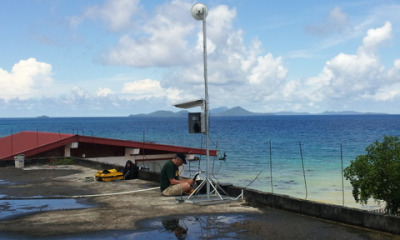
An innovative, solar-powered turnkey Computer-Lab-in-a-Box and a long-distance, solar-powered wireless internet connection were set up at a primary school on the island of Udot within Chuuk, one of the Federated States of Micronesia, in early August 2012. The system was installed by members of the Pacific Island Schools Connectivity, Education, and Solar (PISCES) Project, with assistance from numerous local community members. This technology deployment provided an in-field training opportunity for the PISCES project, which is a multi-partnered endeavor emphasizing hands-on training in solar-powered technology for Pacific Islanders. The previous week, the PISCES team had led a workshop on Solar-powered long-distance WiFi technology at the University of Guam. Click headline to read more and access hot links--
Just as the portal to a city has devolved physically from a massive gateway in a wall, to a network of roads and rail, and eventually for some, an airport, the boundaries of a city have followed suit. Cities of the future would benefit from tapping into the ‘connect the dots’ framework, which will bypass borders and nations and instead connect points of interest directly. Forward-thinking cities, the ones best poised to excel, will make the process of moving ideas and people easy and fast, thus offering a massive boost to productivity. With more people now living in urban environments for the first time in human history, we have a tremendous opportunity to harness the productive capacity of a city. Money saved from no longer maintaining physical boundaries could be better spent on developing the urban fabric of future cities. High density, multi-functional spaces, and interconnectivity are paramount. Investing in renewable energies as well as innovative food sources would further the autonomy of the city. Click headline to read more and access hot links--
Alvarion Ltd., a global provider of optimized wireless broadband solutions addressing the connectivity, coverage and capacity challenges of public and private networks, announced today that BusyInternet, a leading Internet service provider in Ghana deployed its 4Motion solution in Accra, Ghana, a city of approximately 2.3 million which acts as the business and financial capital of the country. Alvarion's advanced 4Motion solution replaces an existing solution in order to deliver reliable and quality bandwidth and services needed from corporate customers. BusyInternet is an award-winning ISP (Chamber of Marketing Ghana (CIMG) Best ISP 2009, 2010 & 2011) whose target client base is mostly corporations and businesses from all sectors, including the financial community in Accra and Tema. With a promise of superior customer service and more than 98.7% uptime, BusyInternet needed to upgrade its existing network infrastructure to handle the sensitive business information and heavy bandwidth needs of its customers while at the same time deliver a high-quality user experience. 'As an ISP operating in the high-end segment of the market, we place very specific demands on the network we deploy in order to deliver the high-quality user experience we promise our customers,' states Praveen Sadalage, Managing Director of BusyInternet. 'The 4Motion solution met these demands for superior reliability and quality of service.' Click headline to read more--
A new record for the maximum output from wind generation has been achieved, the energy system operators National Grid confirmed today. At 3pm yesterday afternoon, the half hourly average for metered wind generation was 4199 MW. This represented 9.3% of the total demand at the time. This compares to the previous half hourly record of 4157 MW at 7pm on the 12th September 2012. Using National Grid’s Wind Power Forecasting System, the forecast 24 hours ahead of real time, was 4055MW - an error of 2.7% of installed capacity. At 4 hours out, the forecast was 4272 MW, an error of 1.4%. Alan Smart, Energy Operations Manager, at National Grid said, “The forecasting performance was excellent. Our wind forecasting tool is under continuous development and we have done a lot of work to improve our forecasts on high wind days. “As more wind generation is connected to the system, this tool will become increasingly important in helping us manage the electricity system.” Click headline to read more--
|
Was it just me or did President Obama sound unprepared for a question on climate change at his press conference on Wednesday? Considering climate change is a top national issue, I was expecting a much stronger response from the President. Here's a breakdown of the three things he flubbed and my perspective on how to tune up the President's message on the issue. Click headline to read more and access hot links--
ICT (Information and Communication Technologies) have the potential to foster sustainable consumption through product-specific improvements, increased dematerialization, and the implementation of “smart technologies” in various sectors of the economy. At the same time, the expansion of ICT goes along with increased energy consumption, direct environmental impacts in terms of materials throughput and end-of-life treatment as well as possible rebound effects. Thus, there is a need to link rigorous research on the environmental, social and economic impacts of ICT with effective policy-making to nurture the potential of ICTs to contribute to sustainable consumption. The 2nd Multinational Knowledge Brokerage Event “Green ICT for Sustainable Consumption?” brings together policy-makers, high-level scientists, and business representatives to address pressing questions on the potentials and challenges of ICT to foster Sustainable Consumption and provide an impetus for effective policy development: Click headline to read more and access hot links--
Renewable power sources – including hydrokinetic (which includes pumped storage), biomass, waste, geothermal, wind, solar photovoltaics (PV), and solar thermal – make up 10 percent of total electricity production in the United States. While news headlines in this election year have highlighted failures by renewable energy companies, such as the solar panel maker Solyndra, North America leads the world in terms of additions of new renewable energy capacity. According to a recent report from Pike Research, a part of Navigant’s Energy Practice, North America will add more than 400,000 megawatts (MW) of renewable capacity from 2012 through 2015, making it the leading region in the world for new renewable energy. “State governments in the United States are pushing utilities to purchase more renewable energy, thus encouraging the market for renewables artificially,” says research director Kerry-Ann Adamson. “Although North America today is heavily reliant on the biofuel and biopower sectors for revenue and new installations in the smart energy sector, there are a number of exciting underlying growth areas that could create a more sustainable, high value, high growth smart energy sector in North America.” Although second to the United States in terms of capacity additions, Europe will be the largest region in terms of smart energy revenue, totalling more than $500 billion through 2015. The fastest growing region, however, is Asia Pacific, according to the report. If its current development trajectory holds, Asia Pacific by 2015 could challenge North America in terms of its global leadership position in annual capacity additions. Click headline to read more and access hot link to report--
Throughout 2012, I’ve often heard entrepreneurs and investors working on technologies like clean energy, smart grid, electric cars and even biofuels, talk about the future of the term “cleantech.” It’s an umbrella term that describes very disparate sectors and was created to explain an investment class that has become less attractive to investors over the past 18 months. So, will cleantech as a term die, or morph into a new term? Or will it survive and stick as the preferred name to classify companies looking to address a coming era of resource constraints? That question was at the heart of my discussion with three cleantech investors at the VERGE Conference this week. I had the opportunity of getting to spend an hour chatting with Josh Green, partner with Mohr Davidow, Rodrigo Prudencio, Partner with Nth Power, and Mitch Lowe, partner with digital green accelerator Greenstart. Click headline to read more and watch video clip of chat--
The Australian government will be releasing an energy white paper on Thursday that could make the country a hotbed of smart grid activity. Some parts of Australia already have deregulated electricity markets, but that could go even further. Smart meters, which are already mandated in the state of Victoria, could be expanded into a federal mandate. Meter support comes not only from energy minister Martin Ferguson, but also from opposition energy spokesman Ian Macfarlane, according to the Brisbane Times. Meters will allow customers to be charged peak-time pricing. One study found that some customers subsidized the heaviest peak energy users by up to $330 a year. "This is clearly an unfair cost, particularly on those less able to afford it," Ferguson said, according to The West Australian. The paper notes that electricity prices have risen 40 percent in the last three years and that investment is sorely needed to replace the aging grid, meet reliability standards and cut peak demand. Click headline to read more and access hot links--
The Minister of State for Power, Zainab Ibrahim-Kuchi, will deliver the opening address of the West African Industry Convention (WAPIC) on Tuesday, 20 November at the Eko Convention Centre in Lagos. Some 500 regional power industry and utility experts are expected to attend the 9th edition of WAPIC 2012 with the theme “Preparing the West African power industry for private sector participation”. In a statement released on Friday, WAPIC programme director Stephanie Roy, said the convention will focus on power industry reform. “This year’s edition will focus on power industry reform in Nigeria, utility performance for the industrial sector, finding solutions for metering, renewable energy and how to attract private sector investment,” she said. “Power is at the heart of driving the manufacturing sector in Nigeria and a reformed power industry will create enormous impetus for the country to prosper.” “We are honoured to have the Honourable Hajiya Zainab Ibrahim-Kuchi, Minister of State for Power of Nigeria at WAPIC because it illustrates shows the commitment of the Nigerian government to the power sector, particularly as this sector is currently undergoing reform and power assets are changing ownership.” Roy explained that private investment plays a central role in securing reliable and sustainable power, adding that “investors should be looking at Nigeria as a booming market with enormous possibilities.' “WAPIC 2012 offers them the opportunity to meet high-level representatives from government, utilities and the private sector while gaining knowledge about this market in sessions on gas, metering, solutions for large power users, financial performance and renewal energy,” she said.
ABB, which has been delivering power over high voltage direct current for more than 60 years, has solved an engineering puzzle that has been around as long as HVDC. The power automation giant just announced that it has cracked the code on building circuit breakers for HVDC power lines. The development allows for extremely fast mechanics with power electronics. In this case, the enormous amounts of power that are moving over HVDC lines can be interrupted within five milliseconds. Currently, HVDC lines are widely used to move power across huge distances, because DC is more efficient across long spans than alternating current. The technology is particularly key for renewable projects, such as offshore wind farms, which are often far from city centers where most of the power is used. “This historical breakthrough will make it possible to build the grid of the future,” Joe Hogan, CEO of ABB, said in a statement. “Overlay DC grids will be able to interconnect countries and continents, balance loads and reinforce the existing AC transmission networks." Click headline to read more, watch video clip and access hot links--
Optimism and growing enthusiasm surrounding the photovoltaic (PV) market in Romania are not just an exercise in positive thinking.
The boom in this sector stems from law no. 134/2012 which provides investors in the PV sector with the guarantee that the current support scheme, which offers six Green Certificates (GC) for one MWh, won't change until after January 1, 2014. This gives producers a strong legal framework encouraging investments on the market.
In 2013 we'll see a boom in PV investments, similar to the one from the wind sector about two, three years ago, says Silvia Vlasceanu, general director of the Energy Utilities Association.
The targets established in 2010 have a great chance of being surpassed, probably this year. “In June 2010, before the first updating of energy law no. 220/2008 with law no. 139/2010 and in the context of the setting up of the National Renewable Energy Action Plan, we estimated about 43 MW installed by 2012, which hasn't been accomplished yet, but there is a great chance of reaching that target by the end of the year and the 140 MW target set for 2017 will probably be reached by next year, says Zoltán Nagy-Bege, head of the Energy Efficiency Regulation Department at the National Authority for Energy Regulation (ANRE).
Click headline to read more--
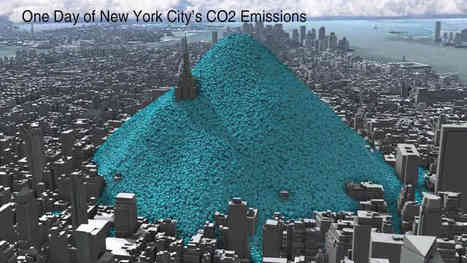
I didn't know what to make of this when I saw it. I live in Manhattan, in a city where people bike, take buses, subways, trains, live and work in towers where they share elevators, share water, share electricity. I thought my town is setting the example for energy-efficient, communal living. And then, the guy who runs the place, Mayor Michael Bloomberg, releases a study — including (see below) a shocking video — that says, you think New York is great on energy? You think that? Well, check this out... The mayor has an Office of Long Term Planning and Sustainability (that includes Jonathan Dickinson and Andrea Tenorio and staff) and they decided to measure how much carbon dioxide escapes into the New York air. To make the data more visual, they assumed every day in New York is a nice day, where the temperature is 59 degrees Fahrenheit, and where, under standard pressure, a ton of CO2 gas would fill a lovely blue bubble 33 feet across like the ones you see down there, rising from the traffic. Then they asked, "if we took all the CO2 coming from vehicles, buildings, power plants across the city and gathered them in a clump, at one spot right next the Empire State Building, how much CO2 is emitted in a single hour? This is what they found. Click headline to read more and view pix--
The Minister of Trade and Industry, Dr Rob Davies says Innovation drives economic development, and Science and Technology are contributors to innovation. Minister Davies was addressing delegates at the dti's annual technology awards ceremony that were held in Kimberley. The purpose of the awards was to raise awareness on the benefits of using technology to improve the competitiveness of enterprises and also to recognise individuals and organisations that contributed towards technology promotion and innovation in South Africa. "Developed and industrialised countries have pinned their hopes on innovation to drive the economy. It is significant for us as a country to produce more innovators and effective entrepreneurs who can generate income and build sustainable businesses for the future,"said Davies. He also said the Private Sector especially big businesses should partner with Government on technological innovations and enhance on the work that is already there. "The Department will again provide bursaries in 2013 to deserving learners from disadvantage communities in the Northern Cape to pursue University Degrees in Science, Engineering and Technology," said Davies. Click headline to read more--
"There have not been any proposals calling for a change from the bottom-up multistakeholder model of Internet governance to an ITU-controlled model," Paul Conneally, head of communications and partnership promotion for ITU, wrote on the organization's website Friday, with the approval of ITU Secretary General Hamadoun Touré. "Internet Control is simply not in the ITU mandate." That will come as news to the U.S. delegation to the upcoming WICT-12 telecom treaty conference in Dubai, a conference where extending that treaty from traditional telecom to broadband, and whether that should even be on the table, is the hot-button issue. The U.S. sees a number of proposals as threatening the multistakeholder model. ITU was responding to a letter from Greenpeace and the International Trade Union Confederation UN Secretary General Ban Ki Moon (ITU is an arm of the UN) suggesting the ITU was trying to take over governance of the Internet, a concern, though not in quite as stark terms, shared by the Obama administration, both parties in both houses of Congress, and others. They, like Greenpeace and the confederation, have been advocating for a continued multistakeholder model of Internet governance. "It is becoming increasingly clear that certain countries are preparing to undermine this inclusive governance model," said Greenpeace and the confederation in a letter to UN Secretary General Ban Ki Moon. "ITU will continue to fully support the multi-stakeholder approach which it initiated some ten years ago for the World Summit of the Information Society," Conneally said. "WCIT-12 cannot empower governments to exercise greater regulation of the Internet. Click headline to read more and access hot link--
The story ought to start with Hong Kong's history as a trading port, our rise to become one of the four Asian Dragons and later the world's premier financial centre. But it is also about our attempt to seek a new role in the context of a rising China, our failure to find a strategy for the much needed economic diversification and creation of high-end jobs expected by the younger generation. This is the story of Hong Kong and China's quest for economic competitiveness. The latest "Global Competitiveness Report" of the World Economic Forum rated Hong Kong the ninth most competitive territory in the world; China ranks 29th. Along with Japan, South Korea, Singapore and Taiwan, Hong Kong is among the five countries or territories in Asia at stage three of economic development where the key economic driver is no longer "basic requirements" or "efficiency". As an unofficial member of the Organisation for Economic Co-operation and Development (OECD), Hong Kong is innovation-driven. Yet we rank 22nd in terms of "innovation and sophistication" among 144 places surveyed, a rating that is near the bottom third of the 35 developed economies listed. So does Hong Kong have the potential to become the Silicon Valley of China? The fact is, Silicon Valley is not just about research and development; it has a solid industrial base, a liberal culture, tolerance of rebels such as Steve Jobs and therefore the freedom to be creative. Most important, Silicon Valley also has the presence of entrepreneurs who are willing to spend their own time and money to help the next generation. Hong Kong is also a very liberal city that is tolerant of rebels, many of whom challenge dominant market players. But we still do not have all the success factors of Silicon Valley. Click headline to read more--
|