Your new post is loading...
Super-fast transmission for super-fast particles: Deutsche Telekom International Carrier Sales & Solutions(ICSS), part of Deutsche Telekom's International Businesses unit, working in conjunction with the local legal entity T-Systems Switzerland, has been appointed to provide a high-speed data connection between the CERN (European Organization for Nuclear Research)data centre in Geneva and a newly established, remote data centre operated by Wigner Research Centre for Physics in the Hungarian capital Budapest. The Ethernet connection supports transmission speeds up to 100 gigabits per second. In Geneva, CERN operates the world's biggest particle accelerator, the Large Hadron Collider (LHC). This facility allows scientists to explore the structure of matter and the fundamental interactions between elementary particles. The experiments generate huge volumes of data. To process them, CERN and partner institutes have developed a distributed computing system, the so-called Worldwide LHC Computing Grid (WLCG). More than 10,000 researchers around the world use CERN's computing infrastructure for their experiments. With the Wigner Data Centre, CERN aims to create additional IT capacity for research activities. Computer systems will be able to transmit enormous volumes of data via the high-speed Deutsche Telekom ICSS connection between the Geneva and Budapest sites. In addition to huge data rates, CERN requires high data transmission reliability and connection availability. The research organization sought a telecommunications service provider able to meet these extremely demanding gigabit Ethernet requirements. Click headline to read more--
During a year with a monster storm and scorching heat waves, Americans have experienced the kind of freakish weather that many scientists say will occur more often on a warming planet. And as a re-elected president talks about global warming again, climate activists are cautiously optimistic that the U.S. will be more than a disinterested bystander when the U.N. climate talks resume Monday with a two-week conference in Qatar. "I think there will be expectations from countries to hear a new voice from the United States," said Jennifer Morgan, director of the climate and energy program at the World Resources Institute in Washington. The climate officials and environment ministers meeting in the Qatari capital of Doha will not come up with an answer to the global temperature rise that is already melting Arctic sea ice and permafrost, raising and acidifying the seas, and shifting rainfall patterns, which has an impact on floods and droughts. They will focus on side issues, like extending the Kyoto protocol — an expiring emissions pact with a dwindling number of members — and ramping up climate financing for poor nations. They will also try to structure the talks for a new global climate deal that is supposed to be adopted in 2015, a process in which American leadership is considered crucial. Many were disappointed that Obama didn't put more emphasis on climate change during his first term. He took some steps to rein in emissions of heat-trapping gases, such as sharply increasing fuel efficiency standards for cars and trucks. But a climate bill that would have capped U.S. emissions stalled in the Senate. "We need the U.S. to engage even more," European Union Climate Commissioner Connie Hedegaard told The Associated Press. "Because that can change the dynamic of the talks." Click headline to read more--
Driving north on 127 out of Lansing, the terrain is fairly flat. Then, all of a sudden, they appear: wind turbines. There are 137 with 34 more on the way. They draw attention and they change the view. They stand in testimony to the fact that an economic development organization can make a real difference. Without the work of Don Schurr and the Greater Gratiot Development Inc., or GGDI, it is highly unlikely the wind turbines would be there at all. Economic development is a fad-ridden business, whether it is robotics, life sciences or green energy. The rhetoric in economic development far outstrips the accomplishments in green energy. Gratiot County stands alone in Michigan, a true best practices case, in making a green energy strategy work. Currently, the county hosts the largest wind farm in the state. Don Schurr is a 35-year veteran economic development practitioner. He is place-based in that he has spent his career in Gratiot County. Economic development work in Gratiot County mandates an understanding of the agricultural economy and nobody understands it better than Don Schurr. So, when small family owned farms began to disappear across the country because they were at a severe competitive disadvantage vis-à-vis the emerging giant corporate farms, Gratiot County realized it had to do something to assist the families who had farmed for decades. Click headline to read more--
THE State Government has reached a deal with the Greens to ensure its new energy reform laws are passed, paving the way for competition in the electricity market. The Government won the Greens' support yesterday by agreeing to spend $200,000 investigating the use of "smart grid" technology in Tasmania. Smart grids and smart meters in homes work by allowing consumers to switch off certain appliances during the "peak load" periods when power prices are highest. "For example, when you're doing your cooking, don't have your hot water operating," Energy Minister Bryan Green said yesterday. If independent consultants recommend the introduction of a smart grid for Tasmania, the Government will commit $10 million towards the project. The legislation tabled yesterday will allow for the sale of Aurora's customer base, ahead of plans to open up the electricity market to interstate companies and hopefully drive down the price of power through competition. Greens energy spokesman Kim Booth admitted his party had little bargaining power and had been forced to abandon a wish list, including the mothballing of the Tamar Valley power station, selling Hydro subsidiaries and setting up three trading rooms inside Hyrdo to encourage wholesale electricity competition. Mr Booth said Labor's proposal was the "least worst" option and would at least deliver "constraint" on prices. "The big losers out of this are the Tasmanian public who won't actually get the best electricity system," he said. Click headline to read more--
The Western Cape’s Medium Term Budget Policy Statement was unveiled by the province’s Economic Development MEC Alan Winde recently, saying that R240 million will be set aside for broadband connectivity in the medium term. “We have already put in place a plan to ensure that the majority of citizens will have easy access to the low cost broadband,” said Winde. “We intend to ensure public ICT access within a 2 km radius of every person living in our province by 2019, and universal broadband access by 2020.” The latest details form part of the Connected Cape vision where “every citizen in every town and village has access to affordable high speed broadband infrastructure and services”. The vision further aims to ensure that all citizens have the necessary skills to use broadband services to improve productivity and access to new markets. According to the Western Cape provincial government the project goes “hand in glove with national government’s targets namely universal broadband access by 2020 and public ICT access within a 2 km radius of anyone by 2019”. Click headline to read more--
A brief preview of our education work communicating (1) recent climate change impacts on humanity, and (2) a comparison of the cost of addressing climate change as defined in the Stern report compared to the costs we currently incur every year to continue using fossil fuels. Click headline to watch the video--
Over half of the continguous U.S. has been in a drought since summer. The latest U.S. Drought Monitor report showed a rise in the extent and increases in the severity of drought: 'The report showed that 60.1 percent of the lower 48 states were in some form of drought as of Tuesday, up from 58.8 percent the previous week. The amount of land in extreme or exceptional drought — the two worst classifications — increased from 18.3 percent to 19.04 percent.' Click headline to read more--
Do you know what percent of the U.S. soybean crop is used for biodiesel? The biodiesel use of soybeans is to be about 16 percent of the total soybean crop this coming year (as a % of total U.S. soybean acres – used for biodiesel). Both the biodiesel and ethanol plants are having difficulty with profitability since the drought has driven up prices for their feedstocks. The increase in mandated use of both corn ethanol and biodiesel, plus this year’s drought, means reduced exports of corn and soybeans from the U.S., growing competition in production of these commodities abroad, and ailing livestock, poultry, and dairy industries. Ecologically, these policies have meant less crop rotation, greater intensive farming on marginal lands, and greater acreage devoted to these two industrial crops. Land prices have increased due to policy support of growing these monoculture crops, making them profitable even in a severe drought year such as this. Click headline to read more and access hot link--
The increased adoption of smart grid technologies and the deployment of microgridsare among the keys for achieving sustainable energy for all, according to a new report from the UN Global Compact and Accenture. The report, Sustainable Energy for All: Opportunities for the Utilities Industry, says that the smart grid and innovative business and financing models to determine how to integrate these new technologies are the major innovation trends taking shape in the utilities industry. These innovations can be combined to expand access to sustainable energy and increase efficiencies and renewable energy generation in the industry. The reportis one of a series of 19 covering the roles of different industry sectors in supporting theSustainable Energy for Allinitiative. Its aim is to provide guidanceand inspire utility companies to takeaction to advance the three objectives ofthe initiative,while simultaneously maximizing theirrealized business value. Sustainable Energy for All is an initiative of UN Secretary General Secretary-GeneralBan Ki-moon, with the triple objectives by 2030 of ensuring universal accessto modern energy services, doubling the globalrate of improvement in energy efficiency, and doubling the share ofrenewable energy in the global energy mix. Click headline to read more and access hot links--
If President Obama is serious about confronting global warming, he’ll have the opportunity to show it through the actions of U.S. representatives at the United Nations climate change summit in Doha, Qatar, next week. Shortly after his re-election this month, Obama invoked “the destructive power of a warming planet” and told reporters he would make climate change a priority in his second term. Veteran climate observers, long exhausted by politicians’ plentiful talk and scarce action on global warming, will be watching to see whether U.S. envoy Todd Stern sticks to America’s commitment to the climate guidelines reached last year in Durban, South Africa, which include limiting warming to 2 degrees Celsius. Click headline to read more--
An international research team has been given the novel task of developing a practical means of monitoring underground stores of CO2 using none other than cosmic rays. The research hinges on the detection of the muons that occur as cosmic rays interact with the Earth's atmosphere, but which can penetrate several kilometers beneath the Earth's surface. It's thought that the approach could save significant amounts of money compared to alternative techniques. Click headline to read more and access hot links--
China is progressively establishing itself as the world's largest automobile producer and consumer, including electric vehicles. The country, for instance, produced 18,420,000 vehicles and sold 18,510,000 vehicles in 2011. Now, China is taking an ambitious step to be a global leader in the next-generation electric car industry as well. Although China is lagging behind foreign competitors in terms of technological competence in the EV and key component industries, it is endeavoring to increase its competitiveness, promoting early commercialization through trial and error. For this, China has designated new energy vehicles Battery Electric Vehicles (BEV), Plug-in Hybrid Electric Vehicle (PHEV) and Fuel Cell Electric Vehicle (FCEV)] as one of its seven new strategic industries. With aggressive government backing for the industry, Research and Markets expects China to hold the central place as the largest producer and seller in the global EV market. On July 14, 2011, the Ministry of Science and Technology of China announced a plan titled “Development of New Energy Vehicles Industry (2011-2020)” where it set a goal of increasing the cumulative sales of new energy vehicles (excluding fuel battery cars) to about 1 million units by 2015 and 10 million units by 2020. Although these new energy vehicles are available at 2-3 times higher prices than those of existing ICE car models, they can run only about 150 km (94 miles) (based on pure EVs) on one charge. Thus, the new energy vehicle industry involves enormous investments and requires large-scale charging infrastructure across China. Furthermore, these problems are coupled with the slow progress in the development of batteries, which are one of key components for EVs. As a result, China's sales of new energy vehicles and hybrid cars remained as low as 8,159 vehicles in 2011, despite the unwavering government support, representing an extremely small market share with 0.04 of the total automobile sales. Click headline to read more and access hot link to report--
This just in: The planet is screwed. Well, if you ask Bill McKibben (and you should) we still have a fighting chance. But that’s only if we actually start fighting. This week proved a holiday downer with multiple reports coming in about how quickly we're losing the battle to stave off the effects of catastrophic climate change. Here’s a quick recap: Click headline to read more--
|
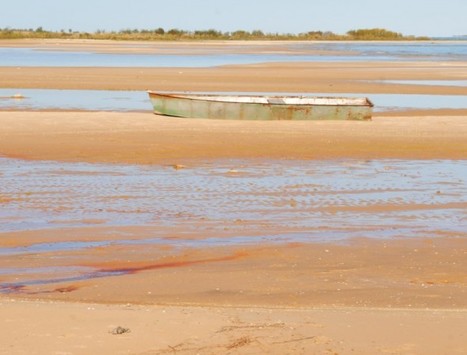
For people living around the Great Lakes, water levels this past month have appeared much lower than many will remember. The upper Great Lakes reached near-record low water levels in October. This was most evident on Lakes Michigan and Huron, where lake levels dropped to less than two inches (4 cm) above record lows and 28 inches (71 cm) below the long-term average. All five lakes, plus Lake St. Clair, remain below their long-term averages. Rock and sand recently exposed by low water levels made stretches of the northern Lake Michigan shoreline look like a moonscape. Recreational boaters had trouble navigating the shallow water this fall, and shipping companies lightened loads to compensate for low water. Lakes Michigan and Huron hovered just above a record low set nearly 50 years ago, and Lake Superior was within five inches (11 cm) of a record low set in 1925. A 2002 National Geographic magazine story, Down the Drain: The Incredible Shrinking Great Lakes, documents declining lake levels and the potential economic and ecological consequences for the region. Ten years later, the story continues to unfold, as water levels remain lower than normal. Experts blame the recent low water on the unusually warm and dry weather over the past year. Rain events in October, including Hurricane Sandy, delayed the inevitable, but forecasters predict Lakes Superior, Michigan, and Huron will likely reach historic low levels in the late fall or winter, a time of year that the lakes are normally already dropping due to high rates of evaporation. Click headline to read more and access hot links--
Using an artificial intelligence technique inspired by theories about how the brain recognizes patterns, technology companies are reporting startling gains in fields as diverse as computer vision, speech recognition and the identification of promising new molecules for designing drugs. The advances have led to widespread enthusiasm among researchers who design software to perform human activities like seeing, listening and thinking. They offer the promise of machines that converse with humans and perform tasks like driving cars and working in factories, raising the specter of automated robots that could replace human workers. The technology, called deep learning, has already been put to use in services like Apple’s Siri virtual personal assistant, which is based on Nuance Communications’ speech recognition service, and in Google’s Street View, which uses machine vision to identify specific addresses. But what is new in recent months is the growing speed and accuracy of deep-learning programs, often called artificial neural networks or just “neural nets” for their resemblance to the neural connections in the brain. “There has been a number of stunning new results with deep-learning methods,” said Yann LeCun, a computer scientist at New York University who did pioneering research in handwriting recognition at Bell Laboratories. “The kind of jump we are seeing in the accuracy of these systems is very rare indeed.” Artificial intelligence researchers are acutely aware of the dangers of being overly optimistic. Their field has long been plagued by outbursts of misplaced enthusiasm followed by equally striking declines. Click headline to read more and access hot links--
On an island whose stock in trade is sun, and lots of it, Lawrence and Cindy Lee figured they'd be foolish not to join their neighbors and put a few solar panels on the roof. The Lees called one of the solar contractors racing around Hawaii these days, and put in their order. Eleven months later, in October — after endless consultations, emails and a $3,000 study required by Maui Electric Co. — they were still waiting for a permit. "Instead of it being like they want to help you get your solar system in," Lawrence Lee said, "it's more like they don't want you to." Solar power has grown increasingly popular across the U.S. Sun Belt, but hardly anywhere has it taken hold as it has in Hawaii. Friendly tax credits, the highest average electricity rates in the nation and the most aggressive renewable energy program adopted by any state have sent homeowners scrambling to install photovoltaic systems on their roofs. The number of solar power systems across the island state has doubled every year since 2007, with nearly 20,000 units installed. But with homeowners and businesses now producing nearly 140 megawatts of their own power — the equivalent of a medium-size power plant — and solar tax credits biting seriously into the state budget, Hawaii legislators and electrical utilities are tapping the brakes. Click headline to read more--
Readers Question: Given the widely varying fiscal policies of countries, both left and right, how come their growth rates over the long term are so close? To some extent growth rates are close; though it also depends which data and countries you use. However, from a very broad perspective, growth rates do share similar patterns and growth rates. Click headline to read more and view charts--
Ten years ago the cost of energy was 50% the cost of maintaining a hospital. This year, for the first time, the cost of electricity is equivalent to the cost of maintaining a hospital, according to hospital group Mediclinic. Similarly, a decade ago electricity accounted for 0.8% of sales at Shoprite. It now accounts for 2% and the retailer expects this to rise to 4% of sales. At African Rainbow Minerals, an 18% increase in sales generated a 2% rise in headline earnings, because electricity and wage increases swallowed the profits. And Astral Chickens has suspended wage negotiations during its most difficult period in 30 years. Rising electricity costs means the company has little wriggle room in the face of other industry related challenges. The food industry is set to impose a 10% price increase as profit margins are eroded by rising input costs like fuel and electricity. These are the stories of big, listed companies with resources to lessen the impact of cost increases. The difficulties faced by the small entrepreneurial businesses are untold. But all the stories, it would appear, are falling on deaf ears. “South African business is at a tipping point,” says Mike Rossouw, chairman of the Energy Intensive User Group (EIUG). “Energy pricing is pricing capacity out of business. There is no doubt in my mind that further price hikes will push companies out of business.” His comments come as the window for written comment on Eskom’s multi-year price determination application – for tariff hikes over the next five years – closes. Public hearings on the MYPD3 will take place in January and final decision will be tabled in parliament by the middle of March 2013. Click headline to read more--
A U.N. conference in Qatar next week is the latest attempt to combat global warmingafter mounting evidence that human activity is disrupting the climate. Here is a timeline of the road to action on global warming: Click headline to read more--
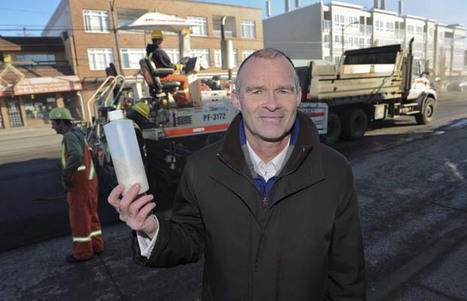
Plastic waste such as bags and water bottles that are difficult to recycle have found a new life in the asphalt mix used to pave streets in Vancouver. The city has worked with GreenMantra of Toronto to develop the granular, waxlike material that's added to asphalt. The material allows the asphalt to flow smoothly at a much lower temperature, which saves on the cost of fuel to heat the asphalt and reduces the amount of vapours released into the atmosphere, according to Peter Judd, the city's general manager of engineering services. That's good for both the workers laying the asphalt and the environment, he said. Traditional hot-mix asphalt needs to be heated to about 140 to 160 degrees C to flow onto the road surface. By adding the recycled plastic, the temperature can be reduced by up to 40 C, Judd said. "What that means is that you use about 20 per cent less fuel to heat the asphalt up," Judd said in an interview. "It's an enormous saving in greenhouse gases." He said using the recycled plastic adds about one to three per cent to the cost of building roads. But, he said, with fuel prices rising and air quality and emission standards becoming tougher, the city expects the cost to drop as supply increases. Click headline to read more--
The Brazilian government will continue to require that a significant portion of telecoms network equipment is manufactured locally as it seeks to harness the sector’s growth to create jobs and local wealth, according to the country’s minister for communications. Speaking at the Ericsson Business Innovation Forum in Sao Paolo on Wednesday, Paolo Bernado said that targets for wider deployment of broadband require sustained investment from both public and private sectors. As an example he pointed to more than 80,000 rural schools that must be given connectivity inside the next three years. He said that, in Brazil, the state is responsible for over 50 per cent of investment in innovation and was committed to creating the right environment for continued private sector participation. In return, he said, the government expects technology developed locally to be available at a low enough cost to make connectivity across some of the most challenging geography in the world truly viable. “The treasury has been removing taxes from equipment and civil construction works because to reach our objectives, and our national broadband plan next year, we need infrastructure available at fair prices,” he said. “We have policies that will demand products made in Brazil because it helps create jobs and trade. In my opinion this is a policy that is here to stay; it is reasonable for companies to invest to develop here in Brazil.” Click headline to read more--
The future of the Connecting Europe Facility is reaching a critical phase as, in the next few weeks, Member States are expected to decide the EU’s budget for 2014-2020. To support European growth and competitiveness, a number of business leaders have signed a declaration calling on senior EU policymakers to support and approve the Connecting Europe Facility. Click headline to read more and sign the decalaration--
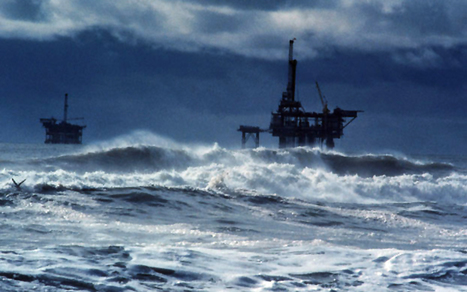
Floating offshore oil drilling platforms, offshore wind farms and buoys are vulnerable to waves, especially those from storm swells. But a team of engineers has found a way to make those ocean-faring structures invisible to waves. The technique could help protect marine structures from damage when big storms hit. Mohammed-Reza Alam, assistant professor of mechanical engineering at the University of California, Berkeley, have designed a rippled platform that sits on the seafloor directly below an ocean-faring structure. The ripples in the platform influence the the behavior of the water all the way up to the surface — ultimately reducing the size of damaging surface waves. Alam calls his technique a “cloak” because it makes the ocean structure invisible to the surrounding waves. He presented the work Monday at an American Physical Society conference in San Diego. The seafloor influences the behavior of surface waves because of the unique structure of deep water. The top is heated by the sun, making the surface less dense as the heat expands it. Meanwhile, at the bottom, the water is cold and dense with more salt in it. The place where the two layers meet and where the temperature and density changes is called the thermocline. Click headline to read more--
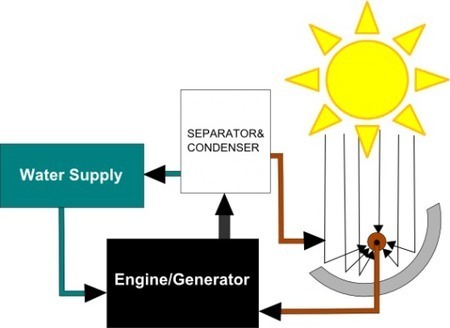
OK, first things first – stop picturing a car with solar panels connected to its engine. What Missouri-based inventors Matt Bellue and Ben Cooper are working on is something a little different than that. They want to take an internal combustion engine, and run it on water and solar-heated oil instead of gasoline. That engine could then be hooked up to a generator, to provide clean electricity. While that may sound a little iffy to some, Bellue and Cooper have already built a small-scale prototype. The duo have labelled the system HydroICE, which is short for Hydro Internal Clean Engine. Here’s how they envision it working To begin, mirrored parabolic solar collectors would be used to heat oil to a temperature of at least 400 to 700ºF (204 to 371ºC). This hot oil would then be injected into the cylinder chamber of the engine, just like gasoline ordinarily is. A few microdroplets of water would then also be introduced, which would turn to steam immediately upon contact with the hot oil. The rapidly-expanding steam would serve the same purpose as exploding gas, driving the piston downward and turning the driveshaft. As the piston reached the bottom of its stroke, the spent steam and oil would exit the cylinder and be run through an oil/steam separator. They could then each be returned to their respective reservoirs, for re-use within the closed-loop system. Click headline ot read more and watch video clip of demo--
The planned Genesee County business park known as Western New York STAMP is gigantic in many ways. The proposed site, 5 miles north of the Pembroke interchange of the Thruway, consists of more than 1,200 acres in the Town of Alabama. Business recruiters say the park could generate thousands of new jobs for people from both the Buffalo and Rochester regions and attract billions of dollars in investment from companies such as computer chip fabricators. STAMP is short for Science Technology and Advanced Manufacturing Park. The goal is to market the site’s vast acreage, access to workforces and colleges, and availability of low-cost power to lure a giant production facility with precisely those mega-needs. STAMP’s advocates say the park could create 30,000 jobs from Buffalo to Rochester – including more than 9,000 directly in the park – and attract $10 billion in private capital investment when fully built out, 15 to 20 years after the start of construction. Economic-development officials, in meeting with The Buffalo News Editorial Board this week, said they have received positive signals from the technology-intensive industries they hope to attract. Steven G. Hyde, president and CEO of the Genesee County Economic Development Center, said plans for the park are in their sixth year. “This isn’t a pipe dream that just started yesterday. This is real and has lots of potential.” Click headline to read more--
|