

Many economists and business leaders are raising alarms about falling birthrates. But advocates for lower human populations say a less crowded world will be happier and more sustainable.
Get Started for FREE
Sign up with Facebook Sign up with X
I don't have a Facebook or a X account


 Scoop.it!
Many economists and business leaders are raising alarms about falling birthrates. But advocates for lower human populations say a less crowded world will be happier and more sustainable.

 Your new post is loading...
 Your new post is loading...
Your new post is loading...
Scoop.it!

From
www

When the modern electric vehicle was still in its infancy, drivers worried that vehicles would need expensive battery replacements within a few years. But battery lifespans are exceeding expectations.
Scoop.it!
From
bsky
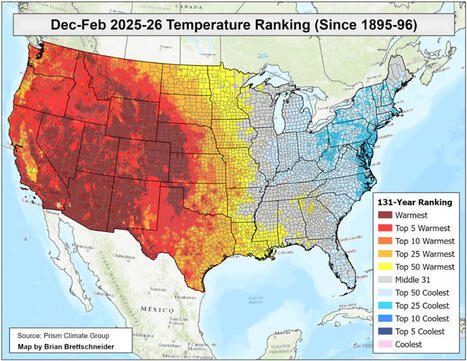
December 2025 through February 2026 was the 2nd warmest winter on record for the Contiguous U.S. according to Prism climate data. The widespread record to near record warmth in the west easily outweighed the cool temps in the east. 🔥🔥🔥
Scoop.it!
Proposed lower Alabama solar project stuck in the mud | by Catherine Dorrough | NewsFromTheSates.com
When the powers-that-be at Silicon Ranch first laid eyes on a gorgeous and available 4,500-acre parcel of timberland in northern Baldwin County, they probably believed they’d found an ideal site to build a utility-scale solar farm.
The unzoned property is plenty big enough to accommodate the 2,000 acres of solar panels they want to install; it’s adjacent to an existing high-voltage transmission line and has good highway access; and it looks like it’s in the middle of nowhere. Check, check, and check.
But it’s not quite that simple. The proposed solar farm, whose explicit purpose is to offset the power needs of Meta’s new data center in Montgomery more than 100 miles away, has gotten locals’ hackles up.
Scoop.it!
Key Senate defense leaders on Friday are privately pressing Anthropic and the Pentagon to resolve their dispute, a source familiar with the matter told Axios.
Why it matters: Pressure has been building on Congress to step in as the Pentagon and Anthropic engage in a prolonged public battle over the limits of the use of Anthropic's Claude AI in classified settings. Driving the news: Senate Armed Services Committee Chair Roger Wicker (R-Miss.) and Ranking Member Jack Reed (D-R.I.), along with Defense Appropriations Chair Mitch McConnell (R-Ky.) and Ranking Member Chris Coons (D-Del.) sent Anthropic and the Pentagon a private letter on Friday urging them to resolve the issue, the source said.
Scoop.it!

. Afunny thing happened on the way to President Donald Trump’s mission to obliterate renewable energy. Solar and wind energy use is surging, especially globally, but even in the United States.
Solar and wind electricity generation grew so much last year that they met 109% of new electricity demand worldwide, pushing these renewable sources past coal for the first time as a global energy supplier, according to an analysis by Ember Energy Research.* More than 600 gigawatts of solar electricity were added last year, led by China and also including India, Brazil, Vietnam, the European Union, Kenya, and Mozambique. African experts say much of the continent is leaning heavily into solar and wind as it electrifies new regions and industries, bypassing fossil fuels.
Meanwhile, investment in new clean energy, including storage, grid upgrades, efficiency measures, and electric vehicles, soared as of 2024 year-end to $2.2 trillion – double the investment in new fossil fuels projects of $1.1 trillion – according to the International Energy Agency. Globally, the future for renewable energy looks bright.
Scoop.it!

From
laist
On a sunny, early summer morning, Matthew Milner waited in his driveway in the Berkeley hills. It was his solar install day, and he was excited. He greeted the installers and walked them around to the back of his house. But instead of pointing to his roof, he pointed to his wooden backyard fence. That is where these solar panels would go, tilted, with their bottom edge on the ground, and top leaning against the fence’s wooden planks.
The installation wrapped up in two hours, demanded minimal paperwork, and damaged Milner’s wallet only marginally, as far as solar installations go. By noon, he plugged in an electrical cord that snaked from the panels into an outlet on the outside of his house. Immediately, solar power coursed toward his electrical panel and then flowed back through his home.
With that, he was offsetting his home’s energy use.
Milner is one of the solar-curious, who are testing the waters by purchasing a small, portable, plug-in display.
Scoop.it!

The farmer bends down, fingers stained the color of red clay, and holds up what looks like a perfectly ordinary green sprig. Morning mist still hangs over the terraced hills of southern Jiangxi, the kind that softens the edges of everything. The plant doesn’t look like treasure. Small leaves. Thin stem. Anonymous. The kind of thing you’d crush under your boot without a second thought. Yet the scientist next to him treats it like a rare jewel. He slips it into a labeled bag, eyes shining. The surrounding soil is loaded with rare earth elements, the invisible metals that power our smartphones, electric cars, and missiles. And this unremarkable weed, quietly, is drinking them up and concentrating them inside its own tissues.
A plant, acting like a living mine.
Scoop.it!
Crystal River City Council members Monday will consider applying for a $19.1 million state revolving fund loan that could be entirely forgiven to help overhaul the city’s flood-prone wastewater treatment plant.
The council meets at 5:30 p.m. Feb. 23 at the Citrus County Welcome Center, 915 S. Suncoast Blvd., Crystal River. Under City Manager Audra Curts’ report, council members will be asked to authorize staff to file an application to the Florida Department of Environmental Protection’s Clean Water State Revolving Fund Loan Program for $19,166,503 in wastewater treatment plant funding.
Scoop.it!

Despite Donald Trump’s unrelenting attacks on renewable energy, there’s a quiet revolution happening on US grids.
The US added a record-breaking amount of energy storage in 2025, according to a new solar industry report published Monday. The growth of battery storage across the US is a rare success story for clean energy during the renewables-hostile second Trump administration—and also a sign of how utilities may be thinking about reorienting electric grids as demand goes up across the country.
The new report, issued by the Solar Energy Industries Association (SEIA), follows another dataset released last week by Bloomberg New Energy Finance showing a similar boom in battery growth.
Scoop.it!
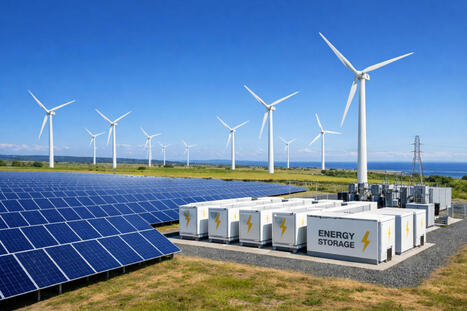
On Feb. 1, California’s batteries bridged the solar gap with seamless precision. After discharging through the night until sunrise, they spent the daylight hours charging, then pivoted back to exporting power well past midnight – effectively sustaining the state on solar energy for a full 24-hour cycle.
Scoop.it!

From
www
When turbulent weather with whipping winds and heavy snow is in the forecast, meteorologists sometimes warn that a storm could “bomb out” or become a bomb cyclone. But what exactly does this mean?
According to the U.S. National Oceanic and Atmospheric Administration, certain storms undergo bombogenesis, which happens when a storm’s central pressure drops at least 24 millibars in 24 hours. These storms are sometimes called bomb cyclones. Storm intensity is measured by central pressure, so the lower the pressure, the stronger the storm.
Scoop.it!

The recent boom in renewables and storage in Texas means its grid is much better prepared for bad weather than it was when Winter Storm Uri hit five years…
Scoop.it!

Electricity prices are surging, voters are growing angry, and the artificial intelligence industry’s data centers are increasingly a target for blame with U.S. mid-term elections on the horizon.
Residential utility bills rose 6% on average nationwide in August compared with the same period last year, according to the Energy Information Administration.
The reasons for price increases are often complex and vary by region. But in at least three states with high concentrations of data centers, electric bills climbed much faster than the national average during that period. Prices, for example, surged by 13% in Virginia, 16% in Illinois and 12% in Ohio.
|
Scoop.it!

From
www
As AI labs gorge themselves on compute, data center operators have headed north in search of cheap and plentiful energy.
On the bank of the river that runs through the Swedish town of Borlänge, construction is underway on a sprawling new data center. The site previously housed a paper mill. When the developer, EcoDataCenter, broke ground in September, its CEO Peter Michelson declared, “The facility once produced paper, the raw material of the newspaper information age. Now, Borlänge will produce the raw material for AI and the next information age.”
The Borlänge facility is one of more than 50 currently under construction or soon to be developed across the Nordics—the region made up of Norway, Sweden, Finland, Denmark, and Iceland—as demand escalates for data centers suitable for training and running AI models. Nowhere else in Europe is data center capacity growing faster, according to research by consulting firm CBRE.
Scoop.it!

From
www
MADISON, Wis. — Earlier this month, Madison, Wis., was host to the city's 14th annual Frozen Assets Festival. "When our lakes are frozen, they are truly our greatest asset," says James Tye, executive director and founder of Clean Lakes Alliance, the nonprofit that hosts the festival.
This time of year, frozen lakes are a part of life here. The city was built on an isthmus — a thin strip of land between two bodies of water. Lake Mendota and Lake Monona border the city's historic downtown on either side, with the strip of land running about a mile wide at its thinnest. The lakes are visible from many places in town. In wintertime, ice fishing, skating, ice sailing and snowshoeing are all common sights.
Scoop.it!

28 February 2026 – CAPE COD, MA –After nearly a week of snow, cold, and power loss Cape Cod recovery is underway. This storm may be remembered as The Blizzard of February 23 and we find out how a behind-the-scenes structure helped us weather the storm.
A blizzard of historic proportions blizzard rolled onto Cape Cod Sunday night, pummeled Barnstable County with hurricane force winds throughout the day on Monday, dumped 17 to 20 inches of wet heavy snow, and knocked out power for more than 155,00. People will no doubt be referring to this as The February 23rd blizzard for the next 20 years. What role did the MACC play?Over at the Barnstable Multi Agency Coordination Center (MACC), a little known but well rehearsed process kicked into play. The regional emergency planning committee turns 15 sometimes turfy towns into a unified response during emergencies. Resource sharing, regional shelters, and perhaps, most importantly, coordinated communication helps Cape Cod punch above its weight during moments like the Blizzard of February 23rd.
Scoop.it!

As primary silver grades decline and solar demand surges, the industry must transition from viewing retired panels as waste to treating them as high-grade mineral reserves essential for the energy transition.
Silver has become one of the most important materials in the clean energy transition. It’s essential for solar photovoltaics, and solar is no longer a minor consumer of silver. It’s becoming one of the largest drivers of demand — at the same time that ore grades are declining and supply is getting harder to expand quickly.
In other words, even as solar gets cheaper and more efficient, its material foundation is tightening.
This is not just an academic concern.
Scoop.it!

Former FirstEnergy execs Chuck Jones and Mike Dowling face state criminal charges connected to HB 6 bailout maneuvers, for which Ohioans are still paying the price.
Ohio jurors will soon decide whether two former FirstEnergy executives are guilty of state criminal charges related to the House Bill 6 utility bribery scheme.
It’s a landmark moment for what is the largest corruption scandal in state history, in which utility execs allegedly bribed state officials to pass and protect a law to bail out uneconomic coal and nuclear plants and to gut the state’s clean energy standards. Its effects still reverberate today, nearly seven years after HB 6 became law, in the form of higher energy bills, dirtier air, and less solar and wind power across Ohio.
Scoop.it!

Scoop.it!

Tampa-based Mosaic, one of the world’s largest phosphate mining companies, will be allowed to continue its mining operation in Manatee County for another 14 years.
On Wednesday, county commissioners voted 5-2 to approve the extension, with Commissioners Bob McCann and Carol Ann Felts opposed. With the extension, Mosaic can continue mining through 2044 and will need to complete land reclamation by the end of 2055.
The Mosaic Company operates the Four Corners Mine in northeast Manatee, which is the largest phosphate mine in Florida at around 13,000 acres. The mine extends throughout three adjacent counties: Hillsborough, Polk and Hardee.
The company has mined in the area since the 1970s and was previously granted extensions and additional mining tracts. In the extension approved on Wednesday, the Four Corners Mine boundary was also expanded to include the East Duette Tract — an additional 1,162 acres.
Phosphate, a key ingredient in plant fertilizer, is central to Mosaic’s business. The Four Corners Mine, one of the largest phosphate mines in the country, employs about 440 people and generates about 8 million tons per year, the company says.
Public opinions were split on the extension.
Scoop.it!
The disappearing islands of Kings Bay were on display Feb. 17 at the Florida Capitol as Save Crystal River marked Florida Wildlife Corridor Day with a renewed call for state funding, according to a press release marking the event.
The Crystal River nonprofit used aerial photos and before-and-after imagery to show how Banana Island, Buzzard Island and Wardens Key have steadily shrunk since the 1970s. According to the group, more than 125 acres of salt marsh and shoreline have been lost over the past 80 years. Those islands serve as a buffer against storm surge and flooding and help filter sediment before it reaches the bay’s spring vents. When they erode, sediment can cloud the water, bury eelgrass and threaten prior restoration gains.
Scoop.it!

Plug-in hybrid vehicles are often touted as a bridge to battery-electric vehicles, promising to slash emissions by operating as EVs for short trips while relying on fossil fuels for longer ones.
They only deliver on that promise if they’re regularly charged. Real-world data drawn from the vehicles’ onboard computers shows that’s often not the case.
Using that data, the Fraunhofer Institute could determine how much of that energy came from charging when plugged in. It found that less than a third of 1 million PHEVs in Germany plugged in either occasionally or not at all.
Scoop.it!
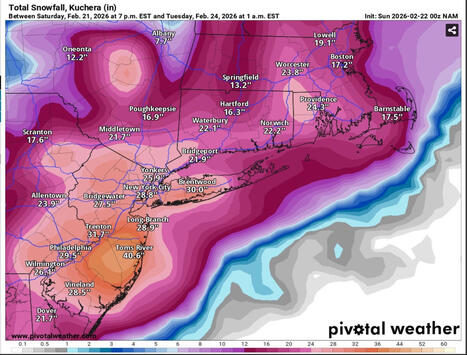
(HYANNIS) – A major Nor’easter was forecast to bring a significant winter storm to Cape Cod and the Islands late Sunday night into much of the day on Monday, bringing heavy, wet snow, high winds and coastal flooding.
The National Weather Service posted a Blizzard Warning for all of Cape Cod and much of eastern Massachusetts though late Monday and Gov. Maura Healey declared a State of Emergency for Massachusetts.
Scoop.it!

As technology continues to advance at a rapid pace, the concept of wireless electricity transmission has captured the imagination of scientists, engineers and the general public alike.
But is this futuristic-sounding technology merely science fiction, or could it become a practical reality in the near future? This article delves deep into the fascinating world of wireless power transfer, examining its history, current applications, potential future uses, and the challenges that must be overcome to make it viable on a large scale.
Scoop.it!

Malaysia rolled out glow-in-the-dark road lines that lit up rural highways without electricity, and drivers loved them.
Within weeks, expansion plans multiplied. Selangor’s state government announced it was considering 15 further locations. Johor identified 31 roads for its own pilot programme. The public reaction was broadly enthusiastic, particularly from drivers who noted the markings remained visible during heavy rain and fog, conditions that render standard retroreflective paint nearly useless.
Twelve months later, Deputy Works Minister Ahmad Maslan stood in the Dewan Rakyat and announced the government would not proceed. The glowing lanes, it turned out, carried a price that no road safety argument could justify at scale.
|





