A new study has revealed that participating in an 8-week mindfulness meditation program lead to measurable changes in brain regions associated with memory, sense of self, empathy and stress.
In addition to weekly meetings that included practice of mindfulness meditation - which focuses on nonjudgmental awareness of sensations, feelings and state of mind - participants received audio recordings for guided meditation practice and were asked to keep track of how much time they practiced each day. A set of MR brain images were also taken of a control group of non-meditators over a similar time interval. (img http://bit.ly/gcitAk)
Specifically, the researchers found that compared with people in the control group, the meditators had increased brain volume and/or density in several areas that are beneficial to health and mental function, including the hippocampus, an area important for learning and memory... the temporal-parietal junction (TPJ), which is associated with compassion and empathy... and the posterior cingulate cortex (PCC), an area responsible for sense of self and introspection. "Other researchers have found changes in learning and memory, attention and compassion as a result of meditation, so these changes in the brain areas may explain their findings,"
The study participants engaged in three different types of mindfulness training exercises...
Participating in an 8-week mindfulness meditation program appears to make measurable changes in brain regions associated with memory, sense of self, empathy and stress. In a study that will appear in the January 30 issue of Psychiatry Research: Neuroimaging, a team led by Massachusetts General Hospital (MGH) researchers report the results of their study, the first to document meditation-produced changes over time in the brain's grey matter
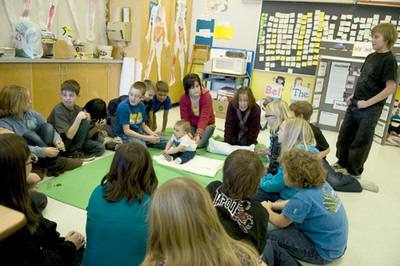
Roots of Empathy is a program designed to teach students to empathize and understand each other. A mother and child volunteer their time to come and visit a class every three weeks, and the class monitors the baby's growth, and learning. "It has really good reviews and it has shown that it has had positive influences in schools," said fifth grade teacher Christa LaClaire. "I thought it was something that would benefit our school.
Kids learning about emotions from a baby—it’s such a simple, elegant, and powerful idea, brought to life beautifully by ROE’s founder Mary Gordon and her team. While the program has spread across Canada, and has now reached several other countries, it has yet to gain similar prominence in the United States.
Everyone is an Educator. Empathy is perhaps the best. Do you wish to meet your fellow Instructors; people who live afar, a professional or personal mentor much like you? Perchance, you seek answers, assistance, or just the acumen of another who relates to your reality. Come on in or See more before you choose!
When it comes to romantic relationships, empathy is essential, but it isn’t always easy, say family researchers Philip A. Cowan, Carolyn Pape Cowan, and Neera Mehta. They explain the obstacles couples face—and how to overcome them.
Empathy seems to come more easily to some partners than others. Yet although we tend to describe some people as empathic and others as lacking empathy, empathy is not a fixed trait—a stable characteristic that a person expresses similarly in all situations. We believe that under ideal conditions, everyone can be at least somewhat empathic in the moment. We see five main conditions necessary for fostering empathy in couples’ lives.
Changes in the brain consequent on meditation have been documented by the Massachusetts General Hospital (MGH) researchers.
A structured 8-week meditation program leads to measurable changes in brain regions associated with memory, sense of self, empathy and stress, the study seems to show.
Participating in an 8-week mindfulness meditation program appears to make measurable changes in brain regions associated with memory, sense of self, empathy and stress.
"Although the practice of meditation is associated with a sense of peacefulness and physical relaxation, practitioners have long claimed that meditation also provides cognitive and psychological benefits that persist throughout the day," says Sara Lazar, PhD, of the MGH Psychiatric Neuroimaging Research Program, the study’s senior author. "This study demonstrates that changes in brain structure may underlie some of these reported improvements and that people are not just feeling better because they are spending time relaxing." (img http://bit.ly/hwe7dR)
Activities to Listen With Empathy. Empathy is an important skill for people to learn when they are trying to communicate effectively with others. People want to feel like others understand and acknowledge their feelings and thoughts during a conversation or an argument. Empathetic listening involves verbal acknowledgments of the other person's thoughts and feelings, and it also involves body language that conveys empathy. In several activities, participants can list, view, and practice empathetic listening.
Can babies prevent bullying? The answer may be a resounding “yes.”
Bullying has been in the news a lot lately. In my last blog posting, I wrote about recent information from neuroscience about the violent changes in the brain from being bullied, and ended on a more hopeful note with suggestions for positive actions to prevent, intervene, or heal from bullying.
One delightful and effective approach to preventing bullying comes from a Canadian program called Roots of Empathy.
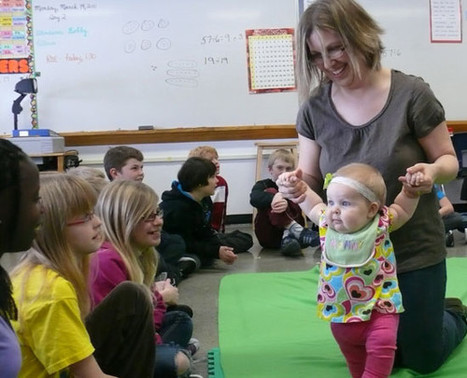
The tiny tot has been paying regular visits to the class with her mom Lin for the past four months, as part of the Roots of Empathy program. The award-winning program is intended to develop empathy in children and adults.
Essentially, students follow the development of an infant over the school year, getting a chance to interact with the baby and ask questions. Geared to develop emotional literacy, the program prepares students for responsible citizenship and responsive parenting. Little Kelcey is one of three babies visiting Grade 5 students at the school this year.
Introducing Roots of Empathy, an award-winning charitable organization that brings empathy-based (and evidence-based) programming to children.
"When I talk to city officials, I speak of the fact that there is fluoride in our water supply to prevent tooth decay. I tell them we need empathy in the water supply to prevent social decay ."
As Manager of Humane Education at the Arizona Humane Society in Phoenix, Dr. Kris Haley uses the Six Pillars of Character to teach kids about having empathy and compassion for animals – and each other.
What more important work is there than teaching
an expanded concept of empathy to kids
through the extraordinary lessons
of animals?
If each heart had empathy, we truly could change the world! The Six Pillars of Character, deepened with a humane dimension, can do just that!
The article also discusses how people come to have empathy, and it turns out it is a combination of our experiences, what we see, and what we are taught, among other things. It is important to teach empathy to our children. There are ways we can go about doing this. Here are several I came up with:
Research around the world demonstrates the tremendous benefits of owning a pet.
Studies show that children who own pets have more empathy and nurturing ability, and as they grow into adulthood, essential skills to develop meaningful relationships.
To get content containing either thought or leadership enter:
To get content containing both thought and leadership enter:
To get content containing the expression thought leadership enter:
You can enter several keywords and you can refine them whenever you want. Our suggestion engine uses more signals but entering a few keywords here will rapidly give you great content to curate.


 Your new post is loading...