Conflict is inevitable in business as people with differing ideas, priorities, and personalities are expected to work toward common goals. It can even be helpful when it generates new ideas and new solutions to business challenges. But conflict often hampers productivity and hinders working relationships, so conflict resolution is an important skill for all professionals.
Here are five steps you can follow to address conflict in positive, mutually beneficial ways.
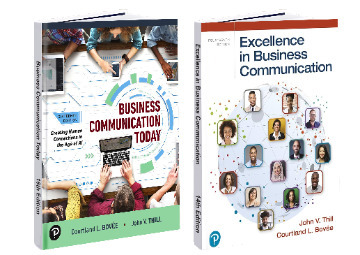
Bovee and Thill are the recognized leaders in the field of digital communication, social media, and technology--including mobile communication and artificial intelligence, and were the first authors to cover these topics. They continue to be far ahead of all other texts with heir cutting-edge coverage.
"Likeable people do better in life in general. They attract more people to them, along with opportunities and invitations. Some say they are likeable because they get more “breaks” than the average person. I think it’s the opposite, and there is a lot of research to back up my opinion. I wrote about the happiness advantage here.
"But if likeable people get further in life, can we become more likeable, or are we dealing with an inherited genetic code that has our gregarious dial preset before birth? No matter what our natural predisposition is, I’m certain we all can improve our likeability factor by changing a few key behaviors."
Scott Mautz is a motivational speaker, best-selling author, and former executive at Proctor & Gamble.
Mautz says that being likable is not only an important personal attribute, but one that he considers key to being successful in the business world, whether as a boss or an employee.
Highly successful people are careful to avoid the most unlikable behaviors, which include humblebragging, being dramatic, needing constant validation, and giving shallow compliments.
"It’s not impossible to make your argument stick. And there’s been some good scientific work on this. Here are two strategies that, based on the evidence, seem promising."
Technology can be dehumanizing. Even our day-to-day personal interactions conducted in digital bursts risk losing the heart of who are. Kareem Yusuf shows how people have aimed to embed emotional "tone" into their digital lives, from text-messages to data. He explores why, in today's fully digitized and globalized world, we must strive to incorporate tone into everything we do.
"Most friendships develop so naturally that you don't even realize how or when they started.
"But sometimes you want to make an effort to befriend a new acquaintance or become a better friend to existing pals. Using tricks and techniques like mirroring, subliminal touching, smiling, and letting that other person talk about themselves can make you appear more likable.
We scoured the psychological research on the science of attraction to find strategies to get people to like you."
All business professionals eventually find themselves in situations where they need to have difficult and sometimes unwelcome conversations. This might involve giving an employee a negative performance evaluation, explaining to your boss why a project you’ve been assigned is unworkable, or simply trying to smooth things over with a colleague. These conversations are challenging because they can involve emotions, egos, and legitimate conflicts with differing points of view.
Are you afraid of worse coming to worse in this doggy dog world? Are you honing in on an answer? Yeah, you're guilty of the most commonly misused phrases.
"Body language is so much more than moving one’s hands or waving one’s arms — and it’s also something we should all get comfortable with using, says communications expert David PJ Phillips. Phillips has spent years analyzing 5,000 public speakers to identify what moves work — and which ones don’t — when talking to an audience."
"It’s clear that artificial intelligence (AI) will be an important part of the way we communicate and collaborate in the foreseeable future.
"Tying in AI technologies with business communication applications such as team collaboration and unified communications can improve worker productivity, save time, and improve the overall business flow."
Bovee and Thill are the only business communication authors who include coverage of artificial intelligence in these textbooks: Business Communication Today and Excellence in Business Communication. See for yourself. Visit http://blog.businesscommunicationnetwork.com/texts
One hint: it often ends with the letters “est.” And it can lead to competition and disappointment, says psychologist and workplace researcher Shawn Achor.
Scientific studies prove that each of us have biases that basically create a filter through which we see the world and people around us. It’s great to know what those biases might be, but it all…
A study analyzing TED Talks last year found that the most popular, viral speakers used an average of about 465 hand gestures, which is nearly twice as many as the least popular speakers used.
Other research has found that people who “talk” with their hands tend to be viewed as warm, agreeable and energetic, while those who are less animated are seen as logical, cold and analytical.
"Empathy is the ability to sense other people’s emotions, coupled with the ability to imagine what someone else might be thinking or feeling. Research suggests that empathic people tend to be more generous and concerned with others’ welfare, and they also tend to have happier relationships and greater personal well-being. Empathy can also improve leadership ability and facilitate effective communication.
To get content containing either thought or leadership enter:
To get content containing both thought and leadership enter:
To get content containing the expression thought leadership enter:
You can enter several keywords and you can refine them whenever you want. Our suggestion engine uses more signals but entering a few keywords here will rapidly give you great content to curate.


 Your new post is loading...


 Scoop.it!