Explore strategies for teaching digital media and AI tools in business communication. Enhance student skills with practical applications and professional insights.


Teaching artificial intelligence in a business communication course: an online magazine by Bovee and Thill, authors of the leading textbooks in business communication, published by Pearson. This site features resources for business communication and business writing instructors. For more information about Bovee and Thill texts and the materials they provide for teaching artificial intelligence in a business communication course, visit https://blog.businesscommunicationnetwork.com. For instructor examination copies, go to https://blog.businesscommunicationnetwork.com/texts/. To find your local sales representative, go to https://www.pearson.com/en-us/help-and-support/contact-us/find-a-rep. To contact the authors, use this form: https://businesscommunicationnetwork.com/contact-us/. To get a free Comprehensive Guide to Business Communication Instructional Resources, visit https://blog.businesscommunicationnetwork.com/resources/. Subscribe to a free weekly newsletter of new posts to all 11 of Bovee and Thill's Online Magazines: https://sco.lt/8kgeVV.
 Your new post is loading...
 Scoop.it! Explore strategies for teaching digital media and AI tools in business communication. Enhance student skills with practical applications and professional insights. 
No comment yet.
Sign up to comment
Scoop.it!

From
www

As artificial intelligence drives change in the workplace, business schools are helping students develop three skills new hires must have.
Bovee & Thill's Online Business Communication Magazines's insight:
Sara Welch's report from Baruch College's Zicklin School is useful because it's specific about what's actually being taught. Zicklin has roughly 12,000 undergraduates in BBA programs and encourages faculty to work AI into courses without requiring it. Kannan Mohan, the associate dean, is blunt about why: a one-size-fits-all approach to AI infusion won't work. The school won a CUNY grant to audit its BBA and MBA curricula for gaps.
The three skills they've settled on are technological fluency, problem solving, and critical thinking. The fluency piece lands closest to our territory. Chul Kim, a marketing professor there, tells students they aren't having a conversation with the tool and should load the first prompt with everything it needs, since the algorithm leans hardest on that one for context. His example is a business message. "Write an email following up with a client" gets you far less than "write a 100-word email using these keywords to summarize the meeting I just had with Client X."
That contrast is a ready-made exercise. Give students a real message situation, have them write the lazy prompt and the loaded one, then compare both against what they'd have written unaided. Michael Kalish at Zicklin's career center reports a Bank of America recruiter telling students AI would take the grunt work and hand them higher-level responsibilities. Whether that's true for any particular job is worth arguing about in class, which is itself the critical thinking the article says employers want.
Scoop.it!

Here’s a 25-question multiple-choice quiz to help you assess your preparedness for teaching AI in your business communication course. Answers are provided.
Scoop.it!
A common worry about AI in business communication courses is that it crowds out the fundamentals. It does the opposite. Tone, structure, persuasion and clarity matter more once a machine can draft the first version.
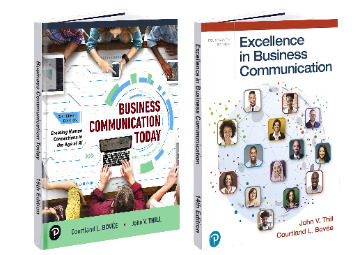
Business Communication Today, 16th Edition, by Bovee & Thill, works AI into every chapter rather than parking it in an appendix. Students meet it through cases they recognize: Sephora's AI-driven influencer strategy in Chapter 12, Coca-Cola's Create Real Magic platform in Chapter 8.
This is classroom-ready material rather than a survey of the technology. AI doesn't replace your expertise. It gives you more to teach with.
Bovee & Thill's Online Business Communication Magazines's insight:
Scoop.it!
Are your students truly ready for the AI-driven workplace? Traditional communication skills—writing, presenting, persuading—are still essential. But in today’s world, where 100% of Fortune 500 companies already use AI, timeless skills alone aren’t enough.
Scoop.it!

Business Communication Today integrates AI with timeless fundamentals, preparing students for modern workplaces without overwhelming your curriculum.
Scoop.it!

Discover trends and insights in AI-powered communications, helping businesses stay ahead in the evolving landscape of AI-driven solutions.
Scoop.it!

In the era of artificial intelligence, the importance of business communication courses in college curricula has never been more apparent. As AI increasingly automates routine tasks, the ability to effectively communicate complex ideas, collaborate with diverse teams, and navigate the nuances of human interaction becomes a critical skill set for future professionals.
Business communication courses equip students with the tools to bridge the gap between technical expertise and interpersonal skills, enabling them to harness the power of AI while maintaining the human touch in business interactions.
Scoop.it!

AI can accelerate the creation of meaningful content, improve workflows with automation, and provide actionable insights to assist decision-making.
Scoop.it!

Discover how AI can transform business communications with personalized interactions, chatbot support, data analytics, virtual assistants, and more. Stay ahead of the competition with AI's efficiency and digital transformation. Unlock the potential of this game-changing technology for your business.
Scoop.it!

The rapid, widespread implementation of artificial intelligence technologies in workplaces has implications for business communication. In this article, the authors describe current capabilities, challenges, and concepts related to the adoption and use of artificial intelligence (AI) technologies in business communication.
Scoop.it!
The ChatGPT writing tool that is causing a stir in business and academia is more evidence of the pervasive role of technology in modern business communication. These tools have profound ethical, legal, and practical implications for communication professionals.
Bovee and Thill have been tracking the rise of AI and other digital tools for years, and their textbooks cover disruptive and innovative technologies from social media listening tools to deepfake videos.
To request examination copies of Bovee and Thill's award-winning business communication textbooks (instructors only), visit https://lnkd.in/bvxGGmT.
Scoop.it!

With the rise of the popular new chatbot ChatGPT, colleges are restructuring some courses and taking preventive measures.

Samantha Alanís's curator insight,
January 24, 2024 1:02 AM
On the positive side, chatbots equipped with AI can provide instant support, answer queries, and offer personalized guidance to students, enhancing the overall learning experience :D This real time assistance can contribute to more efficient and accessible educational resources. |
Scoop.it!
Bovee & Thill's Online Business Communication Magazines's insight:
Patrick Kulp opens on the thing your students will recognize instantly. Emails full of bullets and emoji, "delving" and "pivotal" everywhere. Jeff Hancock at Stanford and Kate Niederhoffer at BetterUp named it workslop in late 2025, just before Merriam-Webster made "slop" its word of the year, and Niederhoffer expects it to get worse before it improves, because organizations change slowly.
The cost everyone reached for first was time. Both researchers think that was the wrong thing to fixate on. The damage they care about is to trust. Thoughtless AI messages make teammates think less of each other, and Hancock points out that the workplace has been one of the few settings where trust was still repairable. Matt Poepsel of Predictive Index adds a second problem. AI is sycophantic, so when you ask it to review your email it sidesteps the tension a human colleague would have named out loud.
Two ideas here are worth stealing for class. Skillsoft trains its people to use AI for feedback rather than as a ghostwriter, asking it what the CEO would criticize about a draft instead of asking it to produce one. And Brian Jabarian at Chicago Booth makes the point that matters most in a writing course. People don't work in tidy sequential steps. A lot of the thinking happens while you're typing the email, which is exactly the part that gets skipped.
Scoop.it!

Prepare students for AI-driven business communication with foundational skills in AI literacy, ethical considerations, and practical applications in week one.
Scoop.it!

The business communication educational landscape is rapidly evolving, and Artificial Intelligence (AI) is driving this transformation. In the field of business communication, AI presents unprecedented opportunities for instructors to deliver personalized, data-driven, and impactful learning experiences.
This article explores the multifaceted ways AI is revolutionizing business communication instruction, focusing on three key areas: personalized learning, Insights and commentary from the authors of the world's leading business communication textbooks, plus complimentary resources for classroom use.
Scoop.it!
|

|
Scooped by
Bovee & Thill's Online Business Communication Magazines
July 20, 2025 9:55 PM
|
Scoop.it!
|
|
Scooped by
Bovee & Thill's Online Business Communication Magazines
September 2, 2025 1:09 PM
|
Scoop.it!
Traditional business communication textbooks are stuck in the past—teaching faxes, memos, and outdated methods that no longer prepare students for the workplace of today (let alone tomorrow).
Business Communication Today, 16th Edition is different.
It integrates AI in every chapter, connects technology with ethics and empathy, and equips students with real-world skills:
AI-powered writing and design
Visual storytelling across cultures
Data-driven decision-making
Inclusive, bias-free communication
Collaboration in hybrid workplaces
This isn’t just a textbook—it’s the future of business communication. The old way is over. The future starts now.
👉 Business Communication Today, 16th Edition – Available Now from Pearson.
|
|
Rescooped by
Bovee & Thill's Online Business Communication Magazines
from Teaching a Modern Business Communication Course
April 30, 2024 5:49 PM
|
Scoop.it!

As we navigate the rapidly evolving landscape of business communication in 2024, it is crucial for instructors to stay informed about the latest advancements in artificial intelligence (AI) and its impact on the field.
AI has become an integral part of modern business practices, revolutionizing the way companies interact with customers, streamline operations, and make strategic decisions.
This article will explore the critical aspects of AI that business communication instructors must understand to effectively prepare their students for success in the contemporary workforce.
|
|
Scooped by
Bovee & Thill's Online Business Communication Magazines
January 5, 3:30 PM
|
Scoop.it!

Equip students with essential skills for the AI-driven workplace through Business Communication Today, 16th Ed., offering new trends and practical applications.
|
|
Scooped by
Bovee & Thill's Online Business Communication Magazines
February 21, 2025 4:00 PM
|
Scoop.it!

Request an examination copy of Business Communication Today, 16th Edition.
|
|
Scooped by
Bovee & Thill's Online Business Communication Magazines
January 27, 2024 5:05 PM
|
Scoop.it!

In recent years, the utilization of AI in business communication has witnessed a significant surge, revolutionizing the way individuals interact, collaborate, and communicate. Nearly every organization has embraced AI in some capacity, and collaborative tools have harnessed AI’s power to enhance eng
|
|
Rescooped by
Bovee & Thill's Online Business Communication Magazines
from Teaching Social Media and Digital Communication in a Business Communication Course
March 31, 2023 11:50 PM
|
Scoop.it!

The newest OpenAI text-generator is a marked improvement over its predecessor – but it still has its pitfalls.
|
|
Rescooped by
Bovee & Thill's Online Business Communication Magazines
from Teaching Social Media and Digital Communication in a Business Communication Course
March 31, 2023 11:51 PM
|
Scoop.it!

"Over the last couple of years, we’ve been seeing a vast improvement in AI writing tools.
If you’re a writer in any shape or form you’ve probably wondered how good these tools really are. Are they a threat to your livelihood? Or can they help you create good content faster than before?" Read more: https://medium.com/mlearning-ai/can-artificial-intelligence-write-great-content-for-your-business-needs-9d36e6d61c3f