Your new post is loading...

|
Scooped by
Scott Turner
November 23, 2012 6:07 AM
|
What is 23 Things?
23 Things is a self-directed course, run as part of Engage: Social Media Michaelmas, that aims to expose you to a range of digital tools that could help you in your personal and professional development as a researcher, academic, student or in another role.
|
|
Scooped by
Scott Turner
November 19, 2012 7:59 AM
|
In response to the growing numbers of African students on the social work qualifying programme at the University of Northampton, three senior lecturers undertook a small-scale study in 2008 to evaluate African students’ particular learning experiences. This trend of increasing student numbers reflects the national picture as indicated by the General Social Care Council (GSCC, 2009). The African student experience is different and therefore different strategies are needed to ensure that learning and subsequent employability are maximised. The research identified two significant outcomes. The first was the need for a peer support group, which was set up in September 2008. The group named itself PADARE, a Zimbabwean term which means: meeting place. The second was the need for a qualified social worker as a mentor to support the students’ transition from academic learning into work-based learning and practice. This paper will focus mainly on the rationale and potential of these two initiatives from both an educator’s perspective and that of the students themselves drawing on relevant contemporary literature in the areas of Mentoring and Peer support groups.
|
|
Scooped by
Scott Turner
November 19, 2012 7:56 AM
|
This article explores the motivations, experiences and perceived outcomes for Doctorate in Education (EdD) students in their journey through a relatively new form of doctoral education at a distance. The research draws on a range of individual EdD participant voices, both student and graduate, and is timely in focusing on an example of an under-researched but increasingly common phenomenon of part-time distance learning professional doctorates. The aims of the research were: to understand what motivated students to register for an EdD; to explore the factors which successfully sustained them on their journey; to identify common outcomes on completion. The researchers developed a case study of the student EdD journey in its distinctive professional context(s). Data was collected in a number of linked stages including postal surveys, semi-structured interviews, and students’ reflective evaluations at different points. Key themes related to professional postgraduate learner transitions emerge from the data, which contrast with previous work on the traditional PhD and relate to: the deliberate choice by students of a part-time distance learning route; a broader and better-informed understanding of professional outcomes on a professionally-oriented doctorate; the value of flexible support systems for EdD students working in demanding educational roles.
|
|
Rescooped by
Scott Turner
from academiPad
November 18, 2012 2:26 PM
|
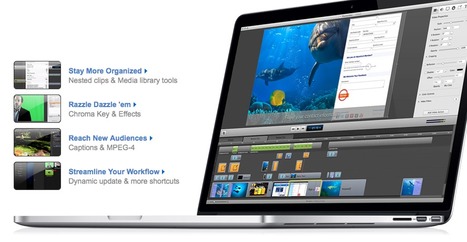
ScreenFlow is my favourite screencasting software tool and the one that I use to make all the video tutorials for my Tech Tools for Teachers series on OneStopEnglish and for the award winning Blended Learning in ELT course I designed for Bell. I'm now using it to create iPad tutorials and it works really well.
~Record from desktop, a video camera, microphone and computer's audio all at the same time
~Full screen HD capture, optimized for the best, most efficient screen capture
~Intuitive editing interface allows you to add professional touches
~Keynote and PowerPoint support
~Full range of elegant 2D & 3D transitions
~Publish directly to YouTube, Vimeo or Flash movie
~Optimized to take advantage of productivity enhancements in Mac OS X Lion
Via academiPad
|
|
Rescooped by
Scott Turner
from academiPad
November 18, 2012 12:53 AM
|
|
|
Rescooped by
Scott Turner
from The 21st Century
November 16, 2012 4:52 AM
|
We worry that many educators are unintentionally and subconsciously averse to weaving technology into the fabric of teaching and learning, simply because they do not see what doing so would look and feel like, and technology does not map onto to...
Via Dr. Susan Bainbridge
|
|
Scooped by
Scott Turner
November 15, 2012 11:58 AM
|
For better or for worse, technology is everywhere in higher education.
|
|
Scooped by
Scott Turner
November 14, 2012 12:27 PM
|
Some great work is happening on evaluating the benefits of electronic assessment in HE externally. A project team at the University of Huddersfield is currently evaluating the impact of e-assessment and feedback on student satisfaction, retention, progression and attainment as well as on institutional efficiency and are sharing recommendations for achieving high quality assessment processes, staff development, student support, sustainability, scalability and curriculum development. Ple
|
|
Scooped by
Scott Turner
November 14, 2012 6:25 AM
|
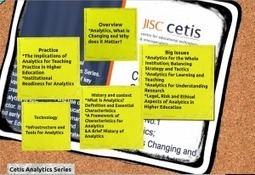
The CETIS Analytics Series consists of 11 papers, written by a range of our staff (and some commissioned pieces) looking at a range of topics relevant to Analytics in education. The series is intended to provide a broad landscape of the history, context, issues and technologies of Analytics in post 16 education, and in particular the UK context.
|
|
Scooped by
Scott Turner
November 14, 2012 5:57 AM
|
How to Research...interesting infographic
|
|
Scooped by
Scott Turner
November 13, 2012 10:49 AM
|
This paper reports a study of the impact of work placements on transferable skills. The study was conducted in three engineering departments at Loughborough University. A pre-test intervention post-test model with a control group was used to sample the views of students before and after placements and of students who did not go on placements. These were triangulated with the views of their line managers in industry and their industrial tutors. The findings indicated that there was strong agreement between students, tutors and line managers on the value of work placements for transferable skills; that students developed their transferable skills on work placements and which transferable skills were developed most effectively on work placements. The consensus of line managers and the DIS (Diploma in Industrial Studies) tutors is that there is no satisfactory alternative to work placements for developing transferable skills. There were mixed views on whether work placements enhanced degree results. In fact, students who did go on placements did obtain better degree grades. These results demonstrate the value of work placements for the personal and professional development of students. But some caution is necessary in generalising the results to other courses. Work placements differ in structure, content and duration, the evidence on the transferability of transferable skills is not clear cut and impact in this field is more a matter of judgment than measurement.
|
|
Scooped by
Scott Turner
November 13, 2012 10:47 AM
|
|
|
Scooped by
Scott Turner
November 13, 2012 4:12 AM
|
|
|
|
Scooped by
Scott Turner
November 19, 2012 10:29 AM
|
We need to ensure learners have the best possible chance of securing a job in the current marketplace and to do this I feel that the further education sector needs to develop a more holistic approach to employer engagement. In my understanding the key to doing this successfully lies in the following steps: Market analysis
Identifying course need
Implementing course design
Presentation and delivery of the course
Gathering feedback to inform future needs and requirements.
|
|
Scooped by
Scott Turner
November 19, 2012 7:57 AM
|
The Nursing and Midwifery Council (2008a; 2008b) not only requires employers to support non-dyslexic students but also requires evidence of how disabled ‘students would be supported both in clinical practice and in the academic environment to help facilitate safe and effective practice sufficient for future registration’ (NMC 2004,p12). Limited research on personal tutor support in nursing and midwifery led to the need for a qualitative study which explored the experiences and needs of 15 non-dyslexic and 7 dyslexic nursing and midwifery students, in relation to personal academic tutor support. Data was collected by one-to one face to face tape recorded interviews which were then transcribed using semi-structured questions. Analysis of the data by constant comparative method (Glaser & Strauss 1999) assisted by the computer software Nvivo8 were used to analyse data. Themes generated suggest that many of the dyslexic and non-dyslexic students in this study view their experience of their personal tutor as ‘supportive’ but Professional needs for both dyslexic and non-dyslexic students and their perception of how tutors could help seem to vary.
|
|
Scooped by
Scott Turner
November 19, 2012 7:55 AM
|
This paper reports on research using postings on websites and online discussion boards to explore the experiences of Chinese students participating in transnational education programmes. It develops the concept of Virtual Third Spaces and establishes themes for future research which will use primary data collection methods. The themes identified relate to: differences in the theories of education; differences in the study methods; issues relating to choice, change, and personal development; quality of the courses and colleges providing the courses; and recognition of qualifications. Issues relating to the use of English as the medium of instruction permeate all these other themes.
|
|
Rescooped by
Scott Turner
from academiPad
November 18, 2012 1:24 AM
|
MakeUseOf: Have you ever done a PowerPoint presentation? Of course you have. If you said “no,” I’d call you a liar. Alright, that may be extreme. But most of us have, right? I’d say so. So, what’s my point?
Via Baiba Svenca, academiPad
|
|
Scooped by
Scott Turner
November 16, 2012 5:16 AM
|
Jobs currently available at The University of Northampton....0.5 FTE Research Assistant to contribute to and coordinate the research, development and consultancy activities of the Institute, internally and externally. The successful applicant will also provide secretarial and administrative support to the Director of the Institute of Learning and Teaching.
|
|
Scooped by
Scott Turner
November 16, 2012 4:51 AM
|
Gaming in the classroom – could this be a new way of teaching for the future?
|
|
Rescooped by
Scott Turner
from academiPad
November 15, 2012 11:54 AM
|
First of all, blogging is writing, 21st century style, plain and simple. Blogging is a massive genre. It comes in many forms, addresses myriad topics, and can certainly range in quality.
Via Kathleen Cercone, academiPad
|
|
Scooped by
Scott Turner
November 14, 2012 12:27 PM
|
The Open University and University of Manchester have undertaken a project to evaluate the effectiveness of e-feedback. The project team recognises the central role that assignment feedback plays in any form of learning, and that HE students consistently report this as one of the areas in greatest need of improvement.
|
|
Scooped by
Scott Turner
November 14, 2012 6:04 AM
|
The report, Going Mobile: Internationalisation, mobility and the European Higher Education Area, highlights challenges to and opportunities for UK universities in achieving the 2009 Leuven 20/2020 commitment. Currently only around 2% of UK undergraduates engage in study or workplace mobility of at least three months.
|
|
Rescooped by
Scott Turner
from academiPad
November 14, 2012 5:53 AM
|
Great article about how to get the most out of twitter - and what tools are out there to help you in this.
Via academiPad
|
|
Scooped by
Scott Turner
November 13, 2012 10:48 AM
|
This evaluative study focuses on the perceptions of black African (international and home) students on an under-graduate social work programme. In particular this paper will consider the more traditional assessment of examinations, where the students perceived that their grades were higher due to a familiarity with the assessment strategy. In contrast, they referred to the bewildering ‘other world’ of less familiar assessment processes which demanded a deeper level of critical thinking skills for example in assignments. This evaluation aims to consider whether the African students’ perceptions that their academic grades fared better dependent on the assessment process is in fact a reality compared to other less familiar ones.
|
|
Scooped by
Scott Turner
November 13, 2012 4:14 AM
|
|