Teaching a Modern Business Communication Course
46.0K views | +3 today
Teaching a Modern Business Communication Course
This is an online magazine by Bovee & Thill, authors of the leading textbooks in business communication, published by Pearson, featuring resources for business communication and business writing instructors. For more information about Bovee & Thill texts and the exclusive, superior materials they provide for teaching a modern course, visit http://boveeandthillbusinesscommunicationblog.com. For instructor examination copies, go http://blog.businesscommunicationnetwork.com/texts. To find your local sales representative, visit http://www.pearsonhighered.com/educator/replocator. To contact the authors, use this form:  https://businesscommunicationnetwork.com/contact-us/. To get a free Comprehensive Guide to Business Communication Instructional Resources, visit http://blog.businesscommunicationnetwork.com/resources.  Subscribe to a free weekly newsletter of new posts to all 11 of Bovee & Thill’s Online Magazines: http://sco.lt/8kgeVV.
Your new post is loading...
Scoop.it!

Under Armour's Business Communication Strategy Crosses  the Finish Line

Under Armour's Business Communication Strategy Crosses  the Finish Line | Teaching a Modern Business Communication Course | Scoop.it

Learn how a change in Under Armour's business communication strategy resulted in a knockout for the company.

No comment yet.
Scoop.it!

How Spotify Harmonized Business Communication

How Spotify Harmonized Business Communication | Teaching a Modern Business Communication Course | Scoop.it

Learn how Spotify resolved company-wide challenges by establishing cross-functional teams.

No comment yet.
Scoop.it!

Inside the Tesla Autopilot Miscommunication Saga

Inside the Tesla Autopilot Miscommunication Saga | Teaching a Modern Business Communication Course | Scoop.it

Your students can learn an important lesson the Tesla Autopilot miscommunication incident.

No comment yet.
Scoop.it!

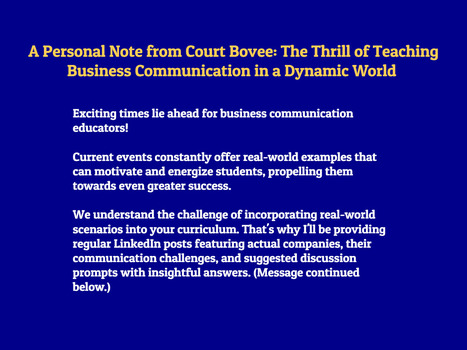
A Personal Note from Court Bovee and John Thill

A Personal Note from Court Bovee and John Thill | Teaching a Modern Business Communication Course | Scoop.it
We believe this practical approach is key to successful teaching. My coauthor and I have always integrated numerous real-world examples from diverse companies within our textbooks. However, my LinkedIn content will stand out for its immediacy. That's why I'm launching a series titled "Ripped from the Headlines."


Get a sneak peek at upcoming titles:

How Airbus Mastered Multilingual Communication

Effective Communication Saved the Day at Amazon

Dropbox: Leveraging Communication for Remote Collaboration

Domino's: Mastering the Art of Business Communication

Peloton Found Its Rhythm Through Business Communication

Uber: The Impact of Business Communication on Conflict

Five Lessons in Business Communication (the Hard Way): Equifax

Ikea's Recipe for Global Harmony


In a separate series called "Optimize Your Business Communication Instruction," I'll share the latest research findings on essential topics like visual communication, algorithms, business writing, interviewing and resumes, social media, listening, email, and reports.


Recognizing the complexities of business communication, I've created "The Mysteries of Business Communication" series. Dive into topics like:

The Body Language Enigma

The Power of Tone

The Nonverbal Void

The Power of Silence

Grasping Speaker Intent and Emotions

The Charisma Conundrum


Join the discussion in "What Do You Think," a thought-provoking series exploring:

Caught Between a Clock and a Camera: The Employee's Privacy Paradox

Like It or Like It Not: Navigating the Social Media Tightrope

Ha-Ha, or Huh-Oh: Office Humor's Minefield

In-Box Obituary: Is Email Dead or Evolving?


Finally, "Bovee & Thill Playbook: Unmasking the Secrets of Business Communication in 2024" offers insights into:

The Magic of AI and Visuals in Messaging

Presentation Skills with Next-Gen Performance Solutions

The Trojan Horse of the Mind: Why Stories Conquer (and Win Hearts)

Emotional Insights at the Speed of Light: Microexpressions


As pioneers in covering digital communication in business communication textbooks, we were the first to cover social media, mobile communication, and artificial intelligence. Naturally, our most extensive coverage of AI appears in the highly acclaimed 14th edition of "Excellence in Business Communication." We appreciate the positive feedback it has received and encourage you to explore it yourself. You can obtain an examination copy by clicking here.


Want to receive these posts as soon as they're published? Join my group, Teaching Business Communication, on LinkedIn! Over 3,400 members enjoy weekly updates and engage in discussions.  Click here to join.


All the best,


Court Bovee

John Thill

Bovee & Thill's Online Business Communication Magazines's insight:

.

No comment yet.
Scoop.it!

The New World of Business Communication

Excellence in Business Communication takes a close look at the fundamental skills and principles of business communication. Featuring practical advice, time-tested processes, and real-world examples, Excellence is the premier text for helping you hone and develop essential communication skills.

The 14th Edition continues to set new standards for currency and innovation. The authors performed extensive research to ensure up-to-date coverage of diversity, equity, and inclusion in communication skills, innovative technology usage, and contemporary business practices.

To learn more and request a free examination copy of this text, visit https://blog.businesscommunicationnetwork.com/.

See also http://blog.businesscommunicationnetwork.com

#teachingbusinesscommunication
#businesscommunicationinstruction
#businesscommunicationtextbooks
#teachingbusinesswriting
#businesswritinginstruction
#businesswritingtextbooks

No comment yet.
Scoop.it!

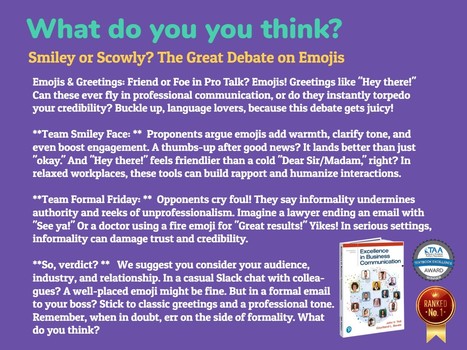
The Great Emoji Debate

The Great Emoji Debate | Teaching a Modern Business Communication Course | Scoop.it

Should emojis ever be used in professional communication? Find the answer here.

No comment yet.
Scoop.it!

Why You Should be Teaching AI in Your Business Communication Classes

Why You Should be Teaching AI in Your Business Communication Classes | Teaching a Modern Business Communication Course | Scoop.it

In today's digital age, business communication is evolving rapidly, paving the way for innovative technologies to reshape how we connect, collaborate, and communicate. One such technology that holds immense potential is artificial intelligence (AI). As students of business communication, it is essential to understand why AI and intelligence technologies are becoming increasingly vital in this field. In this blog post, we will explore the reasons why students in a business communication course should embrace and learn about AI technologies.


Enhanced Communication Efficiency


AI technologies, such as chatbots and virtual assistants, are revolutionizing the way businesses interact with their customers. Learning about these technologies equips students with the knowledge to leverage AI-powered communication tools that streamline processes, provide instant responses, and enhance customer experiences, ultimately driving organizational efficiency.


Data-Driven Decision Making


AI algorithms have the capacity to process vast amounts of data and extract valuable insights. Understanding AI enables students to harness these capabilities in business communication, allowing for data-driven decision making. By analyzing communication patterns, sentiment analysis, and customer behavior, students can shape effective communication strategies and tailor messages to specific target audiences.


Personalization and Customer Engagement


AI technologies enable businesses to personalize communication and engage customers on a deeper level. Students learning about AI can explore how intelligent systems analyze customer preferences, generate personalized recommendations, and craft targeted marketing campaigns. This knowledge empowers students to create communication strategies that resonate with their intended audience, fostering stronger customer engagement and loyalty.


Voice-Based Interfaces and Natural Language Processing


Voice assistants like Siri, Alexa, and Google Assistant are becoming ubiquitous in homes and workplaces. Understanding the underlying technologies, such as natural language processing, speech recognition, and voice search optimization, helps students adapt their communication skills to this growing trend. Incorporating voice-based interfaces in business communication allows for more accessible and interactive interactions with customers, employees, and stakeholders.


Ethics and Responsible AI Use


As AI continues to evolve, ethical considerations surrounding its use become increasingly important. Students studying business communication should gain insights into the ethical implications of AI technologies, including issues like privacy, bias, and transparency. Developing an understanding of responsible AI practices prepares students to engage in meaningful discussions and make informed decisions regarding AI integration in business communication.


By embracing AI as part of their studies, students not only enhance their communication skills but also gain a competitive edge in the professional world. From improved communication efficiency to data-driven decision making, personalization, voice-based interfaces, and ethical considerations, learning about AI technologies equips students to navigate the evolving challenges and opportunities they will encounter in their future careers.


How Students Can Learn about AI in a Business Communication Course


Excellence in Business Communication, authored by Thill and Bovee, is the only textbook in the field to offer full coverage of AI.  Order an examination copy of this text to prepare your students for their AI future.


No comment yet.
Scoop.it!

Harvard Psychologist: If You Use Any of These 9 Phrases, You're More Emotionally Secure Than Most People

Harvard Psychologist: If You Use Any of These 9 Phrases, You're More Emotionally Secure Than Most People | Teaching a Modern Business Communication Course | Scoop.it
Emotionally secure people are confident and comfortable in their own skin. But it takes work to get there. Dr. Cortney Warren, a Harvard psychologist and bestselling author, reveals the phrases that the most emotionally stable people say every day.
No comment yet.
Scoop.it!

16 Dangers to Avoid in Writing for Business

16 Dangers to Avoid in Writing for Business | Teaching a Modern Business Communication Course | Scoop.it

by Courtland Bovee, coauthor with John Thill of three business communication textbooks, published by Pearson. http://blog.businesscommunicationnetwork.com/texts.


Here are 16 practices that are commonly viewed as unethical,  harmful, or even dangerous in professional business  communication and that individuals must be aware of to maintain ethics and legality in their communication practices:


Lying to customers or stakeholders for personal gain or misleading people about goods and services.


Sharing/selling confidential information about customers, partners, or competitors without their approval, leading to liability or litigation.


Manipulating data to improve audit results, financial statements, or other compliance risks or using deceptive practices in financial reporting, raising investor concerns.


Using threats, fear tactics, or intimidation to secure sales or contracts.


Defamation: Writing and intentionally publishing false statements about other people or companies, with ill motives and resulting in damaged reputation or economic harm.


Insider Trading: Sharing information on a company's financial performance or share value, obtained through personal and direct insight/knowledge with other parties, in violation of security laws.


Bribery/Kickbacks: Offering or receiving money, gifts, or any other type of compensation or benefits to influence business deals or enhance personal benefits.


Engaging in plagiarism or intellectual property theft by replicating content or ideas without proper attribution, harming other businesses' legitimate interests.


Harassing or bullying employees or coworkers through malicious gossip or spreading details of someone's personal life, creating possible legal ramifications and toxic office environments.


Cyberbullying & Cyberstalking: Using writing to harass or threaten individuals, with the use of technology such as email, texts, or social media platforms.


Discrimination or unfair treatment of employees based on age, race, gender, religion, or any other protected characteristic.


Exploiting vulnerability or weaknesses in a deal or using unethical tactics to gain an unfair advantage during negotiations.


Fraud: Writing statements intended to mislead investors, prospective customers, or partners about financial performance or the safety and effectiveness of products or services.


Data Privacy Violations: Writing copy that breaches an individual's or company's privacy rights by disclosing personal or confidential information without consent.


Using manipulative language, over-promising, or misleading prospects and customers, driving false expectations that lead to disillusionment and disloyalty.


Creating fake social media profiles, sharing fake reviews, manipulating online reviews to generate fake impressions or endorsements.


By being aware of unethical or illegal communication practices, individuals and businesses can maintain their professional reputation and comply with legal, regulatory, and ethical standards. Additionally, adopting a code of ethics or organizational policy provides guidance to staff and stakeholders on ethical best practices.

No comment yet.
Scoop.it!

40 Hard-to-Pronounce Words You Might Be Getting Wrong

40 Hard-to-Pronounce Words You Might Be Getting Wrong | Teaching a Modern Business Communication Course | Scoop.it
With influences from Latin, Greek, and many other languages, English pronunciation isn't easy. Here are some tricky words people often get wrong.
No comment yet.
Scoop.it!

Using These Words Instantly Makes You Sound Less Intelligent, Study Shows

Using These Words Instantly Makes You Sound Less Intelligent, Study Shows | Teaching a Modern Business Communication Course | Scoop.it
Think you're impressing everyone with your vocabulary? This study shows that using certain words can make you sound less intelligent.
No comment yet.
Scoop.it!

Annoying People Say These 75 Things.

Annoying People Say These 75 Things. | Teaching a Modern Business Communication Course | Scoop.it

"Which sentences are used by annoying people?"

No comment yet.
Scoop.it!

43 Embarrassing Grammar Mistakes Even Smart People Make

43 Embarrassing Grammar Mistakes Even Smart People Make | Teaching a Modern Business Communication Course | Scoop.it
Like it or not, words, spelling, and punctuation can leave a lasting impression on others. But even the most educated people often unknowingly make these common flubs.
No comment yet.
Scoop.it!

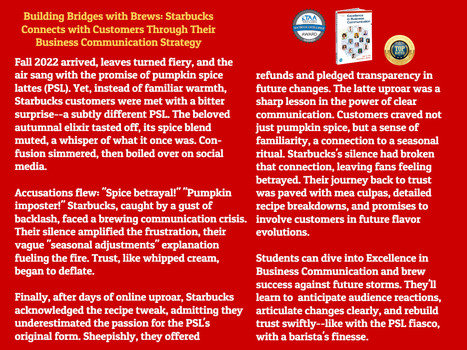
Starbucks Connects with Customers Through Their Business Communication Strategy

Starbucks Connects with Customers Through Their Business Communication Strategy | Teaching a Modern Business Communication Course | Scoop.it

Learn how Starbucks successfully handled an online uproar.

No comment yet.
Scoop.it!

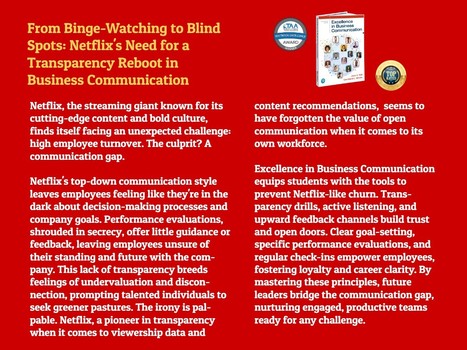
Netflix's Need for a Transparency Reboot in Business Communication

Netflix's Need for a Transparency Reboot in Business Communication | Teaching a Modern Business Communication Course | Scoop.it

Netflix found themselves facing an unexpected challenges Discover how they resolved it.

No comment yet.
Scoop.it!

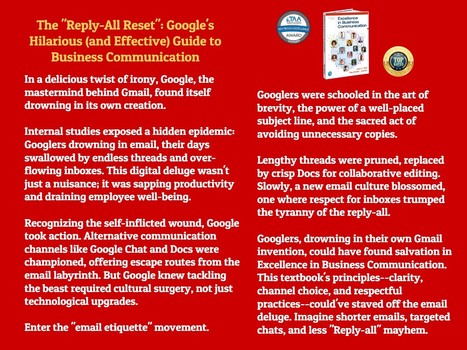
Google's Hilarious (and Effective) Guide to Business Communication

Google's Hilarious (and Effective) Guide to Business Communication | Teaching a Modern Business Communication Course | Scoop.it

How did Google, the mastermind behind Gmail, find itself drowning in its own creation, and what did it do about it?

No comment yet.
Scoop.it!

7 Top Methods for Teaching Excellent Communication Skills

7 Top Methods for Teaching Excellent Communication Skills | Teaching a Modern Business Communication Course | Scoop.it

Learn the seven methods for teaching excellent communication and interpersonal skills to students.

No comment yet.
Scoop.it!

Can AI Be Your Personalized Productivity Partner?

Can AI Be Your Personalized Productivity Partner? | Teaching a Modern Business Communication Course | Scoop.it

Learn whether AI is likely to become your personalized productivity partner.

No comment yet.
Scoop.it!

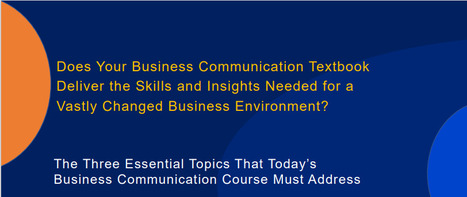
Is Your Business Communication Text Delivering What It Should in Today's Business Environment?

Is Your Business Communication Text Delivering What It Should in Today's Business Environment? | Teaching a Modern Business Communication Course | Scoop.it

Learn more about the three essential topics today's business communication course must address. 

No comment yet.
Scoop.it!

Ten Essential Tips for Writing for the Web

Ten Essential Tips for Writing for the Web | Teaching a Modern Business Communication Course | Scoop.it

Here are ten of the most important things to keep in mind when writing for the web:


Keep it Simple: Writing for the web should be concise and straightforward, using short sentences and paragraphs to make content easy to read and quickly consumable.


Write for Scanning: Most web users skim through content, so organizing your information into digestible headings, subheadings, bullet points, and lists can improve the readability and enhance user experience.


Use Strong Headlines: Strong and meaningful headlines help grab the reader's attention and give them an insight into the content and structure of the post.


Understand Search Engine Optimization (SEO): Having relevant, focused, and keyword-rich content can improve your visibility in search engines and engage your audience.


Use Active Voice: Writing in active voice creates more engaging and compelling content than writing in passive voice.


Make It Relevant: Focus on creating content that adds value and provides solutions to your readership's needs, problems or concerns.


Be Authentic: Writing should reflect the personality and tone of your brand's culture, and reflect authenticity and transparency.


Use Visuals: Including appropriate and engaging visuals in your content can increase readership, enhance the readability, and make your message more memorable.


Edit Thoroughly: Editing your content through multiple rounds of review, spelling, and grammar checks, checking for redundancy or clarity issues can result in a more polished, professional, and error-free final draft.


Focus on Engagement: Encourage engagement with your readers through a comments section, a call-to-action, or well-placed social media buttons, which can increase your visibility, spread your message, and have your content be useful and shareable with a broad audience.


By keeping these essential principles in mind when writing for the web, you can improve user engagement, build your brand and thought leadership, and increase the effectiveness of your website and online presence.

No comment yet.
Scoop.it!

75 Incorrectly Used Words That Can Make You Look Dumb

75 Incorrectly Used Words That Can Make You Look Dumb | Teaching a Modern Business Communication Course | Scoop.it

How many of these words do you get wrong?

No comment yet.
Scoop.it!

Words Have Meaning: Translating the Annoying Things People Say

Words Have Meaning: Translating the Annoying Things People Say | Teaching a Modern Business Communication Course | Scoop.it

"People tend to say what they mean, but our challenge is deciphering the meaning beyond what they say."

No comment yet.
Scoop.it!

15 Misused Words That Make Smart People Look Foolish

15 Misused Words That Make Smart People Look Foolish | Teaching a Modern Business Communication Course | Scoop.it
Do not let these common word mistakes trip you up.
No comment yet.
Scoop.it!

The Most Misspelled Word in Every State

The Most Misspelled Word in Every State | Teaching a Modern Business Communication Course | Scoop.it
Not sure if you're spelling even the most commonly used words correctly? You're not alone. Here are the most misspelled words in every state.
No comment yet.
Scoop.it!

21 Hurtful and Offensive Words You Should Remove from Your Vocabulary

21 Hurtful and Offensive Words You Should Remove from Your Vocabulary | Teaching a Modern Business Communication Course | Scoop.it
We offer 21 words to steer clear of if you don't want to alienate or offend your audience. We also suggest how you can better connect.
No comment yet.