Your new post is loading...

|
Scooped by
Gerd Moe-Behrens
April 12, 2012 5:18 PM
|
Posted by Thomas Howard
One of the advantages of working with bacteria is that genes can be clustered together under control of a single promoter (known as an operon). Multiple protein products can therefore be generated from a single messenger RNA strand (the mRNA is said to be polycistronic (Fig. 1)). As a result entire metabolic pathways can be created using a single promoter. In eukaryotic systems this is generally not the case. mRNA in eukaryotes is typically monocistronic (there are a few exceptions but these undergo post-transcriptional processing and are not viewed as truly polycistronic e.g. lower box Fig. 1). This limitation means more DNA cloning/synthesis, repeated rounds of transformation and increased difficulty in controlling the expression levels of different genes – which can be important for metabolic engineering, for example.
|
|
Scooped by
Gerd Moe-Behrens
April 12, 2012 12:30 PM
|
by Massimiliano Zampini and Finbarr Hayes
"Artificial transcription factors (ATFs) are potent synthetic biology tools for modulating endogenous gene expression and precision genome editing. The ribbon–helix–helix (RHH) superfamily of transcription factors are widespread in bacteria and archaea. The principal DNA binding determinant in this family comprises a two-stranded antiparallel β-sheet (ribbons) in which a pair of eight-residue motifs insert into the major groove. Here, we demonstrate that ribbons of divergent RHH proteins are compact and portable elements that can be grafted into a common α-helical scaffold producing active ATFs. Hybrid proteins cooperatively recognize DNA sites possessing core tetramer boxes whose functional spacing is dictated by interactions between the α-helical backbones. These interactions also promote combinatorial binding of chimeras with different transplanted ribbons, but identical backbones, to synthetic sites bearing cognate boxes for each protein either in vitro or in vivo. The composite assembly of interacting hybrid proteins offers potential advantages associated with combinatorial approaches to DNA recognition compared with ATFs that involve binding of a single protein. Moreover, the new class of RHH ATFs may be utilized to re-engineer transcriptional circuits, or may be enhanced with affinity tags, fluorescent moieties or other elements for targeted genome marking and manipulation in bacteria and archaea."
|
|
Scooped by
Gerd Moe-Behrens
April 12, 2012 11:07 AM
|
DIY genetic engineering, synbio, bio-experimentalism -- join the fight against disease and death today.
|
|
Scooped by
Gerd Moe-Behrens
April 12, 2012 8:10 AM
|
NOVA Elements a new app from PBS that explains why the periodic table has its specific shape http://bit.ly/IqpzEu see also:
DIGITAL PICK: ELEMENTS OF SURPRISE
Posted by The New Yorker
"In 2009, Michael Specter wrote about synthetic biology and the stunningly complex knowledge of basic elements that the field requires. “[Scientists] are attempting to reconfigure the metabolic pathways of cells to perform entirely new functions, such as manufacturing chemicals and drugs,” he explained. “Eventually, they intend to construct genes—and new forms of life—from scratch.” Budding synthetic biologists—and average folks whose knowledge of the periodic table stopped with sophomore-year chemistry—would be wise to check out NOVA Elements, a new app from PBS that explains why the periodic table has its specific shape, what gives each element its properties, and how the elements combine to do what they do. The app also offers “Essential Elements,” an element-building game hosted by David Pogue, of the Times, and a two-hour NOVA video, “Hunting the Elements.”"
http://nyr.kr/HAozg0 #syntheticbiology #synbio #syntheticbio #elements #App
|
|
Scooped by
Gerd Moe-Behrens
April 11, 2012 5:49 PM
|
by Alok Jha "It began with a frustrated blogpost by a distinguished mathematician. Tim Gowers and his colleagues had been grumbling among themselves for several years about the rising costs of academic journals. They, like many other academics, were upset that the work produced by their peers, and funded largely by taxpayers, sat behind the paywalls of private publishing houses that charged UK universities hundreds of millions of pounds a year for the privilege of access. There had been talk last year that a major scientific body might come out in public to highlight the problem and rally scientists to speak out against the publishing companies, but nothing was happening fast. So, in January this year, Gowers wrote an article on his blog declaring that he would henceforth decline to submit to or review papers for any academic journal published by Elsevier, the largest publisher of scientific journals in the world. He was not expecting what happened next. Thousands of people read the post and hundreds left supportive comments. Within a day, one of his readers had set up a website, The Cost of Knowledge, which allowed academics to register their protest against Elsevier. The site now has almost 9,000 signatories, all of whom have committed themselves to refuse to either peer review, submit to or undertake editorial work for Elsevier journals. "I wasn't expecting it to make such a splash," says Gowers. "At first I was taken aback by how quickly this thing blew up."...."
|
|
Scooped by
Gerd Moe-Behrens
April 11, 2012 10:09 AM
|
How would you feel if a tiny robot modeled after the pesky sea lamprey(pictured) was coursing through your bloodstream, seeking out harmful diseases?
|
|
Scooped by
Gerd Moe-Behrens
April 11, 2012 9:28 AM
|
by Caleb Garling
"What do you do with a 200-terabyte instruction manual that tells you how to build a human? You put it on a cloud. That’s what Amazon and the National Institute of Health (NIH) have done with the 1000Genomes project, using Amazon’s S3 storage service to offer over 1,700 human genomes to genetics researchers across the globe. “This is what allows us to drive more complex maps of how genes interact with each other and their environment and zoom in on areas that may have a role to play in human health and disease,” says Matt Wood, who oversees Amazon’s side of the project and holds a PhD in bioinformatics. “This is the seed to create a tree of data.” Amazon and the NIH made a big splash last month when they announced that anyone with an S3 account could now access this data, but the move is only part of a much larger effort to reinvent genetics using the proverbial cloud, with researchers tapping into public services from the likes of Amazon, Google, and Microsoft but also building their own cloud services using tools such as Hadoop, the open source platform for crunching large amounts of data across a sea of ordinary servers...."
http://bit.ly/HKcOBF #syntheticbiology #bigdata #genomics
|
|
Scooped by
Gerd Moe-Behrens
April 10, 2012 11:00 AM
|
by D. Calvin Harris, Michael C Jewett "Just as synthetic organic chemistry once revolutionized the ability of chemists to build molecules (including those that did not exist in nature) following a basic set of design rules, cell-free synthetic biology is beginning to provide an improved toolbox and faster process for not only harnessing but also expanding the chemistry of life. At the interface between chemistry and biology, research in cell-free synthetic systems is proceeding in two different directions: using synthetic biology for synthetic chemistry and using synthetic chemistry to reprogram or mimic biology. In the coming years, the impact of advances inspired by these approaches will make possible the synthesis of nonbiological polymers having new backbone compositions, new chemical properties, new structures, and new functions..."
|
|
Scooped by
Gerd Moe-Behrens
April 10, 2012 10:26 AM
|
by Michael G Montague, Carole Lartigue, Sanjay Vashee
"Technologies to synthetically assemble chromosome sized fragments of DNA as well as to enable making thousands of simultaneous changes to existing genomes are now available. These capacities are collectively termed synthetic genomics. The implications of synthetic genomics extend beyond the limited pathway and gene engineering of the past to include the engineering or whole metabolisms, regulatory networks, and even ecosystems. However, in order for those potentials to be met, certain limitations and barriers must be overcome. These barriers no longer include DNA modification and assembly, but instead are based in the limited organisms that many synthetic genomics methods function in, and the limited software for designing custom genomic sequences."
http://bit.ly/HukV2B
|
|
Scooped by
Gerd Moe-Behrens
April 10, 2012 10:15 AM
|
|
|
Scooped by
Gerd Moe-Behrens
April 9, 2012 2:16 PM
|
"Like people bustling around busy cities, the thousands of molecules inside our cells are constantly interacting with each other: turning each other on or off, working together, splitting up and networking. Understanding the countless ways in which they do so is a major challenge in biology, but it is fundamental to understanding life. Scientists at the European Molecular Biology Laboratory’s European Bioinformatics Institute (EMBL-EBI) and colleagues in the International Molecular Exchange (IMEx) consortium are rising to the challenge by offering researchers a freely available set of experimental interaction data that can be queried from a single interface. Reporting in Nature Methods, IMEx partners describe the advantages of their service and invite others to join the effort.
To make it easier to create a picture of an organism’s ‘interactome’ – the interactions between all of its molecules – IMEx partners have been working since 2004 to create a one-stop-shop for interaction data. A single standard for curating protein interaction data now makes it much simpler for scientists to identify which protein interactions are supported by the strongest evidence. “There are over 100 interaction databases available, but none of them holds enough information to describe the interactome of any organism,” explains Sandra Orchard of the EMBL-European Bioinformatics Institute (EMBL-EBI) in the UK. “In addition to the problem of repeated data entries in these databases, only around 1% of the 151 million binary pairs available are reliable data from published experimental work.” The remaining data are theoretical, or the product of text mining; as such, they are far less dependable. “We’ve now made it easier to find information about proteins that interact with a given molecule, and to compare new experimental results with publicly available, curated experimental data,” says Gianni Cesareni of the University of Rome ‘Tor Vergata’ in Italy. “IMEx web services now display curated, experimental data from several reputable resources so that a clearer picture of interactions between proteins can begin to emerge,” says Henning Hermjakob, head of Proteomics Services at EMBL-EBI. “We are in effect optimising the return on public investment in interaction databases by co-ordinating global annotation efforts. We are certainly looking forward to having more curated data resources join the consortium.” IMEx partners currently include DIP (the Database of Interacting Proteins at UCLA in the US), I2D (at the Ontario Cancer Institute in Canada), InnateDB (Simon Fraser University and the University of British Columbia in Canada and the Teagasc Bioscience Department in Ireland), IntAct (at EMBL-EBI); MatrixDB (at CNRS / Lyon1 University in France), MINT; Molecular Connections (in Bangalore, India); MPIDB (at the J. Craig Venter Institute in the US); observer BioGRID (the Biological General Repository for Interaction Datasets) and the most recent member, the Swiss-Prot group from the SIB Swiss Institute of Bioinformatics, representing the UniProt consortium. IMEx is an outcome of PSIMEx, which is funded under the Health Theme of the European Commissions Seventh Framework Programme...."
|
|
Scooped by
Gerd Moe-Behrens
April 9, 2012 1:28 PM
|
By Edwin Kee
"You know for sure that to describe the Cyberplasm is going to be a mouthful – it is called the synthetic-biology microscale biohybrid robot. Sounds out of this world for sure, but then again, sometimes science needs to make advances in a very different manner in order to break open the new frontier. Cyberplasm integration is achieved through a combination of nano/microscale fabrication as well as matching the synthetic biology with materials development. The latter will be an iterative process, where the Cyberplasm’s will obviously feature a bunch of functions. At its core lies a hydrogel with tunable mechanical properties and a microbial fuel cell, and the hydrogel is capable of being modified thanks to microscale patterning of PEI in order to pave the way for adhesion of myotubes. In the words of the creative team behind the Cyberplasm, “Additionally, mechanical properties of the hydrogel will be tuned via cross-linking to allow maximum motile propulsion of myotubes. The force that myotubes exert on the hydrogel will be assessed by the displacement of embedded fluorescent beads followed by subsequent finite element analysis. We plan to develop a new microbial fuel cell technology to power Cyberplasm electronics.” It would be great to read about a real life application of Cyberplasm, but it is pretty much geeky stuff at the moment..."
|
|
Scooped by
Gerd Moe-Behrens
April 8, 2012 1:14 PM
|
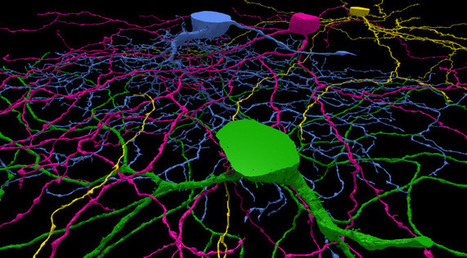
"Understandably, neuroscientists really want to investigate these neurons and synapses to work out how they play such a vital role in our human makeup. Unfortunately, these 100 trillion connections are crammed into a two-pound bag of soggy flesh, making analysis rather hard. At the moment we know that neurons trigger an electrical signal, and that hormones affect the speed at which signals cross between synapses, and that somehow this results in a mental image of a naked Kristen Bell from her Veronica Mars period, but that’s about it. MIT wants to change all that by tasking thousands of people with analyzing a 0.3-millimeter slice of mouse retinal tissue. Using a new site called Eyewire, MIT will ask users to track a neuron’s path by coloring in each axon (tendril). In the future, MIT will roll out another “game” which challenges users to find the synapses. The end result will be the connectome (a tome of connections) of the mouse’s retina."
|
|
|
Scooped by
Gerd Moe-Behrens
April 12, 2012 4:54 PM
|
This is awesome. Launching today is Microryza, a Seattle-based firm that is taking the popular crowd-based fundraising model and is applying it to a critical component of the modern economy: scientific research. Yes, you just might be able to help fund your own Sheldon Cooper now. The platform allows for direct donation to researchers that are working on the things that you care about, allowing you to put your money where your nerdy hunches and passions are. I would fund people looking to figure out if there was ever life on Mars. That’s just me.
|
|
Scooped by
Gerd Moe-Behrens
April 12, 2012 12:22 PM
|
by Rafael Silva-Rocha, Victor de Lorenzo
"Here, we describe a bicistronic reporter system for the analysis of promoter activity in a variety of Gram-negative bacteria at both the population and single-cell levels. This synthetic genetic tool utilizes an artificial operon comprising the gfp and lacZ genes that are assembled in a suicide vector, which is integrated at specific sites within the chromosome of the target bacterium, thereby creating a monocopy reporter system. This tool was instrumental for the complete in vivo characterization of two promoters, Pb and Pc, that drive the expression of the benzoate and catechol degradation pathways, respectively, of the soil bacterium Pseudomonas putida KT2440. The parameterization of these promoters in a population (using β-galactosidase assays) and in single cells (using flow cytometry) was necessary to examine the basic numerical features of these systems, such as the basal and maximal levels and the induction kinetics in response to an inducer (benzoate). Remarkably, GFP afforded a view of the process at a much higher resolution compared with standard lacZ tests; changes in fluorescence faithfully reflected variations in the transcriptional regimes of individual bacteria. The broad host range of the vector/reporter platform is an asset for the characterization of promoters in different bacteria, thereby expanding the diversity of genomic chasses amenable to Synthetic Biology methods."
http://bit.ly/HzC5My
|
|
Scooped by
Gerd Moe-Behrens
April 12, 2012 10:58 AM
|
Synthetic Biology Lab in the Cloud
|
|
Scooped by
Gerd Moe-Behrens
April 11, 2012 5:56 PM
|
Science Gallery & Royal College of Art, London offering a three-day workshop exploring themes of synthetic biology, we…http://t.co/IUVDetS2...
|
|
Scooped by
Gerd Moe-Behrens
April 11, 2012 10:57 AM
|
see also Sharing the Real Synthetic Biology by Zachary Russ "The Internet is a fascinating appliance. The ultimate in far-flung peer-to-peer systems, it allows consumers to double as producers and distributers of content. It's a revolution on par with widespread literacy and the printing press. But the same media that topple dictators and expose wrongdoing can also be used to spread fear, uncertainty, and doubt (FUD). Panic Feeds on FUD FUD—the term—gained popularity in the early days of open-source desktop computing, when companies concerned with their marketshare would spread vague rumors of infringements or security holes in competing free software tools. Ruled by its users, the Internet was partitioned into circles of common interest; sources with a particular bias could be counted on to link to material supporting their viewpoints, and that material was often hosted by a user of a similar persuasion. Free as always, the answers were still out there; but the deluge of information can be daunting when many stories are retweets or reposts or links and so on. What's so wrong with that? Why not let users hang out in their personal echo chambers? If they want the other side of the story, there's always Google. However, Google does not think for you—you need to know the right questions to ask it, and you need the ability to pick out the most relevant (and reliable) pieces of data. It does not discriminate between misinformation and fact, so FUD can hang around for decades, long after it has been thoroughly debunked. It is repeated in these echo chambers until it is dogma and serves to prop up extreme positions. There are precious few occupations that do not draw the ire of some fringe group—firefighters, perhaps. Actually, amend that—volunteer firefighters; as some sites claim the municipal ones are overpaid. Well, you say tomato, I say inferno. So it really comes as no surprise that there are echo chambers devoted to covering synthetic biology misdeeds. It's the same groups who have protested GMOs for decades now, and their perennial reports on the dangers of genetic engineering are akin to the phonebooks once regularly delivered to every doorstep...." http://bit.ly/IXFd4e
|
|
Scooped by
Gerd Moe-Behrens
April 11, 2012 9:55 AM
|
|
|
Scooped by
Gerd Moe-Behrens
April 10, 2012 11:39 AM
|
by Képès F, Jester BC, Lepage T, Rafiei N, Rosu B, Junier I. "Recently the mismatch between our newly acquired capacity to synthetize DNA at genome scale, and our low capacity to design ab initio a functional genome has become conspicuous. This essay gathers a variety of constraints that globally shape natural genomes, with a focus on eubacteria. These constraints originate from chromosome replication (leading/lagging strand asymmetry; gene dosage gradient from origin to terminus; collisions with the transcription complexes), from biased codon usage, from noise control in gene expression, and from genome layout for co-functional genes. On the basis of this analysis, lessons are drawn for full genome design..."
|
|
Scooped by
Gerd Moe-Behrens
April 10, 2012 10:35 AM
|
Tiny particles could manufacture cancer drugs at tumor sites. by
Anne Trafton "Drugs made of protein have shown promise in treating cancer, but they are difficult to deliver because the body usually breaks down proteins before they reach their destination. To get around that obstacle, a team of MIT researchers has developed a new type of nanoparticle that can synthesize proteins on demand. Once these “protein-factory” particles reach their targets, the researchers can turn on protein synthesis by shining ultraviolet light on them. The particles could be used to deliver small proteins that kill cancer cells, and eventually larger proteins such as antibodies that trigger the immune system to destroy tumors, says Avi Schroeder, a postdoc in MIT’s David H. Koch Institute for Integrative Cancer Research and lead author of a paper appearing in the journal NanoLetters. “This is the first proof of concept that you can actually synthesize new compounds from inert starting materials inside the body,” says Schroeder, who works in the labs of Robert Langer, MIT’s David H. Koch Institute Professor, and Daniel Anderson, an associate professor of health sciences and technology and chemical engineering. Langer and Anderson are also authors of the paper, along with former Koch Institute postdocs Michael Goldberg, Christian Kastrup and Christopher Levins...."
|
|
Scooped by
Gerd Moe-Behrens
April 10, 2012 10:16 AM
|
|
|
Scooped by
Gerd Moe-Behrens
April 10, 2012 10:06 AM
|
"Abundance by Peter Diamandis and Steven Kotler argues that technology brings prosperity. How do their predictions of bounty sit with environmentalists' talk of planetary boundaries? A fascinating new book – Abundance by Peter Diamandis and Steven Kotler – suggests we are about to begin an era of unprecedented bounty and human flourishing. The authors have backgrounds in science and innovation (Diamandis is behind the X-Prize and the Singularity University). They argue that coming technological advances – in pervasive digital, nanomaterials and synthetic biology - will allow us to exceed the basic needs of everyone on the planet. In their words, "abundance for all is actually within our grasp". This is, of course, a challenging concept for environmentalists: our science talks of planetary boundaries; our story is one of resource shortages. So, are the Abundance authors just Panglossian techno-optimists, peddling a re-heated Whig interpretation of history?....."
|
|
Scooped by
Gerd Moe-Behrens
April 9, 2012 2:04 PM
|
By Scott Thill "“We’re entering an increasingly dangerous period of our history. But I’m an optimist,” says Stephen Hawking in the exclusive clip above from new documentary Surviving Progress. The theoretical physicist’s balanced perspective is a philosophical template for directors Mathieu Roy and Harold Crooks’ meditative movie, which opens Friday in New York. A brilliant cyborg himself, Hawking is something like living proof of the visually impressive documentary’s existential meditation. Filled with sweeping footage ranging from flaring rockets and swarming schools of fish to pulsing global metropoles and their inhabitants, Surviving Progress asks the question: Can our evolving humanity achieve a moral symbiosis with exponential technological progress? The moviemakers seem intent on making the asking of this question as engrossing as the complicated answers, and the result is an intelligent analysis of humanity at a crucial crossroads, in search of an exit from self-created dystopia. “We always have been the initiators of this experiment; we’ve unleashed it, but we’ve never really controlled it,” author Ronald Wright says in Wired’s second exclusive clip below...."
|
|
Scooped by
Gerd Moe-Behrens
April 8, 2012 4:54 PM
|
by Bruce Sterling "Given the principles of “synthetic biology,” I can see why an attempt to develop this bizarre nano-gizmo makes good solid research sense. A great deal could be learned from this effort. “Synthetic actuators,” “optoelectronic interfaces”… *This effort is sure a new on on me, though. Little teensy robots in the human bloodstream are something of a science-fiction staple, but this “biohybrid” thing is the robotic equivalent of a white blood cell. A thing the size of a cell, as gooey as a cell, that’s a little computer-guided machine made mostly of repurposed cell structures. It has a very Rachel Armstrong feeling about it, somehow. *At least they don’t replicate. By themselves, that is. http://cyberplasm.net/ System_Integration “Cyberplasm integration will be accomplished via a combination of nano/microscale fabrication and matching the synthetic biology with materials development (an iterative process). The body of Cyberplasm will have several functions. Its core will consist of a hydrogel with tunable mechanical properties and a microbial fuel cell. The hydrogel will be modified using microscale patterning of PEI to allow for adhesion of myotubes..."
|