Your new post is loading...

|
Scooped by
Gerd Moe-Behrens
September 8, 2012 7:21 PM
|
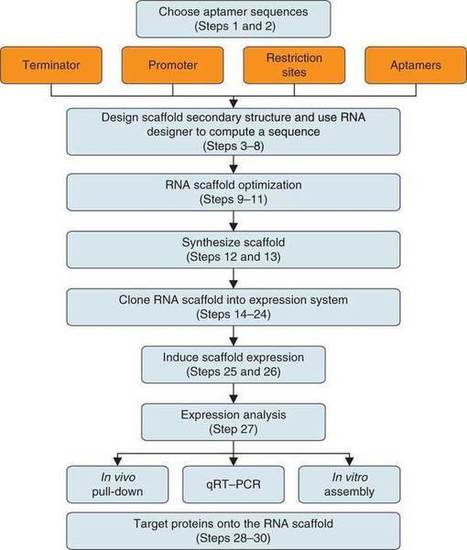
by Delebecque CJ, Silver PA, Lindner AB. "RNA scaffolds are synthetic noncoding RNA molecules with engineered 3D folding harnessed to spatially organize proteins in vivo. Here we provide a protocol to design, express and characterize RNA scaffolds and their cognate proteins within 1 month. The RNA scaffold designs described here are based on either monomeric or multimeric units harboring RNA aptamers as protein docking sites. The scaffolds and proteins are cloned into inducible plasmids and expressed to form functional assemblies. RNA scaffolds find applications in many fields in which in vivo organization of biomolecules is of interest. RNA scaffolds provide extended flexibility compared with DNA or protein scaffolding strategies through programmed modulation of multiple protein stoichiometry and numbers, as well as the proteins' relative distances and spatial orientations. For synthetic biology, RNA scaffolds provide a new platform that can be used to increase yields of sequential metabolic pathways."
http://bit.ly/O3goHC
|
|
Scooped by
Gerd Moe-Behrens
September 7, 2012 7:04 PM
|
by Monica E Ortiz and Drew Endy "Background
Evolution has selected for organisms that benefit from genetically encoded cell-cell communication. Engineers have begun to repurpose elements of natural communication systems to realize programmed pattern formation and coordinate other population-level behaviors. However, existing engineered systems rely on system-specific small molecules to send molecular messages among cells. Thus, the information transmission capacity of current engineered biological communication systems is physically limited by specific biomolecules that are capable of sending only a single message, typically "regulate transcription." Results
We have engineered a cell-cell communication platform using bacteriophage M13 gene products to autonomously package and deliver heterologous DNA messages of varying lengths and encoded functions. We demonstrate the decoupling of messages from a common communication channel via the autonomous transmission of various arbitrary genetic messages. Further, we increase the range of engineered DNA messaging across semisolid media by linking message transmission or receipt to active cellular chemotaxis. Conclusions
We demonstrate decoupling of a communication channel from message transmission within engineered biological systems via the autonomous targeted transduction of user-specified heterologous DNA messages. We also demonstrate that bacteriophage M13 particle production and message transduction occurs among chemotactic bacteria. We use chemotaxis to improve the range of DNA messaging, increasing both transmission distance and communication bit rates relative to existing small molecule-based communication systems. We postulate that integration of different engineered cell-cell communication platforms will allow for more complex spatial programming of dynamic cellular consortia."
http://bit.ly/OgwS4N
|
|
Scooped by
Gerd Moe-Behrens
September 7, 2012 5:32 PM
|
by Juhas M, Eberl L, Church GM. "Essential genes are absolutely required for the survival of any living entity. Investigation of essential genes is therefore expected to advance tremendously our understanding of the universal principles of life. Determination of a minimal set of essential genes needed to sustain life also plays an important role in the emerging field of synthetic biology, whose goals include creation of a stringently controlled minimal cell with predesigned phenotypic traits. In addition, due to their indispensability for survival of bacteria, genes encoding essential cellular functions have great potential in medicine as promising targets for the development of novel antimicrobials. Here, we review recent advances in the investigation of essential genes, with emphasis on the practical applications in medicine and synthetic biology."
|
|
Scooped by
Gerd Moe-Behrens
September 7, 2012 5:11 PM
|
New map provides a reference for interpreting function of disease-associated regions.
|
|
Scooped by
Gerd Moe-Behrens
September 7, 2012 5:01 PM
|
|
|
Scooped by
Gerd Moe-Behrens
September 6, 2012 6:28 PM
|
The Encyclopedia of DNA Elements (ENCODE) project dishes up a hearty banquet of data that illuminate the roles of the functional elements of the human genome.
|
|
Scooped by
Gerd Moe-Behrens
September 6, 2012 5:05 PM
|
Want a big response for your art opening? It might not be a bad idea to put President Obama and Lady Gaga on display.
|
|
Scooped by
Gerd Moe-Behrens
September 6, 2012 4:09 PM
|
by Rodrigo G, Landrain TE, Jaramillo A. "A grand challenge in synthetic biology is to use our current knowledge of RNA science to perform the automatic engineering of completely synthetic sequences encoding functional RNAs in living cells. We report here a fully automated design methodology and experimental validation of synthetic RNA interaction circuits working in a cellular environment. The computational algorithm, based on a physicochemical model, produces novel RNA sequences by exploring the space of possible sequences compatible with predefined structures. We tested our methodology in Escherichia coli by designing several positive riboregulators with diverse structures and interaction models, suggesting that only the energy of formation and the activation energy (free energy barrier to overcome for initiating the hybridization reaction) are sufficient criteria to engineer RNA interaction and regulation in bacteria. The designed sequences exhibit nonsignificant similarity to any known noncoding RNA sequence. Our riboregulatory devices work independently and in combination with transcription regulation to create complex logic circuits. Our results demonstrate that a computational methodology based on first-principles can be used to engineer interacting RNAs with allosteric behavior in living cells." http://bit.ly/Q7CASI
|
|
Scooped by
Gerd Moe-Behrens
September 5, 2012 6:44 PM
|
|
|
Scooped by
Gerd Moe-Behrens
September 5, 2012 6:22 PM
|
ENCODE data describes function of human genome
|
|
Scooped by
Gerd Moe-Behrens
September 5, 2012 6:14 PM
|
|
|
Scooped by
Gerd Moe-Behrens
September 5, 2012 4:57 PM
|
It will be interesting to use such tiny devices in combination with synthetic biological systems..... *Stanford researchers create tiny, wirelessly powered cardiac device* BY ANDREW MYERS "Stanford electrical engineers overturn existing models to demonstrate the feasibility of a millimeter-sized, wirelessly powered cardiac device. The findings, say the researchers, could dramatically alter the scale of medical devices implanted in the human body. A team of engineers at Stanford has demonstrated the feasibility of a super-small, implantable cardiac device that gets its power not from batteries but from radio waves transmitted from a small power device on the surface of the body. The implanted device is contained in a cube just 0.8 millimeter on a side. It could fit on the head of pin. The findings were published in the journal Applied Physics Letters. In their paper, the researchers demonstrated wireless power transfer to a millimeter-sized device implanted 5 centimeters inside the chest on the surface of the heart – a depth once thought out of reach for wireless power transmission. The engineers say the research is a major step toward a day when all implants are driven wirelessly. Beyond the heart, they believe such devices might include swallowable endoscopes – so-called "pillcams" that travel the digestive tract – permanent pacemakers and precision brain stimulators – virtually any medical applications where device size and power matter. A revolution in the body Implantable medical devices in the human body have revolutionized medicine....." http://bit.ly/OUlIO6
|
|
Scooped by
Gerd Moe-Behrens
September 5, 2012 4:36 PM
|
"George Church teases with some ideas he has for achieving physical immortality (indeterminant lifespans) via Synthetic biology. George's idea is to bring in sections of DNA from exotic organisms or genes that are rare for humans to enable all people to have desired genetic capabilities. He describes capabilities such as immunity to all viruses and cellular immunity to radiation and creating immunity to diseases. They are working to sequence and determine the genetic basis for long lived animals and humans and determine how to engineer longer lived people. ...." http://bit.ly/NSzQqi
|
|
|
Scooped by
Gerd Moe-Behrens
September 7, 2012 7:22 PM
|
David Ropeik is an international consultant in risk perception and risk communication, and an Instructor in the Environmental Management Program at the Harvard University Extension School. He is the author of How Risky Is It, Really?
|
|
Scooped by
Gerd Moe-Behrens
September 7, 2012 6:02 PM
|
by
Tom Ran, Yehonatan Douek, Lilach Milo & Ehud Shapiro "An autonomous synthetic programmable device that can diagnose a cell's state according to predefined markers and produce a corresponding therapeutic output may be the basis of future programmable drugs. Motivated to increase diagnosis precision, devices that integrate multiple disease markers have been implemented based on various molecular tools. As simplicity is key to future in-vivo applications, we sought a molecular device that a) integrates multiple inputs without requiring pairwise interactions, and b) harnesses only mechanisms that cells natively use. Here we show a synthetic NOR-based programmable device, operating via a biochemical obstructing approach rather than on a constructive approach, capable of differentiating between prokaryotic cell strains based on their unique expression profile. To demonstrate our system's strengths we further implemented the NOT, OR and AND gates. The device's programmability allows context-dependent selection of the inputs being sensed, and of the expressed output, thus, holding great promise in future biomedical applications." http://bit.ly/Qswizi
|
|
Scooped by
Gerd Moe-Behrens
September 7, 2012 5:16 PM
|
*Fundamentals of Biology now available in open course ware format - MIT* "This Fundamentals of Biology course presents *six outstanding MIT professors* lecturing in their respective specialties. For example, Professor *Eric Lander* — perhaps best known as one of the principal leaders of the Human Genome Project, which mapped the genetic structure and sequence of human DNA — delivers a series of introductory lectures on genetics. The chance to hear each of these professors, many of them recognized as pioneers for their groundbreaking research, deliver course material drawn from their own area of expertise presents a unique opportunity for the independent learner." http://bit.ly/Q9VxUY
|
|
Scooped by
Gerd Moe-Behrens
September 7, 2012 5:06 PM
|
We have published a quiz in order to know what people know and think about Synthetic Biology. Feel free to answer and spread it . If you want to answer it, please click the link that corresponds to...
|
|
Scooped by
Gerd Moe-Behrens
September 7, 2012 4:55 PM
|
|
|
Scooped by
Gerd Moe-Behrens
September 6, 2012 5:12 PM
|
by Gladstone E, Molineux I, Bull J. "BACKGROUND: In prior work, adding a gene to phage T7 that degraded the host K1 capsule facilitated growth when plated on capsulated hosts. However, the transgenic protein (an endosialidase) is expressed as an exoenzyme, released from the cell at lysis but unattached to the phage particle. There is thus the possibility that the gene will be subject to a tragedy of the commons and be selected against, if the enzyme benefits other genomes. Results: This evolutionary perspective was supported in short term experiments. The genome carrying the endosialidase gene was favored on a capsulated host if grown in physical isolation of control genomes (lacking the gene) but was selected against otherwise. Conclusions: These results challenge efforts to engineer phages with exoenzymes that degrade biofilm polymers. If biofilms do not facilitate spatially structured phage growth, the transgenic enzymes may be rapidly eliminated from the phage population after release in the environment, even if the transgene benefits overall phage growth on the biofilm." http://1.usa.gov/RfvnEk
|
|
Scooped by
Gerd Moe-Behrens
September 6, 2012 4:18 PM
|
*The Constructor* www.systemsbiology.nl/the_constructor *a web app optimizing cloning strategies based on modules from the registry of standard biological parts* by
Hesselman MC, Koehorst JJ, Slijkhuis T, Hugenholtz F, Odoni DI, van Passel MW. "Synthetic biology is an emerging field that combines molecular biology with engineering principles, which requires abstraction levels applied to a modular biological componentry. The Registry of Standard Biological Parts harbours such a repository of standardized parts, and thereby facilitates the combination of complex molecular modules to novel genetic circuits and devices. However, since finding the best parts for a pre-determined genetic design can be time consuming, we devised the Constructor, a web tool that recommends the smallest number of cloning steps for pre-designed circuits, and implements user-defined quality checks.We present the Constructor (www.systemsbiology.nl/the_constructor) as a constructive web tool that simplifies the in silico assembly of pre-designed gene circuitries from standard parts, reducing both planning and subsequent cloning time.* http://bit.ly/NOXTwi
|
|
Scooped by
Gerd Moe-Behrens
September 5, 2012 6:56 PM
|
Nature ENCODE: Explore the wealth of information about the project's key findings and numerous integrative analyses.
|
|
Scooped by
Gerd Moe-Behrens
September 5, 2012 6:34 PM
|
A torrent of new data charts the human genome in unprecedented detail, a landmark accomplishment compared by some scientists to the genome’s sequencing in 1999.
|
|
Scooped by
Gerd Moe-Behrens
September 5, 2012 6:21 PM
|
The Encyclopedia of DNA Elements (ENCODE) Consortium is an international collaboration of research groups funded by the National Human Genome Research Institute (NHGRI). The goal of ENCODE is to build a comprehensive parts list of functional elements in the human genome, including elements that act at the protein and RNA levels, and regulatory elements that control cells and circumstances in which a gene is active.
|
|
Scooped by
Gerd Moe-Behrens
September 5, 2012 5:10 PM
|
"Synthetic Biology approaches are catalysing a paradigm shift in genetic manipulation and the engineering of biology. Liberated by rapid, reliable methods for DNA synthesis and assembly, researchers are now able to routinely build synthetic circuits well beyond the scale and complexity of the single gene insertions that characterise the genetically engineered systems of the last forty years. Established design principles, facile assembly from standardised parts and predictable performance have long been the defining features of modern engineering and represent the core goals of Synthetic Biology. Of these, rational and reliable design remains the most challenging problem faced by the synthetic biologist. " http://bit.ly/SkPH8O
|
|
Scooped by
Gerd Moe-Behrens
September 5, 2012 4:42 PM
|
|