"Animal models are very important tools in drug discovery and for understanding human biology in general. However many drugs that initially show promising results in rodents fail in later stages of clinical trials. Understanding the commonalities and differences between human and rat cell signaling networks can lead to better experimental designs, improved allocation of resources and ultimately better drugs.
RESULTS:
The sbv IMPROVER Species-Specific Network Inference challenge was designed to use the power of the crowds to build two species-specific cell signaling networks given phosphoproteomics, transcriptomics and cytokine data generated from NHBE and NRBE cells exposed to various stimuli. A common literature-inspired reference network with 220 nodes and 501 edges was also provided as prior knowledge from which challenge participants could add or remove edges but not nodes. Such a large network inference challenge not based on synthetic simulations but on real data presented unique difficulties in scoring and interpreting the results. Because any prior knowledge about the networks was already provided to the participants for reference, novel ways for scoring and aggregating the results were developed. Two human and rat consensus networks were obtained by combining all the inferred networks. Further analysis showed that major signaling pathways were conserved between the two species with only isolated components diverging, as in the case of ribosomal S6 kinase RPS6KA1. Overall, the consensus between inferred edges was relatively high with the."
The digitization of biology is driving massive disruption in the life sciences field. Human genome sequencing is the single best example of faster, better, c...
"Various approaches are taken to construct synthetic cells in the laboratory, a challenging goal that became experimentally imaginable over the past two decades. The construction of protocells, which explores scenarios of the origin of life, has been the original motivations for such projects. With the advent of the synthetic biology era, bottom-up engineering approaches to synthetic cells are now conceivable. The modular design emerges as the most robust framework to construct a minimal cell from natural molecular components. Although significant advances have been made for each piece making this complex puzzle, the integration of the three fundamental parts, information–metabolism–self-organization, into cell-sized liposomes capable of sustained reproduction has failed so far. Our inability to connect these three elements is also a major limitation in this research area. New methods, such as machine learning coupled to high-throughput techniques, should be exploited to accelerate the cell-free synthesis of complex biochemical systems."
Biology + Engineering = Synthetic Biology (Image Credit: Shutterstock / Tarchyishnik Andrei ) At first glance, the terms ‘synthetic’ and ‘biology’ seem lik
"Genetic devices that directly detect and respond to intracellular concentrations of proteins are important synthetic biology tools, supporting the design of biological systems that target, respond to or alter specific cellular states. Here, we develop ribozyme-based devices that respond to protein ligands in two eukaryotic hosts, yeast and mammalian cells, to regulate the expression of a gene of interest. Our devices allow for both gene-ON and gene-OFF response upon sensing the protein ligand. As part of our design process, we describe an in vitro characterization pipeline for prescreening device designs to identify promising candidates for in vivo testing. The in vivo gene-regulatory activities in the two types of eukaryotic cells correlate with in vitro cleavage activities determined at different physiologically relevant magnesium concentrations. Finally, localization studies with the ligand demonstrate that ribozyme switches respond to ligands present in the nucleus and/or cytoplasm, providing new insight into their mechanism of action. By extending the sensing capabilities of this important class of gene-regulatory device, our work supports the implementation of ribozyme-based devices in applications requiring the detection of protein biomarkers."
by Kayzad Soli Nilgiriwala , José Jiménez , Phillip Michael Rivera , and Domitilla Del Vecchio
"While predictable design of a genetic circuit’s output is a major goal of synthetic biology, it remains a significant challenge because DNA binding sites in the cell affect the concentration of available transcription factors (TF). To mitigate this problem, we propose to use a TF that results from the (reversible) phosphorylation of protein substrate as a circuit’s output. We demonstrate that by comparatively increasing the amounts of substrate and phosphatase, the TF concentration becomes robust to the presence of DNA binding sites and can be kept at a desired value. The circuit’s input/output gain can in turn be tuned by changing the relative amounts of the substrate and phosphatase, realizing an amplifying buffer circuit with tunable gain. In our experiments in E. coli, we employ phospho-NRI as the output TF, phosphorylated by the NRII kinase and dephosphorylated by the NRII phosphatase. Amplifying buffer circuits such as ours could be used to insulate a circuit’s output from the context, bringing synthetic biology one step closer to modular design."
by Christian Pade, Bernd Giese, Stefan Koenigstein, Henning Wigger, Arnim von Gleich
"What distinguishes synthetic biology from earlier approaches in biology and biotechnology? What are future applications that may possibly be realized through synthetic biology? What can be expected from synthetic biology with respect to the benefits it may provide as well as the risks it may pose? This chapter puts forward the idea that these questions, among others that regard the promises and threats of this new and emerging field of science and technology, can be explored by applying the concept of functionality to synthetic-biological structures and systems. Functionality, in this respect, is defined as a certain physicochemical or biological effect that can be brought about by a (synthetic-) biological object. This effect, in turn, has repercussions on the wider systems context the respective object appears in. Looking at the various hierarchical levels of biological life, functionalities that have already been realized through synthetic-biological approaches, as well as those that may be realized through future research and development, are systematically analyzed. Based on this analysis, applications that make use of these functionalities thus far, or may do so in the future, are presented. Furthermore, it is investigated how the functionalities may change the hazardous properties or exposure behavior of the respective structures or systems and thus potentially increase the risk associated with them."
We are the Uppsala iGEM team of 2014. iGEM is a research competition for University students from all over the World, and we are one of Three Swedish Viking ...
"Plants synthesize a huge variety of terpenoid natural products, including photosynthetic pigments, signaling molecules and defensive substances. These are often produced as complex mixtures, presumably shaped by selective pressure over evolutionary timescales, some of which have been found to have pharmaceutical and other industrial uses. Elucidation of the relevant biosynthetic pathways can provide increased access (e.g., via molecular breeding or metabolic engineering), and enable reverse genetic approaches towards understanding the physiological role of these natural products in plants as well. While such information can be obtained via a variety of approaches, this review describes the emerging use of synthetic biology to recombinantly reconstitute plant terpenoid biosynthetic pathways in heterologous host organisms as a functional discovery tool, with a particular focus on incorporation of the historically problematic cytochrome P450 mono-oxygenases. Also falling under the synthetic biology rubric and discussed here is the nascent application of genome-editing tools to probe physiological function."
Dissertation presented to obtain the Master Degree in Molecular, Genetics and Biomedicine
by
Apura, PatrÃcia de Faria Pais
Transcriptional and post-transcriptional control of gene expression dictate the levels of proteins in the cell. Therefore the modulation of gene expression can have important consequences for biotechnological and/or pharmaceutical purposes. Among the types of cellular RNAs, small RNAs (sRNAs) have been an emerging class of bacterial gene expression regulators, which mostly act by base-pairing with one or more mRNA target(s) affecting their translation and/or their stability. Here, we focus on the study of SraL sRNA, more specifically in the validation of putative targets for this sRNA obtained in a previous transcriptomic analysis. Until now SraL was only shown to regulate the mRNA levels of Trigger Factor, an important protein chaperone. The information here reported give strong evidence for SraL involvement in the cysteine biosynthetic pathway, which requires further investigation. Nevertheless, our results could not provide a validation of those putative targets previously obtained by transcriptomic analyses. Optimization of protein expression requires not only an increase of the stability of mRNA transcripts but also an optimal behavior of function-encoding DNA segments, which are often context-dependent. Building on the work of others, we have designed a set of combinatorial promoters and 5’UTRs and evaluated their effects/outcomes using Superfolder GFP as reporter. Our data shows a clear variability of protein levels within our set of constructs. The highest levels of protein were associated with the implementation of an insulation sequence flanking the promoter region and the introduction of 5’ stabilizing structures at the mRNA level. Further investigation concerning the alteration of the rate of the mRNA decay by depletion of the function of participating nucleases, might constitute an advantageous approach. The knowledge collected will be extremely important to design robust modules which substantially increase protein production. This field is rapidly growing and much remains to be discovered about these important regulatory processes.
by Pablo Cárdenas, Maaruthy Yelleswarapu, Sayane Shome, Jitendra Kumar Gupta, Eugenio Maria Battaglia, Pedro Fernandes, Alioune Ngom, and Gerd Moe-Behrens
"As we move deeper into the digital age, the social praxis of science undergoes fundamental changes, driven by new tools provided by information and communication technologies. Specifically, social networks and computing resources such as online cloud-based infrastructures and applications provide the necessary context for unprecedented innovations in modern science. These tools are leading to a planetary-scale connectivity among researchers and enable the organization of in silico research activities entirely through the cloud.
Research collaboration and management via the cloud will result in a drastic expansion of our problem-solving capacity, since groups of people with different backgrounds and expertise that openly gather around common interests are more likely to succeed at solving complex problems. Another advantage is that collaboration between individuals becomes possible regardless of their geographic location and background.
Here we present a novel, open-web application called Leukippos, which aims to apply these information and communication technologies to in silico synthetic biology projects. We describe both the underlying technology and organizational structure necessary for the platform’s operation. The synthetic biology software search engine, SynBioAppSelector, and the game, SynBrick, are examples of projects being developed on this platform."
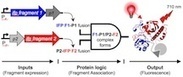
Rice University scientists have developed a plug-and-play approach to detect interactions between proteins. Their split fluorescent proteins could greatly improve understanding of basic biological functions.
Synthetic biology has emerged at the interface between life sciences and engineering. This has a resulted in a cultural divide regarding the status of intellectual property.
by Philip D. Howes, Rona Chandrawati, Molly M. Stevens
"Nanoparticle biosensors have the potential to enhance or supersede current analytical techniques, and their introduction could have a great impact in research and clinical practice. The unique optical properties of many nanomaterials make them ideal for biosensing. Colloidal fluorescent and plasmonic nanoparticles are particularly interesting, as they produce intense responses to incident light, and linking this response to the presence of a target analyte yields extremely sensitive detection in solution."
"A research breakthrough has identified a way to charge tiny health-tracking devices that could be embedded in our brains, hearts or livers.
New wireless charging technique developed at Stanford University could enable embeddable sensors, pacemakers and nerve stimulators
A breakthrough in wireless technology could allow a new wave of health tracking tools that can be embedded inside our bodies – in our livers, hearts and even in our brains.
A new wireless charging technique known as “mid-field wireless transfer” can deliver power to tiny electronic devices such as sensors, pacemakers and nerve stimulators embedded deep within the body. They can be charged using a device the size of a credit card placed outside the body.
"With this method, we can safely transmit power to tiny implants in organs like the heart or brain, well beyond the range of current near-field systems,” said Dr John Ho, co-author of the study that appears in the Proceedings of the National Academy of Sciences.
‘Make these devices as small as possible’
Sensors can be embedded deeper into the right areas of the body, without needing to be close to the skin for current near-field wireless charging technologies like those that charge electric toothbrushes. The embedded devices will also no longer need large, bulky batteries, which means it is possible for them to fit into tighter, more sensitive spaces.
“We need to make these devices as small as possible to more easily implant them deep in the body and create new ways to treat illness and alleviate pain," explained Professor Ada Poon, lead researcher behind the new technique in a press release......"
by Diego Barcena MenendezVivek Raj Senthivel Mark Isalan
+Sender–receiver (S–R) systems abound in biology, with communication systems sending information in various forms. Information theory provides a quantitative basis for analysing these processes and is being applied to study natural genetic, enzymatic and neural networks. Recent advances in synthetic biology are providing us with a wealth of artificial S–R systems, giving us quantitative control over networks with a finite number of well-characterised components. Combining the two approaches can help to predict how to maximise signalling robustness, and will allow us to make increasingly complex biological computers. Ultimately, pushing the boundaries of synthetic biology will require moving beyond engineering the flow of information and towards building more sophisticated circuits that interpret biological meaning."
In October 2013, Greg Gage and Tim Marzullo unveiled a cyborg cockroach that could be controlled from a smartphone through electrodes attached to its antennae and a wireless unit on its back. Imagine in the coming years what would happen if we are able to go much smaller and nanoscale computing devices could be integrated with individual bacteria. And what if these hybrid devices could be designed to control colonies of bacteria? Of course a big problem could be powering such devices, but bacteria based batteries are already a reality.
So should we allow this living technology to develop and be autonomous? If it was possible, then the extension of "the internet of things" to "the internet of biology" e.g., bacteria, molds, plants and crops should also be possible -- in fact all living things could be networked and online. An online connection could enable living systems to be controlled by software allowing bioware "apps" to add functionality beyond that allowed by biology.
What if the bacteria connected online could be turned into sophisticated swarms with collective intelligence spread over many miles, vastly exceeding the primitive-by-comparison biological sensing? What if the synthesis of bacteria and silicon-powered intelligence gave rise to a new symbiotic life form? I would imagine that these swarms could be used to remove pollutants, sent out to sense the environment, even monitor the emergence of new viruses in the wild. Perhaps even more exciting could be the direct control of the machinery within the cells. Enter the realm of cybernetic synthetic biology.
What exactly is cybernetic synthetic biology? From my point of view I see this as the integration of biological organisms with small silicon-based computing devices and I've been pondering this concept -- as well as the consequences -- for around 12 months. In my own scientific work I am interested in understanding the chemical origin of life, creating new life forms, and investigating new ways of controlling chemistry and biochemistry. The taming of existing life forms using silicon seems extremely attractive, albeit a few decades off (although some would argue that silicon, such as in the form of smart phones, is already controlling us through social media and messaging).
Although the internet of biology seems rather outlandish, I really think it might be very interesting to anticipate what the consequences of such a technology could be. Could a responsible approach explaining the potential wins, wonders, and pitfalls be used to educate the public and policy makers? This would also give scientists and technology developers time to think about the implementation as well as debate possible safety measures.
We are now entering a time of research developments, technological innovation and policy development where it is not only possible to peer review scientific ideas, but also to discuss possible consequences before the work is done. Could such a discussion not only focus on the merits of the science in question, feasibility and value for money, but also the impact of success on society as a whole? This approach is not without risks. Preventing science that generates anxiety could inhibit chance discoveries that is the very essence of blue-sky thinking. Of course we need to responsibly discuss the risks, as well as address the fears say of unleashing the god-particle equivalent of black hole that swallows the Earth, or perhaps a bioweapon that can be remotely programmed by their masters to lie silent and then unleash all manner of terror.
However, I feel that this is unlikely, and scientists have a duty to push the boundaries -- and in this case redefine how the fusion of technology and living systems will shape the future. A serious debate is needed. A future where biology and computers are integrated poses significant questions, especially if native living things are replaced by a new technology. It may be that the future for human kind will be as hybrid biological-robots. I guess we'd better start discussing this now.
To get content containing either thought or leadership enter:
To get content containing both thought and leadership enter:
To get content containing the expression thought leadership enter:
You can enter several keywords and you can refine them whenever you want. Our suggestion engine uses more signals but entering a few keywords here will rapidly give you great content to curate.


 Your new post is loading...


 Scoop.it!