Membrane Computing was introduced as a computational paradigm in Natural Computing. The models introduced, called Membrane (or P) Systems, provide a coherent platform to describe and study l
"Researchers would like to place very small implants deep inside our bodies to monitor health or treat pain. But providing electric power to implants without wires or batteries has been a big obstacle.
Now, engineers are developing a way to send power—safely and wirelessly—to “smart chips” programmed to perform medical tasks and report back the results.
The approach involves beaming ultrasound at a tiny device inside the body designed to do three things: convert the incoming sound waves into electricity, process and execute medical commands, and report the completed activity via a tiny built-in radio antenna.
“We think this will enable researchers to develop a new generation of tiny implants designed for a wide array of medical applications,” says Amin Arbabian, assistant professor of electrical engineering at Stanford University.
Arbabian’s team recently presented a working prototype of this wireless medical implant system at the IEEE Custom Integrated Circuits Conference in San Jose, California.
TINY, WIRELESS NODES
The researchers chose ultrasound to deliver wireless power to their medical implants because it has been safely used in many applications, such as fetal imaging, and can provide sufficient power to implants a millimeter or less in size.
Now, Arbabian and his colleagues are collaborating with other researchers to develop sound-powered implants for a variety of medical applications, including studying the nervous system and treating the symptoms of Parkinson’s disease.
“Tiny, wireless nodes such as these have the potential to become a key tool for addressing neurological disorders,” says Florian Solzbacher, professor of electrical and computer engineering at University of Utah and director of its Center for Engineering Innovation.
POWERED BY PIEZOELECTRICITY
The implant chip is powered by piezoelectricity, which is electricity caused by pressure....."
How do you transform mushrooms into furniture, or re-wire algae to conduct electricity? Biohacking, the practice of rewiring the biology of living organisms ...
ACS Synthetic Biology is progressively rapidly gaining traction in the synthetic biology community as a journal of choice for publishing papers relevant to our community.
The research is part of a new DARPA program called Folded Non-Natural Polymers with Biological Function (Fold F(x)), which plans to use synthetic polymers to ad
"Transient delivery of gene circuits is required in many potential applications of synthetic biology, yet the pre-steady-state processes that dominate this delivery route pose major challenges for robust circuit deployment. Here we show that site-specific recombinases can rectify undesired effects by programmable timing of gene availability in multigene circuits. We exemplify the concept with a proportional sensor for endogenous microRNA (miRNA) and show a marked reduction in its ground state leakage due to desynchronization of the circuit's repressor components and their repression target. The new sensors display a dynamic range of up to 1,000-fold compared to 20-fold in the standard configuration. We applied the approach to classify cell types on the basis of miRNA expression profile and measured >200-fold output differential between positively and negatively identified cells. We also showed major improvements in specificity with cytotoxic output. Our study opens new venues in gene circuit design via judicious temporal control of circuits' genetic makeup."
"We have taken a rational approach to redesigning the amino acid binding and aminoacyl-tRNA pairing specificities of bacterial glutaminyl-tRNA synthetase. The four-stage engineering incorporates generalizable design principles and improves the pairing efficiency of noncognate glutamate with tRNAGln by over 105-fold compared to the wild-type enzyme. Better optimized designs of the protein-RNA complex include substantial reengineering of the globular core region of the tRNA, demonstrating a role for specific tRNA nucleotides in specifying the identity of the genetically encoded amino acid. Principles emerging from this engineering effort open new prospects for combining rational and genetic selection approaches to design novel aminoacyl-tRNA synthetases that ligate noncanonical amino acids onto tRNAs. This will facilitate reconstruction of the cellular translation apparatus for applications in synthetic biology."
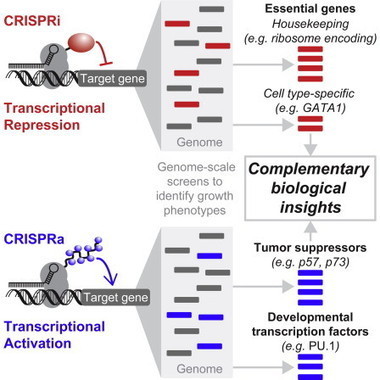
"While the catalog of mammalian transcripts and their expression levels in different cell types and disease states is rapidly expanding, our understanding of transcript function lags behind. We present a robust technology enabling systematic investigation of the cellular consequences of repressing or inducing individual transcripts. We identify rules for specific targeting of transcriptional repressors (CRISPRi), typically achieving 90%-99% knockdown with minimal off-target effects, and activators (CRISPRa) to endogenous genes via endonuclease-deficient Cas9. Together they enable modulation of gene expression over a ∼1,000-fold range. Using these rules, we construct genome-scale CRISPRi and CRISPRa libraries, each of which we validate with two pooled screens. Growth-based screens identify essential genes, tumor suppressors, and regulators of differentiation. Screens for sensitivity to a cholera-diphtheria toxin provide broad insights into the mechanisms of pathogen entry, retrotranslocation and toxicity. Our results establish CRISPRi and CRISPRa as powerful tools that provide rich and complementary information for mapping complex pathways."
"Synthetic cellular logic gates are primarily built from gene circuits owing to their inherent modularity. Single proteins can also possess logic gate functions and offer the potential to be simpler, quicker, and less dependent on cellular resources than gene circuits. However, the design of protein logic gates that are modular and integrate with other cellular components is a considerable challenge. As a step toward addressing this challenge, we describe the design, construction, and characterization of AND, ORN, and YES logic gates built by introducing disulfide bonds into RG13, a fusion of maltose binding protein and TEM-1 β-lactamase for which maltose is an allosteric activator of enzyme activity. We rationally designed these disulfide bonds to manipulate RG13’s allosteric regulation mechanism such that the gating had maltose and reducing agents as input signals, and the gates could be toggled between different gating functions using redox agents, although some gates performed sub optimally."
by Wen Xue,Sidi Chen,Hao Yin,Tuomas Tammela,Thales Papagiannakopoulos,Nikhil S. Joshi, Wenxin Cai,Gillian Yang,Roderick Bronson,Denise G. Crowley,Feng Zhang,Daniel G. Anderson,Phillip A. Sharp& Tyler Jacks
"The study of cancer genes in mouse models has traditionally relied on genetically-engineered strains made via transgenesis or gene targeting in embryonic stem cells1. Here we describe a new method of cancer model generation using the CRISPR/Cas (clustered regularly interspaced short palindromic repeats/CRISPR-associated proteins) system in vivo in wild-type mice. We used hydrodynamic injection to deliver a CRISPR plasmid DNA expressing Cas9 and single guide RNAs (sgRNAs)2, 3, 4 to the liver that directly target the tumour suppressor genes Pten (ref. 5) and p53 (also known as TP53 and Trp53) (ref. 6), alone and in combination. CRISPR-mediated Pten mutation led to elevated Akt phosphorylation and lipid accumulation in hepatocytes, phenocopying the effects of deletion of the gene using Cre–LoxP technology7, 8. Simultaneous targeting of Pten and p53 induced liver tumours that mimicked those caused by Cre–loxP-mediated deletion of Pten and p53. DNA sequencing of liver and tumour tissue revealed insertion or deletion mutations of the tumour suppressor genes, including bi-allelic mutations of both Pten and p53 in tumours. Furthermore, co-injection of Cas9 plasmids harbouring sgRNAs targeting the β-catenin gene and a single-stranded DNA oligonucleotide donor carrying activating point mutations led to the generation of hepatocytes with nuclear localization of β-catenin. This study demonstrates the feasibility of direct mutation of tumour suppressor genes and oncogenes in the liver using the CRISPR/Cas system, which presents a new avenue for rapid development of liver cancer models and functional genomics."
by Nithya Srinivasan,Maniraj Bhagawati,Badriprasad Ananthanarayanan& Sanjay Kumar
"Grafting polymers onto surfaces at high density to yield polymer brush coatings is a widely employed strategy to reduce biofouling and interfacial friction. These brushes almost universally feature synthetic polymers, which are often heterogeneous and do not readily allow incorporation of chemical functionalities at precise sites along the constituent chains. To complement these synthetic systems, we introduce a biomimetic, recombinant intrinsically disordered protein that can assemble into an environment-sensitive brush. This macromolecule adopts an extended conformation and can be grafted to solid supports to form oriented protein brushes that swell and collapse dramatically with changes in solution pH and ionic strength. We illustrate the value of sequence specificity by using proteases with mutually orthogonal recognition sites to modulate brush height in situ to predictable values. This study demonstrates that stimuli-responsive brushes can be fabricated from proteins and introduces them as a new class of smart biomaterial building blocks."
Advances in DNA synthesis have enabled the construction of artificial genes, gene circuits, and genomes of bacterial scale. Freedom in de-novo design of synthetic constructs provides significant power in studying the impact of mutations in sequence features, and verifying hypotheses on the functional information that is encoded in nucleic and amino acids. To aid this goal, a large number of software tools of variable sophistication have been implemented, enabling the design of synthetic genes for sequence optimization based on rationally defined properties. The first generation of tools dealt predominantly with singular objectives such as codon usage optimization and unique restriction site incorporation. Recent years have seen the emergence of sequence design tools that aim to evolve sequences toward combinations of objectives. The design of optimal protein coding sequences adhering to multiple objectives is computationally hard, and most tools rely on heuristics to sample the vast sequence design space. In this review we study some of the algorithmic issues behind gene optimization and the approaches that different tools have adopted to redesign genes and optimize desired coding features. We utilize test cases to demonstrate the efficiency of each approach, as well as identify their strengths and limitations.
Y Combinator, which set off a whirlwind of skeptical commentary when it opened its highly ranked tech accelerator program to biotechnology startups last sp
The technology industry has fought bitterly over patents and other property rights in recent years. Could the fast-moving changes brought on by new kinds of technology make those fights less important?
I recently started listening to podcasts by the Long Now Foundation, which is their monthly recorded lecture series. They've all been really good. However, this month's talk on Massively collaborat...
"Ability to produce embryonic stem cells will allow researchers to push faster toward cure
arvard stem cell researchers announced today that they have made a giant leap forward in the quest to find a truly effective treatment for type 1 diabetes, a disease that affects an estimated 3 million Americans at a cost of about $15 billion annually.
With human embryonic stem cells as a starting point, the scientists were for the first time able to produce, in the kind of massive quantities needed for cell transplantation and pharmaceutical purposes, human insulin-producing beta cells equivalent in most every way to normally functioning beta cells.
Doug Melton, who led the work, said he hopes to have human transplantation trials using the cells under way within a few years. Twenty-three years ago, when his infant son Sam was diagnosed with type 1 diabetes, Melton dedicated his career to finding a cure for the disease.
“We are now just one preclinical step away from the finish line,” said Melton, whose daughter Emma also has type 1 diabetes.
A report on the new work is being published today by the journal Cell."
by Lara Bereza-Malcolm , Gulay Mann , and Ashley Edwin Franks
"Whole cell microbial biosensors are offering an alternative means for rapid, on-site heavy metal detection. Based in microorganisms, biosensing constructs are designed and constructed to produce both qualitative and quantitative outputs in response to heavy metal ions. Previous microbial biosensors designs are focused on single-input constructs; however development of multiplexed systems is resulting in more flexible designs. The movement of microbial biosensors from laboratory based designs towards on-site, functioning heavy metal detectors has been hindered by the toxic nature of heavy metals, along with the lack of specificity of heavy metals promoter elements. Applying a synthetic biology approach with alternative microbial chassis may increase the robustness of microbial biosensors and mitigate these issues. Before full applications are achieved, further consideration has to be made regarding the risk and regulations of whole cell microbial biosensor use in the environment. To this end, a standard framework for future whole cell microbial biosensor design and use is proposed."
To get content containing either thought or leadership enter:
To get content containing both thought and leadership enter:
To get content containing the expression thought leadership enter:
You can enter several keywords and you can refine them whenever you want. Our suggestion engine uses more signals but entering a few keywords here will rapidly give you great content to curate.