The debates around STEM v STEAM are plentiful - many STEM advocates disconnect STEM content from meaningful and engaging contexts; seemingly forgetting about active and inquiry focussed pedagogies that can only operate well in a rich integrated ecosystem. We advocate for STEM+ and the "+" is essential.
In this tutorial, we are building a simple 4-bit computer capable of addition, subtraction, data retrieval and data storage. We learn how to arrange the boards and connect them with power, data and control wires.
We program the B4 by entering data into the Data RAM and control instructions (the program code) into the Program RAM. For both, we use the Manual Programmer.
Step by step, we then walk through the code and observe how it operates inside the machine.
Bradley County Schools may soon be offering health science as an elective in both of its middle schools. The agenda for the Bradley County Board of Education’s meeting at 5:30 this evening includes a vote which would allow for the introduction of health science at Ocoee Middle School and Lake Forest Middle School. “We would like to explore offering more courses at the middle school level,” said Arlette Robinson, Career and Technical Education coordinator for the school system. “We have all these career clusters in the high schools but not as much for middle school.”
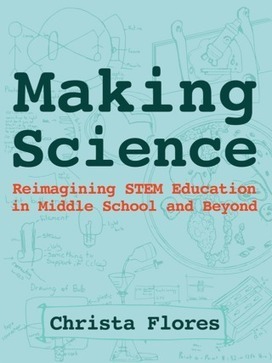
Excerpted from Making Science: Reimagining STEM Education in Middle School and Beyond by Christa Flores, published in 2016 by Constructing Modern Knowledge Press.
By Christa Flores
“How do research and design relate to each other? (…) Both activities produce knowledge, but of different kinds. (…) So, on the one hand, design is not a science in its own right, but draws on technical and scientific insights as well as artistic skill and ability. On the other hand design, although not a science, can be the object of systematic research.” — Christian Gänshirt, Tools for Ideas Design is an artistic endeavor that values the creative and human centered application of math, science and technology. Using design to help others learn science is not intuitive, however, once practiced you will see how humanistic and authentic it is to incorporate design in any subject. Below is a list of the most promising benefits that I have noticed in the past six years for using design as a framework and making as the engine to empower students as they gain and apply their scientific literacy.
Since experimenting with “Genius Hour and 20% Time” in my class a few years ago, I’ve been fascinated by the research and history of this practice in education and the business world. This has led me down a long road to eventually writing Inquiry & Innovation in the Classroom (published by Routledge) on inquiry-driven education and choice-based learning experiences.
During that time I’ve had hundreds of conversations with fellow teachers practicing choice-based and inquiry-driven learning in some way shape or form (Genius Hour, 20% Time, Passion Projects, Choose2Matter etc). Lately, through the book-writing process I’ve had some more in-depth interviews about inquiry-based education, and I’ve spent a great deal of time researching the beginnings and reasons behind Genius Hour’s effectiveness.
NEW! A free Printable LEGO challenge calendar to use anytime during the year. Print it out, hang it up, give it to your kids. Feel inspired and taking your LEGO building time in a new direction. I have written out 31 Days of fun LEGO ideas using the bricks you have and hopefully thinking of new ways to use some of those specialty pieces that don’t see much action. We love kid’s LEGO activities!
Using this history of projects built on passions, in community and with a playful spirit, the Scratch team is gearing up to release a new version of Scratch. They’re integrating feedback from educators and users by making teacher accounts, learning resources, in-person communities and several new features to the actual program.
The new version of Scratch is being designed to work on mobile devices, so it will be lighter and more flexible. The developers are redesigning the blocks to be more finger-friendly and to look more horizontal, akin to the Scratch Jr. blocks, which can be used for the lighter, smaller projects likely to be created on a mobile device.
The team is also working on a way to integrate the physical world with Scratch using what they’re currently calling a “Scratch Pad,” but whose name could change. Its design is intentionally minimal, just a small round object with a knob, a button, a slot and sensors inside.
Earth’s molten core and the lost city of Atlantis are not traditional summer destinations for kids, but intrepid young campers can now contend with lava or rebuild the underwater metropolis as they learn, play and socialize in the digital realms of virtual camps.
California-based Connected Camps is part of a growing offering of online camps that fill a unique niche to complement their traditional pine-and-mortar counterparts. Accessible across the U.S. and around the world, the camp offers programs in engineering, architecture, coding, animation, game design and storytelling, all hosted on custom Minecraft servers or delivered with MIT’s Scratch coding software. Each weeklong program connects kids with fellow campers and expert mentors who support the participants and share their expertise.
“We meet kids where they are, where they’re already engaged with social and interest-driven learning,” said Mimi Ito, a co-founder of Connected Camps and a cultural anthropologist whose research focuses on how young people engage with digital media. “If you’re already messing around with redstone in Minecraft, this is a pathway for you to learn circuitry and get interested in engineering.”
If you like this post, check out: Cheat Sheet of Machine Learning and Python (and Math) Cheat Sheets While machine learning has a rich history dating back to 1959, the field is evolving at an…
Just like an elite athlete in the midst of rigorous training, Sydney school girl Ada Fang is preparing intensely to represent Australia, but she’s studying equations and poring over atoms, elements and compounds. Ada, who’s in Year 12 at Sydney Girls High School, is one of 27 Aussie students prepping and packing before they test their skills against 2,000 of the world’s top students in biology, chemistry, earth science, informatics, mathematics and physics. The 27 students succeeded against a pool of more than 25,000 applicants in extension programs and qualifying exams across the country to make it to the final cut for the UNESCO International Science and Mathematical Olympiads.
A University of Canberra research project has found a way to develop a year’s worth of mathematics skills in just three weeks for primary school students.
The preliminary findings from the project, which was a collaboration between the university’s STEM Education Research Centre (SERC) and tech giant Samsung Australia, were presented Wednesday at Parliament House in Canberra.
The research provided a group of year 5 and 6 pupils in 20 Canberra and Goulburn Catholic schools with software and hardware to take them through a spatial reasoning program, which developed the students’ ability to “locate, orientate and visualise objects”, decode infographics, and create and interpret diagrams.
After three weeks, the group was tested and compared to children that went through traditional classroom teaching. The outcome was that students that went through the spatial reasoning program showed improvements in maths skills that usually only develop over a full year.
Girl Scouts will soon be ready to take over your IT department.
The organization is teaming up with Palo Alto Networks, an internet security company, to introduce a set of new badges to promote computer and internet literacy and cybersecurity. The initiative aims to foster educational programs across all ages of the Girl Scouts, with a major emphasis on providing access to girls who might otherwise never be exposed to the field.
The 18 new badges will be available to Girl Scouts across the US starting in September 2018.
I endeavour to be as accurate as possible in my videos, but I am human and definitely don’t know everything, so there are sometimes mistakes. Also, due to the nature of my videos, there are bound to be oversimplifications. Some of these are intentional because I don’t have time to go into full detail, but sometimes they are unintentional and here is where I clear them up.
1. “Isaac Newton invented calculus.” Actually there is controversy over who invented calculus first Isaac Newton or Gottfried Leibniz. Regardless of who it was I have used Leibniz’s mathematical notation here and so he definitely deserves credit. I did’t know about all this so thanks to those who pointed it out. https://en.wikipedia.org/wiki/Leibniz... 2. “Maxwell derived the laws of electromagnetism.” This is a simplification as Maxwell’s work was built on the backs of other scientists like Hans Christian Ørsted, André-Marie Ampère and Michael Faraday who discovered induction and saw that electricity and magnetism were part of the same thing. But it was Maxwell who worked out all the maths and brought electricity and magnetism together into a unified theory. https://en.wikipedia.org/wiki/Electro... 3. “Entropy is a measure of order and disorder”. This is also a simplification and this does a good job of explaining it better https://en.wikipedia.org/wiki/Entropy 4. Einstein and Quantum physics: I made it sound like quantum physics was built by people other than Einstein, but this couldn’t be further from the truth. Einstein got a Nobel prize for his work on the photoelectric effect which was a key result to show the particle-like nature of light. Funnily enough he never got a nobel prize for his work on Relativity!
Also, if you enjoyed this video, you will probably like my science books, available in all good books shops around the work and is printed in 16 languages. Links are below or just search for Professor Astro Cat. They are fun children's books aimed at the age range 7-12. But they are also a hit with adults who want good explanations of science. The books have won awards and the app won a Webby.
Many school districts struggle with how to expand students’ interest, excitement, and achievement in STEM. Without the right approach, however, the result is often random acts of STEM that do little to show students how fascinating or relevant these subjects really are. Unlike the science and math classes of yesteryear, STEM is not about reading from textbooks or memorizing facts and formulas. STEM is about doing. It’s about helping students to develop a deep understanding of science, technology, engineering and mathematics, and giving them ample opportunities to apply that learning. Creativity, communication, and innovation are essential pillars of this journey. Here are a few of the strategies we’ve implemented to give students hands-on, inquiry-based STEM learning experiences that are preparing them for college and careers.
How can you make a cardboard owl that flaps its wings? Or a paper flower that blooms? With funding from the National Science Foundation, we are working with the University of Colorado’s Craft Technology Lab and the Children’s Creativity Museum in San Francisco to study and enhance the engineering education potential of Paper Mechatronics, an innovative educational technology genre that mixes creative papercrafts, mechanical design, and computational thinking. Soon, young learners will be designing real and fantastical paper inventions of their own imagination and animate them with mechanical motions.
The new two-year project builds off an earlier project by Principal Investigators Sherry Hsi and Michael Eisenberg, which prototyped several Paper Mechatronics design projects, organized activity formats, and piloted the various design elements with children and adults to determine which worked best to inspire learning and teach design. These included a custom software design tool, simple hardware modules, cardboard electronics, sample workshop formats, and project ideas. Early Paper Mechatronics activities—from a percussion workshop to a cereal hackathon and a Robot Petting Zoo—showed encouraging results with after school youth (ages 12-18) and museum visitors.
"Welcome to The STEAM Journal, a transdisciplinary, international, theory-practice, peer-reviewed, academic, open access, online journal with a focus on the intersection of the sciences and the arts. The STEAM Journal integrates perspectives from a variety of contexts and fields....
"This publication features the bridges between Science, Technology, Engineering Mathematics (STEM) and the Arts. In this context, the journal acts as a forum for open dialogue of STEAM as well as expanding the body of transdisciplinary knowledge. The STEAM Journal is a hub for scholars and practitioners of many disciplines who wish to provide commentary, exchange ideas and inform policy and practice of STEAM.
"Although there is a long history of the interaction of the sciences with the arts, STEAM is a new acronym that has emerged over the last decade and has a multitude of definitions and approaches. Some of the main themes of STEAM are fostering innovation, the need for twenty-first century skills, and divergent and convergent thinking. The STEAM Journal welcomes a diverse dialogue on the many aspects of STEAM."
Jim Lerman's insight:
This is quite an interesting FREE ejournal. So far (summer 2017) there have been four issues. Numerous excellent articles and also fascinating artwork. Many of the articles deal with creativity.
Kelly Lovell is a G20 Youth Entrepreneurship Alliance delegate.
The third grade was an exciting time for me. I remember the dedicated class time learning how to cursive write and when my homework was to fill up an entire page with the same letters over and over. I know this may seemingly date me, but the truth is that I'm still part of the under-25 generation – this is simply the rapid pace at which our world is changing.
Peers only a few years younger than me have already had dramatically different learning experiences. We live in an era of connected classrooms, online modules, and tablets in the hands of toddlers. These drastic changes to the education system are resulting in equally dramatic shifts to the work force, which brings us to the critical question for educators, parents and professionals alike: What are the new skills needed to penetrate the labour market?
This is my third summer offering maker education summer camps as part of a bigger program at a local school. During mornings (9 to 12 with a half hour recess), campers, grades Kindergarten through 6th grade, can choose from one of four enrichment classes: art, drama, games, foreign languages, computers, and in my case, maker camps. During the afternoons, all campers get together for typical camp activities – fun and games, field trips, water sports, silly competitions. Each camp lasts a week. This summer I am offering: Cardboard Creations, Circuit Crafts, Toy Making and Hacking, and Robotics and Coding.
ExploreLearning Gizmos provides over 400 math and science online simulations that power inquiry and understanding. It has a free Gizmos account available for science and math educators with a curated collection of Gizmos that change every January/July. Aligned to NGSS and state standards, each Gizmo comes with teacher guides and customizable lesson materials to help teachers and students delve deeper into the material.
Some of the major features of Gizmos include: interactive design which allows for extensive manipulation of variables and ‘what-if’ experimentation; visualizations and graphing tools help capture and compare results from experiments; in-depth activities create more moments to explore, discover and apply new concepts. Watch the video below to learn more about Gizmos.
The same can often be said for managers who hire employees who are just like them. This is a result of the mere-exposure effect, whereby people tend to be attracted to what they’re familiar with. Sally Ride, the first American woman in space, bluntly explained how this can disadvantage women in STEM. “So in the hiring process if you have a department of 20 males, they tend to hire males,” Ride said.
The solution? More women at science’s top. A 2015 UNESCO study supports this assertion. It found that there is, “a lack of female role models in STEM, which can…affect young women’s choices for…study and their future careers in STEM fields”.
STEM is one discussion that won’t disappear from the nation’s agenda for a while and there’s good reason for it. It’s generally understood that our students are leaving school without strong enough foundations in science and mathematics, or STEM skills more generally. This is an issue relevant to business, community and educators and we all have a responsibility to contribute to solutions. There are countless examples of industry leading work in STEM skill development in Australia and around the world, while strong outcomes may be delivered, programs built on evidence-based insights and evaluated against educational objectives need to take priority. Put simply, more attention is required to determine what a successful STEM program should deliver and what best-practice actually looks like in an Australian context.
The debate over STEM vs. STEAM perfectly sums up the dilemma educators face. Proponents of integrating the arts and sciences often face stiff opposition from within a deeply siloed education system, even as employers clamor for workers who can think and work across multiple disciplines.
But such discourse “only marks the beginning of what needs to happen in education,” says John M. Eger, director of the Creative Economy Initiative at San Diego State University. The STEM and STEAM acronyms, he adds, are merely placeholders for the need to eliminate silos in education and focus on interdisciplinary learning.
“Eventually,” he says, “all subjects need to be integrated.”
Almost two years ago, Spanish filmmaker Cristóbal Vila shot an exquisite little film, Nature by Numbers, which captured the ways in which mathematical concepts (Fibonacci Sequence, Golden Number, etc.) reveal themselves in nature. And the short then clocked a good 2.1 million views on YouTube alone.
This week, Vila returns with a new film called Inspirations. In this case, the inspiration is M.C. Escher (1898-1972), the Dutch artist who explored a wide range of mathematical ideas with his woodcuts, lithographs, and mezzotints. Although Escher had no formal training in mathematics beyond secondary school, many mathematicians counted themselves as admirers of his work. (Visit this online gallery to get better acquainted with Escher's art, and be sure to click on the thumbnails to enlarge the images). As Vila explains, Inspirations tries to imagine Escher's workplace, "what things would surround an artist like him, so deeply interested in science in general and mathematics in particular." It's a three minutes of unbridled imagination.
“Wonder Woman’s strength is more relevant today than ever, especially in the technology space, since girls are less likely than boys to be encouraged to pursue computer science and only 22 percent of gaming developers are women,” Google Play’s Mathilde Cohen Solal wrote in a blog post. Made with Code, Google’s initiative to champion the next generation of female leaders and inspire them to see coding as a way to pursue their dreams, released an interactive coding project for teen girls to add coding to their superpower toolkit.
The project, presented in the form of a game, is a collaboration between Google Play, Made with Code and Warner Bros. “Teen girls can code three unique scenes from the film, using introductory coding principles to help Wonder Woman navigate obstacles and reach her goal,” Solal explained. “We hope Wonder Woman’s message of empowerment inspires teen girls, and women, to build confidence in pursuing careers in computer science, engineering, gaming — or whatever their dreams may be.”
To get content containing either thought or leadership enter:
To get content containing both thought and leadership enter:
To get content containing the expression thought leadership enter:
You can enter several keywords and you can refine them whenever you want. Our suggestion engine uses more signals but entering a few keywords here will rapidly give you great content to curate.


 Your new post is loading...