The debates around STEM v STEAM are plentiful - many STEM advocates disconnect STEM content from meaningful and engaging contexts; seemingly forgetting about active and inquiry focussed pedagogies that can only operate well in a rich integrated ecosystem. We advocate for STEM+ and the "+" is essential.
Curtin University’s Cesar Ortega-Sanchez discusses the benefits students derive from the Curtin Robotics Club. See and hear how the robotics club allows students to build both a technical skill set in robotics and computer engineering and also broader vocational skills such as team working, problem solving, mentoring and working across disciplines, leading to some surprising outcomes such as a remote controlled dress!
Two hundred primary schools will have classrooms converted into science laboratories over the next four years to boost STEM learning for students.
With an estimated 75 per cent of future jobs requiring critical thinking and problem-solving skills, today’s announcement will allow more primary students to conduct hands-on science experiments.
Melville Primary School science teacher Peter Bruce said a science laboratory would help develop students’ mindsets as they entered the room.
Melville Primary School students have been visiting their local secondary school to use science facilities. “Their natural curiosity would be boosted by having equipment on hand and models of inflatable planets and insects hanging from the ceiling,” he said.
“They’d be able to work in small teams, record observations and set up investigations that take longer to produce outcomes like salinity studies and caring for frogs.”
Ninety percent of Australians feel science has made life easier overall. But we’re a complex nation when it comes to the finer details of how we view science and scientists.
We recently released results of the 2017 Australian Beliefs and Attitudes Towards Science (ABAS) survey, which was conducted by the Australian Centre for the Public Awareness of Science, and commissioned by the Department of Industry, Innovation and Science.
The report contains a snapshot of beliefs and attitudes of Australians towards science, and also links key attitudes and beliefs with demographic characteristics of the survey sample.
The report contains a snapshot of beliefs and attitudes of Australians towards science, and also links key attitudes and beliefs with demographic characteristics of the survey sample.
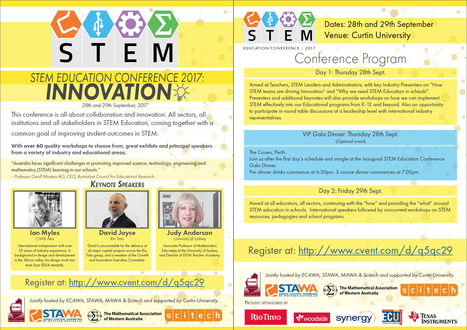
The 2017 STEM Education Conference Aims: To engage Primary and Secondary teachers, STEM leaders and school administrators with: The current and future world of employment. How industry and government agencies have established programs and processes to foster innovation. What challenges industry and government agencies face and how they form and foster multi-disciplinary teams to tackle these challenges. Grass roots reasons to change school practices and approaches to STEM education. Industry and successful school STEM models and partnerships. Pedagogy to better engage students with authentic and problem-based learning experiences that help reflect the world of work.
A real chance exists to bridge the gender divide in the number of girls studying maths and sciences by demonstrating how these subjects are a springboard to socially valuable, stimulating and worthwhile careers, a world-renowned researcher says.
A real chance exists to bridge the gender divide in the number of girls studying maths and sciences by demonstrating how these subjects are a springboard to socially valuable, stimulating and worthwhile careers, a world-renowned researcher says.
"In its quest to make computer science education free and accessible to everyone, Google is expanding its igniteCS program. The initiative pairs volunteer computer science undergrads, who serve as mentors, and younger students, who learn from them.
Libraries now are being recruited as sites to host the growing program. “Our goal really is to make computer science free and accessible to everyone,” said Erin Mindell Cannon, a Google program manager. “Computer science, in a lot of ways, is so broad and so intangible that I think a lot of students don’t understand what it can be.”" (from DML)
An elementary school in Melbourne, Australia is on the forefront of the next digital revolution, teaching students about blockchain technology and its potential applications.
In Melbourne, Australia, local reports have recently focused attention on Wooranna Park Primary School, a small public institution which sits in one of country’s “most disadvantaged urban areas.” But, don’t be misled by Wooranna Park’s humble profile. The primary school is giving students a digital leg up through its pioneering education.
An elementary school in Melbourne, Australia is on the forefront of the next digital revolution, teaching students about blockchain technology and its potential applications.
Interland is an adventure-packed online game that makes learning about digital safety and citizenship interactive and fun—just like the Internet itself. Here, kids will help their fellow Internauts combat badly behaved hackers, phishers, oversharers, and bullies by practicing the skills they need to be good digital citizens.
Interland Certificate of Awesomeness and Badges Proof of Internet awesomeness comes in the form of an official certificate and badge for each lesson.
Let your students amaze you with their mathematical minds as they create art with turtle geometry! This is a three-part post. I have set it apart from the blog because of its currency and practical nature. What is Turtle Geometry? Getting Started. Constructivism & Constructionism The Issue of Transfer . 1. What is Turtle Geometry?…
Communication skills rank high on the list of career skills necessary for success in the quickly-growing Internet of Things (IoT) field, according to a new survey from Northeastern University-Silicon Valley.
The university surveyed more than 500 members of the Institute of Electrical and Electronics Engineers (IEEE), and the responses yielded surprising findings about the challenges facing the IoT field.
Nearly 60 percent (58.8 percent) of survey respondents said those working in the IoT field need communications skills, including an ability to explain ideas or concepts clearly and effectively.
That compares to just 19.5 percent of respondents who cited deep industry knowledge as the most relevant skill, and 14 percent who cited collaboration.
A new report by LinkedIn shows that nearly a third (33%) of students who graduated in the last three years from Australian educational institutions studied a STEM degree,
However the job market is struggling as it is losing nearly a fifth of this talent (16%) to overseas opportunities
The study found that almost half (46%) of these highly skilled STEM graduates have pursued careers outside of engineering (17%), science (15%) and tech (22%).
According to Australia’s Chief Scientist, 75% of Australia’s fast-growing occupations already require STEM skills and at this current rate of technological innovation 44% of all jobs in Australia are likely to be automated.
However, LinkedIn’s data shows that there is a growing gap from education to workforce.
Steven Isaacs — @mr_isaacs on Twitter — is a full-time technology teacher in Baskingridge, N.J. He's also the co-founder of a new festival that set the Guinness World Record for largest gathering dedicated to a single video game.
The game that cements both halves of his life together? Minecraft.
(In case you haven't heard, Minecraft, originally developed by Markus Persson of Sweden, offers players the chance to build a 3-D world out of "blocks." Since its release in 2009, Minecraft has sold more than 121 million copies, making it the best-selling game of all time after another blocky favorite, Tetris.)
Australia’s Science Channel is free and open to everyone. We work with leading minds, universities from around Australia, organisations and institutions to provide compelling science stories for everyone to watch, read, listen and share thoughts on what’s happening in science. Australia’s Science Channel is operated and developed by The Royal Institution of Australia Inc., an independent charity and unique national science hub promoting public awareness and understanding of science.
Australia’s Science Channel is free and open to everyone. We work with leading minds, universities from around Australia, organisations and institutions to provide compelling science stories for everyone to watch, read, listen and share thoughts on what’s happening in science. Australia’s Science Channel is operated and developed by The Royal Institution of Australia Inc., an independent charity and unique national science hub promoting public awareness and understanding of science.
The UCS Science Network invites you to a webinar to learn strategies for building support for scientist engagement with the public and decision makers.
Date: Thursday, August 31 Time: 2:00-3:00 p.m. EDT
This webinar will feature the following individuals and organizations that have been part of this movement, and who will discuss strategies and resources for transitioning to a culture that is more supportive of sharing science more broadly:
Elyse Aurbach-Pruitt, co-founder and co-director, RELATE (Researchers Expanding Lay-Audience Teaching and Engagement) Nalini Nadkarni and Caitlin Weber, STEM Ambassador Program (STEMAP) Dan Pomeroy, managing director and senior policy advisor, International Policy Lab, Massachusetts Institute of Technology
The UCS Science Network invites you to a webinar to learn strategies for building support for scientist engagement with the public and decision makers.
Date: Thursday, August 31
Time: 2:00-3:00 p.m. EDT
This webinar will feature the following individuals and organizations that have been part of this movement, and who will discuss strategies and resources for transitioning to a culture that is more supportive of sharing science more broadly:
RANDOLPH, NJ- More than 100 rising third to fifth grade students at Fernbook Elementary School in Randolph spent three weeks engaged in creative problem solving and learning about engineering, environmental science, computer technology, art technology and performing arts activities through the Summer STEAM Program.
Students selected the discipline they were most interested in and studied it July 24-August 10 in a special morning summer program at the school. This was the fourth year and largest year of the program at Fernbrook, which increased by 10 students.
Fernbook Teacher Jenise Janulis, the lead teacher and program director for STEAM, worked together with Fernbrook Media Specialist Michele Savvides to create the program. This summer was an exciting one for students who created a stop motion animation video, built robots outs of Legos, designed and constructed an irrigation system for the Outdoor Education Center, investigated the best growing environments for plants in the school garden and performed an educational show about bees.
About the VC Meat and Livestock Australia’s virtual excursion Farming Around Australia gives your students an exciting and engaging opportunity to talk to a working Aussie farmer. Students will learn about:
How farmers look after their animals and plants on their farm. How different climates affect farms and the type of animals kept on them. How technology is used to help run farms efficiently and sustainably.
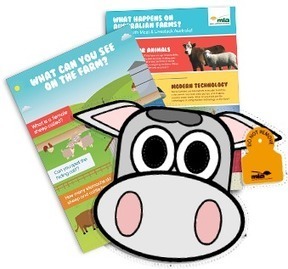
Students will have the opportunity to complete interactive quizzes and to speak directly to a guest farmer to ask any questions they have about life on a farm. Resources Each participating classroom will receive a free activity pack including 2 posters and a cattle eartag activity so you can continue your learning in the classroom. There is also a variety of resources available for teachers and students at www.mla.com.au/education including:
Digital interactive lessons from Foundation to Year 6 with supporting lesson plans. A ‘Virtual Farm’ where students can navigate around a digital farm, meet real Aussie farmers and watch videos. Study guides covering curriculum outcomes including lesson plans, activities and worksheets.
From the Farm to the Classroom FREE Virtual Excursion's - Linked to the curriculum!
Our FREE virtual excursion Farming Around Australia is filling up fast! Give your students the opportunity to interact with a working Aussie farmer by connecting them straight to your classroom. This authentic and engaging Foundation to Year 6 curriculum linked lesson gives your students an insight into life on an Australian sheep or cattle farm. Our Aussie farmer is looking forward to meeting your class and answering their questions.
GET ON BOARD at http://www.potatopirates.game This game is designed for ages 6 and up. With this, we are trying to make this obscure thing calling programming more accessible to everyone by gamifying it, bringing it offline and introducing a social element to encourage peer learning.
In this game you play as a Potato Pirate controlling a fleet of ships and have to eliminate all other players by attacking their ships with anti-potato attacks like mash, fry and roast. There are alliances, backstabbing, looting, plundering, hijacking and betrayal. Atop all the potato piracy, this game also covers fundamental programming concepts such as Booleans, variables, for loops, while loops, functions, control flow statements such as switch statements and conditionals.
So if you’re someone who is into potatoes, programming, piracy and party games, join the Potato Pirates crew at http://www.potatopirates.game
This game is designed for ages 6 and up. With this, we are trying to make this obscure thing calling programming more accessible to everyone by gamifying it, bringing it offline and introducing a social element to encourage peer learning.
The toolkit includes six sections aligned to the policy recommendations outlined by the Code.org Advocacy Coalition:
- Current Landscape and Goals: Collecting data and surveying the current landscape of computer science education and setting strategic goals. - Diversity: Keeping equity and diversity at the forefront of the initiative. - Teacher Pipeline: Building up teachers’ capacity to offer computer science courses through professional development, certification, and pre-service programs. - Curriculum and Courses: Defining standards, guiding curriculum, and allowing computer science to satisfy graduation requirements. - Outreach: Communicating with and involving stakeholders. - Funding: Allocating and accessing funds to drive the initiative.
Eight-year-old computer prodigy Seth Yee has swapped his home in Singapore for Dandenong North, drawn by a program at a local primary school where students are learning how to build the next Bitcoin.
In what is believed to be a Victorian first, students at Wooranna Park Primary School are being taught how to use the software behind Bitcoin to create their own security-encrypted digital currency.
In what is believed to be a Victorian first, students at Wooranna Park Primary School are being taught how to use the software behind Bitcoin to create their own security-encrypted digital currency
According to a study from Oxford University and the Oxford Martin School, 47% of jobs in the United States are "at risk" of becoming "automated in the next 20 years." PwC has similar findings, estimating that 38% of U.S. jobs are at risk of being replaced by robots and artificial intelligence in the next 15 years. And while two-thirds of Americans believe robots will take over most of the workforce in the next 50 years, they're also in denial: 80% say their job will "probably" or "definitely" be around in five decades.
Here are five robots that are coming to take some jobs from unsuspecting humans:
When it comes to productivity, humans don't come close to robots. Machines don't need sleep, won't slack off or ask for a raise and generally don't need vacation days so they can sunbathe in Bali.
As research scientists, we read a lot of scientific papers.
But it may surprise you to learn that a lot of the time we – yes, we scientists – don’t understand what we’re reading, or we’re too bored to remember what we’ve just read.
Peer-reviewed papers are the currency of science. They are the basis upon which knowledge is recorded and traded. They are our stamps of approval and they keep us employed. In short, research papers are our bread and butter.
But our buttered bread can be difficult to digest; typically, it is bloated, dense and so dry that no amount of chewing can make it tasty.
So we decided to do something about it. We wrote a paper about writing papers, explaining why and how it’s important for scientists to change the way we write.
Our paper is centred around one key character: Ingredient X.
Next-gen robots: The latest victims of workplace abuse
Robots must contend not just with internal flaws and bugs but with humans. Recent introductions of robots to everyday scenarios have led people to initiate some intriguing forms of interaction. Knightscope’s security bot, for example, has been harassed by kids, painted in red lipstick and used as a canvas for graffiti artists.
Hewlett-Packard Enterprise and the US National Aeronautics and Space Administration will send a pair of supercomputers into space to see how they cope with high radiation events.
The experiment is being performed in preparation for a Mars mission and will last a year - the same amount of time it takes to travel to the planet.
To get content containing either thought or leadership enter:
To get content containing both thought and leadership enter:
To get content containing the expression thought leadership enter:
You can enter several keywords and you can refine them whenever you want. Our suggestion engine uses more signals but entering a few keywords here will rapidly give you great content to curate.


 Your new post is loading...