The debates around STEM v STEAM are plentiful - many STEM advocates disconnect STEM content from meaningful and engaging contexts; seemingly forgetting about active and inquiry focussed pedagogies that can only operate well in a rich integrated ecosystem. We advocate for STEM+ and the "+" is essential.
By the age of 16, most women in the United States, Europe and Israel have already decided not to pursue a career in cybersecurity, according to a new study from Kaspersky Lab. The researchers attribute that disinterest in part to a negative image of the security industry as a whole, citing respondents' perception that cybersecurity roles are for "hackers," "geeks" and "nerds."
By the age of 16, most women in the United States, Europe and Israel have already decided not to pursue a career in cybersecurity, according to a new study from Kaspersky Lab. The researchers attribute that disinterest in part to a negative image of the security industry as a whole, citing respondents' perception that cybersecurity roles are for "hackers," "geeks" and "nerds."
In their poor, Communist country, Romania's computer curious built an underground industry.
Back then, Romania’s hardware industry mainly cloned the British Sinclair ZX Spectrum, a machine released in the UK in 1982. This device was copied all across Central and Eastern Europe. The ZX Spectrum was an 8-bit personal computer built around a Zilog Z80 A CPU running a BASIC interpreter, an easy-to-use programming language widespread on microcomputers at that time. It used a TV set as a display and audio cassettes for storage.
Among the clones manufactured by the Communists was the Cobra or CoBra. The name stands for COmputere BRAsov, with Brasov being the town in central Romania where these machines were assembled to be used by enterprises. Of course, ordinary people couldn’t buy them—which is what first led several students at the Politehnica University of Bucharest deciding to build them themselves.
“It was a highly illegal operation. And we knew this very well,” Moldovanu tells me. “But to us, it didn’t matter. We were super excited to turn a pile of parts into a cool project.”
To a young Moldovanu, computers were magic. The country he grew up in barely had access to landline telephones and black-and-white TV sets, and he rarely came across Western goods. Romania had its borders closed tightly. For the average citizen, there were no opportunities to travel or to receive accurate news regarding what was the state of technology in the West.
The establishment of a new Australian national space agency was announced by federal minister for education and training, Simon Birmingham, at the International Astronautical Congress (IAC) in Adelaide this past week. The announcement was met with loud cheers from the 4,300 delegates attending from around the world, 30% of whom were Australians.
While the details are pending, it’s worth considering whether the space agency could play a vital role in inspiring students to take up science, technology, engineering and mathematics (STEM) subjects.
10 Reasons Kids Should Learn to Code When it comes to preparing your children for the future, there are few better ways to do so than to help them learn to code! Coding helps kids develop academic skills, build qualities like perseverance and organization, and gain valuable 21st century skills that can even translate into a career. From the Tynker blog, here are the top 10 reasons kids should learn to code:
10 Reasons Kids Should Learn to Code When it comes to preparing your children for the future, there are few better ways to do so than to help them learn to code! Coding helps kids develop academic skills, build qualities like perseverance and organization, and gain valuable 21st century skills that can even translate into a career. From the Tynker blog, here are the top 10 reasons kids should learn to code:
MUSCATINE — A teacher at Central Middle School received Bridgestone's Classroom of the Quarter grant to buy equipment to teach students about energy consumption.
The grant, totaling $500, is designed to assist a teacher with the resources needed to shape the classroom environment to enhance learning for every child.
Jenny Mullikin, the recipient, teaches in the Project Lead the Way program, which focuses on STEM education.
"Kids have a hard time understanding energy, so we are going to buy some of those thermal cameras that go on iPads and iPhones so (students) can see the energy. It could help them understand energy more."
Jenny Mullikin, the recipient, teaches in the Project Lead the Way program, which focuses on STEM education. "Kids have a hard time understanding energy, so we are going to buy some of those thermal cameras that go on iPads and iPhones so (students) can see the energy. It could help them understand energy more."
STEM careers are some of the most rewarding vocations the future will provide for our learners. Preparing them to succeed in them starts in the classroom.
STEM careers are some of the most rewarding vocations the future will provide for our learners. Preparing them to succeed in them starts in the classroom.
Geographically they may live worlds apart – one resides on the Gold Coast and the other in Singapore. But it doesn’t bother the brothers James and Adam Gilmour, who are determined to grow their company Gilmour Space Technologies to compete in the same realm as space transport companies like Elon Musk’s SpaceX.
“We’re not necessarily looking to fulfil or supply to the domestic market. We’re actually looking to compete with the global space industry,” says Gilmour Space Technologies’ director James Gilmour.
“Satellite and other space technologies are getting significantly smaller and a lot more capable. We’re looking to be part of that,” he said.
Last year, the pair successfully test launched its hybrid rocket using proprietary 3D-printed fuel. The brothers are now working towards launching two low-cost sounding rockets into suborbital space by next year.
In front of an expectant audience of more than 4,000 international delegates attending the International Aeronautical Congress in Adelaide, today Senator Simon Birmingham - representing Minister for Industry, Innovation and Science, Arthur Sinodinos – announced Australia’s federal government is committed to a space agency.
Although details on timelines, funding and practicalities are yet to be described, here three experts address the question of how an Australian space agency will support the sector.
Although details on timelines, funding and practicalities are yet to be described, here three experts address the question of how an Australian space agency will support the sector.
The ability to name all of the elements on the periodic table from actinium to zinc is an impressive feat. Actually being able to explain how each element functions in the real world is a little more challenging. If you agree that learning the everyday relevance of all the Earth’s elements is just as important as memorizing their symbols, check out the chart above. This graphic, spotted by inhabitat, presents the information found in a traditional periodic table with pictographs and labels indicating where you might encounter each element in your life.
“The Periodic Table of Elements, in Pictures and Words” was created by Boeing software engineer Keith Enevoldsen. He frames the design as a tool for teaching students in elementary through high school, but it can also be used by adults looking to polish their rusty knowledge from chemistry class. The uses of some elements are widely known: Sodium, for instance, is paired with a picture of a salt shaker, while neon is illustrated with an illuminated advertising sign. Others, though, aren’t so obvious: Did you know that strontium is used in fireworks, or that boron can be found in sports equipment? What about scandium in bicycles, or tantalum in cell phones? There’s a helpful illustration accompanying each element found in nature.
This graphic, spotted by inhabitat, presents the information found in a traditional periodic table with pictographs and labels indicating where you might encounter each element in your life.
Scratch has become a popular way to introduce coding to young people around the world. Yet many schools are just beginning to realize the potential of Scratch to support project-based learning across subject areas and grade levels.
How can you integrate Scratch into your curriculum to help students learn to think creatively and work collaboratively? Here are three things to know about Scratch — and the opportunities it opens up for learners with diverse interests and backgrounds.
How can you integrate Scratch into your curriculum to help students learn to think creatively and work collaboratively? Here are three things to know about Scratch — and the opportunities it opens up for learners with diverse interests and backgrounds.
Download the report at http://go.nmc.org/2017-digilit. What does digital literacy look like around the world? A host of frameworks, tools, and exemplars are increasingly placing college students in the driver’s seat as content and media creators. In a discussion moderated by lead author Bryan Alexander, join the NMC for the official release of our follow-up NMC Horizon Project Strategic Brief focused on digital literacy. In addition to expanding upon the preliminary definitions outlined in the first report, the brief includes more global and discipline-specific information and context. The aim is for this deep exploration of frameworks and initiatives to contribute to the body of knowledge used by the higher education community to inform strategic planning around digital literacy.
The aim is for this deep exploration of frameworks and initiatives to contribute to the body of knowledge used by the higher education community to inform strategic planning around digital literacy.
Jason Silva has hosted 5 seasons of the Emmy-nominated, global hit TV series Brain Games on the National Geographic Channel. Here Jason encourages students from 13-18 to take part in the 2017 Breakthrough Junior Challenge. Register for the Challenge at www.breakthroughjuniorchallenge.org.
The deadline for entries is October 1, 2017. #breakthroughjuniorchallenge
Interactive graphic novel that teaches coding for kids - dystopia2153.com
Are You Ready for Dystopia 2153?
Do you like graphic novels or comic books? Are you interested in learning to code? If you answered, yes, then you'll love Dystopia 2153! This brand new, three-episode series teaches kids the basics of coding through a digital graphic novel. It connects 21st Century skills with the love of reading. Use code to solve puzzles that help the characters overcome obstacles and escape their dystopian world.
Do you like graphic novels or comic books? Are you interested in learning to code? If you answered, yes, then you'll love Dystopia 2153! This brand new, three-episode series teaches kids the basics of coding through a digital graphic novel. It connects 21st Century skills with the love of reading. Use code to solve puzzles that help the characters overcome obstacles and escape their dystopian world.
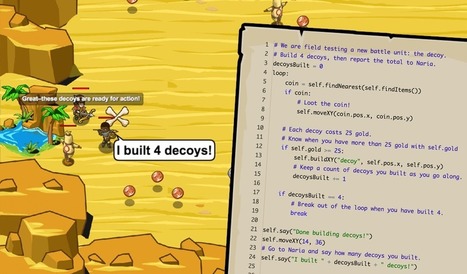
Learn programming with a multiplayer live coding strategy game for beginners. Learn Python or JavaScript as you defeat ogres, solve mazes, and level up. Open source HTML5 game!
Learn programming with a multiplayer live coding strategy game for beginners. Learn Python or JavaScript as you defeat ogres, solve mazes, and level up. Open source HTML5 game!
In 2015, there were nearly 8.6 million STEM jobs in the United States, and that number is growing every year. In fact, STEM job growth in the past 10 years is three times that of any other field, but by 2018, it is projected that 2.4 million STEM jobs will go unfilled. Yet, STEM education programs have not kept pace–calling into question whether there will be enough qualified employees available to take on these new positions.
Worryingly, only 16 percent of students graduating high school are proficient in STEM and also interested in a STEM career. The natural response to such a low percentage would be to prioritize improving STEM education efforts in the classroom. However, this is unfortunately easier said than done.
You may have heard that algorithms will take over the world. But how are they operating right now? We take a look in our series on Algorithms at Work.
Machine learning algorithms work blindly towards the mathematical objective set by their designers. It is vital that this task include the need to behave ethically.
Such systems are exploding in popularity. Companies use them to decide what news you see and who you meet online dating. Governments are starting to roll out machine learning to help deliver government services and to select individuals for audit.
Yet the algorithms that drive these systems are much simpler than you might realise: they have more in common with a pocket calculator than a robot from a sci-fi novel by Isaac Asimov. By default, they don’t understand the context in which they act, nor the ethical consequences of their decisions.
You may have heard that algorithms will take over the world. But how are they operating right now? We take a look in our series on Algorithms at Work. Machine learning algorithms work blindly towards the mathematical objective set by their designers. It is vital that this task include the need to behave ethically.
It’s a sweet development that’s certainly causing a buzz around industry: Next year, NSW high schoolers will be able to study beekeeping.
In an Australian-first, HSC students will have the option of doing a Certificate III in Beekeeping as a school-based traineeship, where they will be paid to work alongside professional apiarists.
It’s a sweet development that’s certainly causing a buzz around industry: Next year, NSW high schoolers will be able to study beekeeping. In an Australian-first, HSC students will have the option of doing a Certificate III in Beekeeping as a school-based traineeship, where they will be paid to work alongside professional apiarists.
Innovator Solutions highlights contributions from corporate sponsors and advertisers representing education organizations, businesses, policy-making bodies and other influencers dedicated to transforming education.
Amid the buzz over bringing coding into classrooms, many teachers are stopping to consider the benefits it brings to their students and how they want students to experience coding.
Why coding? And why now? Many of us would quickly respond that learning to code is a necessary skill in today’s world with the vast amount of technology tools available. However, it is a little more difficult to define why or how it is applicable in our daily lives.
As an educator, ask yourself: What are the underlying skills that coding teaches students? What are the learning outcomes we want for students as a result of bringing coding into the classroom?
Amid the buzz over bringing coding into classrooms, many teachers are stopping to consider the benefits it brings to their students and how they want students to experience coding.
Australian space industry leaders have hailed the Commonwealth’s “historic” creation of a national space agency, saying it will lead to thousands of local jobs and help coordinate the growing sector.
The federal government announced on Monday morning that it decided to act on a national space agency following “overwhelming” support from the local industry.
The Opposition also unveiled its own plan for an agency, and so regardless of who wins the next election, Australia will get a federal body coordinating the local sector.
The proposed agency has been welcomed by space-focused businesses and their leaders, who have long been saying that a space agency would bring together the fractured industry in Australia, creating local jobs and stemming the brain drain of talent moving overseas.
The proposed agency has been welcomed by space-focused businesses and their leaders, who have long been saying that a space agency would bring together the fractured industry in Australia, creating local jobs and stemming the brain drain of talent moving overseas.
An innovative software shield developed by Curtin University researchers that prevents increasingly common cyber security attacks has been crowned the overall winner in the 2017 Curtinnovation Awards.
An innovative software shield developed by Curtin University researchers that prevents increasingly common cyber security attacks has been crowned the overall winner in the 2017 Curtinnovation Awards.
Let’s do the time warp again The first thought experiment that Dr Brukner’s group came up with, published earlier this year in the Proceedings of the National Academy of Sciences by him and two of his students, Esteban Castro Ruiz and Flaminia Giacomini, involved an imaginary clock of great precision. The accuracy with which such a clock could be read is constrained by Werner Heisenberg’s uncertainty principle. This limits how well pairs of properties of any physical system (such as location and velocity) can be measured. The more precisely one member of a pair is known, the more uncertain is the value of the other.
In 2006 Jen Nagarah and Kate Fraser, science teachers and teachers of the visually impaired, wished for a website where activities and resources about teaching science could be shared with other teachers, as well as with parents and students. The first version had very few activities or materials. In 2008 Phase II of the website involved developing a new format and the addition of much more material. Many staff in a variety of roles from across the campus were involved.
The site was moved from www.perkins.org to its current location on www.perkinselearning.org in February 2014. We are grateful to SAP for their support of this project. We believe that all students, including those who are blind or visually impaired, deafblind, or those who have additional disabilities, can fully participate in science education and activities. The goal of this site is to share techniques and strategies to make science accessible to all. We have adapted activities to meet the needs of our students. We hope these adaptation ideas inspire teachers to find their own creative ways to include students who are visually impaired in the science classroom.
We invite you to share your ideas, resources and activities with us!Activities and resources for making science accessible to students who are blind or visually impaired
In 2006 Jen Nagarah and Kate Fraser, science teachers and teachers of the visually impaired, wished for a website where activities and resources about teaching science could be shared with other teachers, as well as with parents and students.
To get content containing either thought or leadership enter:
To get content containing both thought and leadership enter:
To get content containing the expression thought leadership enter:
You can enter several keywords and you can refine them whenever you want. Our suggestion engine uses more signals but entering a few keywords here will rapidly give you great content to curate.


 Your new post is loading...