Your new post is loading...

|
Scooped by
Kim Flintoff
August 19, 2016 3:46 AM
|
Curtin University professor and eminent botanist Professor Kingsley Dixon was named WA Scientist of the Year at the 2016 Premier’s Science Awards last night, in recognition of his efforts in conservation science, restoration ecology and plant science.
|
|
Scooped by
Kim Flintoff
August 17, 2016 9:49 AM
|
Help save threatened species and preserve Australia’s iconic wildlife!
Become a citizen scientist and assist researchers by looking for animals in wilderness photos taken by automated cameras around Australia.
Anyone can join in and you can do it all online.
Start Classifying
|
|
Scooped by
Kim Flintoff
August 15, 2016 4:11 AM
|
An expert has warned a discipline war is brewing among the STEM subjects, and she expects engineering to come out on the bottom.
STEM is the oft-used acronym for science, technology, engineering and mathematics, the focus of politicians and educators who are trying to lift Australian standards in these areas.
Queensland University of Technology professor Lyn English, a leading primary school engineering educator, argued engineering is being marginalised when it comes to teaching primary school students.
|
|
Scooped by
Kim Flintoff
August 11, 2016 10:43 PM
|
One thing that has remained true throughout the years is that the American people demand job creation. But are the American people prepared to fill the jobs that will become available to them? According to Quartz’s article American Schools Are Teaching Our Kids How To Code All Wrong there will be one million jobs in computing that will be unfilled by 2020. What are we doing wrong?
Perhaps the answer can be found by analyzing schooling for current students. The TIMES explains that today’s youth are simply not being taught programming languages. They’re not equipped for the emerging modern world because there’s no one preparing them.
|
|
Scooped by
Kim Flintoff
August 11, 2016 10:05 PM
|
The Global Search for Education (GSE) is a regular contributor to the Edmodo Blog. Authored by C.M. Rubin, GSE brings together distinguished thought leaders in education and innovation from around the world to explore the key learning issues faced by today’s nations. Look for a new post every week and join the Global Search for Education Community on Edmodo to share your perspectives with their editorial staff.
According to Center for Curriculum Redesign (CCR) founder Charles Fadel, education is “falling behind its mission to prepare students for the future: a world that’s increasingly volatile, uncertain, complex and ambiguous.” Curriculum was significantly redesigned in the late 1800’s when societal and human capital needs demanded it. But the 21st century bears little resemblance to the past. WHAT should we teach young people in an age where Dr. Google has an answer for everything? Humans are living longer; the traditional professions disappear while new ones are created; international mobility is drastically increasing population diversity; terrorism, environmental threats and inequality need our collective attention; and robots and gene editing are coming, requiring us to re-examine the very core of what it means to be human. WHAT does all that we know now, and all that we still can only imagine, mean for Curriculum?
If we agree that the technological trends futurists are predicting will mean constant and dramatic changes for all, why aren’t we more focused on rethinking the WHAT of education i.e. WHAT curriculum will make education more relevant in the future?
According to Andreas Schleicher, Director for Education and Skills at the OECD, Fadel’s book, Four-Dimensional Education: The Competencies Learners Need to Succeed, provides a “first of its kind organizing framework of competencies needed for this century which defines the spaces in which educators, curriculum planners, policy makers and learners can establish WHAT should be learned.”
|
|
Scooped by
Kim Flintoff
August 11, 2016 9:47 PM
|
As STEM becomes increasingly promoted and Liberal Arts defunded, can technology serve as mediator?
If my English Liberal Arts degree was mocked 10 years ago, you can imagine what students majoring in French Literature must be going through today. In fact, according to the New York Times, even state governors are denying funding for some humanities students.
In fact, according to the same article, “when it comes to dividing the pot of money devoted to higher education, at least 15 states offer some type of bonus or premium for certain high-demand degrees, according to the National Conference of State Legislatures.” (To learn more about these high-demand degrees, read: “3 blossoming fields of study with massive potential.”)
But as anyone invested in education knows, focusing on one end of the curricular spectrum is never wise: too much focus on the humanities and there goes scientific progress bolstering the economy; too much focus on STEM and there goes creativity and reasoning bolstering the human species.
|
|
Scooped by
Kim Flintoff
August 7, 2016 2:26 AM
|
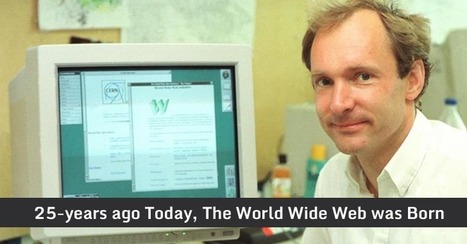
On this day 25 years ago, August 6, 1991, the world's first website created by Tim Berners-Lee went live
|
|
Scooped by
Kim Flintoff
August 6, 2016 8:55 PM
|
Much of the Internet runs Linux and open source software, yet in most of our schools—whether PK-12 or higher education—Linux and open source software are given short shrift.
Linux has made serious inroads on hand-held devices, the desktop, and the Internet of things (IoT) that use platforms such as Raspberry Pi, Galileo, and Arduino. Despite this astounding growth, a relatively small number of secondary and post-secondary schools offer technology training that prepares students for increasingly in-demand technical skills. The growth of the maker movement and the concurrent interest in STEM skills, which include coding and ethical hacking, may provide a much-needed impetus to change this trend.
The problem for most schools is finding the mentors and exemplars of this paradigm. Codecademy and similar online resources provide opportunities for anyone to learn how to code in Python, Java, and other languages, and for students to learn the commandline, which is useful in Linux, MacOS, iOS, and other Unix-like systems. Most schools, however, continue to emphasize competence in proprietary office suites. Experience in word processing, financial analysis, and database management is important, but also can be gained using open source software, such as LibreOffice, which comes free with most Linux distributions.
|
|
Scooped by
Kim Flintoff
August 4, 2016 1:57 AM
|
Born with symbrachydactyly, eight-year-old Sophie doesn’t have fully developed finger bones in her left hand, but with the help of a CITRIS Invention Lab team, she is the new user of a 3-D printed super hand.
|
|
Scooped by
Kim Flintoff
August 3, 2016 8:56 PM
|
In the words of their teacher: “this child-centered activity provided students the opportunity to show understanding of ELA skills using a participatory child-centered activity. It integrated technology in a cooperative multi-media experience allowing students remote interaction with peers at a distance using Google Hangouts.
Illustrated here is Room 407’s use of Sphero the Robot(right side) and SPRK the Robots (left side) acting as characters/students in the class. The BB8 Robot (featured in the center) plays the character of classroom teacher. The students used the green screen, DoInk, and iMovie to create a story.
Perhaps some of these different robots will inspire creativity in your language arts and social studies lessons.
|
|
Scooped by
Kim Flintoff
August 2, 2016 9:06 PM
|
Welcome to the TeacherCast Podcast. In this episode, Jeff sits down with Margaret Weigel from Lego Education to discuss the amazing LEGO Mindstorms products and how they can fit into your STEM Education Curriculum.
About Lego Education
For 35 years LEGO® Education has been working with teachers and educational specialists like to deliver playful learning experiences that bring subjects to life in the classroom and make learning fun and impactful. We have a wide range of physical and digital educational resources that encourage students to think creatively, reason systematically and release their potential to shape their own future. We believe that expanding knowledge and building academic and 21st century skills will create active, collaborative, lifelong learners. Together with educators, we aim to enable every student to succeed in education and be prepared for future life challenges.
|
|
Scooped by
Kim Flintoff
August 1, 2016 8:12 PM
|
Seymour Papert, whose ideas and inventions transformed how millions of children around the world create and learn, died Sunday, July 31, 2016 at his home in East Blue Hill, Maine. He was 88.
Papert’s career traversed a trio of influential movements: child development, artificial intelligence, and educational technologies. Based on his insights into children’s thinking and learning, Papert recognized that computers could be used not just to deliver information and instruction, but also to empower children to experiment, explore, and express themselves. The central tenet of his Constructionist theory of learning is that people build knowledge most effectively when they are actively engaged in constructing things in the world. As early as 1968, Papert introduced the idea that computer programming and debugging can provide children a way to think about their own thinking and learn about their own learning.
|
|
Scooped by
Kim Flintoff
July 31, 2016 8:53 PM
|
For six hours a day on five consecutive days, the artist Stelarc will be seeing through the eyes of someone in London, hearing through another's ears in New York and surrendering control of his right arm to strangers.
It is all part of his latest performance work, titled ReWired/ReMixed, which will run from August 3 to 7 at the Perth Institute of Contemporary Arts (PICA).
He will be wearing a mask, which will control what he sees, and headphones to control what he hears, while at the same time visitors to the gallery will be able program his right arm movements on a touch screen, which will trigger the exoskeleton he is wearing.
|
|
|
Scooped by
Kim Flintoff
August 18, 2016 6:34 PM
|
Few programs for girls in STEM are as intensive, comprehensive and affordable as the Girls Who Code Summer Immersion Program.
|
|
Scooped by
Kim Flintoff
August 17, 2016 9:41 AM
|
Google CS First is an online platform for creating, managing, and teaching a middle school computer science (CS) program. There are currently 72 programming explorations and lessons across nine domains (such as arts, gaming, sports, storytelling, and social media). Each lesson is ready to go out of the box and includes a minute-by-minute teacher script, student instructions, example projects, materials (with solution guides), and more. The site also features comprehensive help guides for everything from setting up and maintaining a club to tips for classroom management and discipline issues.
|
|
Scooped by
Kim Flintoff
August 12, 2016 11:01 PM
|
A new app that lets users upload photos of insects and animals is aiding the discovery of new species, NPR reports.
Photos uploaded to the iNaturalist app are accompanied by a location, and from there, amateur and expert naturalists can examine the photos to identify the species.
One of the app’s developers told NPR that making science fun and gamifying it can be challenging when a “mixed crowd” wants both technical capabilities along with open-ended exploration.
Activities and tools such as this app, which can be used for amateur biologists but also for classroom purposes, might be key to engaging students in STEM subjects.
|
|
Scooped by
Kim Flintoff
August 11, 2016 10:17 PM
|
Event Description
Curtin University has the pleasure of inviting you on a journey through time and place to celebrate National Science Week 2016.
Join us at Curtin University, St Georges Terrace on Tuesday, 16 August for a presentation on the Historical Panoramas project, a collaboration between Curtin and the State Library of Western Australia.
Historical Panoramas showcases modern-day and historic panoramic images of Perth and Fremantle – some more than a century old – showing how the two cities have changed over time.
Andrew Woods, Manager of the Curtin HIVE (Hub for Immersive Visualisation and eResearch) will take you on a virtual tour back in time to show the development of Perth and Fremantle from as far back as the 1860s. Joel Newman, Director of UAV company Elevo, will provide insights on how drones were used to capture modern day panoramas from historical locations that are now no longer accessible.
|
|
Scooped by
Kim Flintoff
August 11, 2016 9:56 PM
|
Getting out of the classroom can benefit everyone — both teachers and students. Fresh air and fresh perspectives combine to allow for new types of creativity, for play, and for a chance to connect learning to life. The best of these apps help harness what kids are learning outside so they can bring it back into the classroom for further study.
Of course, the Pokémon Go craze hasn’t just been dominating the imaginations of monster hunters everywhere, but also sparking debate among educators around the game’s potential for learning. Sure, Pokémon Go has an inherent ability to get kids outside, observing the world in ways they hadn’t before. But, if you’re looking to help students take their hunt for learning beyond the walls of your classroom, there are plenty of other options to consider.
The four STEM apps below all get kids moving in different ways, whether by looking up at the sky, analyzing how their own bodies move, discovering unique objects to photograph, or getting muddy at their local watershed. Sure, they may not be capturing that next rare Pokémon, but these apps will still help students appreciate the diversity of the world they inhabit.
|
|
Scooped by
Kim Flintoff
August 8, 2016 10:27 PM
|
Many recent science and information technology graduates are failing to find full-time work at a time when science, technology, engineering and mathematics (STEM) education is a priority for government and industry.
Mapping Australian higher education 2016 shows that in 2015, only half of bachelor degree science graduates seeking full-time work had found it four months after completing their degrees, 17 percentage points below the average for all graduates.
Among recent science graduates who found full-time jobs, only half say their qualification is required or important for their job – about 20 percentage points below the average.
Although job outcomes improve over time, science bachelor degree graduates are less likely than other STEM graduates to work in high-skill managerial or professional jobs.
This year’s edition of Mapping Australian higher education, Grattan Institute’s regular overview of key trends in higher education, focuses on STEM graduate employment.
|
|
Scooped by
Kim Flintoff
August 6, 2016 8:56 PM
|
What is the draw of design thinking? For many educators, it teaches students how to think differently. This doesn’t just mean thinking creatively, but thinking empathetically and putting oneself in someone else’s shoes. Design thinking encourages students to fully realize their ideas. Understand, observe, ideate and define is only the first part of the equation. By assigning projects to students, educators can guide them to complete the prototype and iteration aspects of their ideas. Here are a few starter projects to bring into the classroom.
|
|
Scooped by
Kim Flintoff
August 4, 2016 1:57 AM
|
Challenging students, teachers, makerspaces, and anyone with a 3D printer to print and assemble a prosthetic hand for a child.
|
|
Scooped by
Kim Flintoff
August 4, 2016 1:56 AM
|
Berkeley's 'Girls in Engineering' program is a week-long summer camp where girls explore what it means to be an engineer in a fun, hands-on environment.
|
|
Scooped by
Kim Flintoff
August 3, 2016 3:56 AM
|
Abstract
In response to numerous calls for more rigorous STEM (science, technology, engineering, and mathematics) education to improve US competitiveness and the job prospects of next-generation workers, especially those from low-income and minority groups, a growing number of schools emphasizing STEM have been established in the US over the past decade. However, existing STEM schools vary substantially in the way they are organized, the students they attract, and the outcomes they advertise, and there have been few empirical studies of their effectiveness. This comparative case study examines the opportunity structures for STEM at eight public high schools, four in Denver, Colorado, and four in Buffalo, New York. All of the schools were “inclusive” (no admission requirements) and served predominantly low-income and majority minority students. All but one school had been designated “low-performing” for failure to meet federal accountability requirements. In each city, two of the study schools had recently been re-organized to be “STEM-focused” in some way, and two were traditional, comprehensive high schools. We found that the STEM-focused schools were launched with much enthusiasm and high expectations. In both cities, STEM-focused schools achieved some modest success initially but were unable to maintain their gains. Overall among the schools in this study, the STEM-focused high schools did little to improve STEM opportunities compared to the comprehensive high schools. We do not mean to suggest that STEM schools are a bad idea, but that claims and expectations for them must be examined in the context of their implementation, and STEM schools for low-income and minority students are unlikely to be successful without more attention to systemic issues in urban education. © 2015 Wiley Periodicals, Inc. J Res Sci Teach 52: 763–789, 2015.
|
|
Scooped by
Kim Flintoff
August 1, 2016 10:46 PM
|
Curtin University’s Vice-Chancellor Professor Deborah Terry invites you to attend “Global Issues – Local Action”, a discussion on women in STEMM and launch of Curtin University’s Athena SWAN program.
Join us to learn how Curtin University is supporting evidence-based solutions to enhance gender equity.
The discussion panel will include science experts, business and policy leaders who will share their ideas on how to reduce the gender gap in STEMM.
Curtin University is a member of the Athena SWAN Australia Charter and a participant in the Science in Australia Gender Equity (SAGE) Pilot, a two- year initiative that is aimed at encouraging greater participation of women in the STEMM areas.
The SAGE Pilot is a partnership between the Australian Academy of Science and the Academy of Technology and Engineering.
|
|
Scooped by
Kim Flintoff
July 31, 2016 10:16 PM
|
How can schools, universities, governments, parents and business corporations work together to develop, implement and sustain a long-term investment in Science, Technology, Engineering and Mathematics.
These luncheon events will examine:
Why existing programs have not resulted in a national approach to STEM
The obstacles of student participation in STEM
How Australia can increase its STEM teaching workforce
|