The debates around STEM v STEAM are plentiful - many STEM advocates disconnect STEM content from meaningful and engaging contexts; seemingly forgetting about active and inquiry focussed pedagogies that can only operate well in a rich integrated ecosystem. We advocate for STEM+ and the "+" is essential.
In November of this year, freshly promoted Cisco CEO Chuck Robbins delivered a keynote at the Cisco STEM Innovation Challenge, an event that assembled high school students, teachers, and Cisco engineers to promote the importance of STEM-related fields and the "lucrative careers" available to those with a STEM background.
Add this to the chorus of political calls for more STEM education, from the President of the United States down to local school boards, and STEM careers were are being presented as the perfect path to a secure future, with high pay, interesting work, and lifetime employment for anyone entering the field. Less than a year later, Cisco is ending 5,500 of those careers, or about 7% of its workforce. This follows large cuts by other companies that routinely fly the STEM banner, including HP, Intel, and IBM.
Science and art were not always two separate entities. Historically, times of great scientific progress occurred during profound movements in art, the two disciplines working together to enrich and expand humanity’s understanding of its place in this cosmos. Only recently has a dividing line been drawn, and this seeming dichotomy misses some of the fundamental similarities between the two endeavors.
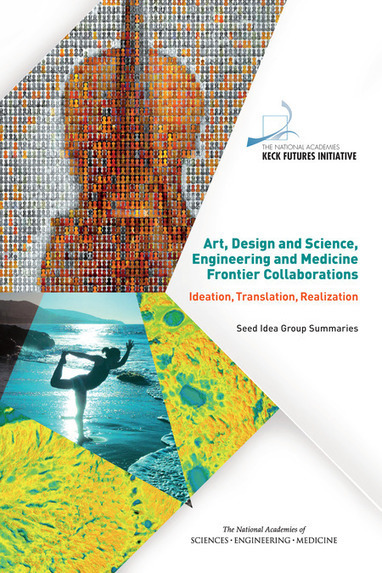
At the National Academies Keck Futures Initiative Conference on Art, Design and Science, Engineering and Medicine Frontier Collaborations: Ideation, Translation, and Realization, participants spent 3 days exploring diverse challenges at the interface of science, engineering, and medicine. They were arranged into Seed Groups that were intentionally diverse, to encourage the generation of new approaches by combining a range of different types of contributions. The teams included creative practitioners from the fields of art, design, communications, science, engineering, and medicine, as well as representatives from private and public funding agencies, universities, businesses, journals, and the science media.
What do students want from math and science courses? What do they expect from the technology used in the classroom?
Our infographic “Closing the Gap in STEM Education: The Appeal of Technology in the Classroom,” shows the challenges students face … as well as the resources (and support) they believe would help them succeed in their courses.
One of five parallel conferences running at the National FutureSchools Expo.
This conference focuses on the Professional Development for teachers of Australia's new digital technologies curriculum, with a focus on how to teach children to code.
Why?
The Digital Technologies Curriculum will lay the foundations for a new generation of Australian’s who will give the term ‘Digital Natives’ a whole new meaning. But, what challenges does THIS generation of teachers face in delivering this new subject, and how are we going to overcome them?
Teaching Kids to Code is a fresh, new part of the FutureSchools experience – a conference designed to explore these challenges and to give K-12 teachers a forum to collaborate and engage with fellow teachers across Australia who are doing great work in pushing STEM, computational thinking and coding beyond the classroom…
Who Should Attend?
- K-12 Teachers with an interest in coding and robotics - ICT Integrators/Facilitators/Coordinators - Computing Teachers - STEM Teachers
Why Attend?
- Understand the rationale behind computational thinking and its application in and outside the school - Discover practical approaches and apps for teaching very young students to program - Equip yourself with tools and websites that can help older students learn to hack code - Learn first-hand from teachers across the country who are delivering the digital technologies curriculum and coding in their schools - Get involved with hands-on practical workshops and find the best approaches in how to teach coding - Gain useful tips on how to engage students and motivate them to learn programming
In this post I am offering my perspectives on how education today remains firmly entrenched in what is often called the Factory Model, which was designed for the Industrial Revolution. The majority of students at that time were educated to prepare for work on farms on in factories. This is an obsolete model of a by-gone era. But it is still with us today, well into the 21st century:
Translation - "Instead of putting the students and myself through a year's worth of grinding through a boring curriculum, I could have been creating schedules and educational experiences which were relevant, rigorous, real world, engaging and motivational!"
So, let's get rid of the obstacles and do what we know is best for kids and what works for actual learning! Lose the "cells and bells"!
Get rid of the siloed curriculum. Integrate the curriculum meaningfully. This can be done by dropping some courses, combining others and letting students experience student-driven, interdisciplinary, project-based curriculum.
According to the National Center for College and Career Transitions (NC3T), about 20 percent of careers — and many of the fastest growing areas — directly relate to science, technology, engineering and math.
But by one count, an insufficient number of students today will pursue STEM careers. So how do we convince students that STEM is important even if they don’t think they will pursue a career in a related field?
“To varying degrees, every workplace is being transformed by enabling technologies,” writes NC3T President Hans Meeder.
Our mission is to educate the next generation of technologists who will use their skills and knowledge to make the world a better place.
Our Story
CodaKid’s goal is to create a generation of young programmers, designers, and entrepreneurs who can build amazing games, apps, and more. Our courses are engineered to teach kids not only how to design and code, but to thoroughly understand the concepts so that they can perform them on their own.
By making computer programming incredibly fun and engaging through game design, CodaKid students will develop the motivation and tenacity to learn to code in actual development environments and develop real world skills.
App Lab is a programming environment where you can make simple apps. Design an app, code with blocks or JavaScript to make it work, then share your app in seconds.
A CURTIN University mechatronics student selected for a six-month research internship with NASA’s Jet Propulsion Laboratory (JPL) in California has spent the time learning to build disposable folding robots, which may be deployed on future planetary missions.
Chris Norman, who is in his fourth year of a Bachelor of Engineering degree, began the internship in Pasadena in January this year and was invited to work on the mechanical design of a folding robot the size of a smartphone, designed to cover surface areas that a future Mars rover is unable to reach.
Chris Lehmann is the founding principal of the Science Leadership Academy, a progressive science and technology high school in Philadelphia, PA. The Science Leadership Academy is an inquiry-driven, project-based, 1:1 laptop school that is considered to be one of the pioneers of the School 2.0 movement nationally and internationally. Science Leadership Academy is the Dell Computing Center of Excellence for Technology in Education. The school was recognized by Ladies Home Journal as one of the Ten Most Amazing Schools in the US, has been recognized as an Apple Distinguished School from 2009 through 2013 and has been written about in many publications including Edutopia Magazine, EdWeek and the Philadelphia Inquirer. In September 2013, Chris opened Science Leadership Academy @ Beeber campus, the second campus in the SLA model. In 2013, Chris co-founded the non-profit Inquiry Schools with Diana Laufenberg to help more schools create more empowering, modern learning experiences for students, and he serves as Superintendent and Chair of the Board. Chris returned to his native Philadelphia after nine years as an English Teacher, Technology Coordinator, Girls Basketball Coach and Ultimate Frisbee coach at the Beacon School in New York City, one of the leading urban public schools for technology integration.
Millions of teachers around the world are using PhET interactive simulations in their classrooms. These learning resources are available for free online, and cover a wide range of concepts in science and math. You would be hard pressed to find a teaching or technology conference where teachers aren’t excited to share their sim strategies or visit the PhET booth to say thank you.
“PhET levels the playing field for scientific understanding,” says Developer John Blanco. By representing complex ideas and giving students instant feedback on their interactions, PhET makes everything from fractions to voltage more tangible and understandable. Using rich, dynamic visualizations, PhET sims allow students to see invisible phenomena like molecular motion. Developed by experts at the University of Colorado, the sims aim to improve STEM literacy worldwide by making high quality resources for every classroom.
ScratchJr is an introductory programming language that enables young children (ages 5-7) to create their own interactive stories and games. Children snap together graphical programming blocks to make characters move, jump, dance, and sing. Children can modify characters in the paint editor, add their own voices and sounds, even insert photos of themselves -- then use the programming blocks to make their characters come to life.
ScratchJr was inspired by the popular Scratch programming language (http://scratch.mit.edu), used by millions of young people (ages 8 and up) around the world. In creating ScratchJr, we redesigned the interface and programming language to make them developmentally appropriate for younger children, carefully designing features to match young children's cognitive, personal, social, and emotional development.
Site contains a lot of resources to assist teachers and learners... provides a quick scaffold towards Scratch and other visual programming systems. Emphasis on computational thinking, problem solving and related capabilities.
We proudly offer a range of speakers for this 'hot topic' forum. Kim Flintoff from Curtin University, in his role as Learning Futures Advisor, Keren Caple from the STEM Innovation Unit, in her role as Senior Associate and Ian Simpson, in his role as Head of Science at Wesley College.
Kim Flintoff, as guest speaker will address participants, and then participants will engage in roundtable discussions with each of our three speakers. Groups will each discuss STEM innovations for 10 to15 minutes. The aim of the roundtable discussions is to provide the opportunity for more interaction and discussion within a smaller group.
Event Details
Venue location:
Catholic Education Office - WA Room G2 50 Ruislip Street Leederville WA 3007
Using the ATtiny85 Microcontroller for Intermediate Paper Circuitry Projects Thurs. September 8, 4:00pm PT (7:00pm ET) In this hangout, teacher leader Jeannine Huffman builds on webinars from the August CLTV series with NEXMAP to explain how students, educators, and others can take on intermediate paper circuitry projects for L2P 2.0 and beyond. Specifically, she will describe how to use the ATtiny85 Microcontroller for affordable, straightforward paper circuitry projects.
How can educators support students in taking on intermediate paper circuitry projects?
The Hunter is leading the way in modern education practises, and a focus on the connections between Science, Technology, Engineering and Mathematics is key, writes RDA Hunter’s ME Program Director Dr Scott Sleap.
In recent years and during the election campaign much has been made of the acronym STEM. The acronym stands for Science, Technology, Engineering and Mathematics. However, what STEM means and its significance is often poorly understood.
Many people attribute STEM to the literal meaning of the disciplines and believe that simply by doing more or in fact spending more on the different silos of STEM, it will produce a result. However, STEM is about the connections between and amongst the STEM disciplines. As science relies on engineering, mathematics and technology, and engineering depends on findings from science, the application of mathematics and the use of technological tools, a siloed approach is doomed to failure.
Get started writing Python programs on the BBC micro:bit.
Our unique mix of introductory notes and fun challenges will get you programming the BBC micro:bit in no time. We explain the Python and programming concepts behind the code. Best of all, you don't even need a real micro:bit! Use our full micro:bit simulator to learn, explore what the micro:bit can do, or polish your programs before using them.
Typically superheroes spend their summertime helming big budget franchises for movie studios. This year, with blockbuster season winding down and schools opening their doors, Marvel's following up its summer at the multiplex by giving its superheroes a new assignment.
Last week, the publisher unveiled the last of five special covers featuring disciplines that guide school curricula nationwide — Science, Technology, Engineering, Arts, and Math, also known as STEAM. It's part of an effort, the company says, to encourage young readers to double-down on their studies and explore fields said to lead to better jobs.
"We plan to continue to motivate our fans to explore their passions in the fields of science, technology, engineering, art, and math and present these disciplines through some of our favorite young heroes who are doing just that — following their dreams and preparing for the challenges that await them ahead," David Gabriel, Senior VP for Sales & Marketing of Marvel Comics said in a statement.
While most kids their age are glued to various digital devices, often wasting hours playing mindless games or watching cat videos, 164 fourth and fifth graders, along with eight elementary school teachers, have been using those same devices to explore new paths to learning. In 15 classrooms across Texas and Virginia, students are using manufacturing design and digital fabrication processes to create physical models, learning the underlying mathematical concepts and using them in meaningful contexts.
The FabLab Classroom pilot is a National Science Foundation project focusing on the “E” in STEM education (Science, Technology, Engineering and Math). The project started at the University of North Texas and is based on a scaled-down version of Neil Gershenfeld’s Fab Lab, which originated at Massachusetts Institute of Technology (MIT). Students design their projects in 3D on a computer, then make the item using simple materials.
Since its release, Minecraft has captured the hearts and minds of a generation. Boasting over 100 million users all over the globe, Minecraft is now the third best selling game of all time behind Tetris and Wii Sports, and the game continues to sell 10,000 units per day with no sign of deceleration. Yes, there have been best-selling games before, but most parents are beginning to realize that Minecraft feels different. Minecraft is more than a game – it’s an alternate universe, a cultural scene, a coding platform, and tinkerer’s paradise. For both the well-versed parent as well as the uninitiated it is inevitable that Minecraft will cross your path. Here are seven surprising things that every parent should know about the game that is taking the world by storm.
Last week, Education Matters shared findings from The Grattan Institute’s Mapping Australian higher education 2016 report alongside comments made by its Higher Education Program Director, Andrew Norton.
While the Government has announced its focus on promoting STEM in schools, Norton suggests that students shouldn’t be further encouraged to follow STEM pathways at a tertiary level, citing concerns regarding the employability of these students after leaving their bachelor degree.
“If people think doing a Bachelor in Science will give them skills that are highly valued in the labour market then they should probably look at studying something else,” he said.
Read last week’s article on STEM pathways here.
After sharing this story, Education Matters was contacted by the office of Jillian Segal, Chairman of the General Sir John Monash Foundation, which raises money and administers postgraduate scholarships for Australian students.
Help children become active rather than passive users of technology with these exciting coding games for kids. It’s much easier to teach kids programming when you offer them games that are interactive, entertaining and educational. Kids love playing games, so game based learning is a natural evolution and a perfect environment for coding games. Coding doesn’t have to be hard and boring, it can be fun if taught in the right way. Kids are growing up surrounded by technology so learning to program will be an essential part of their educational agenda and open up many opportunities for jobs in the future. Have a look at these eight best learn to code games for kids and choose the one your kid will love the most.
A federally-funded grant program created by University of Wyoming (UWyo) faculty that promotes STEM careers has wrapped up training 30 teachers from various K–12 schools across Wyoming and New Hampshire.
RAMPED (robotics, applied mathematics, physics and engineering design) is a professional development program funded by the Wyoming Department of Education, through the U.S. Department of Education’s Math and Science Partnerships grant. The three-year program involves at least 25 teachers each year experiencing a 10-day summer institute that takes place on the UWyo campus. In the spring, the teachers attend six days of follow-up training in the Natrona County School District (NCSD), a major partner in the program.
GitHub, a popular web-based repository of software source code and other computer files, has launched a new community forum for teachers and students who use GitHub in the classroom.
According to the company, computer science teachers "are increasingly using the platform in the classroom in an effort to prepare students for the workforce." GitHub Education is intended to provide those teachers with an online community where they can share their ideas for using GitHub academically, including lesson plans and best practices, and where they can suggest improvements to the company's education tools.
To get content containing either thought or leadership enter:
To get content containing both thought and leadership enter:
To get content containing the expression thought leadership enter:
You can enter several keywords and you can refine them whenever you want. Our suggestion engine uses more signals but entering a few keywords here will rapidly give you great content to curate.


 Your new post is loading...