Your new post is loading...

|
Scooped by
Kim Flintoff
July 25, 2016 10:01 PM
|
If you’re a teacher or homeschool parent looking for ideas for STEM project-based learning activities, then you’ve come to the right place! We’ve compiled a list of terrific STEM project-based learning activities that can be tailored to meet your students’ needs.
Our list breaks down the learning activities by subject: Science, Technology, Engineering, and Math. Many of these activities are customizable so they can be catered to toddlers all the way up to high school aged students.
If you’re looking for some quick 5-minute project ideas to keep the kids busy while you’re on the phone or taking care of house chores, check out this Bored Jar idea from Left Brain Craft Brain. Whenever the kids say “I’m bored,” just have them pull something from the jar and get to some fun learning.
|
|
Scooped by
Kim Flintoff
July 24, 2016 9:08 PM
|
This page is the home of the Virtual Molecular Model Kit Mini, a full featured model kit written on an iPad designed for the iPad. Reach out and touch a molecule!
|
|
Scooped by
Kim Flintoff
July 22, 2016 2:31 AM
|
Hands up if you’ve heard of Swift Playgrounds? No, it’s not some new start-up providing quick playdates for bedraggled parents, although that might be interesting.
Swift Playgrounds is the new programming tool, introduced by Apple in June at its annual Worldwide Developer Conference, based on the Swift programming language the company introduced a few years ago.
What makes Swift Playgrounds interesting is that it provides a first-party computer programming platform that can be run entirely on an iPad, no computer required.
While Apple has been slowly adding features to the iPad over the past few years, this represents a pretty significant step change for Apple.
|
|
Scooped by
Kim Flintoff
July 22, 2016 2:11 AM
|
Speakers to be announced shortly.
Catholic Education Office - WA
Wednesday 24 August 2016
4:30 PM - 6:30 PM
|
|
Scooped by
Kim Flintoff
July 15, 2016 1:37 AM
|
As a child growing up on a farm, I was fascinated by the night sky. I could identify all the constellations, and I’d gaze up at them, trying to get my mind around interstellar distances.
I wanted to go to the stars. Surely, I thought, the secret to human existence lay at the heart of a star.
My parents indulged me one Christmas and bought me a tiny telescope. I read all the encyclopedias in the house. I watched the physicist Julius Sumner Miller present his Why is it so? show on the television after school and dreamt of making earth-shattering discoveries.
But at primary school in the mid 1970s, despite my love of science, I soon picked up the message that girls were supposed to be good at words, and boys at numbers. Girls also did sewing while the boys did woodwork, and girls were not allowed to compete in the full range of athletic events.
|
|
Scooped by
Kim Flintoff
July 13, 2016 7:53 PM
|
SPRK+ is an improved version of an educational toy robot previously released by Sphero.
|
|
Scooped by
Kim Flintoff
July 12, 2016 10:43 PM
|
Tynker’s new curriculum now available for rollout by K-12 science, math, and computer science teachers Across North America
Tynker, provider of creative computing that has introduced more than 32 million kids to computer programming through innovative game-like learning activities and courses, announced a new curriculum for high schools across the U.S. and Canada.
The new 2016 curriculum adds 3 new Javascript courses, 12 STEM programming courses, and a course on drone programming in partnership with Parrot, one of the world’s leading civil drone companies.
|
|
Scooped by
Kim Flintoff
July 12, 2016 9:25 PM
|
Moving from Teaching STEM to Doing STEM
Dr. Robin Ellwood moved from lecture to hands-on STEM with her eighth graders and shows us how. Robin’s students designed a remote underwater vehicle (ROV) that went to Antarctica. She was intimidated when she started thinking about it. But she learned it with the kids as she went.
|
|
Scooped by
Kim Flintoff
July 12, 2016 8:58 PM
|
Thursday, July 21, 2016 @ 4:00 pm - 5:00 pm EDT
Presented by Lori Fields, Associate Director of Engagement for Project Lead The Way (PLTW); with Rebecca Reed, PLTW Regional K-5 PLTW Launch Trainer
Sponsored by Project Lead The Way
REGISTER HERE
JOIN THE LIVE SESSION
If you miss the live session, a link to view the recording will be available on this page. Certificates and recordings will be available within 24 hours after the live event. Learn more about edWeb CE certificates.
|
|
Scooped by
Kim Flintoff
July 10, 2016 1:07 AM
|
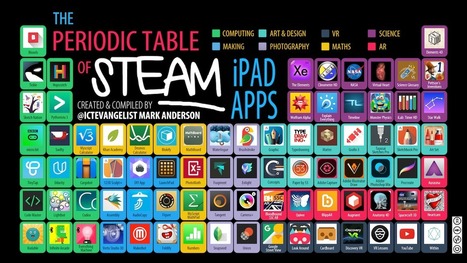
First things first. As I started in my last periodic table post, it’s never just about the apps. End of. That said being guided around tried and tested apps from the classroom can be really helpful.
This new periodic table looks at #STEAM apps, namely those that can link through to Science, Technology, Engineering, Arts and Maths. My massive thanks go to Brett Salakas, Cathy Hunt, Dean Pearman and Rachel Smith for letting me run the table under their gaze and for feeding forward some of the app ideas too.
|
|
Scooped by
Kim Flintoff
July 7, 2016 3:17 AM
|
Teachers who are most confident about educational technology tend to work in low-poverty and suburban schools, bringing their students a wide range of experiences and potential benefits that other young people may lack, concludes a survey released today by the Education Week Research Center.
For example: These teachers are far more likely than their less-confident counterparts to report daily use of digital curricula, learning management systems, and parent communication tools.
As a result, they report that their students spend roughly twice as much class time using digital tools than the students of teachers with less confidence around ed tech. These highly confident teachers also believe that their students are significantly better prepared to use technology for everything from independent research to collaboration on schoolwork via social media.
The findings, unveiled in Denver at the annual conference of the International Society for Technology in Education, come from an exclusive, not-statistically-representative survey of roughly 700 teachers. The new analysis, titled "Teachers and Technology Use in the Classroom: Exclusive Survey Results," represents an in-depth follow up to the Education Week Tech Confidence Index, released earlier this month as part of Education Week's 2016 Technology Counts report.
"We find that teachers' confidence in educational technology aligns with distinct sets of behaviors, perceptions, and choices in the classroom," according to the analysis.
|
|
Scooped by
Kim Flintoff
July 6, 2016 12:40 AM
|
Code Club Australia is pushing for a world record, aiming to have the most children coding at once.
Moonhack, which will coincide with the anniversary of the Apollo 11 moon landing on July 20, is aiming to set a new world record and keep Australia at the forefront of science and technology education too.
Code Club Australia General Manager Kelly Tagalan said coding is the language of the 21st century.
“Empowering young Australians to be able to not just dream about, but actually create their own technology is the most important lesson that they could learn to ensure their success in the future,” Ms Tagalan said.
“Our mission is make sure that every Australian child has the opportunity to learn how to code, no matter where they live or what school they go to.”
Ms Tagalan said the event would be accompanied on the night of July 20 by a livestreaming digital event produced by That Startup Show. More than 10,000 children are expected to take part.
Launched locally in 2014 by Annie Parker, the program is geared to create a nationwide network of educators and volunteers teaching kids to code through free access to tools and a curriculum designed for 9-11-year-olds. Code Club provides a free curriculum to teachers, librarians and volunteers as well as offering training and resources for educators through its Teacher Training program.
Ms Parker, who is also the co-founder and director of Telstra’s muru-D accelerator, said learning to code was quickly becoming an essential life skill.
“It gives children experience in problem solving, collaboration and helps to build their confidence as well. I can’t wait to see what future our students create for themselves,” she said.
|
|
Scooped by
Kim Flintoff
July 4, 2016 10:12 PM
|
An award-winning education expert is taking aim at reversing what he warns is a tendency for students to scoff at the sciences in favour of other subjects.
As career options, sciences have become a more unlikely choice for many because of a focus on teaching scientific facts and related data at the expense of providing opportunities for students to explore, experiment and discover, University of Notre Dame academic Dr Edward Waters argued.
Added to this problem, Waters argued, was the ongoing mistrust among some vocal commentators regarding the validity of climate science. With the often contentious topic now forming part of school curriculums, the doubt being cast over it in some quarters has unfortunately diluted the value of teaching the topic and, in turn, Waters said, suppressed students’ excitement about pursuing a career in science.
“Ironically, the humorous image of a mad scientist with wiry hair and a determined glare overlooking some fascinating experiment held much appeal to many and was a huge drawcard, I believe,” Waters said.
|
|
|
Scooped by
Kim Flintoff
July 25, 2016 8:31 PM
|
Kindergartners participating in a Johns Hopkins study demonstrated increased math performance after exercising their intuitive number sense with a computer game.
“Math ability is not static—it’s not the case that if you’re bad at math, you’re bad at it the rest of your life. It’s not only changeable, it can be changeable in a very short period of time,” said Jinjing “Jenny” Wang, a graduate student in the Krieger School of Arts and Science’s Department of Psychological and Brain Sciences. “We used a five-minute game to change kids’ math performance.”
Humans and animals are born with an intuitive sense of quantities and can demonstrate this knowledge as infants, researchers said. For instance, when presented with a choice between a plate with a few crackers and another with more of them, even a baby will gravitate to the option with more. This intuition about number is called the “approximate number system.”
Watch a video of the math research in action.
|
|
Scooped by
Kim Flintoff
July 22, 2016 8:44 PM
|
If you want to build artificial intelligence into every product, you better retrain your army of coders. Check.
Carson Holgate is training to become a ninja.
Not in the martial arts — she’s already done that. Holgate, 26, holds a second degree black belt in Tae Kwon Do. This time it’s algorithmic. Holgate is several weeks into a program that will inculcate her in an even more powerful practice than physical combat: machine learning, or ML. A Google engineer in the Android division, Holgate is one of 18 programmers in this year’s Machine Learning Ninja Program, which pulls talented coders from their teams to participate, Ender’s Game-style, in a regimen that teaches them the artificial intelligence techniques that will make their products smarter. Even if it makes the software they create harder to understand.
|
|
Scooped by
Kim Flintoff
July 22, 2016 2:30 AM
|
There once was a DNA molecule, magnified 250 million times. Its mutated form hovered above Federation Square, Melbourne, perceived only subliminally by many of the transient pedestrians below.
As a visual science communicator, science by stealth is one of my most powerful strategies. Using striking visuals, and some opportunistic positioning, it is not that hard to inject just a little taste of hard-core molecular biology into the lives of every day people who are not traditionally interested in science.
On the topic of science by stealth, science communicator Dr Craig Cormick with Kylie Sturgess in 2013 said “We’re very good at getting the converted more engaged and more interested in science. But I think we have trouble reaching those in the next category down the line that are marginally interested or occasionally uninterested. So, the challenge I find is often, how do you have a conversation about science that’s not apparently about science, that has a lot of science intrinsically built in its content… …science by stealth is often the answer.”
|
|
Scooped by
Kim Flintoff
July 21, 2016 7:03 PM
|
Activities in the Girls Who Build Cameras workshop included:
Tearing down a digital SLR camera;
Introduction to cameras;
Keynote address by Kristin Clark, a researcher from the Optical Engineering Group at Lincoln Lab, who spoke about her research in space cameras;
Building a camera using a Raspberry Pi single-board computer;
Keynote address by Uyanga Tsedev, a graduate student in mechanical engineering at MIT, who spoke about her research creating imaging probes for surgeons to identify tumors;
Introduction to image processing;
Learning to program Instagram filters using the Processing programming language; and
Demonstrations of a light-field camera, photogrammetry and 3D scanning.
The Girls Who Build Camera curriculum will be published on the MIT OpenCourseWare site, where anybody can access it.
Further information about the workshop series can be found on the Girls Who Build site.
|
|
Scooped by
Kim Flintoff
July 14, 2016 1:07 AM
|
The retraining of public school teachers to become knowledge experts in mathematics and science will be critical in addressing a present and forecasted supply deficit in NSW for those subjects, the NSW Department of Education has outlined in a report.
A spokesperson from the department said the retraining of more than 300 public school teachers over four years was part of a plan to use resources allocated to primary education more effectively in secondary areas of need.
Although NSW will have an adequate supply of secondary teachers in the curriculum areas of English, human society and its environment, and creative arts, a report from NSW Education has projected a critical shortage of teachers in mathematics.
Potential shortages were also identified in a number of other subjects, including physics, technological and applied sciences, and languages other than English.
The department’s Teaching Workforce Supply and Demand 2015 contained workforce estimates for 2016–22, projecting that there would be a shortage of specialist teachers and in some specific subjects in particular regions around the state.
|
|
Scooped by
Kim Flintoff
July 13, 2016 7:41 PM
|
How can you utilize the game “Pokemon Go” into your classroom in a meaningful way? Harnessing student excitement of this game can easily be used to support all kinds of fun and pedagogically-sound lessons and activities.
Before we start, and if you have not yet played the game, there are some vocabulary words you might need.
|
|
Scooped by
Kim Flintoff
July 12, 2016 9:46 PM
|
Best content around Program Evaluation Advocacy selected by the EdTech Update community.
|
|
Scooped by
Kim Flintoff
July 12, 2016 9:18 PM
|
There have been myriad promises made by the major political parties over the years focused on funding programs aimed at increasing the number of women pursuing careers in science, technology, engineering and mathematics (STEM).
Although some of the policies do target disciplines where women are underrepresented, there seems to be very little acknowledgement of the bigger problem.
Attracting women to STEM careers is one issue, retaining them is another. And that does not seem to get the same level of attention.
Simply trying to get more women into STEM without addressing broader systemic issues will achieve nothing except more loss through a leaky pipeline.
Higher Education Research Data from 2014 shows more females than males were being awarded undergraduate degrees in STEM fields. Early career researchers, classified as level A and B academics, are equally represented in the genders.
|
|
Scooped by
Kim Flintoff
July 10, 2016 1:09 AM
|
Deb Smith recently took over as chair of the non-profit Australian Science Innovations (ASI), which runs the Australian Science Olympiads Program – a national extension program for top performing secondary science students.
She told The Educator that in her new role she hoped to further inspire students who were already excelling in the discipline of science.
“There are two things we really want to do. The first is to support highly achieving students. The Australian Science Olympiad is about highly achieving students who are motivated and want to represent Australia,” she said.
|
|
Scooped by
Kim Flintoff
July 7, 2016 8:36 PM
|
These iOS and Web Apps are Visually Oriented and Kid-Friendly and Help to Build Critical Logic and Problem Solving Skills Computer coding is becoming an increasingly popular activity for today’s technology oriented kids. Even kids who do not plan to
|
|
Scooped by
Kim Flintoff
July 6, 2016 12:58 AM
|
The report, The VET Era: Equipping Australia’s workforce for the future digital economy, was compiled by TAFE Queensland and the CSIRO. It has pointed to a troubling gap between the skills profile of the current workforce and the growing demand for skilled workers in Australia.
Further, the report stated, even as the Commonwealth Government has embarked upon its National Science and Innovation Agenda, the focus has been on higher education, rather than on recognising the role the VET sector “can and must play” in training future Australian workers.
The paper suggested the VET sector needs to assume a greater role in addressing the skills gap, and in order to do so it requires financial backing from governments to deliver training to a larger, more diverse student population, at a higher skill level. Research showed that technology design was among the main areas where training was critically important.
|
|
Scooped by
Kim Flintoff
July 5, 2016 9:08 PM
|
The digital future has arrived. Dr Karsten Schulz, Program Manager at National ICT Australia, asks what's next for this generation.
The world's industries are changing. Careers are evolving and new roles are being created. Historically, new technologies have always led to big changes in society, but the revolution happening right now is faster and more fundamental than ever before. So we need to be prepared.
Digital technologies are more than just computer programming. A new wave of digital roles is emerging, which involve applying tech to media, science, business, sports, mining, defence, infrastructure and transport.
Data can be used to gain insights, find patterns and create better solutions to our problems. For instance, while it might seem like the way to fix a transport issue is to build a second rail track, data analysis could show that you just need a more efficient schedule on the existing track.
|