Your new post is loading...

|
Scooped by
Kim Flintoff
November 16, 2016 6:52 PM
|
Color, Astronomy and Coding
Using data from NASA's Chandra X-ray Observatory and other satellites on exploded stars, star-forming regions, and black holes, you'll learn basic coding. By following the video tutorials below, you will see just how integral coding is in the pursuit of learning about our Universe. It's an example of the exciting ways that computer science is both part of routine tasks in our every day lives and part of the exciting quest to explore the cosmos.
Launch the coding activity now or start with the resources below for background information, facilitator guides, video tutorials and student examples.
|
|
Scooped by
Kim Flintoff
November 15, 2016 11:00 PM
|
A new report from the Office of the Chief Scientist has indicated that measures to overcome barriers to women succeeding in science, maths, engineering and technology (STEM) must begin as early as primary school.
The study, titled Busting myths about women in STEM, assessed data and research and discovered that the 'attrition' of females studying in the aforementioned subject areas begins in primary school and continues throughout their journey through education and persists into the workplace. From an early age, women are believed to face obstacles such as gender bias, a lack of role models and an inability to assess their competence in the field.
"The key finding is we are losing female talent right across the STEM pipeline despite the fact there is no innate difference in ability," said report co-author Roslyn Prinsley.
|
|
Scooped by
Kim Flintoff
November 15, 2016 12:00 AM
|
Pru Mitchell discusses the importance of promoting an interest and enjoyment in STEM (Science, Technology, Engineering and Mathematics) among female students. Pru proposes seven steps for school libraries to take to further engage girls in STEM.
|
|
Scooped by
Kim Flintoff
November 9, 2016 2:34 AM
|
WE INSPIRE LEARNING
Cuberider gives high school students the opportunity to learn valuable STEM skills by designing and coding experiments that are tested in space on the International Space Station.
Our program is specifically designed to teach students creative and critical thinking, so that they become the next generation of leaders, innovators and problem solvers.
|
|
Scooped by
Kim Flintoff
November 8, 2016 9:23 PM
|
Researchers from the Argonne National Laboratory (ANL) looked at the second law in the quantum world and were able to reformulate an important theorem according to the rules of quantum mechanics. In doing so, they found that the theorem allowed for a quantum violation of the second law.
The researchers worked on a branch of science called quantum information, which takes information theory – math applied to communication – to the quantum level. Information and entropy show remarkably similar formulas and scientists working in either field have been borrowing heavily from each other.
|
|
Scooped by
Kim Flintoff
November 7, 2016 10:11 PM
|
Curtin is proudly supporting Arcadia Australia, a unique and globally renowned immersive live show which blends performance, engineering, sustainability and creativity.
The event will be held over five days in November, where Curtin will be part of two community focused days on 23 and 24 November at Elizabeth Quay.
The event has a strong focus on Science, Technology, Engineering, Art and Design, and Mathematics (STEAM), and as such will be a great opportunity to showcase some of Curtin’s innovations and highlight the many great opportunities Curtin has in STEAM areas.
The two days will welcome 20 school tours of primary and secondary students who will be able to experience Curtin’s interactive place activation including:
Science behind spider webs
3D printing
Make the spider chase the fly with our sphero robots
Digital microscope
Create your own Rube Goldberg ‘machine’ with the Curtin Library Makerspace
Chaos tower
Augmented and virtual reality
|
|
Scooped by
Kim Flintoff
November 7, 2016 7:31 PM
|
STEM projects work well when using the Solution Fluency model. From defining the problem to debriefing the solution, it all just works. Educator Amber Chase knows this well. That’s why she created a STEM project journal to demonstrate the STEM/Solution Fluency connection.
Amber is the ICT Integrator at Tamworth’s Calrossy Anglican School in New South Wales. She designed this fun STEM project journal to make the STEM planning process fun and simple with Solution Fluency. Here’s your chance to get one of your own. You can download it by clicking on the image below!
|
|
Scooped by
Kim Flintoff
November 4, 2016 2:37 AM
|
By far the most numerous inhabitants are the microbial colonies inside the body itself – there are 10 times as many bacterial cells as human cells. Most are crucial for us to break down food into the nutrients we need to survive; these immigrants pay back just as much as we give them.
In fact, looked at another way, even the small number of cells actually carrying your DNA are not purely human, since they also contain their own individual microbe. It’s a partnership that dates back to life’s earliest days. When life first evolved, the only creatures were simple, single celled organisms. Then, one day, one microbe swallowed another, which began to live inside its host. Slowly they evolved together, and the intruder became the cells’ “mitochondria” – energy generators that could power more complex bodies. Today, they fuel every plant and animal on Earth, including you.
The emerging discipline of data science combines computational thinking, mathematics, statistics, and content knowledge, paving the way for a new genre of educational technology: data science games. Funded by the National Science Foundation, our Data Science Games project is developing games and curriculum materials for middle and high school students to use data while learning science. The goal is to research the potential of this new genre of educational technology.
|
|
Scooped by
Kim Flintoff
November 2, 2016 6:34 PM
|
A new study suggests that teachers' perceptions of girls' math abilities may contribute to the gender gap in that subject.
What is keeping girls from pursuing opportunities and careers in math? Certain barriers could be perpetuated by their teachers, a new study suggests.
Starting as early as kindergarten, teachers perceive boys' math ability as higher than girls', regardless of the students' learning styles and levels of achievement, according to researchers from New York University, the University of Illinois at Urbana-Champaign, and West Chester University in a study published last week in AERA Open. This perception at such an early age could affect girls' confidence and aptitude for math and prevent them from pursuing future STEM opportunities, the researchers wrote.
|
|
Scooped by
Kim Flintoff
November 1, 2016 9:06 AM
|
This equation was published in the 1949 book The Mathematical Theory of Communication, co-written by Claude Shannon and Warren Weaver. An elegant way to work out how efficient a code could be, it turned "information" from a vague word related to how much someone knew about something into a precise mathematical unit that could be measured, manipulated and transmitted. It was the start of the science of "information theory", a set of ideas that has allowed us to build the internet, digital computers and telecommunications systems. When anyone talks about the information revolution of the last few decades, it is Shannon's idea of information that they are talking about.
|
|
Scooped by
Kim Flintoff
October 31, 2016 3:21 AM
|
REPORT OVERVIEW
Science and technology are increasingly important to Canada’s economic well-being and quality of life. A critical element for our long-term success—as individuals and as a country—is learning in science, technology, engineering and math (STEM). In the 2012 Spotlight on Science Learning1, developed by Let’s Talk Science in partnership with Amgen Canada, key benchmarks and recommendations were identified to further STEM learning in Canada.
One key benchmark the 2012 report recommended was monitoring participation in high school STEM courses. The current report goes deeper and recommends that better connections be built between job forecasts and STEM-learning demands so youth and parents are more aware of future employment opportunities. It investigates the financial, opportunity and social costs related to the current drop-off in secondary school participation in science, technology and math courses.
|
|
Scooped by
Kim Flintoff
October 28, 2016 7:51 PM
|
We asked 1000+ U.S. Gen Z students aged 11-17, and 400+ Gen Z teachers to tell us how they feel about learning, creativity and the future, and here is what we found...
Gen Z students see themselves as smart, creative and hardworking.
Technology is Gen Z’s native environment. They feel that they are more creative than past generations and more passionate about making things better and smarter. Learn more.
|
|
|
Scooped by
Kim Flintoff
November 15, 2016 11:52 PM
|
The inaugural Arcadia Australia STEAM AHEAD Community Open Days will take place at Elizabeth Quay on Wednesday 23rd and Thursday 24th November.
STEAM AHEAD will feature a range of hands on activities, interactive activations and workshops that focus on the three pillars of Arcadia Australia; Sustainability, Arts & Culture and Science & Innovation.
Arcadia’s Spider is the embodiment of STEAM – displaying impressive uses of Science, Technology, Engineering, Arts and Mathematics to bring 50 tonne’s of scrap metal to life each show, which is then neatly packed away to travel all over the world.
School groups can book into sessions from 10.00am – 3.00pm and the general public are welcome to participate in the evening open sessions from 4.00pm – 7.00pm. There will also be a food area to enjoy a bite to eat!
STEAM AHEAD is a free community event!
|
|
Scooped by
Kim Flintoff
November 15, 2016 5:24 PM
|
Minecraft is back with a new activity for the Hour of Code. Program animals and enemies in your own version of Minecraft.
For 2016, Code.org, Microsoft and Mojang are announcing the all-new Minecraft Hour of Code Designer, a tutorial that lets students code their own Minecraft rules. This year, students can use code to control how animals and other Minecraft creatures behave—they can create a totally unique Minecraft experience, and then share it with friends or play it on their phones!
The new tutorial begins in a Minecraft world where sheep don't move, the chickens don't cluck, and nothing attacks: it’s a blank slate without movement or defined action. Over the course of an hour, students will bring this world to life using computer science. At the final level, they get to define the rules of Minecraft however they wish. If they want, the cows can lay eggs, sheep can explode, and zombies can run away from players!
|
|
Scooped by
Kim Flintoff
November 9, 2016 5:06 PM
|
Nord Anglia, a network of 43 international K–12 schools, is collaborating with the Massachusetts Institute of Technology to develop science, technology, engineering, arts and mathematics (STEAM) curricula.
The curricula, already underway this fall, guides students toward adopting multidisciplinary approaches to learning and problem solving with real-world applications, according to a news release.
|
|
Scooped by
Kim Flintoff
November 8, 2016 10:30 PM
|
Perhaps you (or a colleague, friend, student, or child) have been using popular software as a means to learn to code. There are several such options available today, including Code.org, Scratch, Swift Playgrounds, and Kodu. Nevertheless, despite your best efforts with such software, you probably haven't substantially improved your programming skills. Quite simply, these solutions are poorly designed to develop the expertise required to become effective at computer programming.
Amidst sleek graphics and user interfaces, these software solutions structure problems around a visual programming system. That's a fancy way of saying that you drag and drop boxes together, where each box represents (but is not actually) code. For instance, an introductory problem might ask you to move a character 5 spaces to the right. To do so, you grab a box labeled "Move Right" and place it into the designated space. Repeat this process 5 times. Then hit the "Play" button to witness the outcome. Ironically enough, there is no coding involved!
|
|
Scooped by
Kim Flintoff
November 8, 2016 7:10 PM
|
A team of scientists unveiled a new tree of life on Monday, a diagram outlining the evolution of all living things. The researchers found that bacteria make up most of life’s branches. And they found that much of that diversity has been waiting in plain sight to be discovered, dwelling in river mud and meadow soils.
“It is a momentous discovery — an entire continent of life-forms,” said Eugene V. Koonin of the National Center for Biotechnology Information, who was not involved in the study.
The study was published in the journal Nature Microbiology.
In his 1859 book “On the Origin of Species,” Charles Darwin envisioned evolution like a branching tree. The “great Tree of Life,” he said, “fills with its dead and broken branches the crust of the earth, and covers the surface with its ever branching and beautiful ramifications.”
|
|
Scooped by
Kim Flintoff
November 7, 2016 7:32 PM
|
By allowing students to research, collaborate, discuss areas of concern, think critically and use creativity, they can begin to look at the pros and cons in an objective way. They gain the ability to generate preventive steps and find possible solutions when dealing with technology advancement. Preparing students to view ethics surrounding technology decisions with a global view in mind is crucial when observing how technology and ethical decisions are handled throughout the world.
Whether or not we ever become technology or not, we must continue to approach it with respect to human nature — understanding the benefits, identifying the concerns, and recognizing the value of being autonomous in a world where man and machine continuously interact.
|
|
Scooped by
Kim Flintoff
November 6, 2016 11:42 PM
|
Fritzing is an open-source hardware initiative that makes electronics accessible as a creative material for anyone. We offer a software tool, a community website and services in the spirit of Processing and Arduino, fostering a creative ecosystem that allows users to document their prototypes, share them with others, teach electronics in a classroom, and layout and manufacture professional pcbs.
|
|
Scooped by
Kim Flintoff
November 3, 2016 2:13 AM
|
If our Committee for Economic Development of Australia (CEDA) report is right that 40 per cent of jobs existing today will be gone within 10 years, children now in primary school need an education that prepares them for a very different future.
One response is a greater emphasis on STEM (science, technology, engineering and maths) learning in schools. This is commendable and necessary, but not enough on its own.
It's time for Australia to take a "systems" approach to innovation, rather than a purely linear one, if we are to use our budding scientists, engineers and mathematicians to best effect.
Futures.edu is part of Spark Festival Sydney, a celebration of Australian start-ups, supported by Jobs for NSW and the City of Sydney, which runs until October 30.
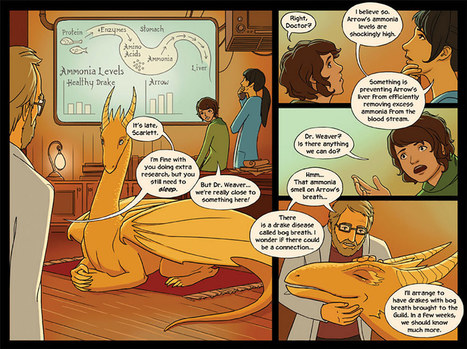
Geniverse is a digital game where high school biology students put genetics knowledge into action as they breed virtual dragons. Now we’re sending our dragons into afterschool programs, specifically those that support underserved middle school youth, with the goal of connecting the students with local biotechnology professionals to strengthen their awareness of STEM careers.
The GeniConnect project, funded by the National Science Foundation, will couple a “next-generation” version of the Geniverse game with coaching from biotechnology industry professionals, hands-on activities and experiments, and visits to local labs to introduce participants to careers in the burgeoning field of biotechnology. Since the research and treatment of human disease is at the core of much of the biotechnology industry, students will encounter dragons with disorders in Geniverse and learn about their real-world parallels and research leading to treatments. Helping students better understand how issues they encounter in their daily lives—for example, the current prevalence of genetic diseases such as diabetes—are being addressed through science is at the core of making science relevant and helping students envision themselves as future scientists.
|
|
Scooped by
Kim Flintoff
November 2, 2016 6:21 AM
|
The team reports fully restoring the memory function of 75 percent of the mice they tested it on, with zero damage to the surrounding brain tissue. They found that the treated mice displayed improved performance in three memory tasks - a maze, a test to get them to recognise new objects, and one to get them to remember the places they should avoid.
"We’re extremely excited by this innovation of treating Alzheimer’s without using drug therapeutics," one of the team, Jürgen Götz, said in a press release. "The word ‘breakthrough’ is often misused, but in this case I think this really does fundamentally change our understanding of how to treat this disease, and I foresee a great future for this approach."
The team says they’re planning on starting trials with higher animal models, such as sheep, and hope to get their human trials underway in 2017.
You can hear an ABC radio interview with the team here.
|
|
Rescooped by
Kim Flintoff
from :: The 4th Era ::
October 31, 2016 8:00 PM
|
"Frankly, it's quite possible that 80% of the jobs that people do today won't exist in the future. It's not quite clear where we go from here."
This is a big claim coming from a man whose company employees over 80,000 people. Stuart Gulliver, the CEO of HSBC, agreed with Patterson's point. HSBC employees over 265,000 people globally.
Gulliver, who was on the panel with Patterson, said: "It's unlikely that there will be the same number of jobs in today's skill set in five years time."
Via Jim Lerman
|
|
Scooped by
Kim Flintoff
October 29, 2016 2:09 AM
|
It’s not a bad day at work. Five of the biggest fundamental problems in physics seem sorted in one go. The model that can do this, formulated by Guillermo Ballesteros at the University of Paris-Saclay in France and his colleagues, may explain dark matter, neutrino oscillations, baryogenesis, inflation and the strong CP problem.
Dubbed SMASH, the model is based on the standard model of particle physics, but has a few bits tacked on. The standard model is a collection of particles and forces that describes the building blocks of the universe. Although it has passed every test thrown at it, it can’t explain some phenomena.
|