 Your new post is loading...

|
Rescooped by
Clairelouise
from KochAPGeography
May 27, 2013 9:32 AM
|
"Many of us have heard the stories of how our parents or grandparents had to walk miles in the snow to get to school. Perhaps some of these tales were a tad embellished, but we got the point. A lot of American kids have the luxury of being driven in a warm car or bus to a good school nearby. This is not the case for the children in this gallery. The photos you are about to see are snapshots of the treacherous trips kids around the world take each day to get an education. Considering there are currently 61 million children worldwide who are not receiving an education—the majority of which are girls—these walks are seen as being well worth the risk. In the above photo, students in Indonesia hold tight while crossing a collapsed bridge to get to school in Banten village on January 19, 2012.Flooding from the Ciberang river broke a pillar supporting the suspension bridge, which was built in 2001."
Via Brian Koch
|
|
Rescooped by
Clairelouise
from Carrie's APHG
May 27, 2013 9:19 AM
|
"In 1979, the National Population and Family Planning Commission in China enacted an ambitious program that called for strict population control. Families in various urban districts are urged to have only one child—preferably a son—in order to solve the problems related to overpopulation. What has happened since then and what are its implications for the future of China?" This is an excellent infographic for understanding population dynamics in the world's most populous country.
Via Matthew Wahl, Carrie Rudder
|
|
Rescooped by
Clairelouise
from AP Comparative Government
May 26, 2013 12:49 PM
|
After years of relying on state spending to supercharge growth, China’s new prime minister, Li Keqiang, said the government would seek to unleash the nation’s creative energies.
Via Janet Espinosa
|
|
Scooped by
Clairelouise
May 26, 2013 12:44 PM
|
"In a new series of four eight-minute videos, National Geographic Emerging Explorer Aziz Abu Sarah is a cultural educator working to build relationships between Israelis and Palestinians in Jerusalem and throughout Israel. In this series of four eight-minute videos, Abu Sarah meets with people from both sides of the conflict in order to better understand and communicate how this international dispute impacts their everyday lives."
|
|
Scooped by
Clairelouise
May 24, 2013 4:06 PM
|
I'm an American male in the Bay Area working for a Kenyan tech company called Ushahidi. I think that’s pretty cool—and that really couldn’t have happened five years ago.
|
|
Scooped by
Clairelouise
May 23, 2013 7:22 PM
|
Curating and sharing stories should be understood as part of a knowledge economy. If stories are tribal currency, then curators are money handlers.gdecugis's insight:The world has changed and so did the economy.
|
|
Scooped by
Clairelouise
May 23, 2013 6:18 PM
|
The revision of History
Naples Daily News (blog)
He is the author of The Government Against the Economy (1979), which was praised by both F. A. Hayek and Henry Hazlitt, and Capitalism: A Treatise on Economics (1996).
|
|
Scooped by
Clairelouise
May 23, 2013 6:14 PM
|
Liberalizing the economy and strengthening democratic centralism seem to be the goals of the new leadership in China. Can it be done? Oh, and by the way, they'll not have any Chinese Khrushchevs or Gorbachevs there.
|
|
Scooped by
Clairelouise
May 23, 2013 6:09 PM
|
The original image of Merida was precious and clung to by moms who adored Merida for her adventures, her love of her family, and her resemblance to the young girls they know and love.
|
|
Scooped by
Clairelouise
May 23, 2013 6:01 PM
|
Parents adopt own rules to curb children's 'media diet'
USA TODAY
Common Sense Media, a San Francisco-based nonprofit that advocates for child and family issues, studied the effects media and technology have on young users.
|
|
Scooped by
Clairelouise
May 23, 2013 5:57 PM
|
Don't be fooled: Gold is no currency MarketWatch And without those rates, there's no forward market with which to gauge the comparative returns on gold versus different currencies over time, no way to speculate on their differing outlooks, and no...
Any civilization in the last 5,000 years can only be understood and measured by what we can read and discover about them. If they did not keep track of their accomplishments and cultures, chances are, we would know very little about them and their achievements. --If you do not know where you came from, do you really have a good idea of where you are headed? --How do you build upon the accomplishments of the past or avoid the mistakes of the past if you are unaware of them? These seem to be good questions to ask people who do not have a good grasp of how this country started and developed throughout the last 200 years. As was pointed out by one museum curator, those in the last generation (the Great generation of World War II) seemed to have more of a focus on working to keep a strong account of our heritage, whereas the next several generations seem to be less and less concerned about our history and preserving the artifacts of the past. Should we blame our educational system and teachers? Why teach history if it is not on the standardized tests? This could be an article or two in itself, but it is a sad commentary to go from one generation to the next and find that one generation could identify and name every plane that flew in World War II. The next generation was able to at least identify who were on what sides of the Allies and Axis powers to the next generation of not knowing who fought in the war and why. “Was it over when the Germans bombed Pearl Harbor?” Sadly, that movie quote is as accurate as some people’s understanding of the most major events of the 20th century. It gets worse if you ask people about the 19th century in America. Click headline to read more--
Via Chuck Sherwood, Former Senior Associate, TeleDimensions, Inc
|
|
Scooped by
Clairelouise
May 23, 2013 5:50 PM
|
The Syrian disaster is like a superstorm. It’s what happens when drought, a fast-growing population, a repressive and corrupt government, and sectarian and religious passions combine.
|
|
|
Rescooped by
Clairelouise
from KochAPGeography
May 27, 2013 9:32 AM
|
|
|
Rescooped by
Clairelouise
from Carrie's APHG
May 27, 2013 9:16 AM
|
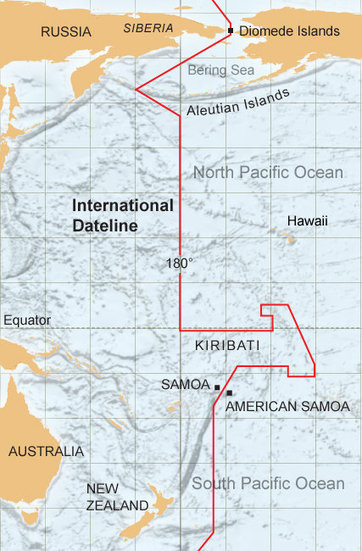
The story behind the the International Date Line. Not too long ago (Jan. 2012), the arbitrary International Date Line (roughly opposite the Prime Meridian) was moved to better accommodate the regional networks and economic geography of the area straddling the line. American Samoa, although politically aligned with the United States, was functionally more integrated on the Asian side of the Pacific Rim when it came to their trade partners and their tourism base. Dynamic economic networks, political allegiances and cultural commonalities create a beautifully complex situation near this 'border.'
Via Carrie Rudder
|
|
Rescooped by
Clairelouise
from The 21st Century
May 26, 2013 12:47 PM
|
We've discussed the benefits of the U.S. Library of Congress many times on Edudemic. Usually we focus on some particular parts of the vast amount of resources or instead offer a more overall picture of what it offers.
Via Dr. Susan Bainbridge
|
|
Rescooped by
Clairelouise
from Mr Tony's Geography Stuff
May 25, 2013 10:52 AM
|
Though he never actually crossed it, the Greek mathematician Pythagoras is sometimes credited with having first conceived of the Equator, calculating its location on the Earth’s sphere more than four centuries before the birth of Christ.
Via Tony Hall
|
|
Scooped by
Clairelouise
May 24, 2013 3:57 PM
|
For as much as $20,000, Worldwide Motion Picture Group compares the story structure and genre of a script with those of released movies, looking for clues to box-office success.
|
|
Scooped by
Clairelouise
May 23, 2013 6:52 PM
|
Media literacy is a vital skill today when mass media is so omnipresent and influential. Understanding how the news media works and doesn't work should be a core competency for everyone. Had Moeser taken my 100-level ...
|
|
Scooped by
Clairelouise
May 23, 2013 6:15 PM
|
Black middle class: aspirational and on the move
The Media Online
This is driven by a sense of financial literacy, recognition of their skills, enablement and is represented in the choices they're experiencing.
I got a couple of emails recently from some of the readers of Educational Technology and Mobile Learning asking about a way to print infographics in poster size. Well, this is a real problem for most of us who do not have access to those large printers and sometimes it becomes frustrating especially when you come across an awesome infographic that you want to hang on your classroom wall. Here is a workaround for this problem and I hope it helps. Click headline to read more--
Via Chuck Sherwood, Former Senior Associate, TeleDimensions, Inc
Waiting hours for a cellphone to charge may become a thing of the past, thanks to an 18-year-old high-school student's invention. She won a $50,000 prize Friday at an international science fair for creating an energy storage device that can be fully juiced in 20 to 30 seconds. The fast-charging device is a so-called supercapacitor, a gizmo that can pack a lot of energy into a tiny space, charges quickly and holds its charge for a long time. What's more, it can last for 10,000 charge-recharge cycles, compared with 1,000 cycles for conventional rechargeable batteries, according to Eesha Khare of Saratoga, Calif. "My cellphone battery always dies," she told NBC News when asked what inspired her to work on the energy-storage technology. Supercapacitors also allowed her to focus on her interest in nanochemistry — "really working at the nanoscale to make significant advances in many different fields." To date, she has used the supercapacitor to power a light-emitting diode, or LED. The invention's future is even brighter. She sees it fitting inside cellphones and the other portable electronic devices that are proliferating in today's world, freeing people and their gadgets for a longer time from reliance on electrical outlets. Click headline to read more--
Via Chuck Sherwood, Former Senior Associate, TeleDimensions, Inc
Simply having a college degree will not get you hired. We need to break away from this idea. In all reality, most employers could care less about your GPA or where you went to school. Today, getting hired in entry-level positions requires experience and fine-tuned skills, not a 4.0 GPA. This probably isn’t what most new grads want to hear, but it’s the truth. Many new college graduates enter their job search with a why-wouldn’t-someone-hire-me mindset. But most employers aren’t going to take on an entry-level hire unless they’re certain they’ll positively impact the company. So the real question for new graduates to consider is this: What can you bring to the table that makes you worth hiring? Here’s some food for thought for those entering the workforce: Click headline to read more--
Via Chuck Sherwood, Former Senior Associate, TeleDimensions, Inc
|
|
Scooped by
Clairelouise
May 23, 2013 5:56 PM
|
Why Austerity Kills: From Greece to US, Crippling Economic Policies Causing ...
Truth-Out
"Because the Italian government's austerity budget had raised the retirement age, Mr.
Here's an amusing one out of the UK. Nick Henderson has created something of a Swiftian "modest proposal" for people who feel guilty about infringement. Modeled after the idea of carbon offsets to become "carbon neutral," he suggests a process for becoming "piracy neutral," which is that if you happen to infringe by downloading an unauthorized song, you should freely release a track of your own composition into the world without restrictions. Click headline to read more and watch video of his proposal--
Via Chuck Sherwood, Former Senior Associate, TeleDimensions, Inc
|

















It is sad what so many children must endure and go through in order to get an education. I wonder if these bridges and structures have been fixed. 61 million children not receiving an education is 61 million too many.
unit 6 economic development
This is really hard to see. Children shouldn't have a hard journey getting to school to get an education and better their lives. These photos are from ten places around the world with the most dangerous journeys to school. This isn't a topic that even comes to mind because many of us living in the United States have had the luxury of being driven to school or riding a bus and we take that simple drive for granted. One of the photos is from Indonesia where students have to cross a collapsing bridge to get to school. The image shows them hanging on for dear life while trying not to fall in the water underneath them. There was a flood that broke the pillar holding this bridge up and it was never fixed after that. What happens when that bridge fully collapses? There needs to be a better way to get these kids to school. These children shouldn't have to suffer with getting their education for situations that are out of their control.