


What Does Good GeographyTeaching Look Like? Answering the Big Questions in Geography.

SoRo class
5.2K views |
+0 today
 Your new post is loading...
 Scoop.it! 
The UN projects Kenya to grow older and healthier 

Lauren Stahowiak's curator insight,
March 17, 2014 4:59 PM
The UN projects that Kenyans will grow older and healthier. Infant deaths will decrease and age expectancy will increase. What will Kenyans have to do to be healthier? Lifestyle changes? 
Nathan Chasse's curator insight,
March 25, 2014 1:49 PM
This article provides statistics for the population growth of Kenya and other African nations in relation to the rest of the world. Africa features some of the world's highest birthrates and the world's youngest population. In Kenya, improving healthcare will see the life expectancy rise significantly due to less infant death while the population will become older as birthrates begin to decline, as they tend to do as a nation develops, but not before Kenya becomes one of the more populous nations in the world.
Kenya's growing population and increasing median age could mean good things for its economic prospects. Population growth along with maturation means there is a large and capable workforce available, but Kenya must have the resources and abilities to create jobs for its burgeoning population or face widespread poverty. 
Jess Deady's curator insight,
May 4, 2014 4:01 PM
As the years go on, the world is learning how to live longer. With new medicinal practices and people supplying clean water and food to third world countries, there is definitely room for Kenya to grow old with the U.S. and other countries that have higher life expectancies.
Scoop.it!

A 12-year plan to move hundreds of millions of rural residents into cities is intended to spur economic growth, but could have unintended consequences, skeptics warn.
Scoop.it!

In today's post I'm sharing information I gave to my students about the differences between summarizing and synthesizing information in terms of reading strategies and research. Via Joan Vinall-Cox
Scoop.it!

The view that literary fiction educates and civilizes its readers is widespread, and unproven." Via GoogleLitTrips Reading List, Joan Vinall-Cox

GoogleLitTrips Reading List's curator insight,
June 2, 2013 11:58 AM
If you teach literature you must read this article.
Really! You may not like it. But it presents a question and an argument worthy of deep consideration.
And in what might be a bit of a surprise, I have to admit that I am in agreement with much of what is presented.
There is little evidence that there is a direct link between reading great literature and its civilizing impact on humanity.
IF THE QUESTION IS "Does great literature make us better?
However, IF THE QUESTION IS "Can great literature make us better?" then there is tremendous evidence of its ability to inspire, even in the long-term, our decisions and actions in the presence of life's many ethical challenges.
And even using the word "our" in the preceding sentence is a bit of a misleading and simplistic over-generalization. More accurately perhaps would be the replacing of the words "...our decisions and actions in the presence of life's many ethical challenges..." with "...many people's decisions and actions in the presence of life's many ethical challenges.." as it might be more accurate to suggest that some people do benefit from reading great literature while others do not.
And, to be even more accurate, it might be better to suggest replacing "...many people's decisions and actions in the presence of life's many ethical challenges..." with "...many people's decisions and actions in the presence of many of life's ethical challenges..." because even for the most dedicated bibliophile, none of us would suggest that reading great literature is a panacea-like preventative inoculation.
There are simply too many variables that influence our decisions and actions in the face of life's ethical challenges to assign any universal conclusions. There is a world of difference between the question "DOES ____ make us better?" and "CAN _____ make us better?"
Personally, I'm convinced that literature and great art and spiritual beliefs and scientific discoveries and superstitions and wealth and poverty all have the potential for influencing our actions in the face of life's ethical challenges. And, that potential influence can actually influence people to sometimes make better ethical choices and sometimes make worse ethical choices.
There are as some quite literate people believe and other quite literate people reject, many paths. No two of us take the same life journey. Nor are our decisions and actions influenced in exactly the same ways when we do share bits and pieces of our life's journeys.
All of this is not to say that literature can not be defended if it can not be supported by evidence that it DOES make us better. But, I'm willing to bet that in representing the most articulate expressions of humanity's great questions, regardless of the original cultural, religious, social, economic or other circumstances influencing its creation, most have a universal common core of the very questions that CAN lead to influencing humane behaviors for many.
And for that reason, I can't help but believe that storytellers have always held an important "go to" place in every cultural in every age.
The warning though at the end of the article, is well worth heeding... _____
"I have never been persuaded by arguments purporting to show that literature is an arbitrary category that functions merely as a badge of membership in an elite. There is such a thing as aesthetic merit, or more likely, aesthetic merits, complicated as they may be to articulate or impute to any given work."
"But it’s hard to avoid the thought that there is something in the anti-elitist’s worry. Many who enjoy the hard-won pleasures of literature are not content to reap aesthetic rewards from their reading; they want to insist that the effort makes them more morally enlightened as well. And that’s just what we don’t know yet." _____
Scoop.it!

Russian cuisine, as can be expected, is a multifaceted phenomenon, varying with time, space, and social class.
Scoop.it!

From
io9

Pretty wild, right? It's a map of Pangea — a supercontinent that formed roughly 300 million years ago — mapped with contemporary geopolitical borders.

Steven Flis's curator insight,
December 17, 2013 3:27 PM
My favorite part about this map has to be its unintentionaly demographich connecter (If that even makes sense) for example along the south east part of the united states their are alot of latin americans and on this map the two continents are brought closer to each other to match the cultural demogaphic. To continue this the east coast and dixie are have a massive african american population. and again the african continent is brought close to people who have ancestreal roots to it. I know that pangea is not the reason why each culture settled in its respetive area just funny how well that worked out.
Scoop.it!

Try to replicate it with development schemes all you want, but you're overlooking what makes New York City—and other places of ambition—so great.

Matthew DiLuglio's curator insight,
November 27, 2013 6:31 PM
I think that historical opportunity is what makes NYC so great... well, great as implied by the writers of this article. Having a good history, it is only natural that it would become something so popular and draw the ambitious to it. In contrast, a newly formed colony of humans on Mars would be potentially better- because in this hypothetical/planned colony, people would be able to benefit from the fact that they are building from the ground up, from scratch, and with the knowledge of other development schemes/trends that occurred elsewhere. This could entirely circumvent all ill aspects of society... Sometimes to create, one must first destroy... perhaps NYC should be rebuilt to eliminate problems, before humans move on to other worlds? I thought NY was a bit of a mess when I drove through with my cousin. The graffiti was gorgeous, but the filth and traffic were quite triumphant, and it is not a place where my ambition would lead me. I think true talent will be found, regardless of this subliminal advertisment brought about by the article endorsing NYC as a 'place of ambition.' Not all of us can go to these 'meccas' of talent... but it doesn't mean we are any less extravagent as life forms. I would ask if most people would want to make it big in places like that, or if they would rather be happier, elsewhere.
Steven Flis's curator insight,
December 17, 2013 2:53 PM
This reminds me of the production method idea you taught us where even though you may be able to produce 2 products better than a third world country it is for the best if you have them do what they excel at while you do your thing. (You made a lebron james reference in class). the reason why im connecting this is because every city has its own thing to offer with San fran being the arts portland with the mom and pop shops and new york with the enterainment. if you can excel at what you do then your city can blossom.
Scoop.it!
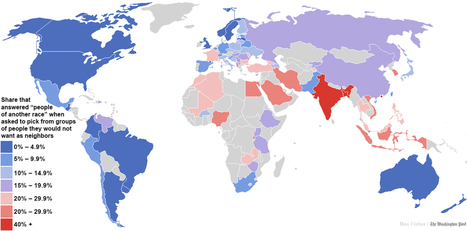
When two Swedish economists set out to examine whether economic freedom made people any more or less racist, they knew how they would gauge economic freedom, but they needed to find a way to measure a country's level of racial tolerance. Via Matt Beiriger
Scoop.it!
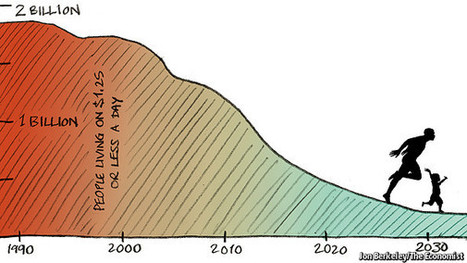
IN HIS inaugural address in 1949 Harry Truman said that “more than half the people in the world are living in conditions approaching misery. For the first time in...
Scoop.it!

Several earlier GeoCurrents posts examined the history and geography of culinary vocabulary, particularly words for ‘cheese’, ‘onion’, and ‘tea’.
|
Scoop.it!

It's already unlikely we'll get a view as good as the ones collected in "Earth As Art"
Scoop.it!

From
www
With theaters — particularly larger theaters — chock full of men's stories, where did the women go?
Scoop.it!

"Many of us tend to think of Antarctica as a sheet of solid snow and ice. But, in contrast with its peer to the north, the southern pole's ice sheet lies atop a rocky continent. What are its features, its mountains and valleys, plains and coastlines? A new dataset from the British Antarctic Survey provides the most detailed map ever of the bedrock below, information scientists hope will enable them to better model the affects of climate change on the ice, whose melting will have an impact on climate the world over."

Jason, Charlie's curator insight,
October 3, 2013 1:33 PM
This is the Intellctual part of Antarctica. This video talks about what is underneathAntarctica. Its' ice is flowing out towardsstone sea and could contribute to sea rise. If Antarctica didn't have anymoreonce our ocean would have a major rise but Antarctica would be a new place.
Scoop.it!


Nik Peachey's curator insight,
June 5, 2013 9:20 AM
Create online quizzes from templates and use them in class. Great to get students creating peer reviews of materials.
Scoop.it!
"This case study examines the challenges of human well-being and urbanization, especially in the megacity of Jakarta."

Tracy Galvin's curator insight,
May 1, 2014 2:25 PM
It is nice to see an organization that is not just blindly giving resources to people in need but actually empowering them and training them to be able to get the things they need through work. The women in this story describe how they have learned to make and sell things in order to take care of their families and they describe how empowering that feels. 
Mark Hathaway's curator insight,
November 28, 2015 6:53 AM
Megacities are beginning to populate the entire globe. In the developing world, more and more megacities are beginning to form. Jakarta Indonesia is an example of a rising megacity. This rapid urbanization has placed a special burden on the resources and local economies of many developing nations. This areas are not prepared to deal with the rapid population growth associated with the development of a megacity. This strain placed on the local areas, will often lead to terrible living conditions for the lower classes of society. Sanitation will often become a major issue in many of these megacities. Large portions of the population will often lack a proper sanitation system. The lack of proper sanitation will lead to the onset of deadly diseases. The effects of rapid urbanization can be deadly, for those living in the pooper regions of society.
Scoop.it!

Rust Belt population woes tend to be a lack of inmigration, not outmigration and brain drain as is commonly assumed.
Scoop.it!

A decades-long war over river flow into Apalachicola Bay in Florida has contributed to the collapse of the oyster industry there.
Scoop.it!

Life can get complicated in Xinjiang, the far-Western Chinese province perhaps best known as the home of ethnic Uighurs, who are majority Muslim. Via Matt Beiriger
Scoop.it!
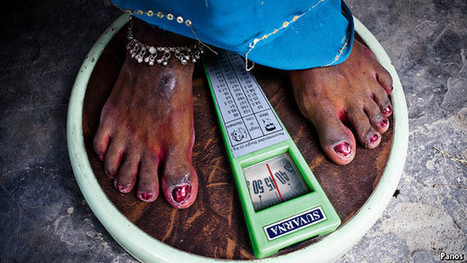
IN SEPTEMBER 2000 the heads of 147 governments pledged that they would halve the proportion of people on the Earth living in the direst poverty by 2015, using the...
Scoop.it!

You were right all along: It IS the media's fault
Scoop.it!

Deconstructing History gives you all the facts and figures on history's most famous places, statues and structures, from Mount Rushmore and the White House to the Parthenon and the lost city of Pompeii. Via Mike Busarello's Digital Storybooks
|






