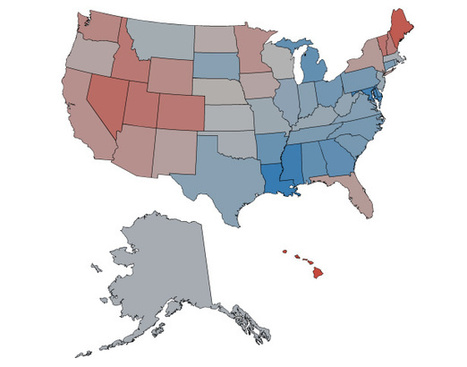

The happiest city in America is Napa, California -- and the saddest all swear too much.

 Your new post is loading...
 Scoop.it! The happiest city in America is Napa, California -- and the saddest all swear too much. 
No comment yet.
Sign up to comment
Scoop.it!
"This video shows the basic concept of HDI (Human Development Index), by using four different examples (Japan, Mexico, India and Angola)."
Scoop.it!

“ Decision to build thousands of illegal structures on occupied land called threat to talks with the Palestinians.”
Via Mr. David Burton
Scoop.it!

“ Teen birth rates by state, 2008, USA Related: Teenage Pregnancy Rates (per 1,000), By State, in 2008 Teen Birth Rate in the U.S. (Teen birth rates by state, 2008, USA Related:Teenage Pregnancy...”
Via Mr. David Burton
Scoop.it!

“ Author Dante Chinni's breakdown of who we are, and how we live.”
Via Joel Leagans
Scoop.it!

Mannequins with bulging bosoms have become standard in Venezuela, reflecting the country’s embrace of plastic surgery even among those who can least afford it. Via Seth Dixon

Seth Dixon's curator insight,
November 7, 2013 9:34 AM
Unrealistic manniquins are nothing new...but society produces mannequins and the mannequins are a part of the cultural landscape that has some normative ideals of beauty and gender. How does the media and society's images of the 'ideal body' influence and shape cultural values and aspirations? On the opposite side of the spectrum watch this video about the production of manniquins modeled on people with disabilities. The tag line for the project was "because who is perfect anyway?" 
Albert Jordan's curator insight,
February 12, 2014 6:39 PM
It comes as no surprise that mannequins are becoming “sexier” in other markets as countries develop and become more consumer driven. We can already see the evolution of the store mannequin in the United States as every few trends it will change its form to what is the attractive norm. Right now, “curvy” focused mannequins are beginning to show up in store front windows as a push for more natural bodied women in advertising grows. The evolution of the Venezuelan mannequin may be a bit more extreme but it goes to show the cultural change(or regression, depending on how you feel about body image) of an area as well as the influence put on it by globalization and even regional influence. As the article states, Venezuelan women have begun to undergo plastic surgery to “improve their self-esteem.” While not many do, it becomes a status symbol to have an operation. Even some shop owners, when told by the costumer that they wish to look like the mannequin, are told to go get an operation. While here in America, the plastic surgery trend began to die off and is now seen as for those who are superficial or materialistic. However, this trend had been seen in Brazil many years prior to Venezuela today and it can probably be safely assumed that because these two countries share a border, certain trends and elements of culture have gone back and forth. As western media penetrates further and further into traditionally institutionalized anti-western countries, the advertising effects on body image will change as more companies that deal with fashion, make up, and image begin to do business, invest, and advertise. Especially so in a Latin society where men are still typically held in higher regard, competition amongst women could fuel the importance of looks. The maker of the “new and improved” mannequins has made quite an income out of it. Many of the shopkeepers who use the mannequins have even seen an increase in revenue. In Venezuela there is also a culture of aesthetics and a certain pride in what is perceived as beauty, due in part to the countries own scenic magnificence . Although a socialist country who’s past and now deceased President was very critical of the “Western” and American influence, Venezuela had nourished a culture of easy money and consumerism due to the wealth of its oil reserves and the cheapness at which its citizens were able to buy it. During the late President Hugo Chavez’s reign, the government attempted to dissuade the desire for plastic surgery by saying the money being spent by poor women on plastic surgery should be going to more important needs. Nevertheless, sometimes cultural and societal demands can be as powerful as governmental demands and advice. Again, globalization and consumerism can drive a cultural phenomenon. The owner of the store wanted to attract more buyers of his mannequins and so he made them “sexier.” By doing this, he put into the minds of the women looking at them that if they dress like that statue or shop at that store, they will look as good. Even if it is unrealistic, the placebo affect is almost just as good as the real thing.
Scoop.it!

"I recently saw this map in a Washington Post article about modern day slavery and was immediately was struck by the spatial extent and amount of slaves in today’s global economy. As stated in that article, “This is not some softened, by-modern-standards definition of slavery. These 30 million people are living as forced laborers, forced prostitutes, child soldiers, child brides in forced marriages and, in all ways that matter, as pieces of property, chattel in the servitude of absolute ownership.” This map shows some important spatial patterns that seem to correlate to economic and cultural factors."

Jessica Rieman's curator insight,
March 19, 2014 5:04 PM
MOdern Slavery is a huge problem throughtout the world and especially in Africa and surrounding sister countries. For example, in Africa this map shows us that the slave rate is more than .75 this indicates that there is a small percentage of the country that is not enslaved in some way. This is outrageous for the modern society to think of in todays world especially because as Americans we think of the slave trade and slavery being something that happened many years ago and then slavery was abloished and now nothing bad happens anymore well we couldn't be more WRONG! AMericans are mostly ingornat to the fact that although slavery is not announced in surronding counintents and countries does not mean that it doesn't exist. Another example of this is the Somali blood diamonds and how the children become toy-soldiers and are turned into rebels because if they dont they will be killed so this is the type of society where it is kill or me killed. These CHILDREN are trained to kill anyone and everyone who gets in their way; taken away from their families at a young age and then brainwashed into using their ignorance as bliss. 
Logan Haller's curator insight,
May 25, 2015 9:51 PM
This article has to do with unit 6 because it deals with development.This article explains how 30 million people work as forced labors, forced child soldiers, forced brides and many other forced things. The map illustrates spatial patterns on economic and cultural factors on where the people enslaved are. The map shows that India is 1.1% enslaved.People say that fair trade and not free trade will lead to sustainable economic growth and lower social injustice. Two questions asked by the article is what realistically can we do to lessen slavery in the world today, and how our our own spending habits part of the system. The article also includes a video on some of the ways the slaves are treated poorly . 
8A JonathanS's curator insight,
February 9, 2017 7:19 AM
https://geographyeducation.org/courses/regional-geography-geog-400/modern-slavery/
This article describes when people in Africa are victims of modern day slavery. It tells us how people are forced into working long long hours a day with no breaks, barely any food or water and a very unsafe working environment. Some examples of what these poor people are forced into working as are laborers, prostitutes, child soldiers, child brides. Many people are also forced into marriages and illegal mining and smuggling of goods across borders . There are currently about 30 million modern day slaves all over the world. Their mostly in large parts of Africa and most of India. There's also some in Europe and in the U.S. One of the most unsafe working environment these slaves are forced into working in are the illegal mining projects. Their forced to work long hours in a mine that could collapse any second with nothing but a cheap flashlight tied to their head and a shovel or spade.
I think this article connects to what were working on in class about modern slavery and Africa. I think this is very sad because I think everybody has the right to do what they feel like and deserve their freedom just like most people. This is extremely unfair and I think that more people should try and do something about it. Of course there are already loads of people trying to prevent this issue from spreading and I think it's a very kind and respectful thing to do. I did learn a lot from this article tho and the TED talk. One thing I learned was that this problem mostly appears in Africa. I honestly though that Asia and more parts of South America would have this issue as well. So yes, I learned quite a lot from this and I think that it was a good article with lots of useful information and I got a lot of emotional feelings from seeing the video.
Scoop.it!
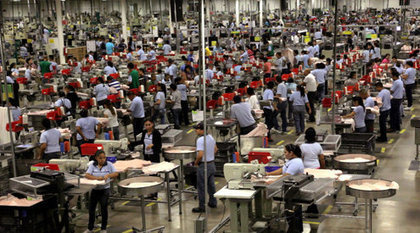
Some four decades after welcoming foreign assembly plants and factories, known as maquiladoras, Mexico has seen only a trickle of its industrial and factory workers join the ranks of those who even slightly resemble a middle class.
Despite making such consumer goods like BlackBerry smartphones, plasma TVs, appliances and cars that most people in the US, for instance, consider necessities, Mexican workers in these factories seldom get to enjoy these items because, as this article argues, the labor system keeps them in poverty. Foreign investment in these businesses keep unions out and attracts workers from poorer areas, allowing low-cost labor to prevail. Less than $8 a day is the going wage - great for the bottom line and consumer prices but very bleak for those who toil in this system.
Jessica Rieman's curator insight,
February 4, 2014 12:47 PM
The labor system keeps workers in Poverty. This is the argument that is transitioned by stating the fact that many factory workers are and will always remian in poverty if they have no oppurtunity to move up in the food chain and become educated in order to get themselves out of poverty. They need different skills in order to aquire a better job to create a better life. 
Edgar Manasseh Jr.'s curator insight,
February 11, 2015 11:33 PM
Its a very sad situation reading this. Seeing people go through all this to just survive. Kids don't even get any education and follow their parents footsteps to work at a plant just to be able to pay for bills. 8 dollars a day, and you wonder why they try to run to united states. Its very unfortunate that a lot of people go through this and i hope it changes soon, because to see that this is going on makes me thankful for what i have around me. Foreign investors are not great as they set out to be take advantage of the poor and get rich out of it, i think its pretty ridiculous. 
Matt Danielson's curator insight,
September 24, 2018 1:31 PM
This is a sad story of struggling in Mexican factories. These factories are a double sided blade. The plus is that these factories bring in jobs and relative safety to the communities( more jobs=less crime, also id imagine factories garner more protection provided by the state via police). The downside is the stagnant low wages and terrible living conditions. Though wages are better than they previously were they are not rising near the rate of other countries going through similar economic change. This reminds me of what the industrial revolution was like in the United States.
Scoop.it!
Watch more at http://www.socionomics.net/youtube/wave. Robert Prechter shows you how popular music and movies reflect movements in the stock market. From his...
Scoop.it!

Residents of rural areas feel shut out of their states' politics, so why not create their own?

Heather Ramsey's curator insight,
November 18, 2013 2:25 PM
On election day this year, several Colorado counties voted on whether to secede from Colorado and create a new state. Many of the counties voted in favor of the idea. (See the link below for more info on the Colorado secession movement.) This is not the first time groups of Americans have considered (and voted on) breaking away from their state. When political issues come up and decisions are made by the government and/or the people, some get their way and others do not. The article explains one way that some people have decided to take action when they do not feel their interests are being served.
BONUS for my students: 1) What steps do you think should be taken before people consider seceding from their state? 2) What are some possible pros and cons of breaking away from a state to create a new one? 3) Hypothetically speaking, what would it take for you to want to create a new state?
Here is the link to the article about Colorado's secession movement: http://abcnews.go.com/Politics/wireStory/colorado-rural-voters-approve-secession-idea-20850962 
Victoria McNamara's curator insight,
December 11, 2013 11:43 PM
Some states urban and rural areas have had differences and beliefs when it comes to politics. For example Virginia and West Virginia have had their differences and this is what has caused them to seperate. If every state did this there would be too much craziness because im sure each state would have a different belief and nobody would agree on anything. 
Nathan Chasse's curator insight,
February 1, 2014 7:57 PM
This article is about segments of California, Colorado, and Oregon wanting to separate and become their own states so their voices can be heard in Congress.
If, hypothetically, new states were formed out of existing ones this kind of gerrymandering would likely only lead to even more new states. It might even lead to a secession arms race to gain more Democrat and Republican seats in the Senate. With so many new states, it could lead to increased division, with no Democrat or Republican wanting to set foot in an opposition’s state. In the long run though, political affiliations do eventually change and we would have a precedent analogous to attempting to take the ball home when the other kids don't want to play the same game as you, which is not how a democratic republic works.
Scoop.it!

A journey through a heartland on the slow road to ruin.
Scoop.it!

What if you could actually see wealth inequality in Chicago -- to visually see where those of us doing better than others lived relative to the rest of us? Nickolay Lamm was wondering exactly that question as it pertained to a number of major U.S.
|
Scoop.it!

A look at the countries who hold the bulk of US national debt. This is a grim infographic.
Scoop.it!

"Our mission is to provide easy-to-use, yet methodologically sound tools for understanding well being and opportunity in America and to simulate fact-based dialogue about issues we all care about: health, education and income. "

Mrs. B's curator insight,
November 18, 2013 9:08 AM
Love how this dissaggregates the data to individual states. What are the states with the highest HDI and why? 
PIRatE Lab's curator insight,
November 23, 2013 5:00 PM
A wonderful tool to explore and play around with demography, income, etc. across the U.S. It would be great if you could dial in on only coastal counties to compare coastal vs. inland regions of the U.S.
Scoop.it!

“ DESCRIPTION (Interactive #CivilWar map that tracks battles and casualties, from @washingtonpost: http://t.co/G1J78C3Bmj #CW150)”
Via Mr. David Burton
Scoop.it!

“ The casualties of the first world war NightmareOn a pole, rotten and foulSquats the conscience of nations,Three children's bones dance around the poleBroken...”
Via Rod Powell
Scoop.it!

“ The next generation of home buyers is abandoning the suburbs and living in the city. Leigh Gallagher, author of the new book "The End of the Suburbs," explains her research.”
Via Dennis V Thomas, Mr. David Burton
Scoop.it!

In Afghanistan, billions are being spent every year on development and humanitarian assistance, but little long lasting change is possible without raising the literacy rate, says Lauryn Oates
Via Mr. David Burton
Scoop.it!

The news from the Philippines, where it's feared that last week’s powerful Typhoon Haiyan killed more than 10,000 people, isn’t getting better as hundreds of thousands of people struggle to survive and authorities struggle to get help to them.
"Its absolute bedlam right now," says Richard Gordon, head of the Philippine Red Cross. “There's an awful lot of casualties, a lot of people dead all over the place, a lot of destruction.”
According to the BBC, a huge international relief effort is underway, but rescue workers have struggled to reach some towns and villages cut off since the storm.
Tags: physical, environment, water, disasters, Philippines.

Al Picozzi's curator insight,
November 13, 2013 10:00 PM
Just the remoteness of the area is going to hinder the relief efforts. Even though the supplies are getting through it is getting through to the areas that need it the most is the problem. When the infrastructure is not that good to begin with, the damage done by this kind of disaster is multiplied. Look at New Orleans when Katrina hit. It still took days for relief and just water to get where it was needed. Imagine what that would have been like if the infrastructure was like like that of the Philippines. The country is overwhelmed by this disaster and needs the help. Its getting it but the problem still exists of how to distrbute it now that it is there. Makes you wonder if Subic Bay was still open as a US military base if it would have made it easier. Sometimes having a military base is not a bad thing. 
Rebecca Farrea's curator insight,
November 14, 2013 8:50 AM
Even though the death toll resulting from Typhoon Haiyan is around 1,000, it is expected to reach 10,000. International aid will hopefully help cities such as Tacloban City recover from this storm. 
Tracy Galvin's curator insight,
May 3, 2014 7:05 PM
With so many of the citizens living on the coast, a large typhoon like this completely destroys most of the country. When this much devastation happens all at one time it takes a very long time to recover.
Scoop.it!

Caren Izzo's curator insight,
November 11, 2013 11:09 AM
Veterans' Day today. Thank a vet for their service.
Al Picozzi's curator insight,
November 11, 2013 12:44 PM
If you have never visited a veterans cemetery, I think it is important to go and just visit even if you do not have a realtive there. These men and women gave their lives for us in one way or another. No matter what creed, what belief or which religion they followed all are treated with same care. If you really want to see an amazing site goto a US Military Cemetery overseas. These gaves are maitained by the locals, French, Italians, Ducth, etc. They keep them neat, clean, with flowers and make sure our soldiers that died for them are not forgotten. The one overlooking Normandy is amazing. I have had the privledge to visit the US Cemetary near Rome and the feeling you get...well undescribable. Take a look here for a view of these cemeteries. http://www.abmc.gov/cemeteries/index.php
Scoop.it!

"Four Chinese students have taken to YouTube to explain the social misunderstandings that block many foreign students—particularly those from Asia—from integrating with the slang-speaking, booze-guzzling Americans." Via Seth Dixon
Seth Dixon's curator insight,
November 4, 2013 4:03 PM
This is a great cultural insight into the social struggles and cultural clashes that Chinese students studying in the United States face on a daily basis. Adapting, adopting or simply dealing with new cultural norms can be quite difficult. Especially watch the video linked at the end of the article. 
Holly Hough's curator insight,
December 8, 2013 3:19 PM

Hye-Hyun Kang's curator insight,
December 8, 2013 11:06 PM
Chinese enrollment has increased by 365 percent but about one fourth of those students don't finish school and go back to China. Major reasons for leaving was not being able to interact and to adjust to American culture. When Americans see Chinese students talking to each other other in Mandarin, they make a comment, "You're in America. You should speak English." Many Chinese students chose to speak Mandarin rather than English because it is their native language. Also, many students that are coming from China learned how to get good grades in American schools not how to communicate in English. In the video, two students point out that yes international students should try their best to improve their language, but they shouldn't feel bad for speaking their own native language.

Lauren Jacquez's curator insight,
October 31, 2013 10:31 AM
HUGGERS...this will affect YOU! Take a look! 
Courtney Barrowman's curator insight,
November 5, 2014 8:29 PM
course info-- 2 AP conferences in the last year and this was not mentioned!
Scoop.it!
Aleksandr Solzhenitsyn’s stubborn, lonely and combative literary struggles revealed the afflictions of Soviet Communism.
Scoop.it!
Many people think the lines on the map no longer matter, but Parag Khanna says they do. Using maps of the past and present, he explains the root causes of border conflicts worldwide and proposes simple yet cunning solutions for each.
|