


Sometimes the Rent is Too Damn Low

 Your new post is loading...
 Scoop.it! 
HIGHER education is one of the great successes of the welfare state. What was once the privilege of a few has become a middle-class entitlement, thanks mainly to... 

Enrico De Angelis's curator insight,
July 6, 2014 2:43 PM
... ok, MOOCS the solution! ... and one of the main drivers for change: disrupting differently best and average universities. Unfortunately, big, best universities will sell their MOOCs in the global higher education market. The future? Following the author, «employment in the industry would drop by nearly 30% and more than 700 institutions would shut their doors. The rest would need to reinvent themselves to survive». These quantities are not supported by any documented model, nevertheless.
Scoop.it!

"Whether urban explorers are aware of it or not, their photographs show us how much of the world has been privatised, permanently segregated from the public by locks, hired guards, barbed wire and surveillance cameras for exclusive use by financial elites. This insight is a direct result of Garrett hanging out with these Underground spelunkers and skyscraper climbers. But hanging out with them also landed him in court. Ethnographers do some deep hanging out. They work, play, live, joke, eat and sometimes fall in love with their subjects. The method builds empathy, rapport, trust, and ideally a transformation of the researcher into a person who has internalised and can communicate a small understanding of the values, discourses, and practices of the people they observe." Via Seth Dixon

Chris Kiser's curator insight,
May 27, 2014 9:52 PM
unit 7- this demonstrates incredibly well how the modern world has come to be imaged. it shows how urban centers develop and how they look in a way accessible enough to be analyzed and charted as data. it is also an eye opener to how commercial business and materialism have affected the way places look and where things are located within them.
Scoop.it!

"California's drought just hit a new milestone: As of this week, 32.98 percent of the state is experiencing "exceptional" drought, making it the worst drought in the 14 years that the Department of Agriculture's Drought Monitor has tracked data."

Character Minutes's curator insight,
June 25, 2014 12:56 PM
Use to emphasize the need to apply character traits of resourceful and thrifty.
Scoop.it!
"A radical fringe Islamic group names ISIS is fighting to establish a extremist Islamic state in Iraq and Syria...and beyond. They control eastern Syria, western Iraq, just took control of Iraq's 2nd largest city of Mosul and are advancing on the capital Baghdad. In this podcast, the professor John Boyer outlines just a few of the contributing factors to why this significant event is taking place, the geographic/historic background of the state, and the consequences for the future of the region."

Michael Mazo's curator insight,
October 6, 2014 3:04 PM
Iraq's position in regards to the militant groups has steadily affected the countries global and economic status in more ways than one. As these militant groups such as ISIS continue to grow then so will their territory and intensity of self-less acts. Not only are these groups a disease to the world but they affect the way our global economy works. ISIS controls oil fields and vast amounts of land in Iraq, Syria and other middle-eastern countries. In my opinion, America's decision to fire airstrikes onto these militant groups could be both good and bad. Good because it will decrease the amount of ISIS members but bad because it could be an incentive for ISIS to cause further damage and chaos in reference to revenge. At this pace, ISIS and other such groups will gain claimed territory in which will come at the cost of innocent lives of women and children. They must be stopped before issues get worse.
Scoop.it!

With Tuesday's seizure of Mosul, Iraq's second largest city, the Islamic State of Iraq and Syria notched a major victory in its campaign to create a new country containing parts of what had part of both Syria and Iraq. On Wednesday, the insurgents continued their march south, taking control of Tikrit, the hometown of Saddam Hussein.
The story of ISIS's spread -- and its influence -- is one that begins in Syria, where the group has been waging a brutal insurgency against the regime of Bashar al-Assad and, increasingly, other more moderate and secular rebel groups. The map above depicts the areas of Syria under its control. The group's influence is bounded by the Free Syrian Army in the west, the Kurds in the north, and pockets of government influence. Who is the ISIS/ISIL?
Tags: Syria, Iraq, MiddleEast, conflict, political, geopolitics.

Jacob Crowell's curator insight,
October 6, 2014 3:06 PM
ISIS has demonstrated how geographies are ever changing and how disputes over borders are constantly occurring. ISIS is looking to reshape the political geography of the land from the Mediterranean to Iran's Zagros mountains into a caliphate. The movement of ISIS has been influenced by geography. The group is contained to transportation corridors because reaching into the countryside is difficult. Furthermore, the physical geography of Iraq and Syria has made ISIS an extremely powerful force. They have taken control of many of Iraq and Syria's oil fields. ISIS has also shifted population geographies causing mass displacement as they advance. In Syria 2.8 million people have fled, 200,000 have come to Iraq. ISIS is causing major shifts in the political, demographic, and economic geographies of Iraq and Syria. 
Samuel D'Amore's curator insight,
October 6, 2014 3:25 PM
ISIS has shown both in the past and more recently that it is far from a group of disorganized rebels and in reality is a competent and dangerous organization. Recent land grabs show that ISIS not only seeks to gain land mass but an economic base. This map shows the the strategic land ownership corresponds with oil fields throughout the area. ISIS' leadership is competent enough to know that in order to run a large Caliphate and support it's troops a viable source of income is needed.

Nicole Kearsch's curator insight,
October 6, 2014 3:29 PM
With the help of maps one can see how much of an impact ISIS has had on Syria and Iraq. We can see where ISIS has taken over, where they have attacked and what areas they have their people around. This gives people an idea of where they have been and where they may be going. Another map shows what cities have been overtaken by ISIS. This gives exact points where ISIS has terrorized the people to gain control. Another map shows just Syria and the control that ISIS has in that country. The fourth map is important to a larger portion of the world. It has Iraq and the where ISIS has taken over and where the area of control is in reference to where oil fields are. The last map refers to the people in Syria and where they have taken refuge to stay safe from ISIS.
Scoop.it!
"Over the course of human history, thousands of languages have developed from what was once a much smaller number. How did we end up with so many? And how do we keep track of them all? Alex Gendler explains how linguists group languages into language families, demonstrating how these linguistic trees give us crucial insights into the past."

Woodstock School's curator insight,
June 4, 2014 6:05 AM
A good teaching tool for explaining the diversity of languages. 
Chris Plummer's curator insight,
January 11, 2015 11:46 PM
Summary- This video explains how so many languages came to be and why. By the early existence of human there was a such smaller variety of languages. Tribes that spoke one language would often split in search of new recourses. Searching tribe would develop in many new different ways than the original tribe. new foods, land, and other elements created a radically different language than the original.
Insight- In unit 3 we study language as a big element of out chapter. One key question in chapter 6 was why are languages distributed the way they are. It is obvious from the video that languages are distributed they way they are is because of the breaking up from people which forced people to develop differently thus creating a different language. As this process continues, there become more and more branches of a language family.
Scoop.it!

Beauty is in the eye of the beholder of Photoshop.
Scoop.it!
Gente mira ese video por favor, agradezco mucho a todos por los comentarios. http://www.youtube.com/watch?feature=player_embedded&v=vX0lS1vNW7U El relojito c...
Clairelouise's insight:
Lost Children of the Dirty War
Scoop.it!

“China has recently increased its pursuit of territorial claims in nearby seas, leading to tense exchanges with neighboring countries. A map of some of the most notable disputes.”

James Hobson's curator insight,
November 21, 2014 7:33 PM
(East Asia topic 4) Though international politics are nothing to be taken lightly, this scenario resembles that of children drawing on a chalkboard and fighting for the space on their sides (or maybe it's just me since this happened a lot in my elementary school...). I admit that there seems to be no one right way of solving these disputes, but perhaps a god starting point would be a historical stance: Who found an island first? Which nation first used it? How historically significant is a place to each country? Those islands which lie outside the EEZs or which there is no clear primary holder could be made into a jointly-managed zone, in which each country with a legitimate claim shares equal profits and usage of the resources. Though nations will argue that they don't want such a settlement, it may end up being beneficial, since one particular place may turn out being much more profitable than another one nearby. So even if China were to inherit 90% of these islands and territory, theoretically a large amount of oil or gems could be discovered in the other 10%, making aggression a bad move over a sharing compromise. 
Matt Ramsdell's curator insight,
December 14, 2015 4:38 PM
Why do we care so much about smaller islands? Some of these islands are very useful when it comes to gaining access to minerals and deep sea drilling off its shores. Someof these countries can also claim the land and have their own government and be run themselves. These islands have a special economic zone of 200 miles. 
Olivia Campanella's curator insight,
December 14, 2018 9:22 PM
In this article China has increased in its pursuit of territorial claims in the East and South China seas leading to very tense exchanges with neighboring countries. For example, china claimed airspace that overlapped with standing clams by South Korea and Japan. China also stationed an oil rig near the coast of Vietnam in early May increasing tensions between countries.
Scoop.it!

"France's administrative regions — Normandy, Alsace, Burgundy, etc. — have long been part of the identity of citizens of this diverse country. Now, merging some of them is seen as a logical way to save money on bureaucracy, and the French support it — as long as it's someone else's turf."

Jordan Schemmel's curator insight,
May 21, 2014 1:04 PM
How countries identify smaller administrative regions is crucial to understanding both how they are governed, and how these regions impact cultural differences. 
Joy Kinley's curator insight,
June 16, 2014 3:28 PM
It is amazing that people are all for redrawing and redistricting until it impacts them. This is a touchy subject in the United States with some small towns and communities merging even though they only have decades of identity not centuries. If these merges happen in France I see that there will be many strikes and protests and when it is over everyone still would maintain what they would call their "real identity" not what France gave them. |
Scoop.it!

As the sprawling Zaatari camp evolves into an informal city — with an economy and even gentrification — aid workers say camps can be potential urban incubators that benefit host countries like Jordan.
Enrico De Angelis's curator insight,
July 13, 2014 11:06 AM
beautiful intriguing post telling the story of something I - personally - never considered. It pictures a new city growing, with not only basic needs, ... 
VEILLOT Mathieu's curator insight,
December 6, 2017 12:48 PM
Les camps de réfugiés syriens en Jordanie deviennent des villes "fait maison"
Suite à l'expansion territoriale de Daech au Moyen-Orient , des millions de personnes et principalement des syriens, ont été contraints à fuir la guerre et les bombardements en se réfugiant dans les pays voisins. En Jordanie, un camp de réfugiés syriens devient au fil du temps une véritable ville : Zaatari. Le camp est parcellisé selon un ordre militaire avec des abris en tôle, un plancher en terre battue et des toilettes publiques insalubres. On est passé de 11 000 à 85 000 réfugiés syriens qui vivent dans le camp prévu pour accueillir jusqu'à 100 000 personnes. C'est devenu une place dynamique, ce qui n'était pas prévu par les structures humanitaires qui dirige le camp. l'axe principal est semblable à celui de n'importe quelle ville avec des magasins alignés, des vendeurs de légumes, des boutiques de vêtement, etc. Des services comme un livreur de pizza, ou une agence de voyage. On parle de poussée civilisationnelle dans l'un des endroits les plus désespérés au monde à l'heure actuelle. Un véritable sentiment d'appartenance au lieu est né, l'exil prolongé de ces familles amène à penser un camp de réfugiés destiné à fonctionner à long terme. Un membre d'une structure humanitaire, Mr Kleinschmidt, dit "on conçoit des camps de réfugiés, les réfugiés construisent des villes". Ces réfugiés syriens redeviennent petit à petit mettre de leur destin, de leur territoire. Sans être utopique, c'est important qu'ils puissent se sentir comme chez eux en attendant de pouvoir retrouver leur maison. C'est d'autant plus fascinant que cette "incubateur urbain" se réalise dans le desert jordanien avec des conditions de vie très rudes. En Turquie, les camps de réfugiés sont en matière d'équipement mieux lôtis mais les intitiatives des réfugiés sont réprimées, contrairement à Zaatari.
Scoop.it!
For centuries, people from China have immigrated to major cities in the United States. There, many formed their own neighborhoods known today as Chinatowns. But with China's economy booming and the U.S. Via Mr. David Burton, Seth Dixon

Seth Dixon's curator insight,
May 7, 2014 9:14 AM
Nothing stays the same...some nostalgically mourn the loss of what once was, but the cultural fabric of an individual neighborhood continues to get reshaped but successive waves of national migration and global restructuring.
Scoop.it!

The local name for the Philadelphia neighborhood of Kensington is “the Badlands,” and with good reason. Pockmarked with empty lots and burned-out row houses, the area has an unemployment rate of 29 percent and a poverty rate of 90 percent. Just a few miles to the northwest, the genteel neighborhood of Chestnut Hill seems to … Via Dr. Susan Bainbridge
Scoop.it!
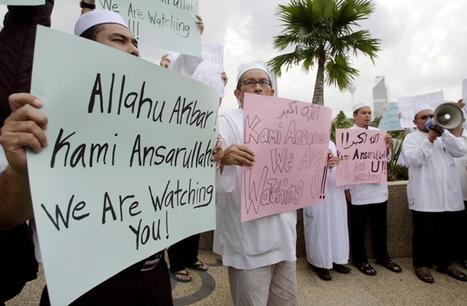
Is limiting the use of the Arabic word for God a sign of growing intolerance towards minorities?

Caterin Victor's curator insight,
June 25, 2014 4:25 PM
Yes !! The religion of love and peace, is not a religion, and sure that not a pacific love, just a bunch of hatred and criminals wich endanger the world, in the name of a pedophile crazy, Muhamad, and and inexisting allah, a Devil, not a God !! The Obama`s "Holly Curan ", a dirty instruction book for killing !! 
Mark Hathaway's curator insight,
November 27, 2015 8:28 AM
Religion and politics are often effect each other in ways people can never imagine. Even in Western nations, were religion is separated from the state, religion still plays a major role in many political debates. This law banning the use of the word Allah by non- Muslim people in Malaysia is an extension of the political movement within Islam. Politics has been the major reason for the rise of the radical sect of Islam. It developed as reaction to the perceived westernizing of Muslim nations that was occurring in the 20th century. The Iranian revolution was a response to the westernizing polices of the Shah. It replaced a secular government with a theocratic one. ISIS main goal is to establish a caliphate i.e. a ruling empire. Throughout history, religion has been used as an excuse to build dynasties and gain more power. Politics in the true motivation behind much of this radicalization.
Scoop.it!

Giovanni Sonego's curator insight,
June 19, 2014 4:15 AM
Questa mappa interattiva vi permette, muovendovi sui singoli paesi, di leggere un aggiornamento sulle situazioni di conflitto in tutto il mondo.

Claudine Provencher's curator insight,
June 19, 2014 5:40 AM
This looks like an excellent tool for students of international relations. 
Courtney Barrowman's curator insight,
June 23, 2014 12:26 PM
unit 4 --but really a great overall course resource!
Scoop.it!

The world behind a simple shirt, in five chapters.
Scoop.it!

"More than a billion people around the world subsist on a dollar a day, or less. The reasons differ but the day-to-day hardship of their lives are very similar. A book by Thomas A Nazario, founder of the International Organisation, documents the circumstances of those living in extreme poverty across the globe, accompanied by photographs from Pulitzer prizewinner Renée C Byer. Living On A Dollar a Day is published by Quantuck Lane."

Alyssa Dorr's curator insight,
December 11, 2014 8:26 PM
\I guess it's true what they say; a picture is worth a thousand words. Before even opening this article, you could get a sense from the picture that it wasn't going to be a good one. You can tell by their facial expressions and the environment that surrounds them. Even the colors that are portrayed in the picture send off meaning. The picture is not very bright. It sends off a sad image with all the brown everywhere. However, we do see a little peek of sunlight shining through. Before reading this, one might see this as a good sign from God, or someone watching over these people. Once I opened the article, there were many more pictures describing their lifestyles. You can tell that they don't make much money by the way they live. There was another picture in the article with a dark tint to it, representing a negative atmosphere, including one girl folding her arms and one girl with tears running down her face . There are no pictures were everyone in the images have smiles on their faces. 
Hector Alonzo's curator insight,
December 15, 2014 7:18 PM
These picture paint a very sad and very real truth. Many of the people in the pictures are caring for children and barely have enough to make it through the day. One woman works long hours for about 50 cents a day and that is horrible, another woman is 40 years old and works at a construction site, which is obviously not the norm. These people, mainly the children, have hope of going to school, but for most of them that is just a dream that will never come true.
Scoop.it!

Turns out, it's better to sound like Clueless' Cher Horowitz than it is to sound like Britney Spears.
Scoop.it!
Book is a revolutionary product: Bio Optical Organiced Knowledge device... Find out about its amazing advantages!
Scoop.it!
Join the conversation: #WakeUpCall. Find out more at http://www.gaiafoundation.org/wakeupcall/ Have you ever felt like we're living through a nightmare of co...
Scoop.it!

"A Facebook page called Stealthy Freedoms of Iranian Women has garnered more than 200,000 likes since its creation at the beginning of this month. The idea behind it is simple: an anonymous platform for Iranian women to post photos of themselves without their head scarves. As Mid East Faces reports, Iranian journalist Masih Alinejad, who moved to London in 2009, decided to create the page after receiving countless complaints from her female friends back home. They were jealous of her Facebook photos of "her hair blowing in the wind," Mid East Faces writes. Alinejad told the Guardian that she doesn't judge when it comes to whether or not a woman in Iran wants to wear a hijab." Via Seth Dixon
Seth Dixon's curator insight,
May 19, 2014 10:52 AM
The hijab is an incredibly complex cultural artifact full of social meanings all over the political spectrum. This poster shows some of the social pressures exerted on women in Iran to wear the hijab. Many hijab-wearing women don't want other women to be shamed into conforming.
Scoop.it!

Many schools that have adopted one-one tablet technology struggle with the pre-requisite skills associated with moving files from app to app. This process is now called App Smashing, and when you learn how to use it to your advantage, it really does make things nice and simple.Workflow is king and the easier it is to distribute content, create solutions, and then store that information for feedback, the more success you will have in the digital classroom.
|






