I found this on pinterest (where else?) and decided to share the geographically inspired craftiness:
1. Paint your nails white/cream 2. Soak nails in alcohol for five minutes 3. Press nails to map and hold 4. Paint with clear protectant immediately after it dries.
This also works with newspaper, but don't try it with NatGeo Maps because the paper is of too high a quality to have the ink bleed out; I would recommend using an old USGS Topo map.
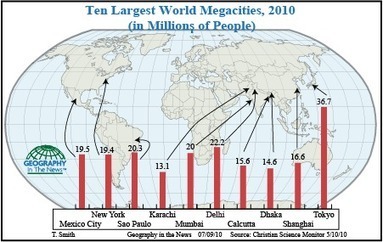
"For the first time in human history, more of the world’s 6.8 billion people live in cities than in rural areas. That is an incredible demographic and geographic shift since 1950 when only 30 percent of the world’s 2.5 billion inhabitants lived in urban environments.
The world’s largest cities, particularly in developing countries, are growing at phenomenal rates. As a growing landless class is attracted by urban opportunities, meager as they might be, these cities’ populations are ballooning to incredible numbers.
A May 2010 Christian Science Monitor article on “megacities” predicted that by 2050, almost 70 percent of the world’s estimated 10 billion people—more than the number of people living today—will reside in urban areas. The social, economic and environmental problems associated with a predominantly urbanized population are considerably different from those of the mostly rural world population of the past."
What observations can you make about where the largest cities are? What will be the impact be of these areas in terms of resources such as housing, power, food, etc.? Where will you choose to live?
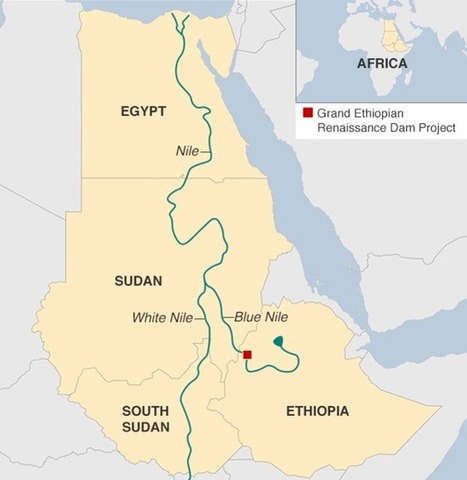
Three African leaders sign an initial deal to end a long-running dispute over the sharing of Nile waters and the building of Africa's biggest hydroelectric dam.
This article discusses the dispute between Egypt and Ethiopia over the construction of a dam that would provide Ethiopia with a larger share of the Nile's water. Egypt is wholly opposed to this dam because it would mean less water for the country, which so desperately needs it. With 95% of the population of Egypt living within 20km of the Nile River, a reduction in the amount of water supplied to these tens of millions could potentially spell slow disaster. At the same time, however, Ethiopia desperately needs water from the Nile in order to provide sustainable energy for its citizens.
The Nile has been a source of life and energy for thousands of years in an oppressively hot, dry place. The ancient Egyptians counted on the Nile to flood every year so that they would have arable land and used the large river to irrigate their farmland. It is almost ironic, therefore, that Egyptians are once again counting on the water of the Nile to help them survive in such a harsh climate. It seems that the Nile is one of those natural geographic features that is pivotal to political, economic, and social wellbeing. It represents the nexus between natural landforms and the political and economic goals of human beings and nations. Dispute over use of the Nile as a natural and life-giving resource is not the first instance of human debate over possession or use of natural geography and it likely won't be the last.
85% of the Nile's water comes from the Blue Nile that originates in the Ethiopian highlands--it is the Blue Nile that Ethiopia has been working on damming since 2011. The Grand Ethiopia Renaissance Dam (GERD) will be located near the border with Sudan (see in Google Maps). Prior to this trilateral agreement, Egypt and Sudan received the majority of the Nile's waters because of outdated colonial-era treaties that ignored upstream riparian states. This explains why in the past, Egypt was so adamantly opposed to Ethiopia's plan fearing that their water supply with be threatened. Today though, the Egyptian President said, "We have chosen cooperation, and to trust one another for the sake of development."
This article shows how important it is for countries to have good relationships with one another. This is an example of political geography. Diverting the Nile would help Ethiopia immensely, producing electricity and providing a water source. Egypt and Sudan were able to create a compromise and agree to share, and a long dispute is now over.
"Fantasy cartography: An animated redrawing of the map of Europe. Imagine a world in which countries could move as easily as people. A suggestion for a rearranged Europe."
This video shows countries being able to move easily in order for each countries benefit. Many countries are moved away from their enemies or other feared countries. Also in this idealistic video countries that are landlocked are able to move to places with easier access to water. It also includes moving countries and territories to be near countries that would work well together.
Insight
This personifies countries as moving as they please, literally. I found this a little funny and pretty interesting to see what countries would do if they could daily move. It really reveals the importance of location and geography for countries in that countries are stuck where they are for the most part ad can't just move away from their enemies of conditions.
A very interesting and fun short video. It raises a lot of questions has to how this could be done (if it could) and how one creates borders and regions.
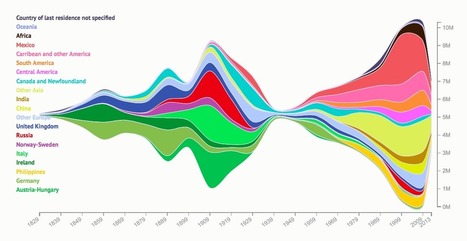
"Where have immigrants to the U.S. come from? Natalia Bronshtein, a professor and consultant who runs the blog Insightful Interaction, created this fascinating visualization of the number of immigrants to the U.S. since 1829 by country of origin. The graph hints at tragic events in world history. The first influx of Irish occurred during the potato famine in 1845, while the massive influx of Russians in the first decade of the 20th Century was driven by anti-Semitic violence of the Russian pogroms (riots). Meanwhile in the Austro-Hungarian Empire, army conscription and the forced assimilation of minority groups drove people to the U.S. in the early 1900s. Since WWII, Central and South America and Asia have replaced Europe as the largest source of immigrants to the U.S. Immigration shrunk to almost nothing as restrictions tightened during WWII, and then gradually expanded to reach its largest extent ever in the first decade of the 21st Century."
The statistics in this article shocked me. I already new America took in a large number of immigrants, but I thought most came illegally from Mexico. Instead, the immigrants we hold are very diverse in ethnicity.
We tend to forget that the first real Americans were the Native American Indians. Immigration is a hotly discussed topic right now, but I wonder where we would be as a nation, if the original Native Americans told the settlers at Roanoke Island, the Chesapeake, and Plymouth Rock, that no, we are not allowing any foreigners to settle on our shores and land. Food for thought. Fred Issa,
I mentioned this through an allusion in another article, but GMOs and the movements against them perplex me. I don't think that fossil-fuel burning engines are natural, but many anti GMO people that claim they are bad for the environment leave me completely stunned as to their intolerance for what could possibly benefit other people. I feel very much an outsider when I examine many topics of controversy related to GMOs, and I am quite sure that I have consumed them before -- and loved them? as for the FDA... I don't approve of the FDA. They like more money coming into their pocket more than bettered well-being of citizens. When I mentioned to my doctor that I wanted to apply for medical marijuana for a series of conditions that I have following a severe accident, I was told that they refused because it was not fully endorsed, approved, or even allowed by the FDA. That really pissed me off because I suffer from excruciating pain every day and night of my life. Could you imagine being a poor person in need of food, and the only viable way of getting food was through the production of GMOs...? and then some pseudo-hippie activists that didn't live through the 1960s trying to be all like, "We don't want anyone to have GMOs!"... I pose that abstractly, because I view most everything with a level of abstraction and distance from the situation, sampling perspectives with which I may empathize or consider. I keep thinking that this world around us all came from a big bang, with other possible universes before that, and something before that... and I really can't see Capitalism ever becoming as bad as it is, with such disregard for other people's wellbeing, until I look at today's world.
So many articles about organic or genetically engineered foods are written with someone with a very defined position on the subject (much like abortion, gun control or other controversial topics). This article is an attempt to separate out the good the bad and the ugly regarding genetically engineered foods.
The varieties of wheat, corn and rice we grow today may not thrive in a future threatened by climate change. Cary Fowler takes us inside a vast global seed bank, buried within a frozen mountain in Norway, that stores a diverse group of food-crop for whatever tomorrow may bring.
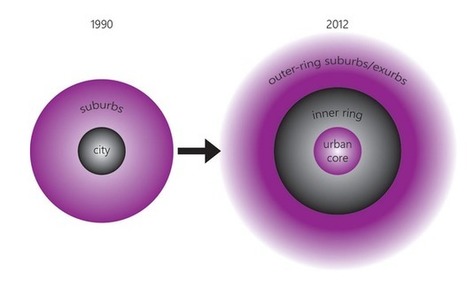
A new report tracks demographic trends across 66 U.S. metro areas. The report provides comprehensive evidence for Aaron Renn's "new donut" model of cities (pictured in above image, on the right). Renn's model proposes that city centers and outer-ring suburbs are doing well economically, but inner-ring suburbs are struggling with a new influx of poverty."
This article goes in to depth on a newer model on cites called the donut model, as pictured similar to a donut. The donut model was created by Aaron Renn, and it shows urban development recently in cities. The center of the city is grownign economically and falling. There is an influx of people moving in , resulting in an increase of poverty too. Also more educated people are moving in like young newly educated individuals.
insight
The new structure of cities forming is a change from the old. With cities now developing bigger and more industrial, there are many opportunities for people for work in the center of the cit. however, many people may want the jobs but can't get them, so many of those in poverty live in the city centers in search of economic opportunities. It is also interesting to see the status of the people changing the in the city center with that also more young educated people move to city centers, most likely in search of job opportunities. This new way of urban development is modernizing the work system.
More and more the urban stage is filling and cities are becoming once again the next big thing. After WW2 suburbs became intensively popular but now since a change in personnel views people prefer the city more.
The importance of being able to accurately assess text complexity for your grade level. Being able to anticipate and plan for challenges your students may encounter is key.
Via Darren Burris
AmaMany of us only know the world's most famous landmarks through images that show them in all their beautiful, historical glory. The world has changed since these structures were built, so the surrounding landscapes might not be what you'd expect.
Most of the world's major religions are made up of multiple sects or denominations, and Islam is no different. Islam's two major sects are the Sunnis and the Shiites, and the division and interplay between the two is a major factor in the geopolitics of the Middle East. How well do you understand Sunni and Shiite Islam? Take our quiz and find out!
After taking this class about Political Islam I thought I knew about Sunni and Shiite Islam. Taking this quiz I definitely mixed up a lot of the information. It seems like it would be simple to understand the differences and the similarities, but they are so parallel its easy to get the information mixed up.
"Muslim Extremists!" "Death to militant Islam!" "Muslims are terrorists!" These cries are often heard from conservative factions of the United States, who are a lot more eager to blindly hate than they are to learn about the lives of the same people they want dead. Islam encompasses some 1.3 billion believers, and there are significant deviations in both the faith and its application among such a wide population of believers. Before this exam, I knew about the Sunni majority and the Shia minority currently in conflict in the Middle East, but my understanding of the distinction between the two faiths was vague at best. I also did not recognize that each of the two main branches are then further split into different denominations, much in the same way that Christianity is today within our own country. As different and "other" we try and make the Middle East out to be, they are not that different in their religious practices (and their fanatics ruining the name of the religion for everyone else) than many conservatives would like them to be. I definitely enjoyed taking this exam, particularly within the context of everything I have been learning about with what is happening in Syria. I had no idea Assad was not just a regular Shia, but instead a member of a much smaller, stricter denomination. Learning about this region has definitely been an eye-opening experience for me, in the sense that I know a lot less about the world than I thought I knew.
I am not very educated on the religion but I do know from my notes in class that religion is what stops Iraq from unifying. That country is made up of three religions Muslims , Sunnis and Shiites.
"Oldest and most incredible footage of New York City ever, including where the WTC would be built. With added maps carefully researched to show where the camera was. 28 shots of classic footage circa 1905." http://tinyurl.com/ohsuobg
"Material de archivo más antiguo y más increíble de la ciudad de Nueva York , incluyendo donde se construiría el World Trade Center. Con mapas añadidos investigado cuidadosamente para mostrar dónde estaba la cámara.
In the 19th century, London was the capital of the largest empire the world had ever known — and it was infamously filthy. It had choking, sooty fogs; the Thames River was thick with human sewage; and the streets were covered with mud. But according to Lee Jackson, author of Dirty Old London: The Victorian Fight Against Filth, mud was actually a euphemism. 'It was essentially composed of horse dung,' he tells Fresh Air's Sam Briger. 'There were tens of thousands of working horses in London [with] inevitable consequences for the streets. And the Victorians never really found an effective way of removing that, unfortunately.'"
London has come a far way from the industrial town it was in the 19th century, and is now cleaner than ever. But pollution led to many issues in London at the time. This is also evident in the developing world today, such as in China, Africa, and South America.
This article is about London, UK during the time of Industrial Revolution. The city of London expanded so rapidly, that there wasn't enough time for urban planning. Factories and houses were going up everywhere, and thousands of people migrated to London for jobs. This led to an influx of filth. The air was polluted and there wasn't adequate irrigation systems or waste systems. Everything dirty could be found on the streets like horse dung, and the water would get polluted and unsanitary.
I liked this article, because it really created an image in my head how terrible and filthy the Industrial Revolution was at the start.
This photoblog will also link you to a full article and video that explains how the American pork industry is supplying China's demand for protein as globalization forces (among others) has led the Chinese consumers to eat 10% more meat than they did just 5 years ago. WHat impact will this have on American agriculture? How to we explain fo the rise in meat demand in China?
Chinese farmers cannot keep with with Chinese demand from pork, so America is stepping in to fill the gap. The globalization of American pork seems like it would benefit American farmers and Chinese consumers, but the environmental cost of raising so many extra pigs on American land must be considered, as well as transportation costs to ship it to China.
We never focus on the goods leaving the United States and being imported to China. American pork is filling the demand in China and because globalization has made it cheap to ship exports, China is responding by eating more pork because it is affordable. This is important in keeping American exporting business afloat. There are plenty of pigs in the US to provide large numbers to foreign countries. I also find it interesting that what Americans would consider a staple of so called "Chinese food" is being exported from the US.
The need for speed devours huge chunks of American cities and leaves the edges of the expressways worthless. Busy streets, for almost all of human history, created the greatest real estate value because they delivered customers and clients to the businesses operating there. This in turn cultivated the highest tax revenues in town, both from higher property taxes and from elevated sales taxes. But you can't set up shop on the side of an expressway. How can cities afford to spend so much to create thoroughfares with no adjoining property value?
This blog really made me realize what an impact humans are to the environment. They compare different cities and talk about the impacts and it really showed me how humans have built up cities.
A side by side comparison at first blush is striking but the devil is in the details. Florence, Italy is a city of only 368,000 while the Atlanta metro area is about 4.5 million. Agree that sprawl is ineffective real estate and efficiency wise, but fuel prices may be having a counter effect on the reduction of sprawl. It is much less expensive to commute given the price of oil at its current levels and the millennials will have a say in this urban sprawl contracting or expanding. Many do not own cars, relying on commuter systems within the city to get around. This in theory should drive down demand for fossil fuels, culminating in reduced prices for gasoline. If the infrastructure is already built, was is the cost to maintain it, given the static population of the large metro areas? Interesting to see how this plays out.
“ELECTRONICS are like drugs. You can buy them for $1 and sell them for $40,” says Jordi Muñoz, a 27-year-old Mexican entrepreneur. People in Tijuana, where he...
To get content containing either thought or leadership enter:
To get content containing both thought and leadership enter:
To get content containing the expression thought leadership enter:
You can enter several keywords and you can refine them whenever you want. Our suggestion engine uses more signals but entering a few keywords here will rapidly give you great content to curate.


 Your new post is loading...















Yes to map fashion! I saw a woman with a map skirt - so cool. MAPSMAPSMAPS!!!
I heart maps! I cant wait for spring break to try this :)