In which John Green teaches you about the Protestant Reformation. Prior to the Protestant Reformation, pretty much everyone in Europe was a Roman Catholic. N...
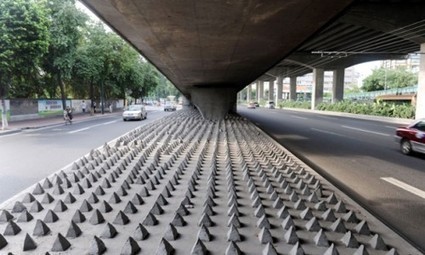
"Defensive architecture is revealing on a number of levels, because it is not the product of accident or thoughtlessness, but a thought process. It is a sort of unkindness that is considered, designed, approved, funded and made real with the explicit motive to exclude and harass. It reveals how corporate hygiene has overridden human considerations…"
The government should try to develop better methods to keep homeless out of the street. Planning and designating a place to the homeless group by offering better conditions, will change the problem. As the architects have new ideas to resolve a problem with the homeless, they should also be formulating ideas to prevent homelessness such as providing feasible shelter on the street. Part of the problem is that shelters should be marketed in the communities. Local businesses, policies and general communities could be more active in helping these minority groups to get aid and better their life. Cities should provide more programs and aid for the homeless group.
These structures such as benches with dividers that make it impossible to lie down, spikes and protrusions on window ledges and in front of store windows, forests of pointed cement structures under bridges and freeways, emissions of high pitched sounds, and sprinklers that intermittently go off on sidewalks to prevent camping overnight are very rude and without a shadow of a doubt send a message to the homeless that they aren't welcomed, and we will do whatever it takes to make sure they cannot be comfortable; even something as simple as sitting on a windowsill.
This article deals with unit 7 because it discusses architecture and new things in cities. In some cities they have defensive architecture to make it harder for homeless people to live. For example benches with dividers, and pointed cement structures under bridges. This tells the homeless they are unwanted and that others don't care about them.Some corporations have turned to aggressive ways to keep out homeless and the article says the government is denying it. In addition there are few resources to help the homeless and what they do have is insufficient. It also notes that free shelters are very rare. The author says that we should worry a little more about the homeless because "given just the right turn of events, it could happen to us."
"TeachMideast is an educational outreach initiative developed by the Middle East Policy Council. TeachMideast is a resource designed primarily to give high school and community college teachers the foundation they need to teach about critical , complex, and intriguing subjects."
"How do you raise awareness about population explosion? One group thought that the simplest way would be to show people in pictures the impact of population, pollution and consumption."
It is absolutely astounding to me how we are so continually growing and expanding as a human race. What's more astounding to me is how quickly we are depleting and wasting all of the resources we have been given. Don't get me wrong, I was aware there were 7 pushing 8 billion of us on the planet, but growing up in the suburbs I wasn't as aware of it as I could have been. Ignorance is bliss, right? It breaks my heart to see the clearing of beautiful forests, the once turquoise water of Haiti filled with trash, and the death of animals that accidentally stumbled upon our waste. If we as humans don't start taking care of our planet, there won't be any where left for us to over populate, or even populate for that matter.
These eye opening photos paint a perfect picture of what the world will be like in years to come if we keep living the way we do. There are pictures of trash waves, extreme deforestation, hill-side slums, thousands of fields of oil wells, and overwhelming crowds of people.
It is important to see pictures like this one to help visualize just how much population, pollution, and consumption are effecting our world. Awareness is vital for change.
With Michigan soon to become the 25th state to adopt "Right to Work" laws it about time you understood them. My Johnny Cash Teacher attempt to Walk the Line ...
New figures show the lowest total number of births since the formation of the modern Italian state
Fewer babies were born in Italy in 2014 than in any other year since the modern Italian state was formed in 1861, new data show, highlighting the demographic challenge faced by the country’s chronically sluggish economy. National statistics office ISTAT said on Thursday the number of live births last year was 509,000, or 5,000 fewer than in 2013, rounding off half a century of decline. The number of babies born to both natives and foreigners living in Italy dropped as immigration, which used to support the overall birth rate, tumbled to its lowest level for five years.
As Italy becomes a highly developed country, it begins to experience a large population decline. Fertility rates are negative and continue to decline, and mortality rates are dropping as well. People are not having large families, and all of these factors contribute to the rapidly declining population of Italy. The prime minister of Italy hopes to simulate an economic and cultural recharge in hopes that this will help encourage people to make more babies so that the population does not continue to decline at this rate.
This relates to the demographic transition model, as Italy is in the last stage of it. Once countries are developed, fertility rates begin to slow as mortality rates continue to decline, causing a decline in the total overall population. This is clearly exemplified through this story about Italy.
The low birth rate in Italy is causing the country to think that its dying because there aren't enough new-born to replace the ones that passed away. As the article state, it mainly in the south where the economy is very poor and the average family is not making as much money as they should to support more children. This might lead people to migrate to other places to find opportunities for their future generations. If Italy could find a way distribute wealth evenly across the countries they might be able to find a better result in birth rate. This is easier said than done however.
its fascinating that there may no longer be such a term as Italian outside of history books in fifty years. the low birth rate in European countries is a major concern, especially as the economies in those same countries start to suffer.
http://www.ted.com Rural villages worldwide are being deserted, as billions of people flock to cities, to live in teeming squatter camps and slums. And Stewa...
Brief explanation of the Concentric Zone (Burgess), Sector (Hoyt) and Multiple Nuclei Models illustrating the growth and organization of cities and urban are...
This movie is a good overview of the models used for explaining urban growth and development in cities and residential areas. The video went through many different models like the Concentric Model, by Burgess. Another is the multiple nuclei model, another model. And the last model was the Hoyt model. These meddles have different zones of urban and suburban ares and gave historical evidence to why people even where they went.
Insight
This video was a good recap and way to learn the models.The models present similar ides. Some ideas shared are the CBD, central business district, placement and the suburbanization. In some models you can see different reasons for development, especially in Chicago. Chicago is a changing city and it is revealed that models aren't perfect in that many are drawn and different ones are accepted.
The Rise and Fall of the Ottoman Empire can be clearly seen at the beginning and the end. They had a massive territory expansion at 1300 and it bloomed from there. from then to 1900 then only had some minor changes with some changes in territory. At the end, in 1900s was the most significant change with the Empire collapsing with the Republic of Turkey being established in 1923.
A fascinating look into the shifting nature of borders through history. Unfortunately it also reflects many atrocities that also occurred in those years. Geographically the Empire wouldn't last given its difficult to defend borders. Additionally its extremely conservative Political and Cultural nature made it nearly impossible for it to adapt to changing times in technology. Which is ironic in a way because it was their innovation that sparked the Empire and the seizure of Constantinople to begin with. Also it should perhaps be mentioned that the current nation of Turkeys borders are an unnatural creation on the part of the Turks when they were aware their Empire would collapse. This unfortunately also means this map hides events such as the Armenian Genocide to try and purify Anatolia so that the Turks could claim it as its sole homeland while abandoning the rest of the Empire (so in effect they consolidated to try and keep as much land as possible).
This is a very simple GIF map, but one that we can look at using other outside materials and really used to our advantage of seeing the every changing Middle Eastern Area. The Rise and Fall of the Ottoman empire is a key geographical and political fallout from the 1300's until what is now present day Turkey. When you examine the map and see how big the Empire eventually got and what lands it covers we can use this map to interpret some current conflicts like the one in Syria. Also nowadays we do not think of Turkey as a world power or even a regional power. However, it shows there past history as a world power and that can drive a country (see Russia) to wanting to regain that power. Will Turkey look to regain that power as well? What could they possibly to do to regain this power and how would that effect other Middle Eastern countries. We also can look at the map and realize that the region probably contains many people of Turkish acenstory and what effect does that have on political polices in certain countries that had previously been under the power of the Ottoman Empire.
Definitely a good way for multi-purpose land use. They are utilizing the space they have conservatively, they really nailed this one on the head coming up with an idea to put a market right on a railroad track. Is this concept even safe or sanitary? Most definitely not. First off, it is not sanitary because that train on a daily basis has gone through all sorts of dirt and the train is literally passing right over the farmer's food that he is still going to sell to customers. Also, probably not the safest, because the people are just inches away from the passing train and with the wrong move, they can possibly fall onto the track and they are dead. I will hand it to them though, they act in an orderly fashion and move swiftly both when it comes and when it leaves. As a matter of fact, they go on with life so well after it leaves, it is almost like the train never passed through in the first place.
In one video we see issues surrounding urban development, city planning (or lack thereof), population density, and land use, among other topics. As more and more people move into Southeast Asia's unplanned cities, there will be more crowding and people will have to use every last available inch of land, even if that means going right up to the train tracks. This is a culture shock to people in the West, where most land is single-use only.
Urban planning in a rapidly urbanizing area can be difficult, but in this area two very different urban entities use the land together so beautifully. This market was built around the train tracks and when the train passes through at a slow speed the market clears the tracks and both work together so flawlessly. This is uncommon for us to see because many cities in America had room to grow and expand and had ample planning time because urbanization happened much slower than it is in Asia, with urbanization happening so fast the countries need to use their space flexibly.
A punishing drought is forcing a reconsideration of whether the aspiration of untrammeled growth that has for so long been the state’s engine has run against the limits of nature.
The scale of China's land reclamation in the South China Sea is leading to "serious questions" on its intentions, a top US official says.
China is building artificial land by pumping sand on to live coral reefs - some of them submerged - and paving over them with concrete. China has now created over 4sq/km (1.5 sq miles) of artificial landmass. China is creating a great wall of sand with dredges and bulldozers over the course of months.
Tags: borders, political, conflict, water, China, East Asia.
In addition to the original BBC article, here is another article from the Telegraph with some aerial imagery showing the extent of this geo-engineering project. This has plenty of geopolitical implications and the United States government is on record saying that it is "concerned."
Pumping in sand to cover coral reef and create more land is a very inventive way to make new territory, using concrete and placing bulldozers and other machinery is helping China gain more land and gain more access in the South China Sea yet this who pumping is making people question and causing places such as the Philippines to file complaints saying they will not be associated with the whole plan that China has. Why is China exactly pumping sand and spreading concrete over the live coral reefs? Does China know they are killing live animals and plants underneath the sea?
While looking into the matter I found that China believed the whole act of reclaiming land to be "entirely within China's sovereignty and are totally justifiable". Now people all over the world are focused on land and power, not about other social matters. This land pumping is not only causing conflict but it is creating more opportunity to better work and living conditions.
China is a large and powerful nation that is not afraid of flexing military muscle to its smaller neighbors. The developments of China building artificial land to strengthen its claim in the region shows how determined the country is to have its claims honored. It also shows that China will stop at nothing to have regions were resources could be to aid in the countries economic growth. However, China is causing a great deal of controversy through its actions. Also, China's neighbors are becoming increasingly frustrated with the large nation, yet they are all much smaller nations that really can't prevent the Chinese from doing what they want, especially with China declaring it won't listen to what the UN has to say. China is a country that is not afraid of strongman politics to get what it wants.
“We tell our students about change over time, we have our students read about change over time, with GIS my students are able to see change over time”. - Teresa Goodin, Gifted Resource Teacher, Albemarle County Schools
Do you want your students to work like twenty-first century “digital” historians?Do you aim to have your students grasp the connections between geography and history?Do you aim to make your activities inquiry-based, interactive, and exciting?Do you aim to create activities that integrate twenty-first century workforce skills?
Via Seth Dixon
A sobering new study finds that the world's biggest industries burn through $7.3 trillion worth of free natural capital a year. And it's the only reason they turn a profit.
To get content containing either thought or leadership enter:
To get content containing both thought and leadership enter:
To get content containing the expression thought leadership enter:
You can enter several keywords and you can refine them whenever you want. Our suggestion engine uses more signals but entering a few keywords here will rapidly give you great content to curate.


 Your new post is loading...


 Scoop.it!