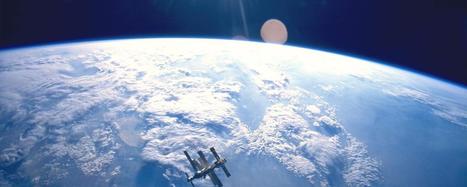
Global warming has raised global sea level about 8" since 1880, and the rate of rise is accelerating. Rising seas dramatically increase the odds of damaging floods from storm surges.
Tips for teachers to use when looking for primary source documents. Watch one teacher describe her method of finding primary source documents for her 9th grade history students. These tips and strategies are great for all grades and all subjects.
Via Darren Burris
While the process of making ethanol takes a long time and is expensive, I think it is worth investing in and pursuing as an alternative to fossil fuels. Like most products, once the process of making the ethanol is perfected and made more efficient, it will be cheaper and easier to make. Brazil has not invested as much time in the product after they found reserves of oil, because the oil was more profitable. The demand in the world in extremely high and therefore it was more economically wise for Brazil to put focus on fossil fuel extraction. However, they already have created technology that is able to run on ethanol and they’ve realized that the product is more environmentally friendly. This means that the potential to stop relying on fossil fuels is realistic. Since sugar is a renewable resource, it makes more long term economic sense to invest into sugarcane and ethanol production because fossil fuels will eventually run out.
"One of my readers asked me to create a map showing the 'density' of metal bands in European countries—and so I did. The following map shows the number of entries (which represent both active and inactive metal bands) in Encyclopaedia Metallum, divided by the country’s population in millions.
For comparison: The number for the United States is 72.
"For the first time in more than 130 years, Americans ages 18-34 are more likely to live with their parents than in any other living situation, according to a new analysis by the Pew Research Center. Less educated young adults are also more likely to live with their parents than are their college-educated counterparts — no surprise, Pew notes, given the financial prospects in today's economy. Black and Hispanic young people, compared with white people, are in the same situation. But the overall trend is the same for every demographic group — living with parents is increasingly common. Still, young Americans are still less likely to live with their parents than their European counterparts, Pew says.
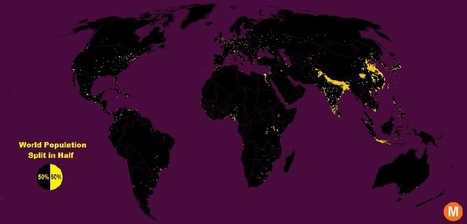
"Data viz extraordinaire Max Galka created this map using NASA’s gridded population data, which counts the global population within each nine-square-mile patch of Earth, instead of within each each district, state, or country border. Out of the 28 million total cells, the ones with a population over 8,000 are colored in yellow."
Great simple map of world population. Scroll down and look at the U.S. It reflects the global trend. This also has political implications, as evidenced by voting patterns in the 2012 presidential election. Elections are dependent upon votes, which come from people, which are primarily clustered in cities. Election campaigns would use this data to plan their schedules as to where to focus their campaigning efforts. For the folks in Wyoming, they rarely see candidates other than during the primaries. And these world populationclusters have been relatively consistent historically, particularly in south and east Asia. Northern India has serious carrying capacity challenges. Notice the clusters along the Nile- evidence of arable land.
We might live in a time of digital abundance, but our digital memories – our personal memories and our collective memories – are incredibly brittle. We might be told we’re living in a time of rapid technological change, but we are also living in a period of rapid digital data decay, of the potential loss of knowledge, the potential loss of personal and collective memory.
The majority of students study by re-reading notes and textbooks — but the psychologists' research, both in lab experiments and of actual students in classes, shows this is a terrible way to learn material. Using active learning strategies — like flashcards, diagramming, and quizzing yourself — is much more effective, as is spacing out studying over time and mixing different topics together.
McDaniel spoke with me about the eight key tips he'd share with students and teachers from his body of research.
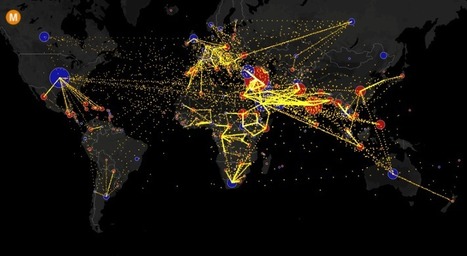
This map shows the estimated net immigration (inflows minus outflows) by origin and destination country between 2010 and 2015. Blue circles = positive net migration (more inflows). Red circles = negative net migration (more outflows). Each yellow dot represents 1,000 people. Hover over a circle to see that country’s total net migration between 2010 and 2015. […]
Via Tony Hall
The US is a big, complicated place that has undergone some big changes over its 238 years, and even in the last few decades. Here are 21 charts that explain what life is like today in the US — who we are, where we live, how we work, how we have fun, and how we relate to each other.
And then ? Should everyone blindly accept what scientists have discovered ? No opposition for nothing ? This is the end of the humanity if we do so Mr Nobel Laureate.
This news article was written in favor of GMOs. The target audience are consumers questioning the safety of GMOs. The article states that a group of Noble laureates are upset with Greenpeace for making false statements about GMOs and attempting to stop a new type of rice with increased vitamin-A levels from being marketed. The Noble laureates stressed that GMOs have not been found to be unsafe. The author discusses the fact that GMO crops are not riskier than other forms of breeding and cut down on the use of pesticides, which are dangerous. The author of this article appears to be supportive of the use of GMOs, but also touched on the opinions of the opponents of GMOs, which have been disproved by science.
Beyond the stunning act that has become Britain’s vote to leave the European Union lies a deeper message: Democracy is not destiny, but devolution. Ceaseless entropy — the second law of thermodynamics — applies to politics as well. The more countries democratize, the more local populations seek greater self-rule.
In this article, Parag Khanna argues exactly what the title suggests, "London should secede from the United Kingdom". In light of the UK's decision to leave the European Union, Khanna discusses that "Londoners... voted by a wide majority to 'remain' in the EU" and suggests that many Londoners have lost their sense of British Pride after the secession. Though it is mentioned that the city "can't and won't" leave the country, the exit from the EU directly impacts London's economy because "immigrants are essential for the city’s financial and education sectors". Without the immigrants, the city's finances will not only be in jeopardy, but its connection between foreign places will be impacted as well.
“ The people of the Solomon Islands have already had to adapt the changing conditions, with villages being moved due to rising seas.”
Via HABS Geographical
Cakewalks, for many, evoke visions of childhood and carnivals. Today, a cakewalk is where dancers promenade around a circle of numbers on the floor.
Via Mr. David Burton
To get content containing either thought or leadership enter:
To get content containing both thought and leadership enter:
To get content containing the expression thought leadership enter:
You can enter several keywords and you can refine them whenever you want. Our suggestion engine uses more signals but entering a few keywords here will rapidly give you great content to curate.


 Your new post is loading...