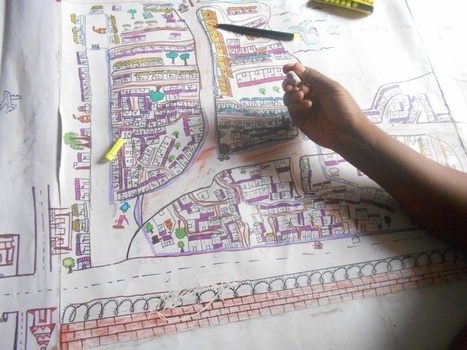
As Nepali men migrate to find work, women are taking over in the fields – earning them more money and respect.

 Your new post is loading...
 Scoop.it! As Nepali men migrate to find work, women are taking over in the fields – earning them more money and respect. 
No comment yet.
Sign up to comment
Scoop.it!

From
nymag

In a purely objective sense, a person’s face and name are, by and large, unrelated.
Scoop.it!

From
www
"Globalization hit organized crime over the last decade and now is integral to its most profitable business -- the international narcotics traffic. Once a regional problem involving a customer base of a few million, and barely a billion dollars in sales, the illegal drug industry is now a worldwide enterprise with tens of millions of hard core consumers spending hundreds of billions on opiates, cocaine and amphetamines and marijuana, as well as other drugs."
Scoop.it!

The US is a big, complicated place that has undergone some big changes over its 238 years, and even in the last few decades. Here are 21 charts that explain what life is like today in the US — who we are, where we live, how we work, how we have fun, and how we relate to each other.
Tags: USA, map, map archives.

Michael Harding's curator insight,
July 11, 2016 7:22 PM
A really challenging set of charts from the US.
Scoop.it!
So today Craig is going to look at political ideology in America. We're going to focus on liberals and conservatives and talk about the influencers of bot
Scoop.it!

Research into "childhood amnesia" sheds light on how memories are formed and maintained.
Scoop.it!

Scientists finally worked out what killed a group of the creatures stranded for millennia on an island no bigger than Disney World.
Scoop.it!
A tutorial on the economic systems of capitalism, socialism, and communism, and how they essentially differ.
Scoop.it!
Learn more about population: http://ngm.nationalgeographic.com/7-billion To coincide with the arrival of the world's 7 billionth person on October 31, 2011
Scoop.it!
http://rodrigowerner.com/ Will smith's mindset wisdom says it all! It has helped me have a mindset towards my dreams in life, helped me have self
Scoop.it!

Across much of the developed world, researchers have found that more young adults are living at their parents' home for longer periods of time.
Across the European Union’s 28 member nations, nearly half (48.1%) of 18- to 34-year-olds were living with their parents in 2014, according to the EU statistical agency Eurostat. The Scandinavian countries have the lowest rates, with Denmark coming in at 18.6%. Southern and eastern European countries tend to have higher rates, led by the former Yugoslav republic of Macedonia: 72.5% of 18- to 34-year-olds reportedly were living with their parents.
|
Scoop.it!

Global warming has raised global sea level about 8" since 1880, and the rate of rise is accelerating. Rising seas dramatically increase the odds of damaging floods from storm surges.
Scoop.it!

Yes, free trade and the cheaper goods it provides have cost the American jobs, but not as many as feared.
Scoop.it!

Economists have examined the relationship between education and marriage across 23 developed countries, with interesting results.
Scoop.it!

"Violence and insecurity are so bad that other war-torn countries have become sites of refuge."
In 2015, nearly 100,000 Ethiopians and Somalis traveled by boat to Yemen, one of the world's most dangerous countries. Last year, nearly 5,000 citizens of Congo, which is fighting powerful rebel groups, were seeking refuge in the Central African Republic, itself torn apart by civil war. And yet 10,000 Burundians have fled their country's own growing civil unrest for Congo. Thousands of Nigerians escaping the extremist Islamist group Boko Haram have gone to Chad, where different strains of that same insurgency conduct frequent deadly attacks.
Developing countries have long taken in a disproportionate number of the world's refugees — roughly 80 percent, according to the United Nations. But even for migration experts and relief workers, the willingness of refugees to leave one war for another is shocking. It's also proving an enormous challenge for humanitarian agencies, which are already overstretched and often not equipped to welcome refugees in countries that are still racked by conflict.
Tags: refugees, Africa, migration, conflict, political, war.

Richard Aitchison's curator insight,
March 9, 2018 11:23 AM
When we hear of migration or refugee issues we tend to think towards Europe and many of the current day issues with Syria. Most date proves that as well, as listed in the article roughly 80% of refugee movement comes in the developed world. Now we get to the more shocking part of the article that we are seeing a refugee crisis in Africa. First off this is the first time for myself hearing this and probably because its not major national news and is buried way below the more "important" problems of the developed world in Europe. However, yes this is a problem and many people who study migration are shocked by it. People are leaving one war zone and immediately move to a possible more unstable land into more war. Why and how does this make sense? People have fled there own countries to find worst situations and have gone to governments that can not support them and an outside world that while trying to help support some of these current countries can not help support refugee as well. This will be a continuing problem until Africa can become more stabilized and we stop seeing genocide and other authoritarian government policies. The study of why people move is always very captivating as we often tend to think we know exactly why people move to and from areas. However, as the article shows until you are put in a desire situation one can not truly know what you would do, such as move your family to a war torn country because just maybe its better than your war torn country. We need to continue to assess this area and try to not just fund the area, but try to find ways in which we can stabilize an area. The major importance of this article is that we realize there is a problem first, with out articles like this the focus would continue to stay on Europe and more developed areas.
Scoop.it!
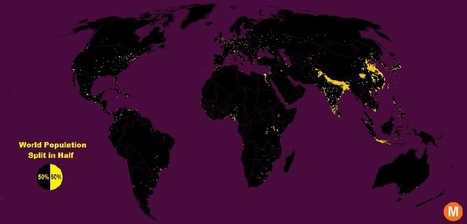
"Data viz extraordinaire Max Galka created this map using NASA’s gridded population data, which counts the global population within each nine-square-mile patch of Earth, instead of within each each district, state, or country border. Out of the 28 million total cells, the ones with a population over 8,000 are colored in yellow."
Tags: population, density, mapping, visualization.

Brian Weekley's curator insight,
July 27, 2016 10:47 AM
Great simple map of world population. Scroll down and look at the U.S. It reflects the global trend. This also has political implications, as evidenced by voting patterns in the 2012 presidential election. Elections are dependent upon votes, which come from people, which are primarily clustered in cities. Election campaigns would use this data to plan their schedules as to where to focus their campaigning efforts. For the folks in Wyoming, they rarely see candidates other than during the primaries. And these world populationclusters have been relatively consistent historically, particularly in south and east Asia. Northern India has serious carrying capacity challenges. Notice the clusters along the Nile- evidence of arable land.
Scoop.it!

As it happens every few years, the U.S. tradition of jus soli is back in the spotlight. Some Republican presidential candidates want to end the practice, which would take a constitutional amendment.
Scoop.it!

Do you read faster or slower than the national average speed? With so many readers shifting to eReaders this question has new implications. An eReader can hold hundreds of books - how many can you read before needing a charge and how long will you take to read classics like The Lord of the Rings or War and Peace? Check your reading speed on this fun interactive infographic and challenge your friends and co-workers to a battle of the mind.
Scoop.it!

First released in the Spring of 1999, How People Learn has been expanded to show how the theories and insights from the original book can translate into actions and practice, now making a real connection between classroom activities and learning behavior. This edition includes far-reaching suggestions for research that could increase the impact that classroom teaching has on actual learning.
Scoop.it!

As a baby-boom generation ages, businesses struggle to make money out of a rare growth sector
Scoop.it!

Learn about the world by changing the familiar map. Select a subject from the top menu and watch the map resize. A countrys total area no longer represents land mass, but items relevant to the subject (i.e. persons, barrels, tonnes).
Scoop.it!
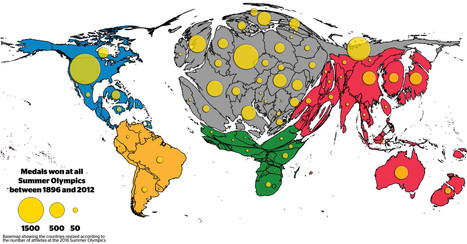
The distribution of medals shows the existing Olympic inequalities: The overall patterns are a reflection of wealth distribution in the world, raising the question whether money can buy sporting success. Besides investment in sports by those countries who can afford it, the medal tables also reflect a battle for global supremacy in political terms.
Tags: sport, popular culture, mapping, historical, cartography.

PIRatE Lab's curator insight,
August 15, 2016 8:32 PM
Another very interesting way to present geographic data.
|